
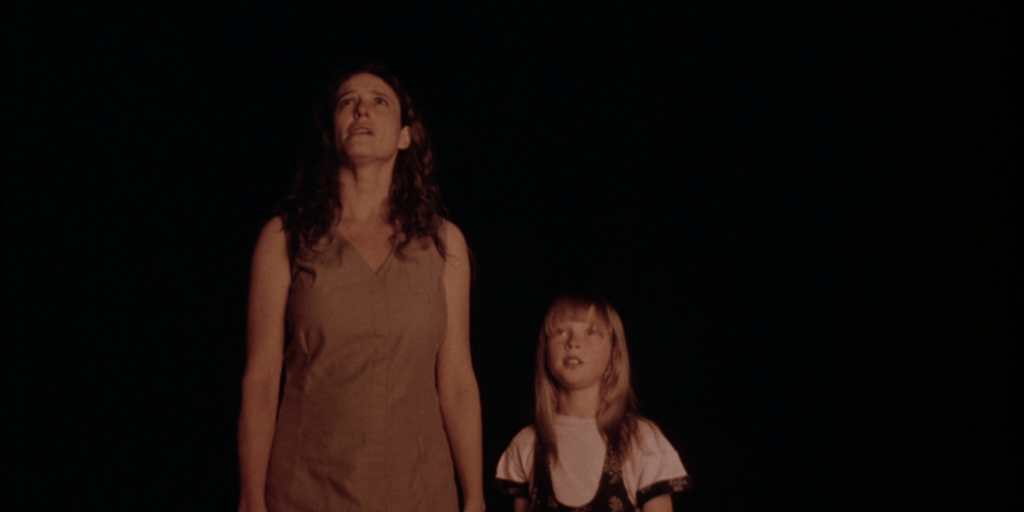
For decades, Hollywood movies that took Christianity seriously were nearly guaranteed to make money and to receive reverent reviews as well (sometimes deservedly so, e.g., Black Narcissus, Song of Bernadette). But in our more secular age, they often divide audiences and critics. Ebert and Siskel exemplified the split when they reviewed the 1991 film The Rapture. The former put it on his 10 best films of the year list, while the latter said he considered it “more preachy than provocative”. I am much more inclined to Ebert’s view of Michael Tolkin’s directorial debut.
The film opens with a Metropolis-level portrayal of soul-killing work: an evocative shot of a bevy of telephone operators who looked caged in their cubicles as they near-mindlessly answer request after request for directory assistance. One of them is named Sharon (none of the film’s characters have a last name). Sharon’s (Mimi Rogers) dreary daytime existence stands in sharp contrast to her nights, which she spends cruising hotels for group sex with her friend Vic (Patrick Bachau). One of the men she encounters, Randy, (a then little known David Duchovny) takes an enduring interest in her and they start to share their regrets and hopes.
Meanwhile, Sharon becomes aware of coworkers who, unlike her, seem happy, and learns they are involved in a religious community that dreams (literally) of the coming rapture in which the faithful will be raised to heaven. In a superbly executed scene, two door-knocking Christians also begin to shake her lack of faith. Like Augustine, she abandons her sexually wanton ways and begins praying and worshipping until she too is convinced that the end of the world is nigh. This precedes further astounding plot developments that you will turn over in your mind long after the final credits roll.

Tolkin has made a challenging movie that is absolutely not for all tastes, but I admire his courage for unflinchingly following a theme out to its conclusion. This is not an evangelical film: Tolkin portrays what it would it mean if people who believe a certain theology are in fact correct, but he neither endorses nor condemns it. His dialogue is searching and at times even searing as his characters struggle with what life means, whether God exists, and if so what he expects of humanity. His film weakens a bit in its unique concluding act, which was almost inevitable given his limited budget, but overall this is one of the most impressive debuts by a writer-director in recent decades.
Mimi Rogers deservedly received universal acclaim for her no holds barred performance. She is by turns sensual, sad, yearning, inspiring, frightening, damaged, and defiant. Taking the role of Sharon was a big risk and it pays off artistically in an Oscar-caliber performance. Sadly, it did not pay off in terms of box office receipts or wider recognition that she is much more than just another Hollywood sex bomb.
To return to where I began, let me close this review by quoting Roger Ebert: “Movies are often so timid. They try so little, and are content with small achievements. The Rapture is an imperfect and sometimes enraging film, but it challenges us with the biggest idea it can think of, the notion that our individual human lives do have actual meaning on the plane of the infinite.
p.s. Tolkin also wrote the story and co-wrote the screenplay of another of my recommendations, Deep Cover.
 All Good Movies