

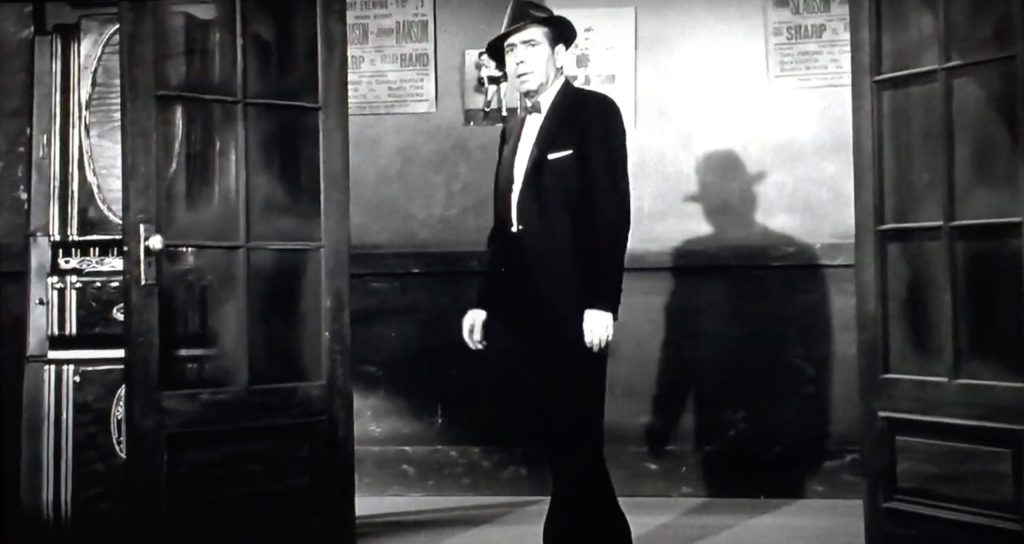
Humphrey Bogart has a secure place on the Mount Rushmore of Hollywood actors. I’ve recommended movies where he plays unpretentious heroes (Sahara and To Have and Have Not) and figures of genuine menace (In a Lonely Place) but like most of his fans I cherish Bogie most for his world weary, cynical idealists who haven’t quite given up hope. As morally compromised sportswriter Eddie Willis in 1956’s The Harder They Fall, Bogart ended his career by nailing such a role for us a final time.
Columbia promoted this movie as a sort of sequel to its commercial and critical 1954 mega-smash On The Waterfront based on the shared presence of Budd Schulberg’s writing, Rod Steiger’s acting, and a story about a boxer and mobsters. But the novel The Harder They Fall (adapted for the screen by Philip Yordan) was actually written by Schulberg first and the film’s subject matter is the boxing industry itself rather than a hard-luck longshoreman whose pugilistic career is behind him.
The plot is loosely based on the career of Primo Carnera, an Italian strongman who became world heavyweight boxing champion after winning a series of suspect “victories” that were fixed by the mob. In the movie, the central character is a big, clumsy Argentinian mountain of a man named Toro Moreno (Mike Lane), whose sleazy manager Nick Benko (Steiger) needs Moreno to get positive press from a trusted source like the Eddie Willis (Bogart). Eddie can see that Moreno is a lousy boxer, but he’s financially desperate enough to become corrupted by Benko. The entourage begins touring the country winning fixed fights and showering Moreno with enough misleading publicity to make him a challenger for a lucrative (for Benko) title bout.

Morally, Eddie Wilson is much farther gone than, say Rick Blaine in Casablanca. He sells out almost immediately and exploits colleagues and friends to spread lies about Moreno’s boxing prowess. Bogart brings his growing self-loathing across with furtive looks and tired movements, and that he was manfully making this film while dying of esophageal only amplifies the effect of his acting (He had to do some reshoots of scenes in which his eyes were watering from the pain of his disease). Coming from a completely different style of acting (“The method” which Bogart apparently found a bit amusing), Steiger is a superb foil for Bogart as a man who behaves just as badly but feels no compunction about doing so.
Little known Mike Lane, a former circus wrestler, brings across the central tragedy of the story: Toro Moreno really believes he’s a great boxer and that the people around him have his best interests at heart. He is a physically huge man, but psychologically his character is a naive, tender-hearted little boy. His exploitation by Benko eats at the audience’s conscience just as it does Eddie’s.
The strong performance by Lane as well as by real-life boxers Jersey Joe Walcott, Max Baer, Pat Comiskey, and Joe Greb, is a credit to the fine director Mark Robson, who made actors out of all of them. And the legendary cinematographer Burnett Guffey is in top form, contributing arresting visuals outside the ring and even moreso in it.
The Harder They Fall has as bleak of view of humanity as any of the noirish dramas of the period. It paints a world where most people are heartless and those who trust are victims. And who better to play someone caught between such amorality and decency than one of the greatest movie stars of the 20th century?
p.s. Two somewhat different endings were shot and are still in circulation, one with Eddie calling for boxing to be banned (reflecting Robson’s distaste of it) and the other with him only demanding an investigation into corruption within the sport (reflecting Schulberg’s taste for it, warts and all).
 All Good Movies