Categories
British Drama

Traffik

I saluted the Tinker, Tailor, Soldier, Spy mini-series as the summit of BBC programming. The 1989 mini-series Traffik is in the same league. Most Americans remember Steven Soderbergh’s Oscar-winning adaptation of this series, but far too few have seen the British original, which at just over 5 hours allows much more character and plot development than could Soderbergh’s excellent movie.

Simon Moore’s masterful script anchors what could have been a sprawling, confusing series in the lives of a small number of characters: A UK Home Office drugs minister (Bill Paterson) whose daughter is a heroin addict (Julia Ormond), a dogged German cop (Fritz Müller-Scherz) who relentlessly pursues an ice queen (Lindsay Duncan) who steps into the drug trafficking business when her husband (George Kukura) is indicted, and a desperate Pakistani poppy farmer (Jamal Shah) who finds work with a ruthless drug lord (Talat Hussain). As events buffet the protagonists and their respective story arcs cross, Moore’s narrative skills and Alastair Reid’s deft direction ensure that the viewer is irresistibly drawn in emotionally and able to track the complexities of the plot.

The performances by the actors range from good to amazing. Though it is hard to choose some to single out for praise, Müller-Scherz completely inhabits his role as a working class police detective who seems to hate traffickers as much for their wealth as their drugs. Paterson (best known to US audiences from Fleabag) is marvelous in a tragic role, playing a rigid man who desperately wants to do good at home and at work yet almost always fails in both domains. Lindsay Duncan is also impressive, beginning the film as a woman accustomed to wealth and knowing yet not wanting to know where the money comes from. After her husband’s arrest, Duncan makes credible her character’s transformation into someone even more cold-hearted than he, revealing the greed and entitlement that was lurking in her all along. Her character, along with Talat Hussain’s Pakistani drug lord, are used by the film to portray the drug trade much as socialists tend to see all of capitalist enterprise: A system with a few rich sociopaths on the top and countless marginal people (whether in the drug trade or addicted to its products) scraping by and suffering at the bottom.

The cinematic team behind Traffik took a somewhat subjective approach in their portrayal of drug production and daily life in Pakistan. Home Office minister Jack Lithgow (Paterson), improbably, roams around Pakistan unstaffed, not unlike Macbeth lost in the haunted forest. His encounters with the locals are more emblematic than realistic, including his somehow running into Fazal, the farmer who will be a hub of the story that unfolds. Coupled with dreamlike, sun dappled shots of the countryside by cinematographer Clive Tickner, the whole effect of the Pakistan sequences is akin to watching a surrealist play. Yet it works because Lithgow is on a mission of unreality, trying to stop drug production with a feeble crop substitution program and more generally trying to control a culture that he can barely even understand.

In contrast, the scenes set in Europe are more gritty and realistic, particularly Ormond’s descent into addiction. The skies are darker, the shadows longer and the cinematic look grimier. And over both the European and Pakistani scenes hangs Tim Souster’s music, a quasi-mystical threnody that accentuates the emotional anguish that the film creates. You won’t get his score out of your head quickly nor will not want to.

Traffik is a powerful, mournful film that doesn’t speechify or offer easy answers about drugs. Both artistically and as an education about its subject, it’s a triumph from start to finish.

Categories
Horror/Suspense Mystery/Noir

My Name is Julia Ross and Dead of Winter **Double Feature**

The 1941 novel The Woman in Red has been used as the basis of a film twice, with a four-decade gap between versions. As a special double feature, I recommend both adaptations: 1945’s My Name is Julia Ross and 1987’s Dead Of Winter.

My Name is Julia Ross was a modestly budgeted Columbia production with a 12-day shooting schedule. But at that point in his career, director Joseph Lewis was used to churning out a C-picture a week on Poverty Row. To have a B-movie budget was for Lewis a major upgrade in resources that allowed him to show how much talent he had. Clocking in at just over an hour, the film serves up noirish gothic suspense and a career-best performance by Nina Foch as the title character. She’s an American living in London who answers a job advertisement placed by a seemingly gentle old woman (a deliciously evil Dame May Whitty). Julia thinks she will be working as a personal assistant, but instead is promptly drugged, kidnapped and moved to a remote mansion on the Cornwall coast where everyone calls her by a different name and acts as if she’s married to a knife-obsessed weirdo (George Macready, who was made for these sorts of roles)! But the villains have not figured on how brave and resourceful is their prey…

My Name is Julia Ross is often cited by critics as being the perfect demonstration that you can make a fine movie on a low budget. The script and performances are solid and the brisk pacing keeps the viewer engaged throughout. Burnett Guffey, a future Academy Award winner, contributes moody and at times even eerie photography, and Lewis’ influence on shot selection is also easily evident (He loved to shoot actors through wagon wheels and fences, here there are shots through the newels of a staircase and the iron bars of a secured window). It is not surprising that the movie more than returned its modest budget and put Lewis on the path to even greater successes (Most notably, the simply amazing Gun Crazy, which features a central character with a fetish that resembles Macready’s here).

Many years after My Name is Julia Ross was released, Marc Shmuger and Mark Malone re-imagined the story considerably in Dead of Winter, making the lead character an actress desperate for work (Mary Steenburgen, who has fun playing three different characters). She is interviewed for a role by an inordinately polite and at the same time somehow disturbing assistant (Roddy McDowell, who steals the film) to an alleged film producer (Jan Rubes). In the midst of a raging, isolating winter storm, they bring her to a remote New England mansion and ask her to shoot a scene in which she impersonates Julie Rose, an actress whom they claim has had a nervous breakdown and needs to be replaced on a major film production currently underway. But as the audience we know that Julie has been murdered, and our heroine is falling into a web of danger.

Some of the plot twists and shocks in the film are anticipatable, but others are complete, effective surprises. As you would expect from a modern film, there is more graphic violence than in the original, but it’s not at all overdone. As in the original, it’s rewarding to see a strong, smart female lead character and also have a few moments of black humor. The one significant weakness of Dead of Winter is its length. If director Arthur Penn had to work with Joseph Lewis’ budget, I suspect he would have cut the first 11 minutes of set-up and character backstory and opened the film instead with the Steenburgen’s first meeting with McDowell. That would have made a better movie because the film as made can’t keep the audience in suspense throughout its 100 minute running time, even though the climax is truly nail-biting.

As a set, the two versions of this story make an entertaining and suspenseful double feature. Also, for film buffs, watching these films back to back is a chance to appreciate how the production of movies has changed over the decades.

p.s. Some trivia for you: Gene Wilder’s 1984 film The Woman in Red was based not on the book but a French movie).

p.p.s. Steenburgen’s husband in Dead of Winter (William Russ) is apartment bound because his broken leg is in a cast, but he can at least look out his window and take photos with his high-end camera…I think we know to which classic movie this is an allusion!

Categories
Documentaries and Books

Enron: The Smartest Guys in the Room

Enron: The Smartest Guys In The Room Review | Movie - Empire

How did one of the country’s largest companies go from riches to rags almost overnight, if it ever truly had riches in the first place? That question is skillfully and intelligently answered in Alex Gibney’s 2005 documentary Enron: The Smartest Guys in the Room.

The title refers to Ken Lay and Jeff Skilling, who convinced themselves and the world that they had a created a new kind of company that could make unprecedented profits in the energy sector. As one insider puts it, as each quarterly report approached it seemed the company was not going to make its numbers yet somehow it always did, and then some. Enron’s astronomical reported profits did not gain credibility in a vacuum: Its books were audited by Arthur Anderson, its accounts were interconnected with those of some of the nation’s most trusted financial firms (e.g., Merrill Lynch) and all the “objective” stock analysts were singing the company’s praises. But of course it was all a lie, and it unraveled with shocking speed and horrific destructiveness.

This movie adroitly combines interviews of journalists, former Enron insiders and political figures with archival news footage (e.g., Skilling and fellow crook Andrew Fastow’s Congressional hearings) and some truly damning movies made by Enron executives themselves. Although it’s a bit long-winded at 110 minutes, the film has an admirable ability to explain even to financial novices how Enron executives defrauded investors (not least its own rank and file employees) as well as put California through living hell by intentionally starving the state of electricity.

When this muckraking documentary came out, some critics complained that the film massaged the facts for the sake of left-wing axe-grinding. The narrator being staunch anti-capitalist Peter Coyote and one of the key interviewees being the lawyer who led the class action suit against the company (Bill Lerach) could trigger worries for some viewers that the film is simply comfort food for socialists. But any concerns about bias disappear as the film unfolds because the perpetrators so thoroughly hang themselves before the viewers’ eyes. The film accuses Enron of dodgy “mark to market” accounting and backs it up with Skilling himself appearing in a company produced comedy sketch where he brags about the phony nature of Enron’s books. Likewise, the accusation that Enron traders delighted in destroying California with contrived energy shortages and price gouging is immediately backed up by audiotapes of traders laughing over doing just that (Most disgustingly, cheering on a raging wildfire because it is damaging power lines).

Gibney has done a public service with this movie, but it doesn’t feel like eat your peas viewing. It’s fascinating, disturbing and compelling throughout. And also, there is something refreshing about a movie in which white collar criminals who steal billions actually go to prison in the end. Those were the days.

Categories
British Horror/Suspense Mystery/Noir

Obsession

In my recommendation of Dear Murderer, I described my fondness forBritish films in which brutal people say awful things with perfect manners and diction. Another fine example of the “Terribly sorry old chap, but I’m afraid I’m going to have to kill you” school of Brit Noir is 1949’s Obsession.

Like Dear Murderer, the film revolves around a beautiful, faithless wife (Sally Gray) whose urbane, intelligent cuckold (Robert Newton) seeks indirect vengeance by trying to kill one of her lovers in a fashion that the police will never uncover. Gray is at her most alluring…and her most cold. If there were any doubt as the film progresses, the final scene makes clear her character’s utter selfishness, and she puts it over in a manner worthy of noir’s most memorable femme fatales.

Robert Newton, as a calculating, vindictive psychiatrist plotting the perfect murder, is even better. It’s hard to believe that his suave, perfectly tailored character is the creation of the same actor who made “Arrrrhhh!” the byword of would be pirates everywhere (see my recommendation Treasure Island for details). Because he is ostensibly the victim of his wayward wife and conducts himself so politely, it’s possible to feel sorry for him until about half way through the film, when a critical scene with a little dog makes you realize that he is, like his spouse, a thoroughly nasty piece of work.

Obsession (1949) British Politeness, A Hot Water Bottle & A ...

Phil Brown, remembered today only as Luke Skywalker’s Uncle Owen in Star Wars, is serviceable as the doomed lover, though a stronger actor might have been able to do more in the many face-offs he has with Newton. Naunton Wayne — for once not co-cast with Basil Radford — comes off better as a dogged Columbo-type detective, and also skillfully injects some comic relief into the otherwise grim story.

The other key presence here is director Edward Dmytryk, who was essentially exiled to Britain during the McCarthy witch hunts. He had a smaller budget to work with than what he was no doubt used to in Hollywood, but he gets everything possible out of the small cast and few sets as the film unfolds.

If you have trouble finding a copy of Obsession, look for it under an alternate title that was adopted at some point after its release: The Hidden Room. Any required extra hunting effort on your part will be well-rewarded by this finely-crafted piece of cruel and suspenseful entertainment.

p.s. Look fast for Stanley Baker (whose films I recommended here, here and here) as a cop on the beat.

Categories
Action/Adventure Mystery/Noir

Cry Danger

What the difference between a first time directorial outing by a former film editor versus that of a movie star? In general, about 10-20 minutes of unnecessary footage. As directors/producers, movie stars tend to have too much sympathy with the actors (especially if they have cast themselves in the film) and not enough with the audience. A number of good films with actor-directors, for example Denzel Washington’s The Great Debaters, Ed Harris’ Pollock and Jack Nicholson’s The Two Jakes, did not achieve greatness simply because they were far too long.

Former film editors tend to understand that most movie scenes can be shorter and some movie scenes can be eliminated entirely. That doesn’t stop them from making long movies (David Lean was a former film editor) but it usually prevents them from making flabby ones. A background as an editor was thus ideal for making an economical film noir in just 22 days, which is what Robert Parrish did in Cry Danger. I highlighted Parrish’s Oscar-winning editing in my recommendation of Body and Soul and am happy to report that he also clearly knew what to do behind the camera.

Cry Danger streaming: where to watch movie online?

The plot of the 1951 film is near-boilerplate for these sorts of cinematic outings. Two noir staple characters, an ex-con named Rocky Mulloy who was wrongly convicted of a crime (Dick Powell, which some sources credit to contributing uncredited to the direction as well) and a disillusioned ex-GI (Richard Erdman), team up to find the still-hidden loot from the robbery for which Rocky was framed. They tussle with the crime boss whom they suspect of being behind the original job (William Conrad, as usual a welcome film noir presence). Meanwhile, Rocky comforts his ex-girlfriend (Rhonda Fleming), who is now married to his best friend, who was sent upriver with Rocky and still remains in the Big House. Rocky is tempted by his alluring ex- in more ways than one, but never lets himself be dissuaded from his mission of taking vengeance on those who framed him.

I have written about how former song-and-dance men Dick Powell and John Payne repackaged themselves as noir tough guys after the war, and how Payne did so more credibly. Powell always seemed to me too Father’s Knows Best-ish to carry off morally murky or cynical noir roles, and his mien of near-continual faint amusement undermined his efforts to be an intimidating tough guy. But those problems are irrelevant here due to Erdman’s well-scripted part as Powell’s alcoholic friend, which in Erdman’s hands is extremely funny (Fans of the TV show Community will not be surprised). Powell’s efforts to get his friend to sober up, and to be wary of the floozy (Jean Porter) who keeps stealing his wallet, turn Powell’s paternal demeanor into a strength rather than an annoyance, and the humor of these exchanges is only better for Powell’s frequent smirks.

Despite those light elements, there is still plenty of noirish content and mood on display here, as well as some pleasing mystery and action elements. The “surprise resolution” of the story is not hard to guess, but that will not diminish enjoyment of this tightly-constructed, well-directed crime melodrama.

Categories
British Drama Romance

Brief Encounter

Nothing lasts really. Neither happiness nor despair. Not even life lasts very long.

Elsewhere I recommended In Which We Serve, the first collaboration between Noël Coward and David Lean. As their partnership evolved, Coward ceded full directorial control to Lean and the two men made a series of films (now available as a boxed set from Criterion Collection) that both reflected and defined the image of Englishness for a generation. The strongest of their efforts is 1945’s Brief Encounter.

Expanded from a one-act play of Coward’s, the plot is so simple that it would have been slight in less talented hands. A plain-looking, thoroughly respectable suburban housewife and mother named Laura Jesson is waiting for her regular train on her regular shopping day. A train throws a piece of soot into her eye. The handsome Dr. Alec Harvey comes to her aid and something sparks between them. They meet again by chance, a third time by intention mutually disguised as a trivial convenience, and then, guiltily, on purpose. A forbidden — though by modern standards, extremely restrained — romance develops. But where can it go, for two married parents with a lifetime of British socialization in their veins?

Other than The Browning Version, no British film conveys the nature of quiet desperation as achingly as does Brief Encounter. Coward wisely does not make the choices simple for the characters or the audience. Laura’s husband is gentle and devoted and her children loveable. Alec’s family is never seen, but the audience imagines something similar regarding his own responsibilities and constraints. Alec and Laura are drawn to each other not because they are fleeing violence, hatred or some other overt misery. Rather, they are running from dullness towards passion, which is underscored (pun intended) by perfectly chosen music by Rachmaninoff.

Lean and his frequent collaborators Ronald Neame and Anthony Havelock-Allan understood the possibilities of film as well as any team in the history of cinema (Not incidentally, they went on to make many classics together post-Coward, including another of my recommendations, Great Expectations). This movie is one of their many triumphs. The tone, look, pacing and editing are all unimpeachable.

The other undeniable virtue of Brief Encounter is the acting. Trevor Howard, as Alec, is strong, but Celia Johnson tour de force as Laura, the more fully developed of the two characters, will stay with you until the end of your days. She might have been an unsympathetic character but Johnson’s evident humanity and emotional turmoil will elicit forgiveness from even judgmentally-inclined viewers. Johnson’s most unforgettable moment: Her character’s realization that her husband loves and trusts her so much that he will never suspect the lies she tells to cover up meeting with Alec. Johnson deservedly received a 1947 Oscar nomination for her performance. It came that long after the 1945 British release because a movie in which infidelity is not punished was long considered too scandalous to release in a number of countries, including the U.S.

Every moment, every look and every gesture rings true in Brief Encounter. Pour yourself a cup of tea, get out your hanky and watch this truly magnificent film made by a creatively matchless group of artists.

Categories
Action/Adventure Mystery/Noir Romance

Notorious


Nazis in hiding! Smuggled uranium! Espionage! All minor distractions from the central tantalizing mystery that keeps the audience in delicious suspense: Does Cary Grant’s character really love Ingrid Bergman’s or not? It’s all there in Alfred Hitchcock’s 1946 classic Notorious.

The plot: Alicia Huberman (Ingrid Bergman, in one of her career-defining roles) is the alluring daughter of a Nazi sympathizer. She has a notorious reputation as a drinker, party-goer, and sexual libertine. After the war ends, her father is convicted of aiding the Nazis. At a party where she deep in her cups and flirting with all the men, she meets a handsome, mysterious secret agent who is appropriately named Devlin (Cary Grant, just perfect…again). Devlin eventually persuades Alicia to go investigate Nazis who are now hiding out in South America. Does she agree out of patriotism, guilt over her father’s crimes or growing love of Devlin? He seems at times to love her back, by why then does he seem not to care when her assignment requires her to bed and wed an old friend of her father’s (Claude Rains)? The mystery of the Nazi plot and the maddening complexities of Devlin and Alicia’s relationship become intertwined as the thrilling story unfolds.

This movie vividly demonstrates how the presence of stars can shape how audiences react to characters. Without Bergman’s high-wattage stardom, audiences might have viewed Alicia as a pathetic, boozy, scrubber. Without Grant’s fame and on screen magnetism, audiences might have viewed Devlin as a cold, calculating bastard (Indeed, if Claude Rains weren’t a Nazi, the audience might have rooted for him to get the girl — after all, at least he loves her unreservedly). The instinctive liking the audience had for the stars allows the two film icons to develop multi-layered characters rather than having them rejected out of hand. Quite simply, Bergman and Grant tear up the screen here and they get tremendous support from Rains and from Leopoldine Konstantin as a memorably terrifying mother (even by Hitchcockian standards!).

Notorious (1946, Alfred Hitchcock) | Slices of Cake

In the eyes of many film buffs, Notorious is the pivotal film in Hitchcock’s career, and not just because he famously managed to make Grant and Bergman’s Production Code-allowed three second kiss last for several minutes. When David O. Selznick sold the film to RKO to deal with a money crunch, Hitchcock finally didn’t have to choose between a big budget and production control. From this film onward through the rest of his U.S. career, he was able to be producer-director of marquee projects with A-list stars. Notorious also showcased The Master’s maturing ability to handle grown-up romantic story lines. There were love stories in his earlier films (for example The 39 Steps which I recommended here) but they were generally frothy and light-hearted. The love triangle in Notorious — scripted by the brilliant and prolific Ben Hecht — has much more psychic weight, adding a new dimension to Hitchcock’s work to accompany his already matchless ability to keep an audience on the edge of their seats. Last but not least, Hitch’s visual style, already impressive, took a major leap forward with this film: It’s enthralling to look at and comprises some of his most memorable images.

There’s only one Hitch, and Notorious is among his best works. Do not miss this classic romantic thriller!

p.s. Watch VERY carefully as Cary Grant ascends the stairs to Bergman’s room and compare what you see to the nerve-wracking conclusion as he and Bergman descend the same staircase. Why are there more steps on the staircase in the latter? Because Hitchcock knew how to string out excruciating tension.

Categories
British Comedy Romance

Pygmalion

It’s a fun bit of trivia that George Bernard Shaw is the only person to have won a Nobel Prize for Literature and an Academy Award. He secured the latter for a truly brilliant adaptation of his own stage play: 1938’s Pygmalion.

The plot: Eliza Doolittle is a poor Covent Garden flower girl (Wendy Hiller) with a lower-class accent thicker than a London fog. She is taken on as an experimental subject by imperious, brilliant and eccentric language expert Professor Henry Higgins (Leslie Howard), who intends to pass off this “squashed cabbage leaf” and “incarnate insult to the English language” as a fine, upper class lady. Higgins doesn’t do this out of kindness, but because he wants to show off his abilities as a language and etiquette coach and along the way to win a bet with his friend Colonel Pickering (Scott Sunderland, in a warm portrayal of upper-class decency). The result is abject hilarity underlain by Shaw’s caustic observations on social class hierarchies. There is also, infamously, a strange romance which resolves in a fashion that is still much debated.

There is so much to praise in this movie! Shaw’s peerless source material is only the beginning of the joy for audiences. Co-Directors Leslie Howard and Anthony Asquith give a clinic in how to open up a play with the possibilities of film. Howard is also an antic marvel on screen, consistently watchable and funny without making Higgins more sympathetic than he should be.

But as good as Howard is, and he’s very good, the then-unknown Wendy Hiller is a revelation. She had garnered raves for her Eliza on stage and it’s easy to see why. She wrings all the laughs out of the part but also portrays heart-touching vulnerability and fiery spirit. She later won an acting Oscar for Separate Tables but this is her performance of a lifetime and ranks with the best 20th century turns by a British film actress.

Watch Pygmalion - Stream Movies | HBO Max

This is also a good-looking film, especially if you treat yourself to the restored Criterion Collection version. Cinematographer Harry Stradling Jr. had a fine eye for London life from its poshest to grimiest bits, and he was aided by a soon-to-be famous film editor named David Lean.

Pygmalion is near-perfect cinematic entertainment that remains tremendously appealing today. And though it doesn’t sound or look as good as The Criterion Collection version, you can watch a not bad copy of this public domain film for free at The Internet Archive.

SPOLIER ALERT: Stop reading here if you haven’t seen the film.

Categories
Action/Adventure British Drama

The Scarlet Pimpernel

Leslie Howard was a multi-talented actor/director/producer as well as a true patriot who was taken from us too soon in 1943 when he was murdered along with 16 other defenseless people by the German Luftwaffe. Can a film star be so appealing that the audience will root for a die-hard one-percenter who is battling the cruelty of ignorant poor people in an adaptation of book by a Pro-Imperialist, Pro-Aristocrat author? Well, sink me if Leslie Howard can’t, as you will see in this week’s film recommendation: The 1934 version of The Scarlet Pimpernel.

The film is set during The Reign of Terror, during which déclassé French mobs cheer as the guillotine ceaselessly beheads tumbril-full after tumbril-full of upper class men, women and children. Enter our brave and dashing British hero, The Scarlet Pimpernel (Leslie Howard), to rescue his fellow nibs and show the Froggies a thing or two along the way, hey wot? In private life this crusader hides behind a foppish, effete image as Sir Percy Blakeney, leading his wife (Merle Oberon) to worry that her husband is incapable of manly action. Meanwhile, a tough, clever French agent named Chauvelin (Raymond Massey) blackmails Lady Blakeney over a past transgression in the hopes that she will ferret out the true identity of The Scarlet Pimpernel.

Although the movie contains some exciting action scenes in the early going, it’s really more of a three-handed melodrama (Indeed, the film would have benefited from just a bit more swash in its buckle). Percy doubts his wife’s political loyalty, she despairs of his evident lack of virility and seriousness, and Chauvelin tries to exploit the situation to bring about the death of his hated enemy. What might otherwise have been an overly serious or plodding story is enlivened throughout by Howard’s nearly over-the-top performance as Sir Percy, which he wisely plays for every possible laugh. Sink me, he’s a delight, as is Nigel Bruce in a supporting role as a buffoonish Prince of Wales (Later he would play a similarly comic Dr. Watson in another of my film recommendations).

scarletpimpernel

Raymond Massey, with his dark looks and intense acting, makes a memorable villain as Chauvelin. And 1930s movie icon Merle Oberon is at the peak of her allure. Shortly after this film was made the Hays Code came in to cover up her décolletage with burlap, thereby saving America’s wayward youth from unclean thoughts and perilous temptation. Sadly, Oberon was then in a serious car accident that permanently scarred her lovely face. She did though go on in 1939 to anchor an all-time classic, Wuthering Heights (She also, funnily enough, married The Scarlet Pimpernel’s producer, Alexander Korda, that same year). As a sign of the times and the business in which she worked, this mixed-race actress spent her entire life trying to deny her Indian heritage by invoking the risible claim that she was Tasmanian!

As for the politics of this film, well, only once does an aristocrat (Count de Tornay) in the movie acknowledge that The Terror never would have happened if the rich hadn’t been so out of touch. The author of the novel (a curio to be sure), Baroness Orczy, criticized French aristos for forgetting the code of noblesse oblige and abusing the poor. But neither she nor this film objects to aristocracy in principle, only aristocracy done badly. Should this bother you? Not unless you take this movie way too seriously. This is a Saturday afternoon matinee, not a political science lecture, and it succeeds on those light-hearted terms, particularly because of the standout work of the wonderful Leslie Howard. Best of all, it’s in the public domain (take that, you indolent landed gentry!) so even if you haven’t two farthings to rub together you can see this film for free right here.

Categories
Action/Adventure Drama

Seven in Darkness

SEVEN IN DARKNESS (TV), 1969 DVD: modcinema*

TV movies usually are not very good, but ABC’s Movie of the Week was an exception to the rule. To complement the other films from this series I have recommended, let me endorse the entry that kicked it off in 1969: Seven in Darkness.

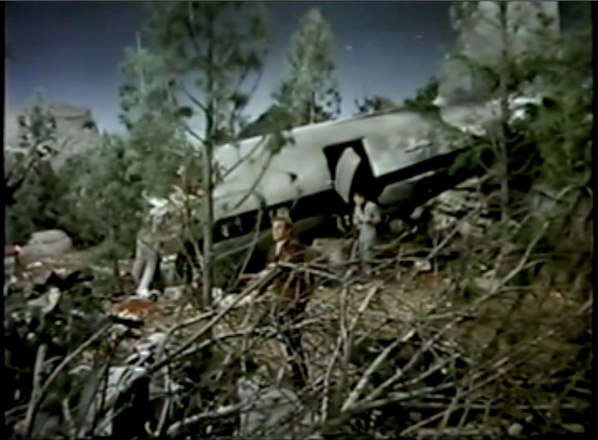
The plot is at one level entirely stale: A group of disparate characters (each with their own dramatic back story, natch) are in peril and must work together to survive. But the movie enlivens the old chestnut by making all of the characters blind! After surviving a plane crash on the way to a convention of blind people, seven people realize that the pilots are dead and therefore no one can guide them out of the wilderness to safety.

Terrifying new possibilities emerge within this genre when no one is sighted, making trivial challenges harrowing: Crossing a rotted railway trestle, evading wolves, climbing steep hillsides and determining who in the band of seven has been secretly stealing food. The most effective twist comes as viewers watch in agony as the characters take enormous risks to cross a river because they can’t see that there is a serviceable bridge right over their heads (As your heart sinks watching their struggle, you might find yourself yelling advice). There is also a nice cinematic virtue to the plot set-up: Instead of needing night shoots that are hard to do well and sometimes leave viewers unsure as to what is happening, the film could be shot entirely in daylight because to the characters, it of course might as well be dark out.

Human drama is also woven into the story, some of which works well (e.g., The complex motives of Barry Nelson’s psychotherapist character) and some of which falls flat (e.g., Lesley Ann Warren’s hysterics). But the cast generally does a fine job, and fans of Milton Berle will enjoy him as a cranky, selfish man who dreams of having his sight restored by a new medical procedure.

It’s a TV movie, so there are no big stars or fancy special effects, and much of it looks like it was shot on a sound stage. But as in another of my recommendations, Devil in a Blue Dress, the filmmakers got the most from adding a novel element to old tropes. The result is 70 minutes of suspense and entertainment which deservedly encouraged ABC to continue with this format for an extended series of above-average made-for-TV movies.