Categories
British Drama

Scrooge

Scrooge is deservedly a beloved Christmas movie. Like the not dissimilar It’s a Wonderful Life, it came by its standing as a beloved film democratically: Long after it was released generations of people fell in love with it on television. And with very good reason.

The heart of this film is Alastair Sim, whose lack of a 1951 best actor Oscar nomination should make the Academy hang its head in perdurable shame. More than any other movie adaptation of Dickens’ novella, screenwriter Noel Langley’s treatment gives Scrooge a backstory that explains his nature and outlook, making him a more fully developed character. Sim must therefore portray powerful moments of grief, cruelty, pity, parsimony, regret, remorse and manic joy, and he does so in a profoundly effective way. He was so damn good in everything he did (e.g., Green for Danger, another of my recommendations) that it’s hard to say which is his greatest film performance, but this may well be it.

Categories
Action/Adventure

Die Hard

One of the great self-referential pop culture moments of recent years occurred on the TV show 30 Rock, when Jack Donaghy (Alec Baldwin) portentously intoned “When Alexander saw the breadth of his domain he wept for there were no more worlds to conquer….Hans Gruber”.

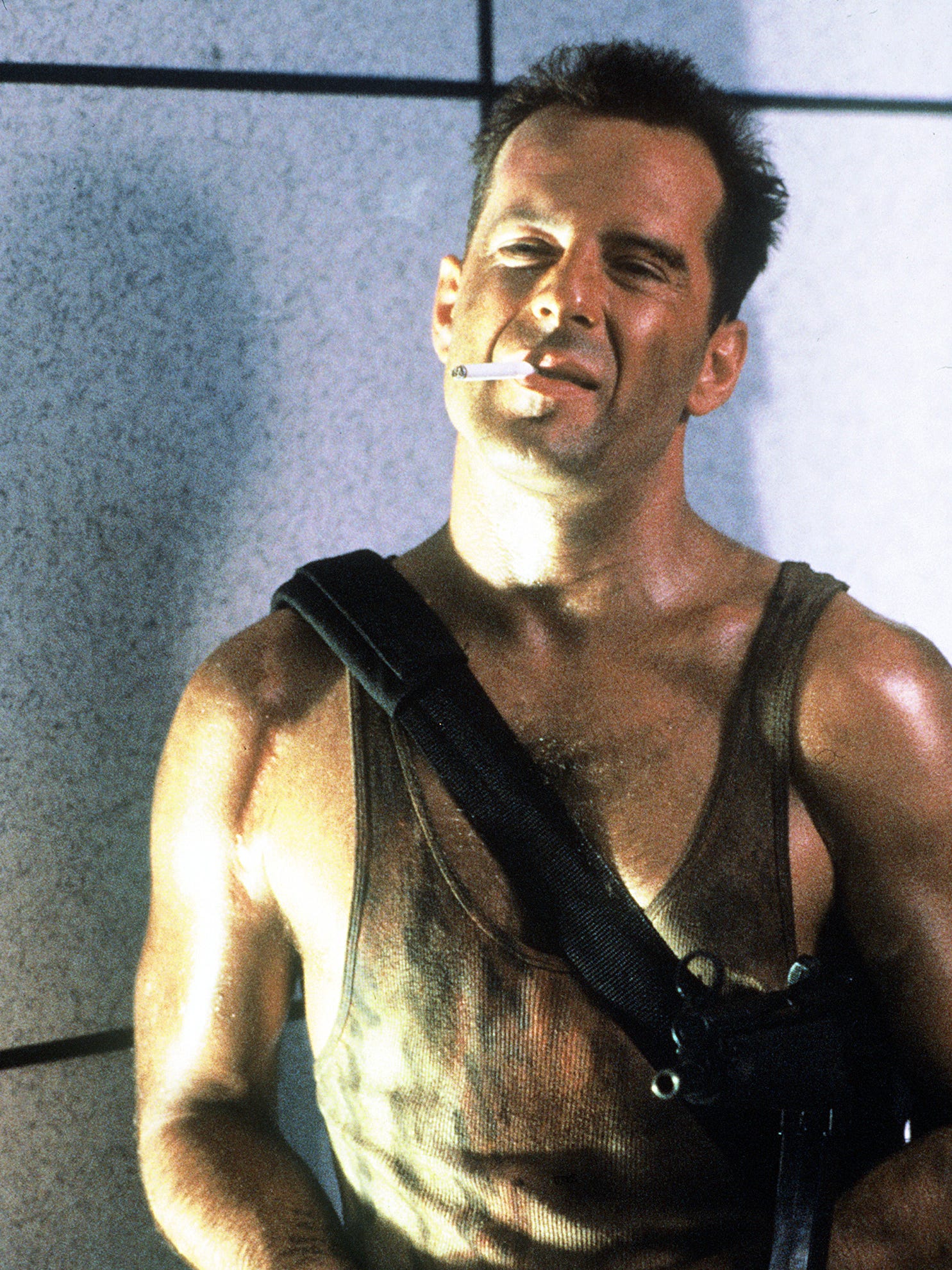
Alan Rickman’s deliciously evil, funny, cultured, intelligent, and violent Hans Gruber is the ultimate Yuletide movie villain. Unlike the Grinch, he is never redeemed. He would shoot Mr. Potter through the head in style, blow up Scott Farkis with gelignite, and hurl Heat Miser from an 80 story skyscraper. He is officially only the second lead in 1988’s Die Hard, a Christmas movie for all members of your family who like watching things explode.

Die Hard' turns 30: Our 30 favorite pop-culture references

The plot: Rough and ready New York cop John McLain (Bruce Willis, ostensibly the star of the film and certainly good in the role) has come to sunny L.A. for Christmas to try to repair his rocky marriage to his wife Holly (Bonny Bedelia). Holly has taken a dream job at the Nakatomi corporation, returned to using her maiden name (ouch!), and thrived as a corporate executive without John around. But before they can get back to serious bickering, John and Holly have to deal with an international team of super-terrorists (think of them as like the EU, but competent) who take over the Nakatomi building. John has his wisecracks, his courage and lots of guns, but the bad guys are more numerous and have cooler accents, especially their master planner and leader Hans (Rickman).

This is a rock ’em sock ’em action film leavened with many pricelessly funny lines, most of them voiced by Willis or Rickman. The plot has many surprising twists and turns as Hans’ plan unfolds, McLain throws spanners into the works, and then Hans adapts, contingency by carefully planned contingency. Not much in the way of traditional holiday themes, but there are some gifts and Santa hats and pine trees and such around, so you can pass this off as a Christmas film if you wish, you orphan of a bankrupt culture.

After you have watched this thrilling movie, you might consider what you would do for a dying friend who had a special last request…

Categories
Horror/Suspense Mystery/Noir

Dial M for Murder

I have recommended a clutch of Hitchcock films (Notorious, Psycho, The 39 Steps, and The Lodger), but omitted some of his best known. Some of his classic films (e.g., Rear Window) have been written about so much that I can’ t think of anything novel to add. Others exceed my powers: I’ve seen Vertigo a dozen times but still can’t fully explain why it is one of the greatest works of art of the latter half of the 20th century, though I know in my heart that it is.

So let me recommend a film you may have missed, which is usually considered a minor success of The Master: 1954’s Dial M for Murder. The movie had a strong foundation because it was based on an extremely well-crafted hit play by Frederic Knott (who also wrote the screenplay for the movie version).

The story is a simple one: A tennis-playing effete British smoothie (Ray Milland) discovers that his glamorous wife (Grace Kelly, elegant and effective) is carrying on a passionate love affair with a broad-shouldered American (an appropriately manly Robert Cummings), so he decides to murder her. But rather than do the deed himself, he seeks the help of an intermediary, leading things to go horribly awry…unless of course he can clean up the mess by framing his wife for a terrible crime.

When film directors adapt plays, they typically insert scenes of exteriors, use many long shots and wide shots and trolley shots etc., in order to give the audience a cinematic experience. Hitchcock did just the opposite, shooting almost entirely on a single set, and using camera placement within it to keep things fresh. The claustrophobic framing adds to the tension of the film while somehow never coming across as stagy.

The highlight of this film is the astonishing performance of Ray Milland as Tony Wendice, the suave and unflappable villain. He won a Best Actor Oscar for The Lost Weekend, but I think he’s even better here. Even when he cruelly and cleverly blackmails an old college mate (Anthony Dawson) into participating in his murder plot, he is ever calm and smiling, the perfect British upper class sort. It is that emotional tone in his performance, combined with Hitchcock’s directorial genius, that makes the famous closing scene of this film so memorable.

The foil for Tony Wendice isn’t really his romantic rival Mark Halliday (Cummings), but the intelligent, moral Chief Inspector Hubbard. He is played by John Williams, never a huge star but someone Hitchcock used over and over in movies and TV shows because he consistently gave solid and intelligent performances. Williams is at his best here, nicely leavening his hard-headed cop role with touches of warmth and humour.

In summary: Fantastic source material, fantastic director, fantastic cast – what’s not to like?

p.s. You may wonder why such a short movie has an intermission. This film was originally made in 3-D, and the intermission was to give a chance for those theaters with only two cameras to load the next two parallel reels. I regret very much never having seen the 3-D version, because Hitchcock allegedly used the technique in a more creative, less gimmicky way than did other film makers. The most famous 3-D moment was the extreme closeup of Ray Milland’s finger dialing M. To get the shot right, they built a gigantic phone and a huge paper-mache finger tip! In any event, unlike most 3-D movies, it’s perfectly watchable without the 3-D effects.

Categories
Comedy Drama

The Hospital

The Hospital (1971)

Over the decades I have worked in hospitals, I have seen countless movies that draw on the drama, humor, joy and frustration that happens every day in the medical world. It’s a tough call, but if pressed to choose my favorite of such films it would be 1971’s The Hospital.

The magnificence of the movie ultimately derives — as is so often the case with the best films — from a sterling script. Even though he died young and was not particularly prolific, Paddy Chayefsky was an extraordinarily influential screenwriter. He wrote unusually realistic, tightly constructed scripts for television plays in the 1950s that he later turned into superb films (Marty is the most famous, but I like The Bachelor Party even better). He went on to achieve two mammoth movie triumphs in the 1970s, of which Network is better remembered but The Hospital is every bit as impressive. He also delivers The Hospital’s pricelessly sardonic opening narration about the trials of a recently admitted patient who is subjected relentlessly to the benefits of modern medicine until he expires.

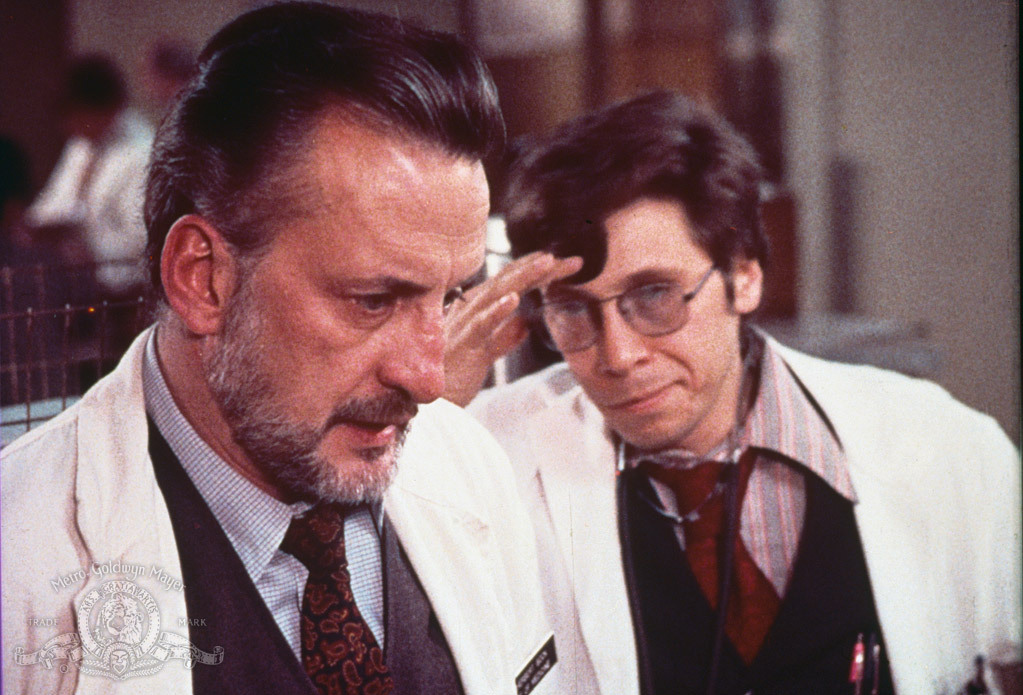
The heart of story is Dr. Herb Bock, Chief of Medicine, one-time wunderkind of immunology and now a hard-drinking, acutely depressed, and suicidal man who sees himself as a failure in every sphere of life. George C. Scott, an actor of great range (it’s hard to believe that the same man played General Patton, General Buck Turgidson and Dr. Bock), gives a bravura performance as the bearish, pained, raging and pitiable Dr. Bock. He is a classic hero/martyr type who works hard to help everyone else at great cost to himself, and is incapable of accepting the love and support he needs. I have known many Dr. Bock’s in my career, people who would say as he does that “love doesn’t triumph for the middle class — responsibility does”. The collision of an A-list actor with a beautifully-written character, as we have here, is one the most enduring delights of film watching.

On top of his considerable personal problems, Bock’s hospital is under great pressure from two directions. Angry activists are protesting the medical center’s alleged insensitivity to the local community (Chayefsky’s take on much of 1970s activism is bitter, but also hilarious). Meanwhile, why are so many people dropping dead…there couldn’t be a mad killer on the loose, could there? As Bock struggles against overwhelming challenges, he is emotionally upended by a loopy yet appealing hippy who seems to understand him better than he understands himself. Diana Rigg is perfect as said hippy, and she and Scott work together brilliantly, particularly in a long and emotionally complex scene involving suicidal and sexually violent longings.

The script has many laughs, almost all of which come with an undercurrent of anger. The foibles of hospitals and physicians are well-skewered, although in one poignant speech at the end, Scott gives a rejoinder to all the cynicism, which also hits home. The supporting players are very good indeed, including Barnard Hughes in two different parts (only one of which is credited), Nancy Marchand as Head Nurse Christie and Frances Sternhagen as “the bitch from the accounting department” (Sternhagen, whose work I have highlighted before, remains underappreciated as an actress).

The Hospital is one of the great black comedy/dramas of the 1970s and beyond that will resonate profoundly with anyone who has spent much time in a medical center as a staff member or as (the poor dears) a patient.

Categories
Action/Adventure British Science Fiction / Fantasy

20,000 Leagues Under The Sea

In my recommendation of Treasure Island, I described how and why Disney started making live-action family films after the war. One of the studio’s greatest films of this period is a dramatic, well-mounted adaptation of Jules Verne’s steampunk classic: 1954’s 20,000 Leagues Under the Sea.

The story opens with sailing vessels being destroyed in the South Seas by a mysterious underwater creature. Is it a kraken, a dragon or something else? At the behest of the U.S. government, a Parisian professor (Paul Lukas), his faithful assistant (Peter Lorre) and a free-spirited sailor (Kirk Douglas) join a military expedition to either find the monster or prove it doesn’t exist. In a fatal confrontation, their ship encounters disaster, which brings them face to face with Captain Nemo (James Mason), his devoted crew, and his extraordinary “submarine boat”.

James Mason as Capt. Nemo | Leagues under the sea, Movie stars ...

Mason, as the tortured, destructive yet also sympathetic Nemo is in top form, adding weight to proceedings that might otherwise have been comic bookish. Lukas, as the brilliant scientist who is both Nemo’s prisoner and his nagging conscience, is an effective foil for Mason. Lorre isn’t given a huge amount to do, but he makes the most of it by being more vulnerable and afraid that the other central players, thereby giving the audience someone with whom to identify.

The special effects were trend setting at the time and still hold up pretty well today, as does the knockout set design on the submarine. It’s particularly hard to forget Nemo playing Bach’s Toccata and Fugue in D Minor on the organ as the Nautilus glides through the ocean deep. Also adding to the striking look of the film is Peter Ellenshaw, who as in Treasure Island does magnificent matte work (the crowded shipyard at the beginning and the Island of Volcania at the end are flawless).

The film has two weaknesses. The first is Kirk Douglas’ endless mugging and preening. I don’t know if Director Richard Fleischer couldn’t control his star’s legendary desire for attention or gave him bad direction, but it gets old pretty quickly. The second is that like many films of the period (e.g., King Solomon’s Mines), this one includes “nature photography” moments that would have dazzled audiences at the time but are pretty slow stuff for a generation that has the web, television and a thousand episodes of Jacques Costeau at its fingertips.

But neither of those flaws stops this from being outstanding family entertainment with exciting action scenes, a strong story, eye-catching visuals and moments of real emotion. It’s great fun for you and the kids on a rainy Sunday afternoon.

I close this recommendation with a must-view clips for film-buffs. The truly spectacular fight with the giant squid in the film version released to theaters was not the first one that was shot. Here is the inferior original, the “Sunset Squid Sequence”.

Categories
British Comedy

Porterhouse Blue

If a little knowledge is a dangerous thing, think how much harm a lot of it could do. That’s the animating spirit of the academically-challenged but gastronomically-unmatched Cambridge college of Porterhouse, as portrayed in 1987’s Porterhouse Blue.

Based on Tom Sharpe’s satirical novel of the same name, this television mini-series centers on the longest-serving employee of the college, Skullion (the beloved British actor Sir David Jason). He and the senior fellows must cope with an ambitious nincompoop, Sir Godber Evans (Ian Richardson), who has been cast off from politics and made the new master of the school. Godber’s motto is “Alteration without change”, but he is an uxorious man very much under the heel of his titled harridan of a wife (Barbara Jefford). She insists that — gasp — women be admitted to Porterhouse! In this and in a hundred other ways, the new arrivals war with the traditionalists, with both sides being played perfectly by the cast for self-puncturing guffaws.

Richardson and Jason sparkle as the leads, as does Charles Gray as a rich, perverted old boy and John Sessions as the one person at Porterhouse who seems keen to get an education. His character, Zipser (allegedly the author’s self-parody), is one of British film’s great comic schmucks. His thesis is on “Pumpernickel as a factor in the politics of 16th century Westphalia”. He is awkward, sexually frustrated and obsessed with the flirtatious older woman who serves as his bedder (Paula Jacobs). His misadventures trying first to obtain — and then to dispose of — several gross of johnnies is uproariously funny.

Fair warning about this movie. If you don’t know anything about Oxbridge life, British society more generally, and can’t make out dog Latin, I would bet that at first Porterhouse Blue could be slow going. But stick with it, because it gets funnier and more accessible as it moves along.

p.s. I have been looking for years for a full translation of the Flying Pickets’ spirited rendition of the ridiculous and delightful Porterhouse college theme song. I have found translations of the first verse, but never the full song. If anyone can point me to a full translation, I would be extraordinarily grateful.

Categories
Comedy Musical

The Rutles: All You Need is Cash

Before A Mighty Wind before Fear of a Black Hat and yes, even before This is Spinal Tap was the first mock rock documentary (or, to paraphrase Marty DiBergi, the first, “if you will, mockumentary”). I am speaking of 1978’s The Rutles: All You Need is Cash.

Monty Python alumnus Eric Idle is in top form as writer/co-director and also on screen, including as Rutles bassist Dirk McQuickly (who bears an eerie resemblance to Paul you-know-who) and as a number of minor characters, including an “Occasional Visiting Professor of Applied Narcotics at the University of Please Yourself, California”. Neil Innes does marvelous work sending up John you-know-who and also by penning some inspired song parodies.

The film reviews the exploits of the “pre-fab four” from their early days in the Cavern in Liverpool, to the naughtiest street in the world in Hamburg to stardom under their eccentric manager Leggy Mountbatten, who loves their tight trousers. Even if you don’t know much about the Beatles, this movie is a laugh-filled treat, not least because so many comedy (including some Saturday Night Live stars from the glory days) and music legends (Mick Jagger and a well-disguised but still recognizable George Harrison) lend their talents at perfect moments. Telling the ridiculous story of The Rutles with an ostensibly straight face and a documentary style only makes it more hilarious, most particularly during a “very expensive” visit to discover the origin of the blues in New Orleans.

If you want to see what a fantastic job Idle and Innes did parodying both the Beatles’ music but also their stage presence and mannerisms, check out this clip of that famous night on the Ed Sullivan show…

p.s. A generation later, Idle revisited the same terrain in Can’t Buy Me Lunch. Not as fresh as the first time around of course, but still a pleasing follow-up to the original.

Categories
Documentaries and Books Drama

Nanook of the North

I admire Robert Flaherty and Neil Sheehan for the same reason: Their persistence in the pursuit of creation. Sheehan’s Pulitzer Prize winning book A Bright Shining Lie was almost never published because he lost 8 months of work in a computer hard drive crash and was so depressed that he nearly quit. Flaherty shot 30,000 feet of film in the Arctic in 1914 and 1915, but lost it all when he dropped a lit cigarette (This was in the days of nitrate). He too somehow persisted, returning to Northern Canada with a Bell & Howell camera and making one of the most influential films of the 20th century: 1922’s Nanook of the North.

The story: In an area of land as large as England that abuts the Hudson Bay of Canada, only a few hundred human beings scratch out an existence. Nanook and his family are among the Inuits who live in this bleak, deadly, yet beautiful environment. We see them fishing, hunting walrus, building igloos and interacting with white traders. We also see them laughing and playing and being a family. The tone is partly anthropological and partly human drama, and viewers find themselves fascinated by the lives of the Inuit family as well as rooting very much for their survival.

Nanook of the North | The Current | The Criterion Collection

Generally hailed as the first documentary, it might better be termed the first docu-drama because it is assembled in a narrative form and because some of the sequences were staged. The family were not really a family; indeed the wife Nyla was Flaherty’s wife. The amazing walrus hunt sequence is real, but Flaherty asked the Inuit to use traditional spears when by this point in history they had firearms.

Cinéma vérité enthusiasts have raked Flaherty over the coals for the above and many other liberties he took with the “documentary” form. But in fairness to him, there was no documentary form at the time, so it’s not as if he overturned conventions upon which the audience had long ago come to rely. And whatever sins he committed as a story teller, it was a remarkable feat with 1916 technology to be shooting and developing film in such an unforgiving place.

Despite being known mainly for its historical significance, this movie is not “film school medicine” (in contrast, say, to the first 15 minutes of Häxan). There is something extraordinarily moving about watching fellow members of our species hanging on by the skin of their teeth yet also finding joy and love in an unimaginably remote, dangerous part of the planet. It is hard to imagine the sensation the film must have caused when it debuted, and it still has psychic weight today.

Nanook of the North is in the public domain and you can watch it for free here. This version has a lovely soundtrack which the original print did not (music was added in 1939).

Categories
Comedy Drama

Slap Shot

George Roy Hill and Paul Newman scored two mega-hit, crowd pleasing films with Butch Cassidy and the Sundance Kid and The Sting (Recommended by Johann Koehler here). When they reunited in 1977, the commercial temptation would have been to more or less repeat themselves. Being highly creative artists, they instead challenged many of their fans’ expectations by making a foul-mouthed, violent, raunchy comedy set during America’s dreary blue collar decline: 1977’s Slap Shot.

Some (though not all) viewers were appalled. But, with critic Gene Siskel being the most well-known example, reactions to Slap Shot have warmed over time to the point that it is today justly regarded as a classic American movie.

The plot: The Chiefs are a minor league hockey team who lose more than they win under aging player-coach Reggie Dunlop (Newman). Meanwhile, the local plant is closing, leading the team’s owner (Newman’s frequent co-star, Strother Martin) to shop the franchise around. His career and marriage on the rocks, Dunlop knows he needs to gin up some victories and some interest for the team. The answer comes in the form of the Hanson brothers, who lead the team into a new style of hockey: Beating the crap out of their opponents! The dirty play pays off as The Chiefs start to win and the fans begin to rally around them. Meanwhile, there is lots of 1970s bed-hopping and retrograde attitudes under threat.

Some may be surprised that the script was written by a woman. But Nancy Dowd, whose brother was a minor league hockey player, knows her way around the game and also around people who use language that would make a sailor’s parrot blush. Hockey fans love the authenticity of the film, not least that Michael Ontkean (As a clean-cut Princeton grad who is the star of The Chiefs and disapproves of dirty play) and many of the other performers were in fact excellent hockey players. The resulting film is funny, rude, politically incorrect, and a jolly good time. Having lived myself though the 1970s de-industrialization of Western Pennsylvania and seen all the leather suits, huge shirt collars, towering heels and other fashion horrors I can vouch for this film’s accuracy about life at the time.

Newman, in a role that was a stretch for him (he apparently rarely even swore in private life), gives a very appealing comic performance as an over-the-hill jock. He also has great byplay with Strother Martin and with Jennifer Warren as his ex-wife. Andrew Duncan is hilarious as a radio announcer with hair from hell. Lindsay Crouse, as Ontkean’s binge drinking wife, delivers a one-note and eventually tedious performance, but all of the other smaller parts are well-turned by the actors.

Last but not least, the scenes of the hockey games are very well done. Everyone can skate and the crushing impacts and high-velocity shots feel real.

Slap Shot will never be shown at a church social or at a gathering of anti-violence activists. As long as that doesn’t put you off, get ready to laugh and be enormously entertained.

p.s. Some fun trivia: can you name ALL the films that Newman and Martin were in together? Martin’s Wikipedia entry claims six such pairings, but I could only come up with five so I am either forgetting one or gasp Wikipedia is wrong about something.

Categories
Drama Musical

Fiddler on the Roof

Gifted filmmakers are able to delve into the particularity of one group’s life to illustrate universal human experiences, thereby appealing simultaneously to those inside and outside the group. That’s part of the transcendent power of 1971’s Fiddler on the Roof. At one level, the film is steeped in the particularity of Jewish villagers under persecution of the Russian czar, and it’s a powerful story on those terms. But it’s also a moving treatment of crumbling tradition, parenthood, culture and faith which spoke to a whole generation of diverse religious and ethnic backgrounds.

The story focuses on a dirt-poor, devout and intelligent milkman named Tevye, his wife Golde and their marriageable daughters. The family scratches out an existence sustained by the bonds, traditions and religion in their shtetl of Anatevka. As suitors present themselves for his fiercely independent daughters, Tevye struggles to reconcile his traditional beliefs and concern about their material welfare with their desire to choose their own husbands based on love. Meanwhile, rumors of pogroms and forced exiles reach his ears, and he wonders when Anatevka will suffer a similar fate.

This is a very hard judgment to make, but of any Broadway musical, I would cite Fiddler on the Roof as having the best songs. “Sunrise, Sunset”, “Tradition”, “Matchmaker” are among the unforgettable musical pieces Jerry Bock and Sheldon Harnick created for the play. These show stoppers are brought beautifully to life in the film by director Norman Jewison (A Canadian Protestant who got the job because the Hollywood execs assumed that with a name like that, he must be Jewish!). Jewison and the fine cast are equally adept at the dramatic scenes, which are given more prominence in the film than in the play because Jewison wanted a more serious tone to what he saw as a largely grim story.

The big debate about this film concerns the non-casting of Zero Mostel as Tevye, the role he made famous on Broadway. To the bitter disappointment of Mostel and his many fans, the part went instead to Topol, the actor who had played Tevye in the London production of the play. It remains a stellar cast regardless, with an extraordinarily talented set of performers with both musical and dramatic talent.

This clip features one of the many wonderful, touching songs from the movie. It also shows how Jewison and top-flight cinematographer Oswald Morris did much much more than photograph a play; they created a remarkable piece of cinematic art using all the techniques the medium can offer.

L’Chaim!