Categories
Action/Adventure Drama Mystery/Noir

Bend of the River and The Naked Spur **Double Feature**

Caftan Woman: The James Stewart Blogathon: Bend of the River (1952)

Nobody can hate like a good man, and maybe that’s why Jimmy Stewart was so magnetic and moving in the hard-bitten Westerns he made with Anthony Mann after World War II. Stewart was a huge star at the outbreak of the war, during which he served with distinction. When the All-American, gee-whiz nice guy every dad hoped his daughter would bring home returned from military service, he was different, the country was different and his films didn’t do great box office. He might easily have appeared on a few TV shows and then drifted into retirement, as did many stars of his generation.

But two magnificent directors saw other qualities in Stewart, including a capacity for rage, bitterness, grief, longing, cynicism and violence. One of them remains famous (Hitchcock), the other, sadly, has mostly been forgotten. His name was Anthony Mann, and you could summarize much of his ouevre worse than saying it was “film noir goes west”.

Their first collaboration, the 1950 movie Winchester ’73, remains famous today because it was a massive hit that revived the then somnolent Western genre. It’s entertaining on any dimension, but for Stewart fans it’s particularly fascinating to see the darkness in his acting. When Stewart’s grief-ridden character (Lin McAdam) mashes Dan Duryea’s face into the bar and painfully twists Duryea’s gun arm, the rage in Stewart’s eyes is frightening; Duryea looks scared that Stewart is really going to hurt him.

The next two Mann-Stewart collaborations are somewhat less known today, which is too bad because they allow Stewart to go deeper into less seemly human emotions. They also both deliver thrilling action scenes. I offer them here as double feature recommendation: 1952’s Bend of the River and 1953’s The Naked Spur.
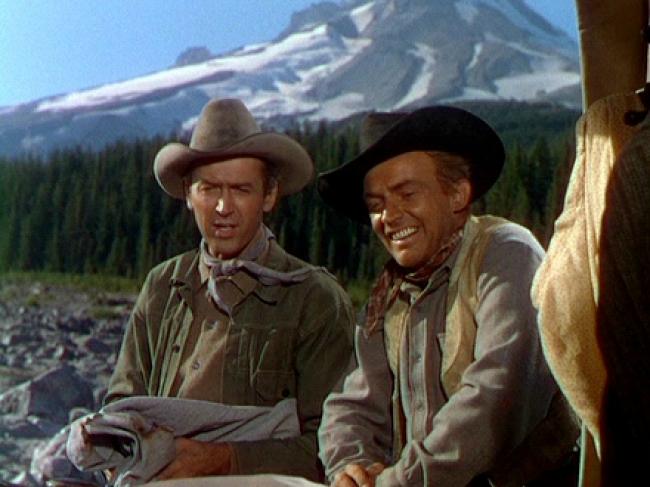
Western Noir: James Stewart in BEND OF THE RIVER (Universal ...

In Bend of the River, Stewart plays Glyn McLyntock, a former Kansas raider now helping a family of good-hearted pioneers settle in Oregon. They know nothing of his past, but slick gunman Emerson Cole (Arthur Kennedy) who becomes attached to their party, does. Cole too seems to want to go straight, and helps defend the party as they make their perilous journey. The pioneers warn McLyntock that a bad man is always bad, and therefore Cole cannot be trusted, but McLyntock knows that he himself needs redemption just as much as Cole does. Ultimately, the pioneers are betrayed by unscrupulous villains, and Stewart, with his old violent nature returning, must try to settle the score.

As foils, Kennedy and Stewart play off each other effectively, and Rock Hudson also does well as a (ahem) charming dandy from San Francisco (Rock liked to watch his own movies with gay friends and laugh at the subtext — they must have chuckled here when he tells a smitten young woman to go away because he wants to be with the men). The violence is extreme for the early 1950s, with dozens of people being wounded or killed on screen. What is unfortunately not out of place in the early 1950s are some mercifully brief but still off-putting scenes with Stepin Fechit as a stereotypical African-American character. But to close on a positive note, the scenery is gorgeous and everyone seems to know how to handle horses and guns, including during the climactic shootout.

The Naked Spur features another psychologically damaged Stewart character who cannot accept that what is lost is lost forever, no matter how much vengeance you take. With able assistance from Mann and two other noir icons (Ralph Meeker of Kiss Me Deadly and Robert Ryan of The Set-Up), Stewart delivers a cowboy movie with psychic weight. The film’s emotional dynamic is the reverse of Bend of the River. Instead of a once bad man trying to be accepted by good people by showing how good he is now, Stewart plays a once good man telling good people that they should not accept him anymore. That’s what makes Stewart and Janet Leigh’s heartfelt closing scene a knockout.

In addition to being a movie star and director, Clint Eastwood is a student of film history, and I am going to give him the last word on the multi-talented, multi-dimensional Jimmy Stewart:

Categories
Action/Adventure Drama Romance Science Fiction / Fantasy

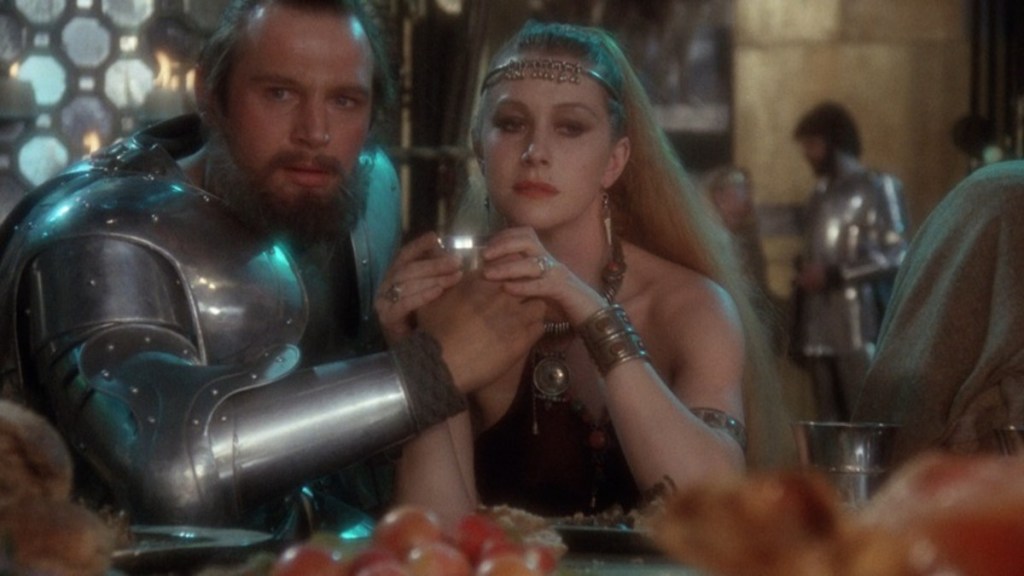
Excalibur

As a filmmaker, John Boorman really goes for it. He has an idiosyncratic perspective on the diverse material he films, and carries it to the limit. Sometimes this has led to abject disaster (e.g., the incomprehensible, pretentious and unintentionally risible Zardoz). But more often than not Boorman’s courage as a filmmaker has resulted in fresh, exciting cinema, such as Point Blank, one of the very best films I have recommended on this site. 1981’s Excalibur is almost as strong and every bit as original as that classic.

Excalibur re-tells the hoary tale of King Arthur, his wizard/mentor Merlin, his knights of the round table and his tragic love triangle with Guinevere and Lancelot. Boorman keeps roughly to the classic Malory version of the story, but tells it in his own inimitable way, with bloody battles, plenty of sex, and even at times a bit of camp (some of the over-the-top moments may have drawn a few chuckles that Boorman didn’t intend). Excalibur illustrates beautifully how a talented artist can breathe new life into familiar material.

The most memorable character in the film is Merlin, played with gusto by Nicol Williamson, who gives the most eccentric portrayal of an Arthurian Wizard since John Cleese essayed Tim the Enchanter. His Merlin is a cranky, cryptic, wise and powerful oddball who alternates between helping his human charges (First Uther Pendragon and then his son Arthur) and upbraiding them for their frailties. The film develops his rivalry/romance with Morgana le Fay more than has any other Arthurian adaptation, which was a wise move given that the ageless and subtle actress Helen Mirren is on hand to play the enchantress who longs for King Arthur’s downfall.

The production values are spectacular and the battle scenes feel real. Rather than people leaping around in plate mail whilst nimbly fencing with longswords, the combat is often slow and clunky. Indeed, the actors visibly strain under the weight of their weapons and armor. Also to admire: Future superstars (Patrick Stewart, Liam Neeson) giving solid performances as knights. Cherie Lunghi and Nicholas Gray also register as the doomed lovers Guinevere and Lancelot, and it’s a shame their film careers didn’t take off after this movie was made.

Ultimately of course, this is Boorman’s movie, and whether it captivates you or not depends directly on whether you are willing to travel along with him as he develops his personal vision of Le Morte d’Arthur. Most viewers will find that while there are a few bumps on that journey, it’s an immensely rewarding trip with one of Britain’s great filmmakers.

Categories
Comedy

Raising Arizona

Edwina’s insides were a rocky place where my seed could find no purchase

In terms of dialogue in American film, we are a long way from Preston Sturges and Ben Hecht. Between the audience becoming younger and the market more international, artful talking has largely been replaced by car chases, explosions and slapstick. Yet in their second film, the amazing, Sturges-loving, Coen Brothers somehow managed to write a passel of quotable lines combined with car chases, explosions and slapstick. The result was zany comic brilliance: 1987’s Raising Arizona.

The plot: Sad sack, inept criminal H.I. McDunnough (Nicholas Cage) thinks his life may be turning around when he weds a no-nonsense police officer named “Ed” (Holly Hunter). But when they discover she can’t have children, they despair for their future. However, a prominent local family is blessed with quintuplets….surely they wouldn’t miss one if someone happened to steal it?

The dialogue, as in other of the Coens’ films (e.g., O Brother, Where Art Thou?), is funny precisely because the quasi-Biblical sesquipedalian lines are voiced by characters who have room temperature IQ. This is coupled with Barry Sonnenfeld’s manic, delightfully silly camerawork, Wile E. Coyote-level chase sequences and WWF-style fights. The over-the-top-and-then-some style of the humor didn’t completely click with audiences and critics at the time, but the film has since accrued deserved respect as a minor classic of comedic cinema.

Nicholas Cage apparently didn’t get along with the Coens on the set and his acting is one-note here (They found their perfect star later in George Clooney). But Holly Hunter, in her career breakout year, is both hilarious and sympathetic throughout. I would put her performance here in a tie for her best ever (along with her star turn as a not entirely different character in The Positively True Adventures of the Alleged Texas Cheerleader-Murdering Mom). In supporting roles, Trey Wilson does rapid fire dialogue as well as Jimmy Cagney, and Sam McMurray gets big laughs as Hi’s boss, a would-be wife-swapper who keeps trying to to tell Polack jokes, but is too stupid to remember the punchlines.

I discovered the Coen Brothers by accident, in an art house theater that was showing a new low budget film made by two unknowns. That film was their superb tale of murder and intrigue, Blood Simple. I am given to understand that they decided in their second time out to make a film that was utterly different from their first in all respects. That showed some artistic courage, and my oh my was it well-warranted.

p.s. Look fast for a reference to my favorite film, Dr. Strangelove, during a scene in a men’s restroom.

Categories
Action/Adventure British Mystery/Noir

The Blue Carbuncle

Christmas time is here, happiness and cheer, fun for all, that children call, their favorite time of year!

Mine too, not least because there are so many enjoyable Christmas films to recommend, including an episode from Granada Television’s justly revered Sherlock Holmes series: The Blue Carbuncle.

Eccentric, unstable, dashing Jeremy Brett, whose acting (as Edward Hardwicke put it) contained “a whiff of the Edwardian” was an inspired choice to play Holmes in this handsomely produced series. David Burke makes a fine, gentle Dr. Watson in the early episodes, succeeded by an equally good Edward Hardwicke as a flintier sort of Watson in the latter part of the series. The Blue Carbuncle features Burke as Watson, and the byplay between the actors is a marvel, bringing out the warmth of their friendship yet also Holmes’ tendency to talk down to Watson, sometimes with marked asperity.

The plot: It’s Christmas time in London, though the scowling Countess of Morcar is unhappy (Rosalind Knight, putting just the right undercurrent of humour into an overtly Scroogish performance). She finds Christmas a chore in any event, but even moreso when her precious gem, the blue carbuncle, is stolen! Meanwhile, Commissionaire Peterson (Frank Mills) brings a goose to Holmes with a strange story of how he has seen a man lose his treasured Christmas dinner. Through an ingenious series of deductions, Holmes sees that the two mysteries may be connected, but he must race against time as an innocent man (Desmond McNamara) has been framed for the crime, leaving his struggling wife and children in agony as the holiday approaches.

As with the series as a whole, the original material is treated reverently, with many lines lifted straight from the text and the climactic scene nicely staged to match Sidney Paget’s drawing from the original Strand magazine publication of Doyle’s story. And the Christmas spirit is everywhere, in the incidental Victorian-style music, set decor and story elements. Not generally thought of as a Christmas movie, The Blue Carbuncle is a fine appetizer for your family by the fire, before you tuck into your own Yuletide bird.

Categories
British Drama

Scrooge

Scrooge is deservedly a beloved Christmas movie. Like the not dissimilar It’s a Wonderful Life, it came by its standing as a beloved film democratically: Long after it was released generations of people fell in love with it on television. And with very good reason.

The heart of this film is Alastair Sim, whose lack of a 1951 best actor Oscar nomination should make the Academy hang its head in perdurable shame. More than any other movie adaptation of Dickens’ novella, screenwriter Noel Langley’s treatment gives Scrooge a backstory that explains his nature and outlook, making him a more fully developed character. Sim must therefore portray powerful moments of grief, cruelty, pity, parsimony, regret, remorse and manic joy, and he does so in a profoundly effective way. He was so damn good in everything he did (e.g., Green for Danger, another of my recommendations) that it’s hard to say which is his greatest film performance, but this may well be it.

Categories
Action/Adventure

Die Hard

One of the great self-referential pop culture moments of recent years occurred on the TV show 30 Rock, when Jack Donaghy (Alec Baldwin) portentously intoned “When Alexander saw the breadth of his domain he wept for there were no more worlds to conquer….Hans Gruber”.

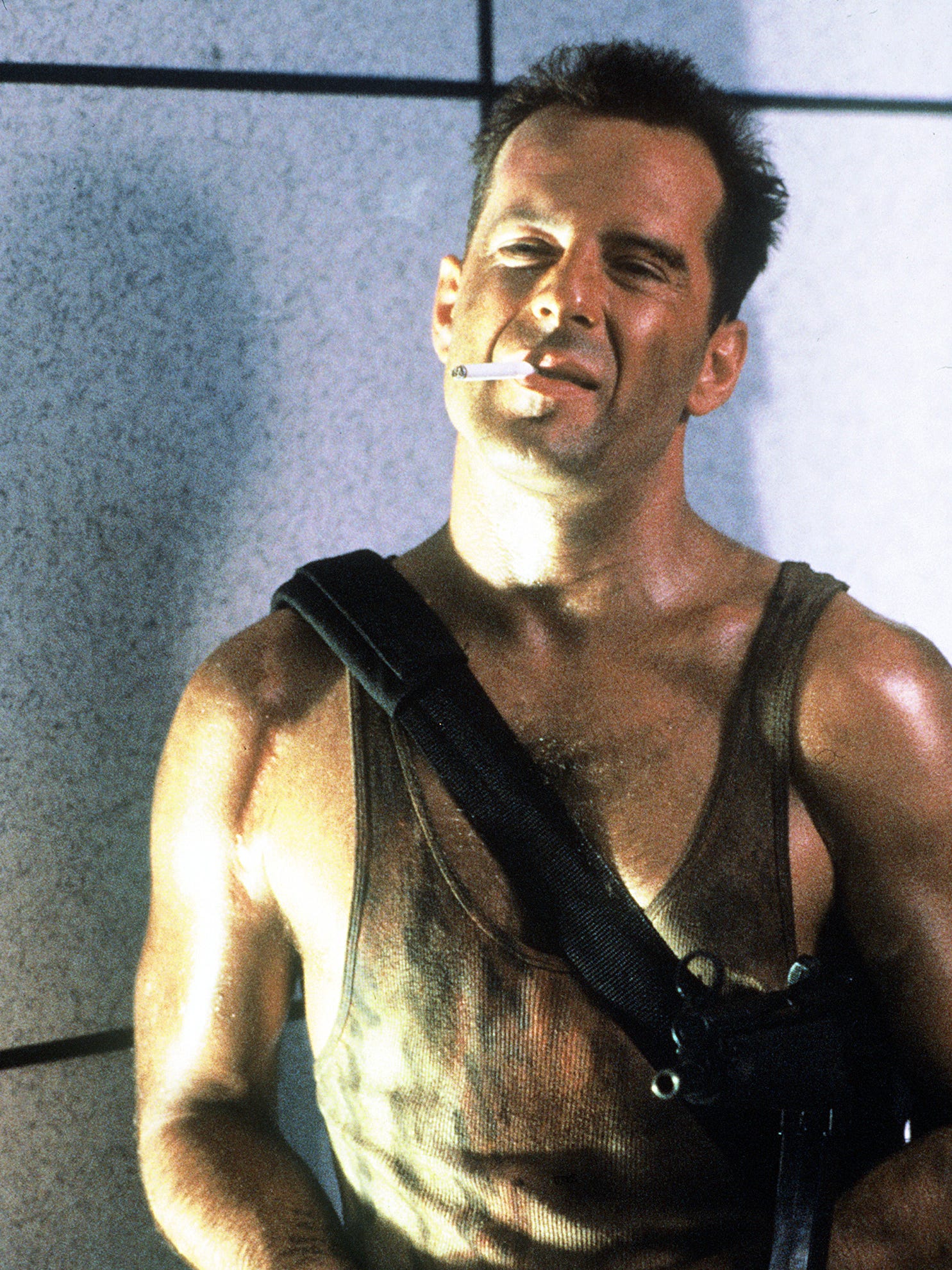
Alan Rickman’s deliciously evil, funny, cultured, intelligent, and violent Hans Gruber is the ultimate Yuletide movie villain. Unlike the Grinch, he is never redeemed. He would shoot Mr. Potter through the head in style, blow up Scott Farkis with gelignite, and hurl Heat Miser from an 80 story skyscraper. He is officially only the second lead in 1988’s Die Hard, a Christmas movie for all members of your family who like watching things explode.

Die Hard' turns 30: Our 30 favorite pop-culture references

The plot: Rough and ready New York cop John McLain (Bruce Willis, ostensibly the star of the film and certainly good in the role) has come to sunny L.A. for Christmas to try to repair his rocky marriage to his wife Holly (Bonny Bedelia). Holly has taken a dream job at the Nakatomi corporation, returned to using her maiden name (ouch!), and thrived as a corporate executive without John around. But before they can get back to serious bickering, John and Holly have to deal with an international team of super-terrorists (think of them as like the EU, but competent) who take over the Nakatomi building. John has his wisecracks, his courage and lots of guns, but the bad guys are more numerous and have cooler accents, especially their master planner and leader Hans (Rickman).

This is a rock ’em sock ’em action film leavened with many pricelessly funny lines, most of them voiced by Willis or Rickman. The plot has many surprising twists and turns as Hans’ plan unfolds, McLain throws spanners into the works, and then Hans adapts, contingency by carefully planned contingency. Not much in the way of traditional holiday themes, but there are some gifts and Santa hats and pine trees and such around, so you can pass this off as a Christmas film if you wish, you orphan of a bankrupt culture.

After you have watched this thrilling movie, you might consider what you would do for a dying friend who had a special last request…

Categories
Horror/Suspense Mystery/Noir

Dial M for Murder

I have recommended a clutch of Hitchcock films (Notorious, Psycho, The 39 Steps, and The Lodger), but omitted some of his best known. Some of his classic films (e.g., Rear Window) have been written about so much that I can’ t think of anything novel to add. Others exceed my powers: I’ve seen Vertigo a dozen times but still can’t fully explain why it is one of the greatest works of art of the latter half of the 20th century, though I know in my heart that it is.

So let me recommend a film you may have missed, which is usually considered a minor success of The Master: 1954’s Dial M for Murder. The movie had a strong foundation because it was based on an extremely well-crafted hit play by Frederic Knott (who also wrote the screenplay for the movie version).

The story is a simple one: A tennis-playing effete British smoothie (Ray Milland) discovers that his glamorous wife (Grace Kelly, elegant and effective) is carrying on a passionate love affair with a broad-shouldered American (an appropriately manly Robert Cummings), so he decides to murder her. But rather than do the deed himself, he seeks the help of an intermediary, leading things to go horribly awry…unless of course he can clean up the mess by framing his wife for a terrible crime.

When film directors adapt plays, they typically insert scenes of exteriors, use many long shots and wide shots and trolley shots etc., in order to give the audience a cinematic experience. Hitchcock did just the opposite, shooting almost entirely on a single set, and using camera placement within it to keep things fresh. The claustrophobic framing adds to the tension of the film while somehow never coming across as stagy.

The highlight of this film is the astonishing performance of Ray Milland as Tony Wendice, the suave and unflappable villain. He won a Best Actor Oscar for The Lost Weekend, but I think he’s even better here. Even when he cruelly and cleverly blackmails an old college mate (Anthony Dawson) into participating in his murder plot, he is ever calm and smiling, the perfect British upper class sort. It is that emotional tone in his performance, combined with Hitchcock’s directorial genius, that makes the famous closing scene of this film so memorable.

The foil for Tony Wendice isn’t really his romantic rival Mark Halliday (Cummings), but the intelligent, moral Chief Inspector Hubbard. He is played by John Williams, never a huge star but someone Hitchcock used over and over in movies and TV shows because he consistently gave solid and intelligent performances. Williams is at his best here, nicely leavening his hard-headed cop role with touches of warmth and humour.

In summary: Fantastic source material, fantastic director, fantastic cast – what’s not to like?

p.s. You may wonder why such a short movie has an intermission. This film was originally made in 3-D, and the intermission was to give a chance for those theaters with only two cameras to load the next two parallel reels. I regret very much never having seen the 3-D version, because Hitchcock allegedly used the technique in a more creative, less gimmicky way than did other film makers. The most famous 3-D moment was the extreme closeup of Ray Milland’s finger dialing M. To get the shot right, they built a gigantic phone and a huge paper-mache finger tip! In any event, unlike most 3-D movies, it’s perfectly watchable without the 3-D effects.

Categories
Comedy Drama

The Hospital

The Hospital (1971)

Over the decades I have worked in hospitals, I have seen countless movies that draw on the drama, humor, joy and frustration that happens every day in the medical world. It’s a tough call, but if pressed to choose my favorite of such films it would be 1971’s The Hospital.

The magnificence of the movie ultimately derives — as is so often the case with the best films — from a sterling script. Even though he died young and was not particularly prolific, Paddy Chayefsky was an extraordinarily influential screenwriter. He wrote unusually realistic, tightly constructed scripts for television plays in the 1950s that he later turned into superb films (Marty is the most famous, but I like The Bachelor Party even better). He went on to achieve two mammoth movie triumphs in the 1970s, of which Network is better remembered but The Hospital is every bit as impressive. He also delivers The Hospital’s pricelessly sardonic opening narration about the trials of a recently admitted patient who is subjected relentlessly to the benefits of modern medicine until he expires.

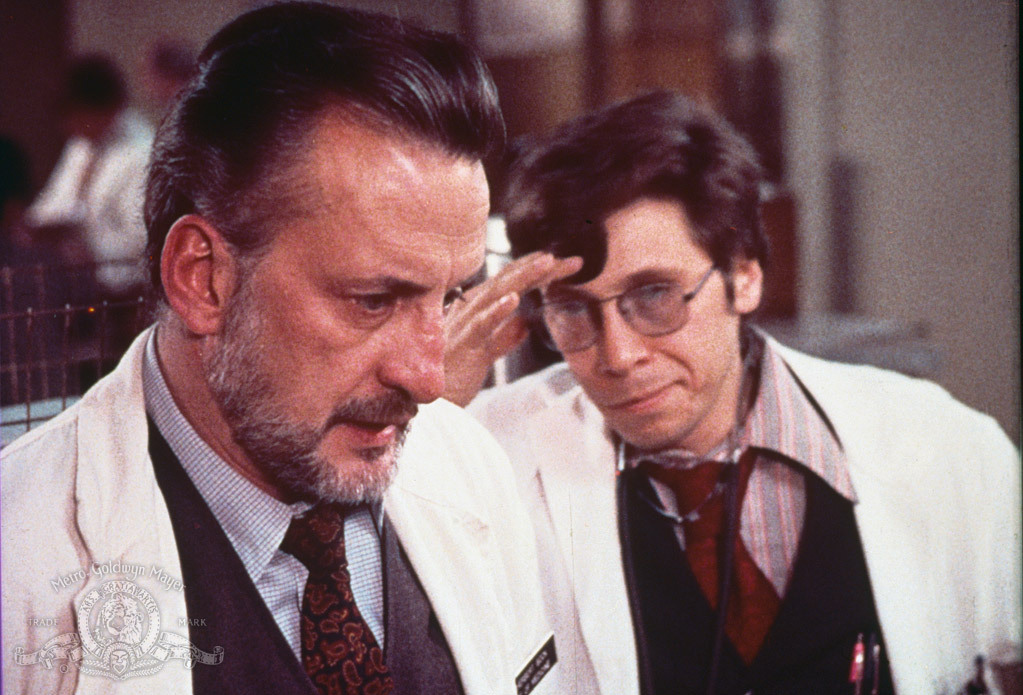
The heart of story is Dr. Herb Bock, Chief of Medicine, one-time wunderkind of immunology and now a hard-drinking, acutely depressed, and suicidal man who sees himself as a failure in every sphere of life. George C. Scott, an actor of great range (it’s hard to believe that the same man played General Patton, General Buck Turgidson and Dr. Bock), gives a bravura performance as the bearish, pained, raging and pitiable Dr. Bock. He is a classic hero/martyr type who works hard to help everyone else at great cost to himself, and is incapable of accepting the love and support he needs. I have known many Dr. Bock’s in my career, people who would say as he does that “love doesn’t triumph for the middle class — responsibility does”. The collision of an A-list actor with a beautifully-written character, as we have here, is one the most enduring delights of film watching.

On top of his considerable personal problems, Bock’s hospital is under great pressure from two directions. Angry activists are protesting the medical center’s alleged insensitivity to the local community (Chayefsky’s take on much of 1970s activism is bitter, but also hilarious). Meanwhile, why are so many people dropping dead…there couldn’t be a mad killer on the loose, could there? As Bock struggles against overwhelming challenges, he is emotionally upended by a loopy yet appealing hippy who seems to understand him better than he understands himself. Diana Rigg is perfect as said hippy, and she and Scott work together brilliantly, particularly in a long and emotionally complex scene involving suicidal and sexually violent longings.

The script has many laughs, almost all of which come with an undercurrent of anger. The foibles of hospitals and physicians are well-skewered, although in one poignant speech at the end, Scott gives a rejoinder to all the cynicism, which also hits home. The supporting players are very good indeed, including Barnard Hughes in two different parts (only one of which is credited), Nancy Marchand as Head Nurse Christie and Frances Sternhagen as “the bitch from the accounting department” (Sternhagen, whose work I have highlighted before, remains underappreciated as an actress).

The Hospital is one of the great black comedy/dramas of the 1970s and beyond that will resonate profoundly with anyone who has spent much time in a medical center as a staff member or as (the poor dears) a patient.

Categories
Action/Adventure British Science Fiction / Fantasy

20,000 Leagues Under The Sea

In my recommendation of Treasure Island, I described how and why Disney started making live-action family films after the war. One of the studio’s greatest films of this period is a dramatic, well-mounted adaptation of Jules Verne’s steampunk classic: 1954’s 20,000 Leagues Under the Sea.

The story opens with sailing vessels being destroyed in the South Seas by a mysterious underwater creature. Is it a kraken, a dragon or something else? At the behest of the U.S. government, a Parisian professor (Paul Lukas), his faithful assistant (Peter Lorre) and a free-spirited sailor (Kirk Douglas) join a military expedition to either find the monster or prove it doesn’t exist. In a fatal confrontation, their ship encounters disaster, which brings them face to face with Captain Nemo (James Mason), his devoted crew, and his extraordinary “submarine boat”.

James Mason as Capt. Nemo | Leagues under the sea, Movie stars ...

Mason, as the tortured, destructive yet also sympathetic Nemo is in top form, adding weight to proceedings that might otherwise have been comic bookish. Lukas, as the brilliant scientist who is both Nemo’s prisoner and his nagging conscience, is an effective foil for Mason. Lorre isn’t given a huge amount to do, but he makes the most of it by being more vulnerable and afraid that the other central players, thereby giving the audience someone with whom to identify.

The special effects were trend setting at the time and still hold up pretty well today, as does the knockout set design on the submarine. It’s particularly hard to forget Nemo playing Bach’s Toccata and Fugue in D Minor on the organ as the Nautilus glides through the ocean deep. Also adding to the striking look of the film is Peter Ellenshaw, who as in Treasure Island does magnificent matte work (the crowded shipyard at the beginning and the Island of Volcania at the end are flawless).

The film has two weaknesses. The first is Kirk Douglas’ endless mugging and preening. I don’t know if Director Richard Fleischer couldn’t control his star’s legendary desire for attention or gave him bad direction, but it gets old pretty quickly. The second is that like many films of the period (e.g., King Solomon’s Mines), this one includes “nature photography” moments that would have dazzled audiences at the time but are pretty slow stuff for a generation that has the web, television and a thousand episodes of Jacques Costeau at its fingertips.

But neither of those flaws stops this from being outstanding family entertainment with exciting action scenes, a strong story, eye-catching visuals and moments of real emotion. It’s great fun for you and the kids on a rainy Sunday afternoon.

I close this recommendation with a must-view clips for film-buffs. The truly spectacular fight with the giant squid in the film version released to theaters was not the first one that was shot. Here is the inferior original, the “Sunset Squid Sequence”.

Categories
British Comedy

Porterhouse Blue

If a little knowledge is a dangerous thing, think how much harm a lot of it could do. That’s the animating spirit of the academically-challenged but gastronomically-unmatched Cambridge college of Porterhouse, as portrayed in 1987’s Porterhouse Blue.

Based on Tom Sharpe’s satirical novel of the same name, this television mini-series centers on the longest-serving employee of the college, Skullion (the beloved British actor Sir David Jason). He and the senior fellows must cope with an ambitious nincompoop, Sir Godber Evans (Ian Richardson), who has been cast off from politics and made the new master of the school. Godber’s motto is “Alteration without change”, but he is an uxorious man very much under the heel of his titled harridan of a wife (Barbara Jefford). She insists that — gasp — women be admitted to Porterhouse! In this and in a hundred other ways, the new arrivals war with the traditionalists, with both sides being played perfectly by the cast for self-puncturing guffaws.

Richardson and Jason sparkle as the leads, as does Charles Gray as a rich, perverted old boy and John Sessions as the one person at Porterhouse who seems keen to get an education. His character, Zipser (allegedly the author’s self-parody), is one of British film’s great comic schmucks. His thesis is on “Pumpernickel as a factor in the politics of 16th century Westphalia”. He is awkward, sexually frustrated and obsessed with the flirtatious older woman who serves as his bedder (Paula Jacobs). His misadventures trying first to obtain — and then to dispose of — several gross of johnnies is uproariously funny.

Fair warning about this movie. If you don’t know anything about Oxbridge life, British society more generally, and can’t make out dog Latin, I would bet that at first Porterhouse Blue could be slow going. But stick with it, because it gets funnier and more accessible as it moves along.

p.s. I have been looking for years for a full translation of the Flying Pickets’ spirited rendition of the ridiculous and delightful Porterhouse college theme song. I have found translations of the first verse, but never the full song. If anyone can point me to a full translation, I would be extraordinarily grateful.