Categories
Action/Adventure Romance Science Fiction / Fantasy

Superman

The undeniable wonder of Richard Donner’s 1978 film Superman can be summed up in one word: Reverence. For decades, comic book fans were dismayed by movie and TV adaptations of the heroic stories with which they grew up. Producers and writers seemed to feel that the material couldn’t stand up on its own. Rather, it had to be made campy (Holy Evil Menace Batman!) or have asinine new characters added or adopt an ironic or juvenile tone. What Donner and Producers Alexander Salkind, Ilya Salkind and Pierre Spengler understood is that the reason untold millions of people around the world love Superman is that it’s a thrilling story with an inspiring central character. In short, it didn’t need some Hollywood type to change it, it needed someone to take it seriously on its own terms and produce it with a real budget and good actors. The result is a superb movie without which many subsequent, highly entertaining comic book hero films (e.g., Spiderman, Captain America, Iron Man) would be unthinkable.

The filmmakers’ respect for the source material is evident in the very first frame, during which a little girl reads some lines from Action Comics #1 (Superman’s 1938 debut) as the velvet curtains of an old style theater open. The camera then glides past the Daily Planet building into outer space, where the audience is treated to a whooshing credit sequence and John Williams’ thrilling, majestic score. This sequence doesn’t typically get discussed when critics debate the best film openings, which I view as rank snobbery: It’s transcendent.

The Superman story is then warmly told, from his origins on the doomed planet Krypton, to his escape to Earth and his Midwest Americana childhood with Ma and Pa Kent (Love these scenes: old pros Glenn Ford and Phyllis Thaxter ease comfortably into the roles of the Kent parents and newcomer Jeff East nicely conveys what it would be like to combine adolescent awkwardness and emotional pangs with budding superpowers). Then of course, Superman moves to Metropolis to work under the guise of a mild-mannered reporter at the Daily Planet, sweetly romances Lois Lane (Margot Kidder, a good choice for the part) and battles the villainous Lex Luthor (Gene Hackman, having and being a good time, while also being appropriately callous).
Superman Movie Review | Movie Reviews Simbasible

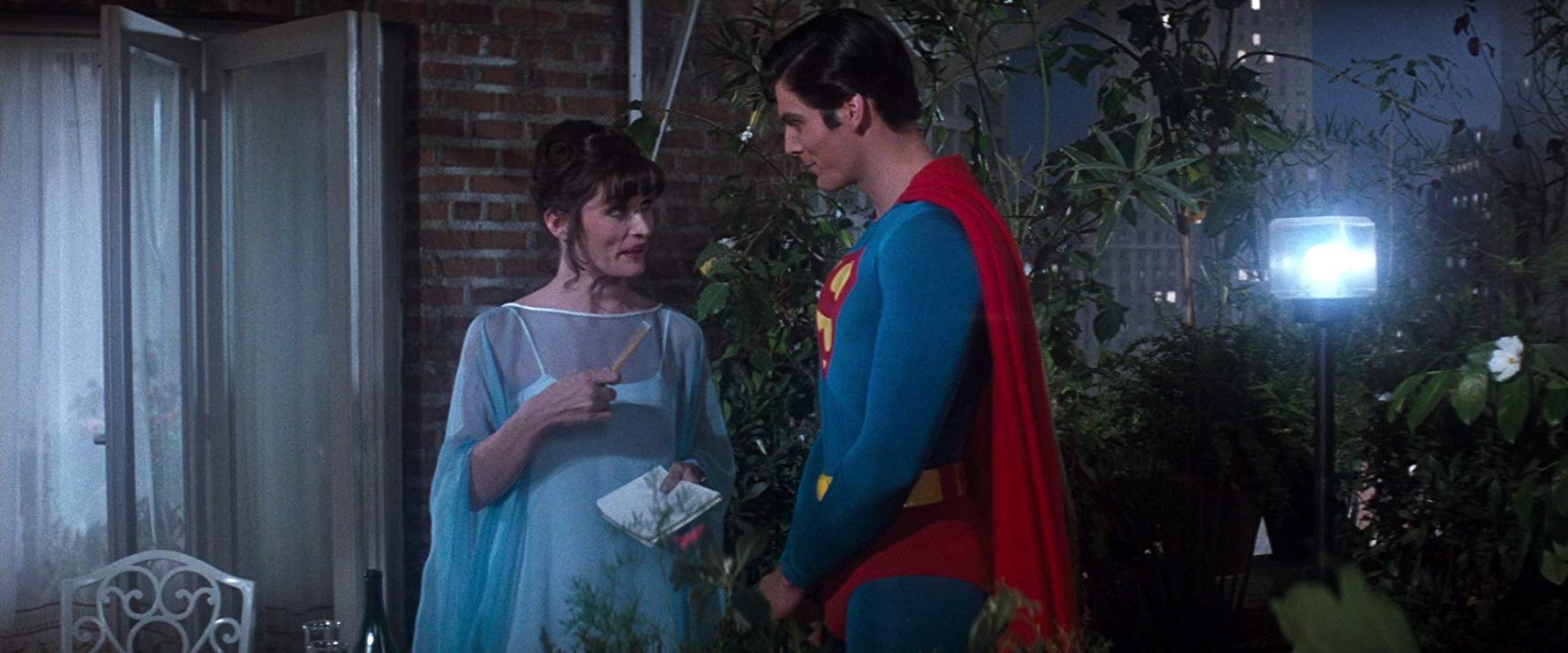
The most unforgettable set piece is Lois Lane’s helicopter disaster, which triggers Superman’s (Christopher Reeve) first appearance. But the romantic scenes and the closing sequence during a massive, Luthor-induced earthquake, are also crowd pleasers.

Though Superman is an uncynical hero who believes in truth, justice and the American Way, and has been sent to Earth from the heavens by his father to save humanity (ahem), this is far from a self-serious film. I still remember vividly the explosion of laughter in the theater when Reeve looks at a modern phone “booth” when he needs to change into costume for the first time. The rapid-fire scenes with Jackie Cooper (as Editor Perry White) and the team at the Daily Planet are also a great deal of fun, almost a bit of Front Page-style screwball comedy interspersed with the overall adventure story. Valerie Perrine and Ned Beatty get some laughs as Luthor’s half-witted assistants. Look fast also for an amusing cameo by Donner as a guy on the street who isn’t sure he believes a man can fly.

Geoffrey Unsworth works miracles combining special effects and live action shots on this film as well as its sequel, Superman II, which was filmed at the same time and is dedicated to his memory (For other film recommendations featuring this gifted cinematographer, see my prior film recommendations here and here). Unsworth’s contribution is one of many reasons why Superman is not just an outstanding movie adaptation of a comic book; it’s a outstanding movie, full stop.

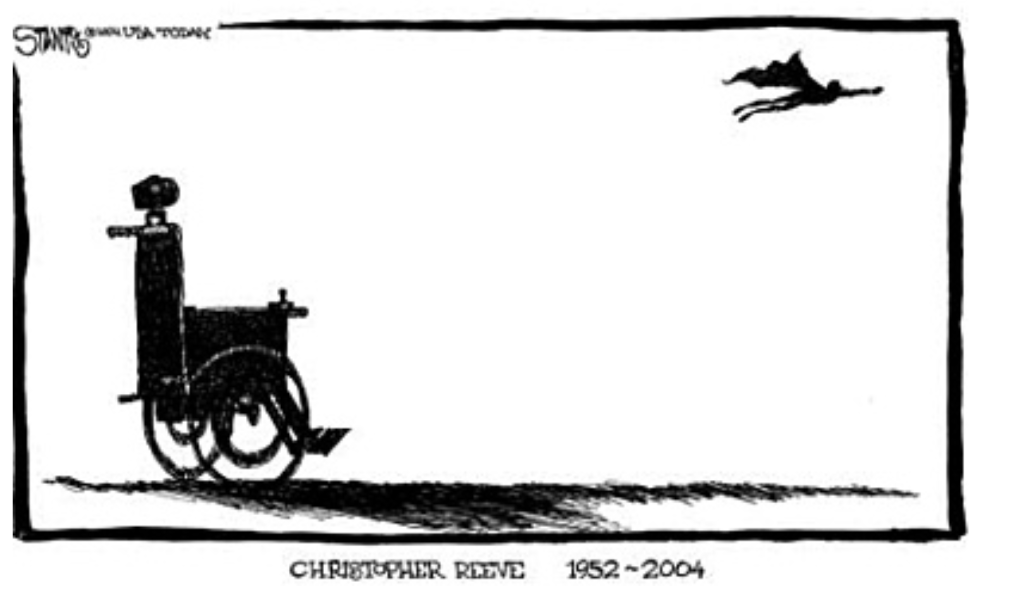
As a closing note, Superman was unquestionably the defining film of Christopher Reeve’s career, so much so that it’s impossible to imagine the movie without him. He passed away in 2004, even more of an inspiration in life than he was as the Man of Steel.
Categories
Blogs on Film

De Niro’s Greatness (Guest Essay)

London-based Ian Jentle had a long and successful career as an actor; Americans are most likely to know him as Josef Goebbels in the epic War and Remembrance television mini-series. I asked Ian to explain from an actor’s point of view what makes a great film performance, and he has kindly agreed to do so using the example of the legendary Robert De Niro. Over to Ian:

When people ask me, as a retired actor, what I think constitutes great acting, I tell them to rent Raging Bull (1980) and The King Of Comedy (1983) and watch them back to back. Both are directed by Martin Scorsese and star Robert De Niro. In the former, De Niro plays Jake La Motta, a man of immensely powerful physical presence who is emotionally unstable, intellectually limited and sadomasochistic. He is huge, lumbering, frightening, and yet pathetic. In the latter film, De Niro plays Rupert Pupkin, a small, weasely loser obsessed with other people’s fame, a stage door hangabout whose very presence is sphincter-clenchingly embarassing. If you removed the credits from both films and showed them to somebody who had lived a cinema-free life, I would bet a large sum that they would not believe the same actor played both roles.

First, De Niro has that strange quality known as presence or charisma. Film professionals will say of a particular performer that “the camera loves him/her” and it is true. But screen presence is not always linked with great acting skills: Charlton Heston had tremendous presence, but his acting was rarely better than wooden, and although one could not accuse John Wayne of creating a wide range of characters, he undoubtedly had presence and was always believable and entertaining. De Niro clearly demonstrates his presence in the scene in Raging Bull in which LaMotta is thrown into a prison cell.

But De Niro brings much more to the screen than mere presence. What marks De Niro out as a truly great actor is the integrity of his approach to his characters, the depth of his observation of human behaviour and the skill he brings to the performance of these characters in the context of a film narrative. Two more clips, one from each movie, demonstrate these skills.

In the clip from Raging Bull, Jake LaMotta repeatedly challenges his brother, played by Joe Pesci, to hit him in the face. Here, De Niro gives his character the objective of “control”. He tries several strategies to persuade his brother to hit him in the face: simple request, provocative insult, older brother authority, even slapping. By the end of the clip his brother demands “What are you trying to prove? What does it prove?” De Niro’s triumphant smile and brotherly tap on the face show that he has “won”, which is the whole point. As he does repeatedly throughout the film, Jake LaMotta uses violence, even the receiving of violence, to exercise psychotic control over others.

In the clip from King of Comedy, Rupert Pupkin sneaks into a car with his comedy hero Jerry Langford, played by Jerry Lewis, to ask for help in becoming a comedian. Once Pupkin invades Langford’s car, he embarks upon non-stop babble with the objectives of impressing Langford with his comedy potential and recruiting his support for his non-existent career. What he reveals is an embarrassing blend of passionate desire to succeed with not a shred of comedic talent. He tries to behave as if Langford is his equal while saying that Langford is his hero. The scene is shot head-and-shoulders but with only his face, shoulders and arms De Niro produces a painfully recognisable character.

For me, these two movies demonstrate De Niro’s ability, flexibility and imaginative range, but don’t take my word for it based on these few clips. Watch the two movies back to back and they will make the argument much better than I can.

Categories
Action/Adventure Horror/Suspense

The Most Dangerous Game

One Halloween, I was looking for a lurid and creepy pre-code film to recommend. I was tempted by White Zombie but like many films of the period, the existing prints are sadly too beaten up to make the film an enjoyable experience. But then I found a movie that is not only better purely on its merits but has also been skillfully restored: 1932’s The Most Dangerous Game.

Joel McCrea plays a big game hunter who is travelling by yacht in the South Seas. As the ship nears a remote island surrounded by dangerous reefs, the light buoys seem to have been misplaced: They actually lead the ship into the rocks, causing it to sink with all hands aboard other than our hero. He makes his way to a fog-shrouded castle where Count Zaroff (Leslie Banks) welcomes him warmly, introducing himself as a fellow hunter. Zaroff has two other guests, the alluring Eve (Fay Wray) and her boozy brother Martin (William Armstrong). Zaroff used to have two other guests, but they disappeared shortly after he gave them a tour of his trophy room. Would you like to come down and see the prizes from his prior hunts?

Based on a story by Richard Connell that has since been re-used in movies and TV shows a million times, this version is closest to the original material. At a briskly paced 62 minutes, it’s both chilling and thrilling. And for film buffs, added interest is provided by the pre-code elements of sadism, sexual exploitation, gruesome violence and some disturbing “trophies” (There are ethnic stereotypes too, but that was okay with the Hays, Breen and the other people who implemented Hollywood’s Production code).

For me, the early 1930’s most hypnotic and frightening portrayal of a villain with an Eastern European accent isn’t Lugosi’s Dracula, it’s Leslie Banks as the depraved Zaroff. This was Banks’ first film and he is magnetic in a role that could easily have been campy. A injured World War I veteran with a scarred face, Banks’ disfigurement is integrated with his character and gestures in highly effective fashion. The leer Banks gives Wray when telling her that “love” will follow the hunt makes the viewer want to bathe immediately.

Ms. Wray alas is at best okay. At times she overdoes it to an extent that I wonder if she thought it was a silent film. She is mainly there to be lusted after and as her clothing is ripped away during sweaty sprints through the jungle. McCrea is agreeably strong-jawed if not playing a character with much depth. But their performances aren’t critical for a film that is really about a breathless, suspenseful chase, and it delivers the goods on that score in spades. One of the good things about such a short running time is that tension can be maintained through almost the entire movie, as the grip marks in the chair armrests of viewers will prove.

You may notice that co-Director Ernest Schoedsack, score composer Max Steiner and many of the actors were involved in making King Kong and that some of the sets and camera shots look like they are from that famous movie. That’s because the two films were shot at the same time, with the actors being borrowed for Kong in the middle of making The Most Dangerous Game (which funnily enough was more profitable because it had a much lower budget).

The restoration has removed almost all the scratches and damage, and the sound quality is very good. Kudos to the magnificent restorers of Flicker Alley for letting a new generation of film fans enjoy this fine example of pre-code cinema, which otherwise might have literally faded away.

Categories
Foreign Language Horror/Suspense

The Cabinet of Dr. Caligari

Film buffs are one of the few groups of people who have extremely positive associations with the words “Weimar Republic”. The German film industry had an embarrassment of talent and explosive creativity in the 1920s. The Cabinet of Dr. Caligari is one of a number of innovative German movies of the era that profoundly influenced whole swaths of 20th century film worldwide: .

It’s a story within a story, told by a man named Francis (Friedrich Fehér) after he sees “his betrothed” walk by in a daze. They have shared an amazing experience he says, and then the film transitions to his bizarre tale of a carnival sideshow that features a fortune-telling somnambulist. The sideshow is operated by the mysterious Dr. Caligari (a magnetic Werner Krauss) who seems to have control over the sleepwalker Cesare (Conrad Veidt). The creepy Cesare blandly informs a carnival patron that he will die at dawn, and the prediction comes true! It’s one of a series of murders that have been terrorizing the countryside. But who is the killer, and what will happen to the fetching damsel in distress (Lil Dagover) whom Francis and his friendly rival Alan (Hans Heinrich von Twardowski) are trying to woo? Strap yourself in for cinema’s first horror film AND the first film with a twist ending (and what a twist!).

Made by Robert Wiene in 1919 or 1920 (depending on which film guide you believe), The Cabinet of Dr. Caligari remains one of the most visually striking films in history. Expressionist artists Hermann Warm, Walter Röhrig and Walter Reimann produced a set design to die for, with light and shadows physically painted onto the walls and floors, twisted furnishings, canted windows and doors, and chiaroscuro galore. It’s a madman’s dreamscape, a physical expression of a warped psychology. Many of the actors move in a stylized way (Caligari recalls a scuttling spider, Cesare a cross between a mod dancer and the Frankenstein monster), further heightening the atmosphere of unreality. And it all would have looked even more mesmerizing at the time because the film was tinted rather than being in pure black and white.

Like the best art of this type, the unreality expresses a greater reality. Every one who has been in some bureaucratic backwater office to complete arcane paperwork under the oversight of an imbecile sees the truth in the design of the town clerk’s office in this movie. The cell at the police station conveys the complete desolation of the wrongly accused. And we have all met leaders of organisations whose personality and outlook are completely captured in the interior of the insane asylum director’s office.

Categories
British Horror/Suspense

Forgotten Draculas **Triple Feature**

Other perhaps than The Bible and The Sherlock Holmes stories, no book has inspired as many movies as Bram Stoker’s Dracula. Everyone knows the famous Bela Lugosi version, but few people are aware of the versions I am recommending here.

Count Dracula was broadcast on BBC in 1977, and is perhaps closer to the original text than any other version (except that Meena and Lucy are sisters rather than friends, and one of Lucy’s three suitors is omitted). The elegant French actor Louis Jourdan makes a memorable Count Dracula, conveying a mixture of civility, erudition, seductiveness, arrogance, and menace. Equally good are Frank Finlay as a kindly, devout Professor Van Helsing and Jack Shepherd in an unusually sympathetic take on the madman Renfield. Props also to Bosco Hogan for vividly portraying Jonathan Harker’s progressive mental breakdown under the strain of being trapped in Dracula’s castle.

The budget for the BBC production was clearly small, and that shows in some cheap special effects, the lack of any eye-popping sets, and the absence of mega-stars. But within the limits of a television budget, it’s a quality movie, especially the exciting closing confrontation between our heroes and Dracula.

An even better TV adaptation, simply called Dracula, was made in 1973 by Dan Curtis of Dark Shadows fame. His frequent collaborator Richard Matheson departs substantially from the original story in his script, offering a fresh take on the world’s most famous vampire. Dracula, played with panache by Jack Palance, is as much sad as threatening, longing for the normal life he had centuries ago and seeming almost to regret his thirst for human blood. Matheson also strips down the number of characters (e.g., no Renfield, Dr. Seward, Quincy Morris or Arthur Holmwood) in a way that simplifies and helpfully speeds up the storytelling. My only gripe about Matheson’s changes is that Professor van Helsing was turned into a proper Englishman (Nigel Davenport) when he works better as an old-world character steeped in the mythology of nosferatu. Oswald Morris, whose work I have praised many times on this site, again offers fine cinematography, which enhances Curtis’ ability to deliver moments that make viewers hold their breath or let out a scream.

The final forgotten Dracula I would recommend was made by Universal Studios in 1931. You are probably thinking “What does he mean ‘forgotten’, that was the most famous version ever, wasn’t it?”. The English-language version is indeed the most famous, but in the early days of talkies, films were not dubbed for foreign markets. Rather, the studios would shoot the same film twice with a different cast in a different language. That’s how the Spanish-language version of Drácula was made in 1931. Bela Lugosi, Tod Browning et al did their shooting during the day, and then a completely different crew and cast shot the same scenes in Spanish at night.

The Spanish-language crew had a smaller budget, but they also had a distinct asset: They got to see the rushes that the English-language crew had shot that day. This allowed them to replace shots that were dull or didn’t work with new set-ups, and the result is much better camerawork in the Spanish-language version. This version also adds in a few scenes that make the story more coherent. I would not say it’s better than the Lugosi/Browning version, but I would say that on balance it’s just as a good and well worth your time both for itself and for comparative interest with its more famous twin.

This 3 minute video from CineMassacre does a superb job comparing the two productions:

Categories
British Comedy

Time, Gentlemen, Please!

Where to stream Time, Gentlemen, Please! (1952) online? Comparing ...

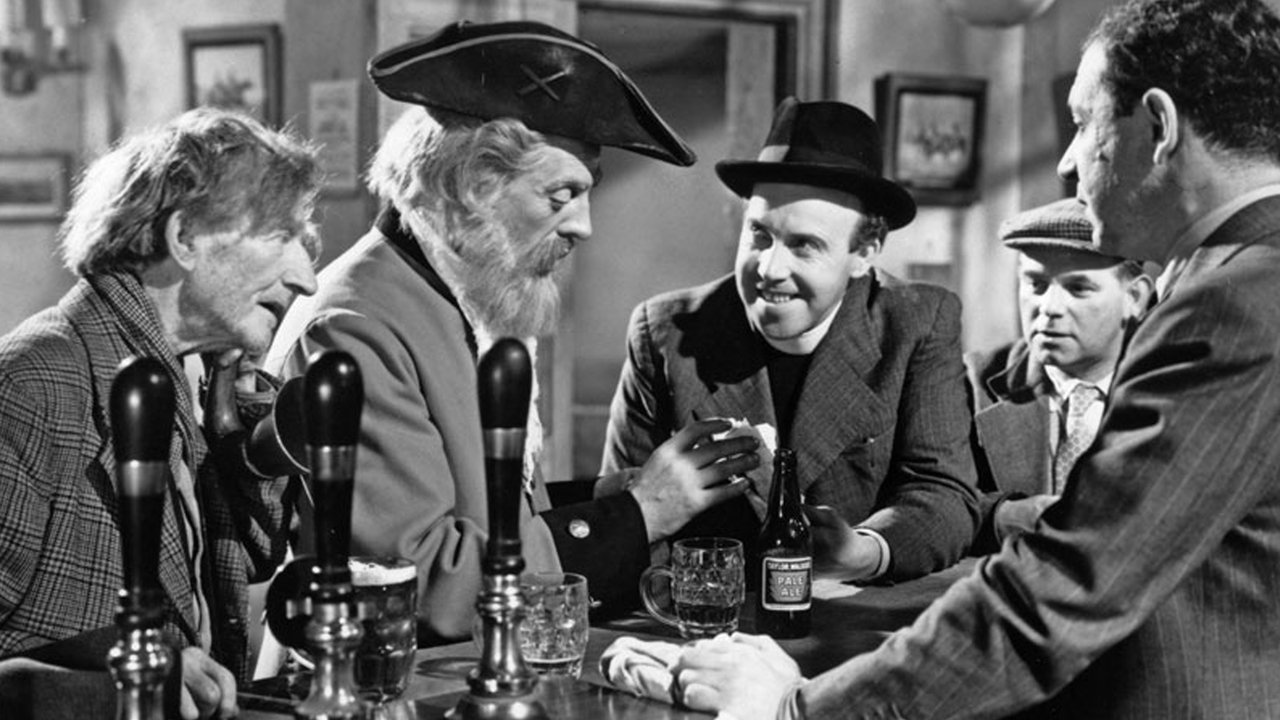
Due to distribution problems, lost celluloid, legal disputes, or bad luck, some excellent films became inaccessible after their debut and eventually fall through the cracks of almost everyone’s memory. 1952’s almost completely forgotten Time, Gentlemen, Please, which isn’t even mentioned in most of my books about film, is a prime example. There were I understand copyright and distribution disputes that kept it from being available after original release for decades. But it’s out on DVD now, and that’s a gift to lovers of British comedy.

The story is set in Essex, specifically in the hardworking town of Hayhoe. Indeed, its 99.9% employment rate has earned it a personal visit by the Prime Minister! The stuffy town council members want to make the employment rate 100% before the PM arrives, but a charming, boozy, Irish rogue named Dan Dance (Eddie Byrne) stands in their way. He has no interest in work, so the prigs in charge stick him in the heretofore unused almshouse, which is run by the dour Mr. and Mrs. Crouch (Ivor Barnard and Thora Hirch). The tables are turned however when a reformist pastor discovers that the town’s founding documents insist that all taxes from the old estates be shared equally among the residents (or, in this case, sole resident) of the almshouses, making Dan the richest man in town, and a candidate for a seat on the town council. The story only gets sillier from there before a most enjoyable denouement.

There are many tremendous character actors in this movie (e.g., Hermione Baddely, Sid Gilbert) but no big stars. The greatest strength of the film is Peter Blackmore’s gut-bustingly funny screenplay, which was based on R.J. Minney’s novel “Nothing to Lose”. Much of the humor comes in the form of the pleasant smiles one gets from “Ye Olde Quaint English Village Full of Eccentrics”, but there are also a number of laugh out loud bits.

The politics of the film are interesting to analyze. If Maggie Thatcher ever saw it, I suspect she would have never stopped throwing up. The hero is willfully unemployed, but rather than resent him sponging off their labour, the townsfolk rally to him and against the local toffs. That was the political mood of the post-war, pro-working stiff, austerity era for many Britons in a way that was not replicated among their American cousins.

Weekend Film Recommendation: Time, Gentlemen, Please! – The ...

I can’t say that Time, Gentlemen, Please! is quite at the level of the great Guinness/Mackendrick Ealing Studios comedies of the period, but it’s almost as good and certainly a highly rewarding film in absolute terms. Please take the trouble to find it; you’ll be richly rewarded for your effort.

p.s. The title is a reference to a pub host’s call at closing time, in an era when watering holes had to close at a certain hour and the patrons were all male.

Categories
British Comedy Drama Musical

The Ruling Class

I stand outside myself, watching myself watching myself. I smile, I smile, I smile.

It takes courage to make a movie that defies all conventions and challenges the audience. Sometimes, indeed most of the time, the filmmakers fall on their faces. But every once in awhile a group of wildly innovative iconoclasts create something that has the right to be called unique, such as this week’s film recommendation: The Ruling Class.

The story begins with the solid, respectable, fiercely pro-Empire 13th Earl of Gurney (The always watchable Harry Andrews, holding nothing back) putting on a tutu and playing an auto-erotic asphyxiation game that goes awry. Enter greedy potential heirs, but the old coot has left his money to his manservant Tuck and his schizophrenic son Jack (Peter O’Toole). Jack currently believes himself to be the risen Christ, though after a dramatic series of events 2/3 of the way into the film he alters his self-identity in a profound fashion, with deadly results. The story barrels along with equally bizarre twists, punctuated by cast members bursting into song and doing Broadway-style dance numbers! It may sounds like an utter mess, but it’s a sublime piece of cinematic art.

As you would guess, there is a good deal of very black humor in the film. There are also many lighter-hearted laughs courtesy of Alastair Sim as a half-baked bishop (Honestly, he could evoke chuckles reading the phone book) and Arthur Lowe as the suddenly rich, alcohol-soaked Trotskyite butler Tuck, who stays on in his servant role while talking relentless smack to his “betters”.

The film is a triumph of three Peters. Peter Barnes wrote the original stage play and the screenplay, Peter Medak directed, and Peter O’Toole leads a champagne cast by giving an all out performance playing a volatile, complicated, exuberant character. Hats must also be doffed to Jack Hawkins, whose acting I have much praised in prior recommendations (e.g., The Long Arm, The Cruel Sea), and who is in the co-producer’s chair here (alongside Jules Buck).

This film did poor box office in 1972 and seemed to get no middling reviews: Critics loved it or hated it. Likewise, today, I can imagine some intelligent people of good will finding this film contrived, overlong, pretentious, and maybe even obnoxious. But in other modern viewers it will evoke wonder and admiration. If you are open to something completely different, please do give it a look, particularly if you can get your hands on the stunning print available from the Criterion Collection.

p.s. Harlaxton Manor, the magnificent pile where much of the film was shot, was once the site of my employer’s study abroad program.

Categories
Mystery/Noir

The Kennel Murder Case

In Hollywood detective serials of the 1930s and 1940s, it was downright dangerous to be an industrialist, socialite, European baronet, heiress or well-heeled widow: You had precious little chance of surviving until the end credits. On the other hand, appropriate to your upper class status, a suave, well-dressed sleuth who moved in your circles would be on hand to crack the case. The Saint, The Falcon, and Philo Vance are among the above-average movie series that plowed this fertile ground, and one of the very best of the type is The Kennel Murder Case.

It’s from the Philo Vance series (not that it matters, they were fairly interchangeable) and was made in 1933. Along with the usual solid character actors characteristic of the series, it had A-List stars (William Powell and Mary Astor) and the magnificent Michael Curtiz as the Director. And for dog lovers, there is the further appeal of it being the only film to derive as much entertainment value from a dog show as did Best in Show.

The plot: While his own pooch is competing in a high-class canine show, Vance (William Powell) is called in to solve a murder involving a number of the other dog owners. The nasty, much-hated Arthur Coe (Richard Barrat) has been discovered dead in a locked room, with a bullet hole in his head and a gun in his hand. The police think it’s a clear case of suicide. Vance isn’t convinced, and he becomes even less so when another murder victim is discovered. Suspects are everywhere, including the Chinese servant (James Lee) who didn’t want Coe to sell his prized Oriental artifacts, the butler with the shady past (Arthur Hohl), the long-suffering private secretary (Ralph Morgan), the saucy mistress next door (Helen Vinson) and her new lover (Jack La Rue), the niece (Astor) who resented his control of her inheritance and the bankrupt, titled man who wants to marry her (Paul Cavanagh). Also on hand is the always appealing mountain of an actor Eugene Pallette as Police Sergeant Heath, who always seems one step behind Vance but is at least smart enough to listen to him.

The solution to the mystery is more than a little rococo, and your odds of guessing it are as close to nothing as makes no odds. So copy Sergeant Heath’s approach by just sitting back and watching William Powell, as Philo Vance, work his investigative magic.

Categories
Action/Adventure British

Charlie Muffin

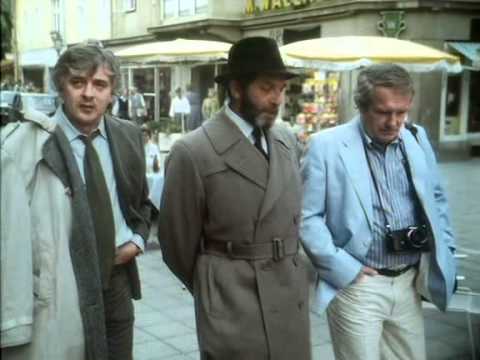
Charlie Muffin is a terrific British spy movie scarcely remembered in the UK and even less so elsewhere, which is a rotten shame. After appearing on UK Television in 1979, it was barely released in the US under the title “A Deadly Game”. If you are among the many people who doesn’t know about this movie, let me try to persuade you to find this gem of an espionage thriller

The film is set at the twiilight of the cold war. Both the Soviet and British spy services are staffed by wily pros from the glory days who report to ineffectual careerists at the top. Among the old British hands is an insubordinate but brilliant agent named Charlie Muffin. In the title role, David Hemmings, prematurely aged well past his days of sleek beauty, gives us a character who is rumpled, raffish, boozy and extremely charming (Yes, perfect casting there). Working class Charlie is at war with his upper class twit superiors, but finds kinship with the equally clever General Berenkov (Clive Revill), a Soviet spy whom he helped capture.

Meanwhile, a Soviet General shows some interest in defecting to the West. As Charlie’s boss Sir Henry Cuthbertson (Ian Richardson, who assays cold-hearted bastards as well as anyone) and arrogant CIA Director Ruttgers (Sam Wanamaker, giving off just the right mix of parody and malice) struggle to respond, they realize they must reluctantly turn to Muffin for help. As the complex plot plays out, with double and triple crosses aplenty, the suspense mounts until the film comes to an extraordinarily satisfying conclusion.

charlie ntsc muffin - YouTube

The best thing about this movie is Jack Gold’s direction and the uniformly outstanding acting by the cast. The scenes between Berenkov and Charlie are emotionally complex, fascinating and perfectly played. Pinkas Braun, as the defecting Soviet General, has the right air of command leavened by moments of vulnerability and wit. And Ralph Richardson, as a great actor can do, makes a tremendous impression as Charlie’s former (and better) boss, despite being on screen for only a few minutes.

Based on a novel by Brian Freemantle, this intelligent and gripping movie richly merits the time it may take to dig up a copy that you can rent or buy. And in my opinion, it’s even better the second time through.

Categories
Action/Adventure Mystery/Noir Science Fiction / Fantasy

Outland

Disappointed in “Cowboys and Aliens” and looking for a film that does a better job of blending the Western and Sci-Fi genres? Look no further than the gritty and exciting Peter Hyams film Outland. The plot of one decent man fighting a corrupt system while trying to redeem himself at the same time is familiar, but it works very well here due to eye-popping special effects, strong performances, and well-staged action scenes.

I like Sean Connery in the Bond films, but his acting talents are put to far better use in those movies where he has more human imperfections and vulnerabilities (e.g., The Offence, The Hill, Russia House). As a paunchy, middle-aged marshal named W.T. O’Neil, Connery gives us a man battered by family and career disappointments. He is working in a near-lawless, awful mining colony on a remote moon because that’s where someone with his mediocre reputation belongs. In every scene, you can see the weight on his shoulders that comes from lack of self-respect and complete disillusionment with the world.

Frances Sternhagen gives a multi-layered performance as the second-rate doctor who helps the new marshal figure out why a number of miners have been committing horribly violent acts against themselves and their fellow colonists. She nicely conveys a romantic interest in Connery that is covered over with self-protective wisecracks. She knows he is committed to saving his failing marriage but can’t help wishing otherwise. The third primary player in the drama is a memorably sleazy and smug Peter Boyle, as the corporate scumbag who runs the colony. He radiates contempt for Connery in every scene as he uses lacerating words, bribe offers, and, eventually, deadly threats to stop the investigation of the strange epidemic of violence among the miners. James B. Sikking is also good in a supporting role as another unhappy, self-hating marshal who befriends Connery.

The space scenes are extremely well done, with the special effects enhancing rather than distracting from the storytelling. Meanwhile, inside the colony there are saloon style swinging doors, people carrying shotguns, scared locals and a Western feel, as a High Noon style digital clock ticks down to the moment when the next shuttle will arrive, bringing Boyle’s goons to take care of the nosy marshal.

The middle of the movie contains a long, superbly choreographed chase and fight scene that must have been an absolute bear to film. This could have made the final confrontation of the movie a letdown, but the climactic scenes — some of them set in outer space rather than inside the colony — have a distinctive, thrilling feel and style.

Outland was only a modest money maker when it was released in 1981, perhaps because people were expecting another Star Wars. It’s not that and it doesn’t need to be. It stands up very well as a highly successful blend of two beloved film genres, as well as a showcase for the acting and still-formidable action chops of the eminently watchable Sir Sean.