Categories
Action/Adventure Mystery/Noir

Ellery Queen Mysteries

In a few minutes, this man is going to be murdered. The question is: who killed him? Was it the frustrated nephew? The spurned housekeeper? The fiancé with a shady past? The willful heiress? Or was it someone else? Match wits with Ellery Queen, and see if you can guess who done it!

Oh what rapture when a high-quality, beloved old TV show re-emerges intact in a digitally remastered, commercial-free DVD set! The superlative television series Ellery Queen which ran on NBC from 1975-1976 is now available in a boxed DVD set comprising all 22 episodes plus the pilot and an informative interview with series co-creator William Link.

Link and Richard Levenson are legends in the TV game for their clever plotting, coruscating dialogue and most of all, unforgettable characters. Their formidable talents are on display in every episode of this series, which draws from the Ellery Queen novels they read growing up (they met in high school and became lifelong best friends and collaborators). Gimlet-eyed viewers will catch a few parallels between Queen and the most famous Link and Levenson creation, Lt. Columbo: Ellery doesn’t shoot or punch anyone, his forgetfulness, occasional clumsiness and gee-whiz manner (which were not elements of the books) leads suspects to underestimate him, and he once even says, while walking away from a suspect he has just grilled, “Oh, there’s one more thing…”.

The series adopts a deliberately old fashioned mystery style, with each episode starting with a “This person is about to be murdered” hook and closing with a “let’s gather all the suspects at the scene of the crime to announce who done it” scene. Victims get murdered in locked rooms and leave cryptic dying clues regarding the killer’s identity. Red herrings look suspicious, private eyes are hard-boiled, newspaper men are cynical and damsels are, well, in distress. Yet the writers also added a fresh twist to the old chestnut formulae: Ellery would look directly at the audience just before the closing scene and announce that he had the solution. He would then allude to a few clues from the story so far (occasionally, too many for my taste) and challenge the audience to solve the mystery. This made the show fun, especially once you had seen a few episodes and knew the drill, because you could try to solve the mystery yourself as you watched: All the evidence was right there in front of your eyes.

The heart of the show is Jim Hutton as Ellery and David Wayne as his father, a widowed police inspector. Both men are skilled actors, perfectly cast. If you smiled to see the nuances of the relationship between Rocky and Jim on The Rockford Files, you will be equally warm to the father-son dynamic here. At times they are like a typical father and son, at other times the son acts like the father to his sometimes truculent and self-neglecting dad (this works particularly well because the towering Hutton looks like he could cradle the diminutive Wayne in his arms), but most of the time they are like a couple of clever little boys running around, solving puzzles, doing good and having fun.

The other tremendously enjoyable aspect of the series is the gallery of guest stars, a mix of old time radio/movie icons (e.g., Ray Walston, Don Ameche, Vincent Price, George Burns, Eve Arden, Walter Pidgeon, Donald O’Connor, Dana Andrews) and experienced television character actors (e.g., John Hillerman, Ken Swofford, Tom Bosley, Betty White). It couldn’t have been too hard to direct such seasoned, talented casts, but that said the direction in the series is several cuts above what one usually sees on television (special shout out to Walter Doniger for “The Adventure of the Wary Witness” and David Greene for the pilot).

Production values are also impressive, with swell-looking cars, clothes and interiors from 1940s New York City. Also to love: Elmer Bernstein’s jazzy big band score played over stylish opening credits.

The series was unusual for its consistently high quality, making it hard to pick favourite episodes, but if pressed I would go with “The Adventure of Miss Aggie’s Farewell” because it so well recalls “Our Miss Brooks” (Eve Arden’s old time radio show whose comedy holds up surprisingly well), and “The Adventure of Caesar’s Last Sleep” because its illuminates the relationship between Ellery and his dad.

Ellery Queen Mysteries is irresistible television. May the corporate pillock who cancelled it after one season burn in eternal hellfire.

Categories
Action/Adventure Drama Science Fiction / Fantasy

The Day the Earth Stood Still

Graffiti messages tend to be clichéd, obscene or vapid, but once every few years I get a smile on my face when I see “Klaatu barada nikto!” scrawled on some random bit of fence or wall. It’s a critical line in Robert Wise’s 1951 science fiction classic The Day the Earth Stood Still.

In a decade when countless movies showed the good people of Earth being threatened by evil aliens (e.g., Earth vs. The Flying Saucers, The War of the Worlds) Edmund H. North’s subtle, intelligent screenplay inverted the usual premise. In this case, a flying saucer lands in Washington DC and disgorges a literate, moral, peace-loving and thoughtful alien (Michael Rennie, in his finest hour) who spends most of his movie under siege by petty, violent and backward Earthlings.

The alien, Klaatu, hopes to persuade humanity to renounce war and atomic weaponry, but mankind isn’t ready to agree (This is wistfully conveyed to Klaatu early in the film by Frank Conroy, in an uncredited, quietly powerful performance as an advisor to The POTUS). After an initial brutish encounter with the military, Klaatu escapes and decides he must learn more about humanity if he is going to save it. He adopts the name of Carpenter (ahem) and moves to a rooming house run by a widow and her boy (Patricia Neal and Billy Gray, who are believable and appealing). The two of them give Klaatu’s hope for humanity, leading him to confide in them about his true nature and mission.

The ingenious premise of the script allows this film to be as much social comment as science fiction. As the alien visitor watches human beings interact, tours the graves of Arlington Cemetery and reflects on our greatest president’s words at the Lincoln Memorial, we see ourselves through his sadder and wiser eyes, with profound emotional effect.

The special effects are solid for the period, with the Frank Lloyd Wright-influenced flying saucer being a particular highlight. Yet the effects don’t overwhelm the story or acting as they often have in more recent zillion dollar CGI-laden sci-fi films. Bernard Herrman’s score is also appropriate to the visuals and themes of the movie. All of this is a credit to Robert Wise’s ability to maintain tone throughout a film. To a number of film buffs, Robert Wise is the hack who destroyed The Magnificent Ambersons, a company man who did whatever project he was assigned but had no artistic vision of his own. If you hold to that negative view of Wise, you really should watch this movie, observe how well it is constructed, see how consistently excellent are the performances, and note how efficiently and effectively the story is told. Wise won Oscars for other films, but in my opinion this movie best demonstrates his considerable skills as a film maker.

Here is the cleverly crafted trailer to this masterpiece of science fiction:

p.s. for trivia fans. There’s a scientific errors in the script: Klaatu says he is from 250 million miles away yet knows how to talk like a contemporary American because he has been monitoring Earth’s radio programs on his home planet.

Categories
Action/Adventure British Drama

The Frightened City

In nearly a century on this earth, Herbert Lom had a long and varied acting career. Born in Prague under the Austro-Hungarian Empire, he achieved screen immortality as the Chief Inspector whom Clouseau slowly drives mad in the Pink Panther films. But before that did excellent work in many high-quality films, most of which unfortunately are largely forgotten today. I have spotlighted his fine performance as the kindly, devout, ill-fated Gino in Hell Drivers. Lom has a completely different role as a cold, clever and super-smooth criminal mastermind in 1961’s The Frightened City.

The Frightened City is a B-movie which doesn’t pretend to be otherwise. The budget is modest and so are the ambitions. But on those terms it delivers as a solid crime melodrama with a great starring role for Lom and excellent supporting work by a then little known Scottish actor who was only a year away from becoming an international superstar: Sean Connery.

The film is set in the London criminal underworld. A wily financier (Lom, conveying the calm of the truly powerful in every scene) figures out that the six biggest gangs could enhance the revenue of their protection rackets by organising themselves as a syndicate. He convinces one gangster (an agreeably lubricious Alfred Marks) to head the syndicate, who in turn recruits a former burglar (Connery) to be the face of the mob to the shops, pubs and restaurants it extorts. All goes well until the gang falls out, leading to a murder that throws the syndicate into turmoil and gives a dogged Scotland Yard detective inspector (John Gregson) the chance he needs to pounce.

The secondary plotline concerns Yvonne Romain as a luscious, ambitious immigrant singer who catches Connery’s eye. They have great chemistry on screen, and the script does a gratifying job of making her craftier than him rather than portraying her as a brainless tart (funnily enough Romain’s real-life husband went on to write the lyrics of several of Connery’s Bond films, including Goldfinger). The other engaging aspect of the story is Connery’s relationship to his former burglary partner (well-played by Kenneth Griffith), who has been crippled in a fall during an attempted break-in. Connery skillfully conveys the guilt he feels about the accident, and how it drives him into the hands of the new, more violent crew who are running the protection racket.

The film is not without weaknesses. Some of the sets look cheap, probably because they are. The script underdevelops its theme of how crime was changing to become more violent and organised and thereby outpacing long-standing law enforcement tactics. As a result, the scenes with the police are a bit slow and stale. And John Lemont’s direction is more reminiscent of a TV show than a movie (on the plus side, if you watch this on DVD instead of in a theater, you are not missing anything). For those reasons, the film goes into the good rather than great category.

As a closing note: Norrie Paramor’s jazzy title song became a big hit for Britain’s premier instrumental group of the era, the Shadows. Just for fun, you can see their totally pukka rendition of the theme on Crackerjack. Love those suits and dance steps!

Categories
Action/Adventure Mystery/Noir

Devil in a Blue Dress

SFMOMA

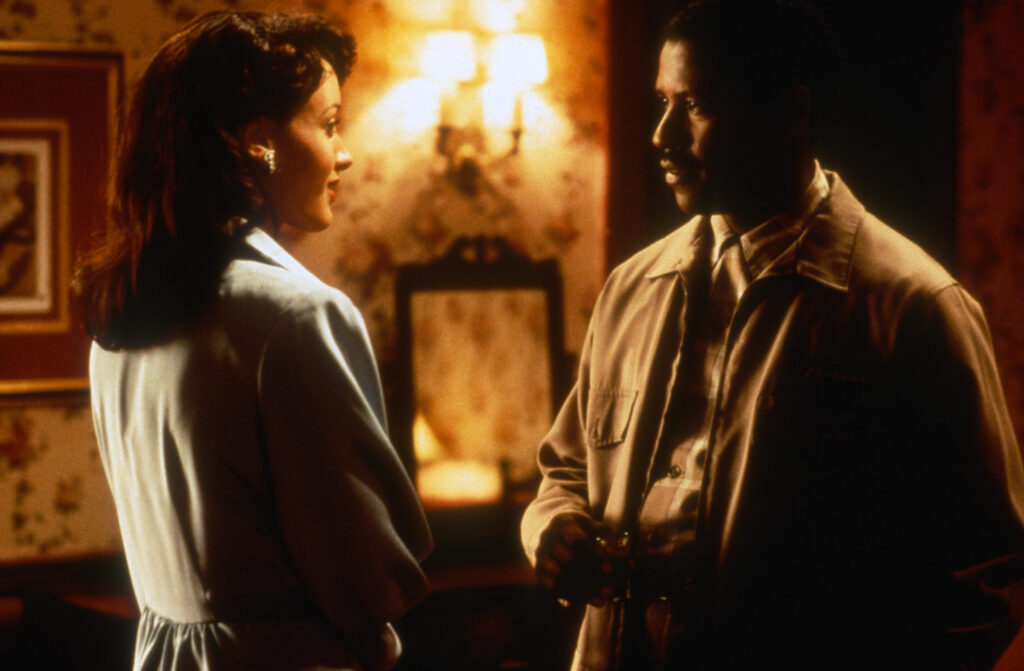
For years, I believed that no one would ever write a Los Angeles detective novel as well as did Raymond Chandler. But then a friend gave me the book Black Betty, which changed my mind. Walter Mosley’s detective, Ezekiel (Easy) Rawlins roams in an atmospheric, corrupt, and dangerous LA just as did Phillip Marlowe, but Easy practices his trade as a Black man in the 1940s. In Mosley’s hands, that difference opens up a world of plot, character, emotion and social comment that countless Caucasian detective novel authors before him never explored. Devil in a Blue Dress is an underappreciated film adaption of Mosley’s novel of the same name.

As the story opens, Easy Rawlins (Denzel Washington) is in a bind. Back from service in World War II and the proud possessor of a GI bill-financed mortgage on his very own house, Easy is fired by his white boss on specious grounds. Desperate for money, he agrees to help find a missing woman for a local hood (a memorably sleazy Tom Sizemore) who claims to be working for a former mayoral candidate. Easy’s investigation reveals that the woman has an African-American female friend that he knows, and who finds Easy hard to resist. He gets a lead on the missing woman (Jennifer Beals) but then there is a murder and everything goes pear-shaped. Soon the police and the criminals are both gunning for Easy, tempting him to call in a favor from an old friend named Mouse (Don Cheadle) who has a penchant for extreme violence.

Director Carl Franklin, recognized as a modern film noir maven since he made One False Move, is in complete command of the tone and style of the movie. Even though this was not a big budget production, the 1940s sets, cars, and clothing look smashing, while Elmer Bernstein’s fine score and some outstanding period music add flavor and style. It’s also fascinating to see a rarity in Hollywood films: Post-war Black neighborhoods of Los Angeles brought to life (the local man with mental illness that Easy encounters is beyond perfect as a realistic, humanizing touch). Even if those aspects of the film don’t grab you, Mosley’s source material provides a complex, exciting mystery for Easy to solve, making the movie effective as a detective story as well.

As in Mosley’s books, the African-American point of view alters and thereby freshens up the old tropes of detective fiction. A midnight meeting with a business associate at the pier? Normally no problem, but this time it’s in white-dominated Malibu, and you can see the wariness in Washington’s eyes with every step he takes. Meet a doll-face dame and chat her up? Not so simple when she’s white and there are white men around itching to give you a beat down. The standard “police interrogation of the interfering private eye” bit? It’s a hell of a lot more scary when you realize that the cops could shoot Easy and dump his body somewhere as they never could with a Caucasian detective. And finally, without spoiling the film, the entire mystery turns on race and racism in a powerful way, including how even the most privileged individual white people can end up suffering from the color line they collectively create.

Categories
Action/Adventure Romance Science Fiction / Fantasy

Superman

The undeniable wonder of Richard Donner’s 1978 film Superman can be summed up in one word: Reverence. For decades, comic book fans were dismayed by movie and TV adaptations of the heroic stories with which they grew up. Producers and writers seemed to feel that the material couldn’t stand up on its own. Rather, it had to be made campy (Holy Evil Menace Batman!) or have asinine new characters added or adopt an ironic or juvenile tone. What Donner and Producers Alexander Salkind, Ilya Salkind and Pierre Spengler understood is that the reason untold millions of people around the world love Superman is that it’s a thrilling story with an inspiring central character. In short, it didn’t need some Hollywood type to change it, it needed someone to take it seriously on its own terms and produce it with a real budget and good actors. The result is a superb movie without which many subsequent, highly entertaining comic book hero films (e.g., Spiderman, Captain America, Iron Man) would be unthinkable.

The filmmakers’ respect for the source material is evident in the very first frame, during which a little girl reads some lines from Action Comics #1 (Superman’s 1938 debut) as the velvet curtains of an old style theater open. The camera then glides past the Daily Planet building into outer space, where the audience is treated to a whooshing credit sequence and John Williams’ thrilling, majestic score. This sequence doesn’t typically get discussed when critics debate the best film openings, which I view as rank snobbery: It’s transcendent.

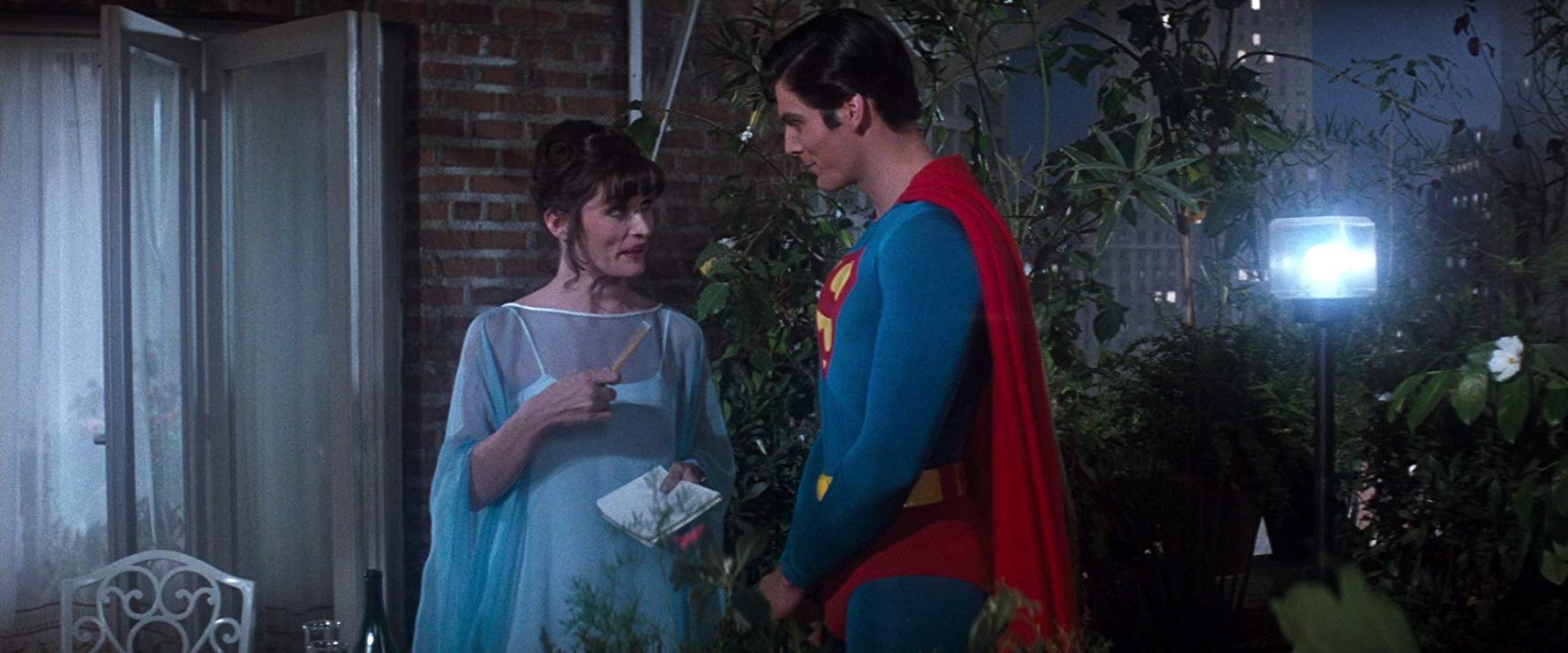
The Superman story is then warmly told, from his origins on the doomed planet Krypton, to his escape to Earth and his Midwest Americana childhood with Ma and Pa Kent (Love these scenes: old pros Glenn Ford and Phyllis Thaxter ease comfortably into the roles of the Kent parents and newcomer Jeff East nicely conveys what it would be like to combine adolescent awkwardness and emotional pangs with budding superpowers). Then of course, Superman moves to Metropolis to work under the guise of a mild-mannered reporter at the Daily Planet, sweetly romances Lois Lane (Margot Kidder, a good choice for the part) and battles the villainous Lex Luthor (Gene Hackman, having and being a good time, while also being appropriately callous).

Superman Movie Review | Movie Reviews Simbasible

The most unforgettable set piece is Lois Lane’s helicopter disaster, which triggers Superman’s (Christopher Reeve) first appearance. But the romantic scenes and the closing sequence during a massive, Luthor-induced earthquake, are also crowd pleasers.

Though Superman is an uncynical hero who believes in truth, justice and the American Way, and has been sent to Earth from the heavens by his father to save humanity (ahem), this is far from a self-serious film. I still remember vividly the explosion of laughter in the theater when Reeve looks at a modern phone “booth” when he needs to change into costume for the first time. The rapid-fire scenes with Jackie Cooper (as Editor Perry White) and the team at the Daily Planet are also a great deal of fun, almost a bit of Front Page-style screwball comedy interspersed with the overall adventure story. Valerie Perrine and Ned Beatty get some laughs as Luthor’s half-witted assistants. Look fast also for an amusing cameo by Donner as a guy on the street who isn’t sure he believes a man can fly.

Geoffrey Unsworth works miracles combining special effects and live action shots on this film as well as its sequel, Superman II, which was filmed at the same time and is dedicated to his memory (For other film recommendations featuring this gifted cinematographer, see my prior film recommendations here and here). Unsworth’s contribution is one of many reasons why Superman is not just an outstanding movie adaptation of a comic book; it’s a outstanding movie, full stop.

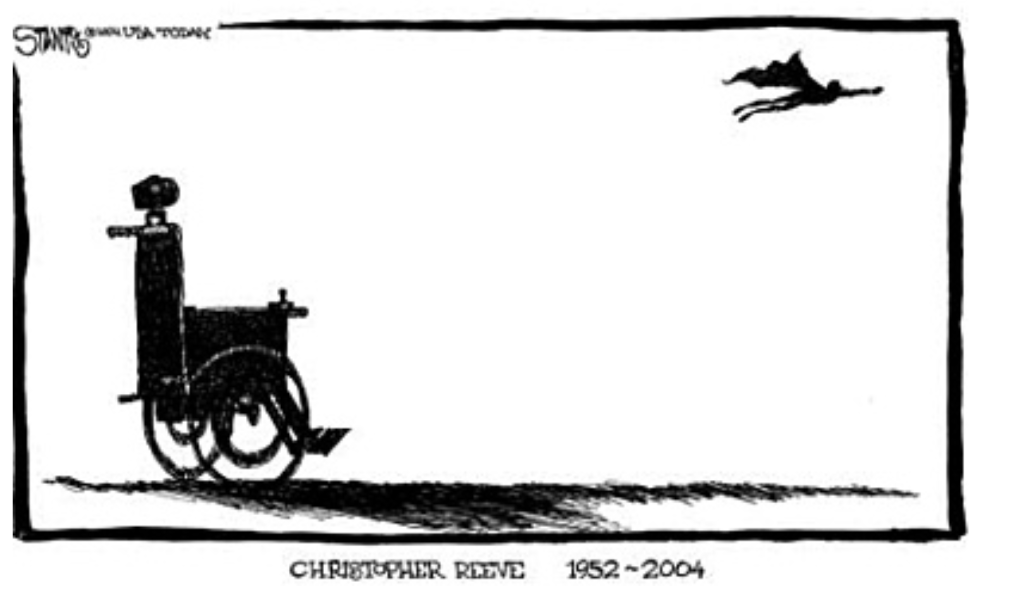
As a closing note, Superman was unquestionably the defining film of Christopher Reeve’s career, so much so that it’s impossible to imagine the movie without him. He passed away in 2004, even more of an inspiration in life than he was as the Man of Steel.

Categories
Blogs on Film

De Niro’s Greatness (Guest Essay)

London-based Ian Jentle had a long and successful career as an actor; Americans are most likely to know him as Josef Goebbels in the epic War and Remembrance television mini-series. I asked Ian to explain from an actor’s point of view what makes a great film performance, and he has kindly agreed to do so using the example of the legendary Robert De Niro. Over to Ian:

When people ask me, as a retired actor, what I think constitutes great acting, I tell them to rent Raging Bull (1980) and The King Of Comedy (1983) and watch them back to back. Both are directed by Martin Scorsese and star Robert De Niro. In the former, De Niro plays Jake La Motta, a man of immensely powerful physical presence who is emotionally unstable, intellectually limited and sadomasochistic. He is huge, lumbering, frightening, and yet pathetic. In the latter film, De Niro plays Rupert Pupkin, a small, weasely loser obsessed with other people’s fame, a stage door hangabout whose very presence is sphincter-clenchingly embarassing. If you removed the credits from both films and showed them to somebody who had lived a cinema-free life, I would bet a large sum that they would not believe the same actor played both roles.

First, De Niro has that strange quality known as presence or charisma. Film professionals will say of a particular performer that “the camera loves him/her” and it is true. But screen presence is not always linked with great acting skills: Charlton Heston had tremendous presence, but his acting was rarely better than wooden, and although one could not accuse John Wayne of creating a wide range of characters, he undoubtedly had presence and was always believable and entertaining. De Niro clearly demonstrates his presence in the scene in Raging Bull in which LaMotta is thrown into a prison cell.

But De Niro brings much more to the screen than mere presence. What marks De Niro out as a truly great actor is the integrity of his approach to his characters, the depth of his observation of human behaviour and the skill he brings to the performance of these characters in the context of a film narrative. Two more clips, one from each movie, demonstrate these skills.

In the clip from Raging Bull, Jake LaMotta repeatedly challenges his brother, played by Joe Pesci, to hit him in the face. Here, De Niro gives his character the objective of “control”. He tries several strategies to persuade his brother to hit him in the face: simple request, provocative insult, older brother authority, even slapping. By the end of the clip his brother demands “What are you trying to prove? What does it prove?” De Niro’s triumphant smile and brotherly tap on the face show that he has “won”, which is the whole point. As he does repeatedly throughout the film, Jake LaMotta uses violence, even the receiving of violence, to exercise psychotic control over others.

In the clip from King of Comedy, Rupert Pupkin sneaks into a car with his comedy hero Jerry Langford, played by Jerry Lewis, to ask for help in becoming a comedian. Once Pupkin invades Langford’s car, he embarks upon non-stop babble with the objectives of impressing Langford with his comedy potential and recruiting his support for his non-existent career. What he reveals is an embarrassing blend of passionate desire to succeed with not a shred of comedic talent. He tries to behave as if Langford is his equal while saying that Langford is his hero. The scene is shot head-and-shoulders but with only his face, shoulders and arms De Niro produces a painfully recognisable character.

For me, these two movies demonstrate De Niro’s ability, flexibility and imaginative range, but don’t take my word for it based on these few clips. Watch the two movies back to back and they will make the argument much better than I can.

Categories
Action/Adventure Horror/Suspense

The Most Dangerous Game

One Halloween, I was looking for a lurid and creepy pre-code film to recommend. I was tempted by White Zombie but like many films of the period, the existing prints are sadly too beaten up to make the film an enjoyable experience. But then I found a movie that is not only better purely on its merits but has also been skillfully restored: 1932’s The Most Dangerous Game.

Joel McCrea plays a big game hunter who is travelling by yacht in the South Seas. As the ship nears a remote island surrounded by dangerous reefs, the light buoys seem to have been misplaced: They actually lead the ship into the rocks, causing it to sink with all hands aboard other than our hero. He makes his way to a fog-shrouded castle where Count Zaroff (Leslie Banks) welcomes him warmly, introducing himself as a fellow hunter. Zaroff has two other guests, the alluring Eve (Fay Wray) and her boozy brother Martin (William Armstrong). Zaroff used to have two other guests, but they disappeared shortly after he gave them a tour of his trophy room. Would you like to come down and see the prizes from his prior hunts?

Based on a story by Richard Connell that has since been re-used in movies and TV shows a million times, this version is closest to the original material. At a briskly paced 62 minutes, it’s both chilling and thrilling. And for film buffs, added interest is provided by the pre-code elements of sadism, sexual exploitation, gruesome violence and some disturbing “trophies” (There are ethnic stereotypes too, but that was okay with the Hays, Breen and the other people who implemented Hollywood’s Production code).

For me, the early 1930’s most hypnotic and frightening portrayal of a villain with an Eastern European accent isn’t Lugosi’s Dracula, it’s Leslie Banks as the depraved Zaroff. This was Banks’ first film and he is magnetic in a role that could easily have been campy. A injured World War I veteran with a scarred face, Banks’ disfigurement is integrated with his character and gestures in highly effective fashion. The leer Banks gives Wray when telling her that “love” will follow the hunt makes the viewer want to bathe immediately.

Ms. Wray alas is at best okay. At times she overdoes it to an extent that I wonder if she thought it was a silent film. She is mainly there to be lusted after and as her clothing is ripped away during sweaty sprints through the jungle. McCrea is agreeably strong-jawed if not playing a character with much depth. But their performances aren’t critical for a film that is really about a breathless, suspenseful chase, and it delivers the goods on that score in spades. One of the good things about such a short running time is that tension can be maintained through almost the entire movie, as the grip marks in the chair armrests of viewers will prove.

You may notice that co-Director Ernest Schoedsack, score composer Max Steiner and many of the actors were involved in making King Kong and that some of the sets and camera shots look like they are from that famous movie. That’s because the two films were shot at the same time, with the actors being borrowed for Kong in the middle of making The Most Dangerous Game (which funnily enough was more profitable because it had a much lower budget).

The restoration has removed almost all the scratches and damage, and the sound quality is very good. Kudos to the magnificent restorers of Flicker Alley for letting a new generation of film fans enjoy this fine example of pre-code cinema, which otherwise might have literally faded away.

Categories
Foreign Language Horror/Suspense

The Cabinet of Dr. Caligari

Film buffs are one of the few groups of people who have extremely positive associations with the words “Weimar Republic”. The German film industry had an embarrassment of talent and explosive creativity in the 1920s. The Cabinet of Dr. Caligari is one of a number of innovative German movies of the era that profoundly influenced whole swaths of 20th century film worldwide: .

It’s a story within a story, told by a man named Francis (Friedrich Fehér) after he sees “his betrothed” walk by in a daze. They have shared an amazing experience he says, and then the film transitions to his bizarre tale of a carnival sideshow that features a fortune-telling somnambulist. The sideshow is operated by the mysterious Dr. Caligari (a magnetic Werner Krauss) who seems to have control over the sleepwalker Cesare (Conrad Veidt). The creepy Cesare blandly informs a carnival patron that he will die at dawn, and the prediction comes true! It’s one of a series of murders that have been terrorizing the countryside. But who is the killer, and what will happen to the fetching damsel in distress (Lil Dagover) whom Francis and his friendly rival Alan (Hans Heinrich von Twardowski) are trying to woo? Strap yourself in for cinema’s first horror film AND the first film with a twist ending (and what a twist!).

Made by Robert Wiene in 1919 or 1920 (depending on which film guide you believe), The Cabinet of Dr. Caligari remains one of the most visually striking films in history. Expressionist artists Hermann Warm, Walter Röhrig and Walter Reimann produced a set design to die for, with light and shadows physically painted onto the walls and floors, twisted furnishings, canted windows and doors, and chiaroscuro galore. It’s a madman’s dreamscape, a physical expression of a warped psychology. Many of the actors move in a stylized way (Caligari recalls a scuttling spider, Cesare a cross between a mod dancer and the Frankenstein monster), further heightening the atmosphere of unreality. And it all would have looked even more mesmerizing at the time because the film was tinted rather than being in pure black and white.

Like the best art of this type, the unreality expresses a greater reality. Every one who has been in some bureaucratic backwater office to complete arcane paperwork under the oversight of an imbecile sees the truth in the design of the town clerk’s office in this movie. The cell at the police station conveys the complete desolation of the wrongly accused. And we have all met leaders of organisations whose personality and outlook are completely captured in the interior of the insane asylum director’s office.

Categories
British Horror/Suspense

Forgotten Draculas **Triple Feature**

Other perhaps than The Bible and The Sherlock Holmes stories, no book has inspired as many movies as Bram Stoker’s Dracula. Everyone knows the famous Bela Lugosi version, but few people are aware of the versions I am recommending here.

Count Dracula was broadcast on BBC in 1977, and is perhaps closer to the original text than any other version (except that Meena and Lucy are sisters rather than friends, and one of Lucy’s three suitors is omitted). The elegant French actor Louis Jourdan makes a memorable Count Dracula, conveying a mixture of civility, erudition, seductiveness, arrogance, and menace. Equally good are Frank Finlay as a kindly, devout Professor Van Helsing and Jack Shepherd in an unusually sympathetic take on the madman Renfield. Props also to Bosco Hogan for vividly portraying Jonathan Harker’s progressive mental breakdown under the strain of being trapped in Dracula’s castle.

The budget for the BBC production was clearly small, and that shows in some cheap special effects, the lack of any eye-popping sets, and the absence of mega-stars. But within the limits of a television budget, it’s a quality movie, especially the exciting closing confrontation between our heroes and Dracula.

An even better TV adaptation, simply called Dracula, was made in 1973 by Dan Curtis of Dark Shadows fame. His frequent collaborator Richard Matheson departs substantially from the original story in his script, offering a fresh take on the world’s most famous vampire. Dracula, played with panache by Jack Palance, is as much sad as threatening, longing for the normal life he had centuries ago and seeming almost to regret his thirst for human blood. Matheson also strips down the number of characters (e.g., no Renfield, Dr. Seward, Quincy Morris or Arthur Holmwood) in a way that simplifies and helpfully speeds up the storytelling. My only gripe about Matheson’s changes is that Professor van Helsing was turned into a proper Englishman (Nigel Davenport) when he works better as an old-world character steeped in the mythology of nosferatu. Oswald Morris, whose work I have praised many times on this site, again offers fine cinematography, which enhances Curtis’ ability to deliver moments that make viewers hold their breath or let out a scream.

The final forgotten Dracula I would recommend was made by Universal Studios in 1931. You are probably thinking “What does he mean ‘forgotten’, that was the most famous version ever, wasn’t it?”. The English-language version is indeed the most famous, but in the early days of talkies, films were not dubbed for foreign markets. Rather, the studios would shoot the same film twice with a different cast in a different language. That’s how the Spanish-language version of Drácula was made in 1931. Bela Lugosi, Tod Browning et al did their shooting during the day, and then a completely different crew and cast shot the same scenes in Spanish at night.

The Spanish-language crew had a smaller budget, but they also had a distinct asset: They got to see the rushes that the English-language crew had shot that day. This allowed them to replace shots that were dull or didn’t work with new set-ups, and the result is much better camerawork in the Spanish-language version. This version also adds in a few scenes that make the story more coherent. I would not say it’s better than the Lugosi/Browning version, but I would say that on balance it’s just as a good and well worth your time both for itself and for comparative interest with its more famous twin.

This 3 minute video from CineMassacre does a superb job comparing the two productions:

Categories
British Comedy

Time, Gentlemen, Please!

Where to stream Time, Gentlemen, Please! (1952) online? Comparing ...

Due to distribution problems, lost celluloid, legal disputes, or bad luck, some excellent films became inaccessible after their debut and eventually fall through the cracks of almost everyone’s memory. 1952’s almost completely forgotten Time, Gentlemen, Please, which isn’t even mentioned in most of my books about film, is a prime example. There were I understand copyright and distribution disputes that kept it from being available after original release for decades. But it’s out on DVD now, and that’s a gift to lovers of British comedy.

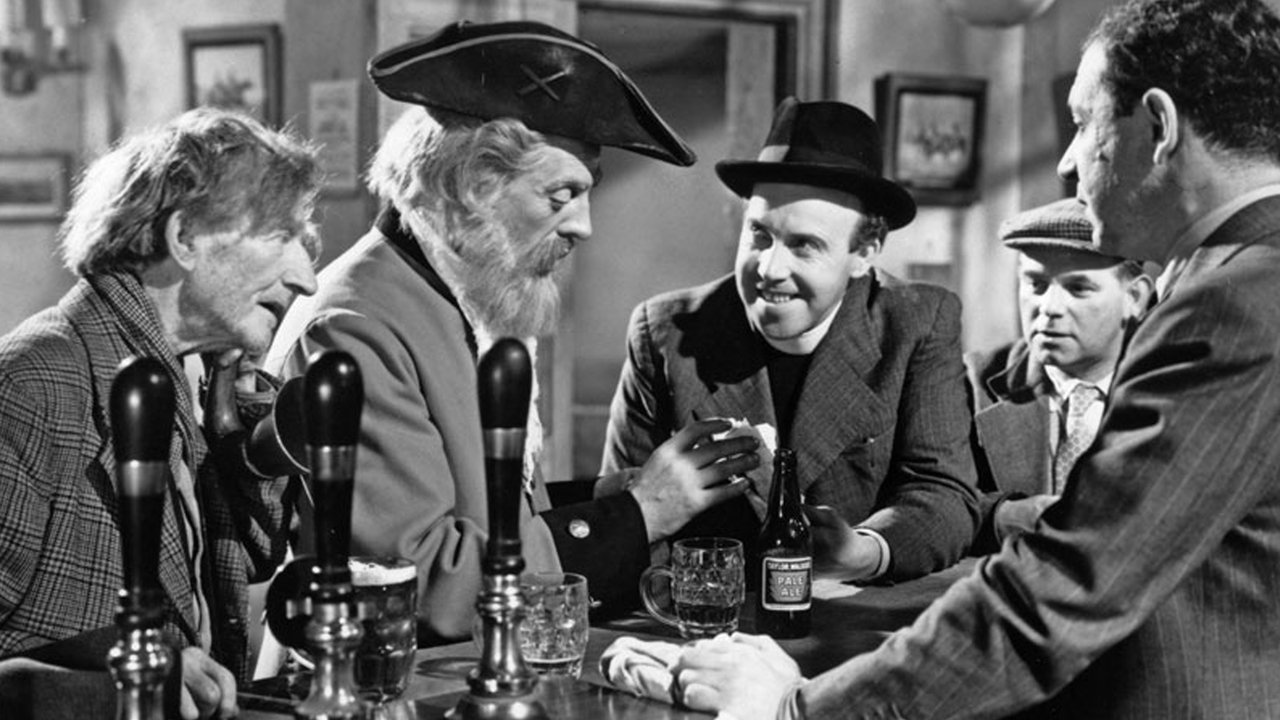
The story is set in Essex, specifically in the hardworking town of Hayhoe. Indeed, its 99.9% employment rate has earned it a personal visit by the Prime Minister! The stuffy town council members want to make the employment rate 100% before the PM arrives, but a charming, boozy, Irish rogue named Dan Dance (Eddie Byrne) stands in their way. He has no interest in work, so the prigs in charge stick him in the heretofore unused almshouse, which is run by the dour Mr. and Mrs. Crouch (Ivor Barnard and Thora Hirch). The tables are turned however when a reformist pastor discovers that the town’s founding documents insist that all taxes from the old estates be shared equally among the residents (or, in this case, sole resident) of the almshouses, making Dan the richest man in town, and a candidate for a seat on the town council. The story only gets sillier from there before a most enjoyable denouement.

There are many tremendous character actors in this movie (e.g., Hermione Baddely, Sid Gilbert) but no big stars. The greatest strength of the film is Peter Blackmore’s gut-bustingly funny screenplay, which was based on R.J. Minney’s novel “Nothing to Lose”. Much of the humor comes in the form of the pleasant smiles one gets from “Ye Olde Quaint English Village Full of Eccentrics”, but there are also a number of laugh out loud bits.

The politics of the film are interesting to analyze. If Maggie Thatcher ever saw it, I suspect she would have never stopped throwing up. The hero is willfully unemployed, but rather than resent him sponging off their labour, the townsfolk rally to him and against the local toffs. That was the political mood of the post-war, pro-working stiff, austerity era for many Britons in a way that was not replicated among their American cousins.

Weekend Film Recommendation: Time, Gentlemen, Please! – The ...

I can’t say that Time, Gentlemen, Please! is quite at the level of the great Guinness/Mackendrick Ealing Studios comedies of the period, but it’s almost as good and certainly a highly rewarding film in absolute terms. Please take the trouble to find it; you’ll be richly rewarded for your effort.

p.s. The title is a reference to a pub host’s call at closing time, in an era when watering holes had to close at a certain hour and the patrons were all male.