Categories
Action/Adventure British Science Fiction / Fantasy

20,000 Leagues Under The Sea

In my recommendation of Treasure Island, I described how and why Disney started making live-action family films after the war. One of the studio’s greatest films of this period is a dramatic, well-mounted adaptation of Jules Verne’s steampunk classic: 1954’s 20,000 Leagues Under the Sea.

The story opens with sailing vessels being destroyed in the South Seas by a mysterious underwater creature. Is it a kraken, a dragon or something else? At the behest of the U.S. government, a Parisian professor (Paul Lukas), his faithful assistant (Peter Lorre) and a free-spirited sailor (Kirk Douglas) join a military expedition to either find the monster or prove it doesn’t exist. In a fatal confrontation, their ship encounters disaster, which brings them face to face with Captain Nemo (James Mason), his devoted crew, and his extraordinary “submarine boat”.

James Mason as Capt. Nemo | Leagues under the sea, Movie stars ...

Mason, as the tortured, destructive yet also sympathetic Nemo is in top form, adding weight to proceedings that might otherwise have been comic bookish. Lukas, as the brilliant scientist who is both Nemo’s prisoner and his nagging conscience, is an effective foil for Mason. Lorre isn’t given a huge amount to do, but he makes the most of it by being more vulnerable and afraid that the other central players, thereby giving the audience someone with whom to identify.

The special effects were trend setting at the time and still hold up pretty well today, as does the knockout set design on the submarine. It’s particularly hard to forget Nemo playing Bach’s Toccata and Fugue in D Minor on the organ as the Nautilus glides through the ocean deep. Also adding to the striking look of the film is Peter Ellenshaw, who as in Treasure Island does magnificent matte work (the crowded shipyard at the beginning and the Island of Volcania at the end are flawless).

The film has two weaknesses. The first is Kirk Douglas’ endless mugging and preening. I don’t know if Director Richard Fleischer couldn’t control his star’s legendary desire for attention or gave him bad direction, but it gets old pretty quickly. The second is that like many films of the period (e.g., King Solomon’s Mines), this one includes “nature photography” moments that would have dazzled audiences at the time but are pretty slow stuff for a generation that has the web, television and a thousand episodes of Jacques Costeau at its fingertips.

But neither of those flaws stops this from being outstanding family entertainment with exciting action scenes, a strong story, eye-catching visuals and moments of real emotion. It’s great fun for you and the kids on a rainy Sunday afternoon.

I close this recommendation with a must-view clips for film-buffs. The truly spectacular fight with the giant squid in the film version released to theaters was not the first one that was shot. Here is the inferior original, the “Sunset Squid Sequence”.

Categories
Action/Adventure Horror/Suspense Science Fiction / Fantasy

Night Slaves and The Screaming Woman **Double Feature**

ABC MOVIE OF THE WEEK COLLECTION" - 18 DVDS - COMPLETE UNCUT - TV ...

I generally don’t recommend made-for-TV movies because they generally aren’t worth watching (With some exceptions, such as Stephen King’s It). But there was a quality series of such films in the 1970s known as the “ABC Movie of the Week”. It gave audiences memorable moments such as Karen Black being stalked by an evil doll in Trilogy of Terror, Elizabeth Montgomery doing some ruthless ax work au naturale in The Legend of Lizzie Borden and Dennis Weaver battling a mysterious truck driver on a lonely road in Duel (An early Spielberg triumph).

I recommend two lesser known but still solid Twilight Zone-esque entries in this series of television movies: Night Slaves and The Screaming Woman.

Night Slaves is based on a novel by Jerry Sohl, a veteran TV writer for Twilight Zone, Alfred Hitchcock Presents and Outer Limits, among others (including the original Star Trek). Familiar plot elements from those worthy programs are all here: A mysterious isolated location, strange experiences, and a central character who can’t tell if he has stumbled across something bizarre and sinister or in fact is losing his mind.

James Franciscus and Lee Grant play Clay and Marjorie Howard, a toothsome married couple who are taking a vacation from the big city in order to help them recover from a recent trauma. Clay was in a terrible auto accident in which he suffered a head injury and two other people were killed. The Howards chance upon a sleepy little town and take a room for the night. But ’round midnight, Clay wakes up to see all the townspeople gathering in a trance-like state and then leaving town. He looks for Marjorie and finds that she too has become a glassy-eyed zombie. He receives cryptic clues about what is happening from an alluring stranger (Tisha Sterling) but she disappears before he can demand a full explanation. When Clay awakens the next morning, the town is apparently back to normal and everyone thinks his head injury has caused him to hallucinate the events he reports having witnessed. Is he going crazy, or is the town in the grip of some malevolent force of which its people are unaware?

The story unfolds slowly enough to be suspenseful without ever dragging — indeed like all the movies in the ABC series the whole thing runs only about 70 minutes. The actors are all believable and, as in a good Outer Limits episode, the resolution is clever and satisfying.

With made-for-TV flicks, I keep to my “B-movie standard” for cinematic releases, i.e., I don’t expect such movies to be more than they reasonably can be and frankly dislike it when they try. For that reason, the “TV elements” of Night Slaves don’t bother me, e.g., the set is clearly a studio back lot used in a million oaters, the reflected camera lights are visible in the store windows on one of the night shots, and there are some static one camera set ups that would have been replaced with more captivating cinematography if this were a big budget product for the big screen. If you can’t accept those sorts of things, don’t bother with this one. But if you can appreciate a solid TV movie as such, Night Slaves is quality entertainment.

An even better film along similar lines is The Screaming Woman, starring Olivia De Haviland in a role that you could consider a follow-up to The Snake Pit. She plays a wealthy woman named Laura Wynant who has just returned from the sanitarium after a mental breakdown. As she walks the grounds near the remnants of a bulldozed old smokehouse, she thinks she hears a woman calling for help from underneath the ground. As with Night Slaves, The Screaming Woman is based on a terrific writer’s (Ray Bradbury) story that depends on a character convincing other people that what has been witnessed is not an insane fantasy.

It’s pleasant as always to watch Joseph Cotten work (He plays Laura’s attorney) and the visuals of the screaming woman are effectively eerie. And the direction, by the accomplished Jack Smight, gets the most from the script and the actors. Again, it’s a TV movie, but it’s a fine TV movie indeed.

Categories
Action/Adventure Drama

The Sting (Guest Review)

My friend Johann Koehler of the London School of Economics is a criminologist, an innovative thinker, and a lover of movies. I asked him to contribute a review of one of his favourites, The Sting. Over to Johann:

Fans of Paul Newman and Robert Redford’s pairing in 1969’s Butch Cassidy and the Sundance Kid would have been raring for a cinema ticket in 1973 to see Hollywood’s most bankable leading duo in George Roy Hill’s multiple Academy Award-winning The Sting.

The plot revolves around a desperate revenge story shrouded in fanciful con artist scheme-ery. After the murder of his mentor, Redford’s Johnny Hooker, an impulsive neophyte in the world of confidence schemes, looks to Newman’s Henry Gondorff for instruction and assistance in bringing about the demise of the villainous Doyle Lonnegan (impeccably played by Robert Shaw). Shaw projects the same unpredictable brutality he mastered as Henry VIII in Fred Zinnemann’s 1966 classic A Man for All Seasons and the Newman/Redford team deliver a characteristically heart-warming performance redolent of Butch and Sundance.

While the film has been rebuked for a plot that drags at times, one can’t help feeling eager to find out how the final scene’s con plays out. In truth, the “long con” provides a deeply satisfying ending. In contrast to the “short con”, in which the con artist fleeces the mark for all that he has on his person, the “long con” is a much more deliberate and vicious scheme. It requires that the mark be seduced into the con artist’s deception and to participate in the construction of his own demise. In so doing, he ultimately becomes both the perpetrator as well as the victim. Lonnegan thus becomes either the most unsympathetic villain, or the least, depending on your mood while watching the film.

Scott Joplin’s jolly ragtime music, anachronistically written two decades before The Sting is actually set, imbues the film with enough whimsy to conceal the bitterness of the underlying storyline. And for a master-class in comic acting, be sure to look out for Newman’s show-stealing drunken poker scene on the train.

Closing trivia note from Keith: The money that Rick Blaine gives up to a needy couple using number 22 on a rigged roulette wheel finally gets paid back by Johnny Hooker in this movie.

Categories
Action/Adventure Mystery/Noir

Ellery Queen Mysteries

In a few minutes, this man is going to be murdered. The question is: who killed him? Was it the frustrated nephew? The spurned housekeeper? The fiancé with a shady past? The willful heiress? Or was it someone else? Match wits with Ellery Queen, and see if you can guess who done it!

Oh what rapture when a high-quality, beloved old TV show re-emerges intact in a digitally remastered, commercial-free DVD set! The superlative television series Ellery Queen which ran on NBC from 1975-1976 is now available in a boxed DVD set comprising all 22 episodes plus the pilot and an informative interview with series co-creator William Link.

Link and Richard Levenson are legends in the TV game for their clever plotting, coruscating dialogue and most of all, unforgettable characters. Their formidable talents are on display in every episode of this series, which draws from the Ellery Queen novels they read growing up (they met in high school and became lifelong best friends and collaborators). Gimlet-eyed viewers will catch a few parallels between Queen and the most famous Link and Levenson creation, Lt. Columbo: Ellery doesn’t shoot or punch anyone, his forgetfulness, occasional clumsiness and gee-whiz manner (which were not elements of the books) leads suspects to underestimate him, and he once even says, while walking away from a suspect he has just grilled, “Oh, there’s one more thing…”.

The series adopts a deliberately old fashioned mystery style, with each episode starting with a “This person is about to be murdered” hook and closing with a “let’s gather all the suspects at the scene of the crime to announce who done it” scene. Victims get murdered in locked rooms and leave cryptic dying clues regarding the killer’s identity. Red herrings look suspicious, private eyes are hard-boiled, newspaper men are cynical and damsels are, well, in distress. Yet the writers also added a fresh twist to the old chestnut formulae: Ellery would look directly at the audience just before the closing scene and announce that he had the solution. He would then allude to a few clues from the story so far (occasionally, too many for my taste) and challenge the audience to solve the mystery. This made the show fun, especially once you had seen a few episodes and knew the drill, because you could try to solve the mystery yourself as you watched: All the evidence was right there in front of your eyes.

The heart of the show is Jim Hutton as Ellery and David Wayne as his father, a widowed police inspector. Both men are skilled actors, perfectly cast. If you smiled to see the nuances of the relationship between Rocky and Jim on The Rockford Files, you will be equally warm to the father-son dynamic here. At times they are like a typical father and son, at other times the son acts like the father to his sometimes truculent and self-neglecting dad (this works particularly well because the towering Hutton looks like he could cradle the diminutive Wayne in his arms), but most of the time they are like a couple of clever little boys running around, solving puzzles, doing good and having fun.

The other tremendously enjoyable aspect of the series is the gallery of guest stars, a mix of old time radio/movie icons (e.g., Ray Walston, Don Ameche, Vincent Price, George Burns, Eve Arden, Walter Pidgeon, Donald O’Connor, Dana Andrews) and experienced television character actors (e.g., John Hillerman, Ken Swofford, Tom Bosley, Betty White). It couldn’t have been too hard to direct such seasoned, talented casts, but that said the direction in the series is several cuts above what one usually sees on television (special shout out to Walter Doniger for “The Adventure of the Wary Witness” and David Greene for the pilot).

Production values are also impressive, with swell-looking cars, clothes and interiors from 1940s New York City. Also to love: Elmer Bernstein’s jazzy big band score played over stylish opening credits.

The series was unusual for its consistently high quality, making it hard to pick favourite episodes, but if pressed I would go with “The Adventure of Miss Aggie’s Farewell” because it so well recalls “Our Miss Brooks” (Eve Arden’s old time radio show whose comedy holds up surprisingly well), and “The Adventure of Caesar’s Last Sleep” because its illuminates the relationship between Ellery and his dad.

Ellery Queen Mysteries is irresistible television. May the corporate pillock who cancelled it after one season burn in eternal hellfire.

Categories
Action/Adventure Drama Science Fiction / Fantasy

The Day the Earth Stood Still

Graffiti messages tend to be clichéd, obscene or vapid, but once every few years I get a smile on my face when I see “Klaatu barada nikto!” scrawled on some random bit of fence or wall. It’s a critical line in Robert Wise’s 1951 science fiction classic The Day the Earth Stood Still.

In a decade when countless movies showed the good people of Earth being threatened by evil aliens (e.g., Earth vs. The Flying Saucers, The War of the Worlds) Edmund H. North’s subtle, intelligent screenplay inverted the usual premise. In this case, a flying saucer lands in Washington DC and disgorges a literate, moral, peace-loving and thoughtful alien (Michael Rennie, in his finest hour) who spends most of his movie under siege by petty, violent and backward Earthlings.

The alien, Klaatu, hopes to persuade humanity to renounce war and atomic weaponry, but mankind isn’t ready to agree (This is wistfully conveyed to Klaatu early in the film by Frank Conroy, in an uncredited, quietly powerful performance as an advisor to The POTUS). After an initial brutish encounter with the military, Klaatu escapes and decides he must learn more about humanity if he is going to save it. He adopts the name of Carpenter (ahem) and moves to a rooming house run by a widow and her boy (Patricia Neal and Billy Gray, who are believable and appealing). The two of them give Klaatu’s hope for humanity, leading him to confide in them about his true nature and mission.

The ingenious premise of the script allows this film to be as much social comment as science fiction. As the alien visitor watches human beings interact, tours the graves of Arlington Cemetery and reflects on our greatest president’s words at the Lincoln Memorial, we see ourselves through his sadder and wiser eyes, with profound emotional effect.

The special effects are solid for the period, with the Frank Lloyd Wright-influenced flying saucer being a particular highlight. Yet the effects don’t overwhelm the story or acting as they often have in more recent zillion dollar CGI-laden sci-fi films. Bernard Herrman’s score is also appropriate to the visuals and themes of the movie. All of this is a credit to Robert Wise’s ability to maintain tone throughout a film. To a number of film buffs, Robert Wise is the hack who destroyed The Magnificent Ambersons, a company man who did whatever project he was assigned but had no artistic vision of his own. If you hold to that negative view of Wise, you really should watch this movie, observe how well it is constructed, see how consistently excellent are the performances, and note how efficiently and effectively the story is told. Wise won Oscars for other films, but in my opinion this movie best demonstrates his considerable skills as a film maker.

Here is the cleverly crafted trailer to this masterpiece of science fiction:

p.s. for trivia fans. There’s a scientific errors in the script: Klaatu says he is from 250 million miles away yet knows how to talk like a contemporary American because he has been monitoring Earth’s radio programs on his home planet.

Categories
Action/Adventure British Drama

The Frightened City

In nearly a century on this earth, Herbert Lom had a long and varied acting career. Born in Prague under the Austro-Hungarian Empire, he achieved screen immortality as the Chief Inspector whom Clouseau slowly drives mad in the Pink Panther films. But before that did excellent work in many high-quality films, most of which unfortunately are largely forgotten today. I have spotlighted his fine performance as the kindly, devout, ill-fated Gino in Hell Drivers. Lom has a completely different role as a cold, clever and super-smooth criminal mastermind in 1961’s The Frightened City.

The Frightened City is a B-movie which doesn’t pretend to be otherwise. The budget is modest and so are the ambitions. But on those terms it delivers as a solid crime melodrama with a great starring role for Lom and excellent supporting work by a then little known Scottish actor who was only a year away from becoming an international superstar: Sean Connery.

The film is set in the London criminal underworld. A wily financier (Lom, conveying the calm of the truly powerful in every scene) figures out that the six biggest gangs could enhance the revenue of their protection rackets by organising themselves as a syndicate. He convinces one gangster (an agreeably lubricious Alfred Marks) to head the syndicate, who in turn recruits a former burglar (Connery) to be the face of the mob to the shops, pubs and restaurants it extorts. All goes well until the gang falls out, leading to a murder that throws the syndicate into turmoil and gives a dogged Scotland Yard detective inspector (John Gregson) the chance he needs to pounce.

The secondary plotline concerns Yvonne Romain as a luscious, ambitious immigrant singer who catches Connery’s eye. They have great chemistry on screen, and the script does a gratifying job of making her craftier than him rather than portraying her as a brainless tart (funnily enough Romain’s real-life husband went on to write the lyrics of several of Connery’s Bond films, including Goldfinger). The other engaging aspect of the story is Connery’s relationship to his former burglary partner (well-played by Kenneth Griffith), who has been crippled in a fall during an attempted break-in. Connery skillfully conveys the guilt he feels about the accident, and how it drives him into the hands of the new, more violent crew who are running the protection racket.

The film is not without weaknesses. Some of the sets look cheap, probably because they are. The script underdevelops its theme of how crime was changing to become more violent and organised and thereby outpacing long-standing law enforcement tactics. As a result, the scenes with the police are a bit slow and stale. And John Lemont’s direction is more reminiscent of a TV show than a movie (on the plus side, if you watch this on DVD instead of in a theater, you are not missing anything). For those reasons, the film goes into the good rather than great category.

As a closing note: Norrie Paramor’s jazzy title song became a big hit for Britain’s premier instrumental group of the era, the Shadows. Just for fun, you can see their totally pukka rendition of the theme on Crackerjack. Love those suits and dance steps!

Categories
Action/Adventure Mystery/Noir

Devil in a Blue Dress

SFMOMA

For years, I believed that no one would ever write a Los Angeles detective novel as well as did Raymond Chandler. But then a friend gave me the book Black Betty, which changed my mind. Walter Mosley’s detective, Ezekiel (Easy) Rawlins roams in an atmospheric, corrupt, and dangerous LA just as did Phillip Marlowe, but Easy practices his trade as a Black man in the 1940s. In Mosley’s hands, that difference opens up a world of plot, character, emotion and social comment that countless Caucasian detective novel authors before him never explored. Devil in a Blue Dress is an underappreciated film adaption of Mosley’s novel of the same name.

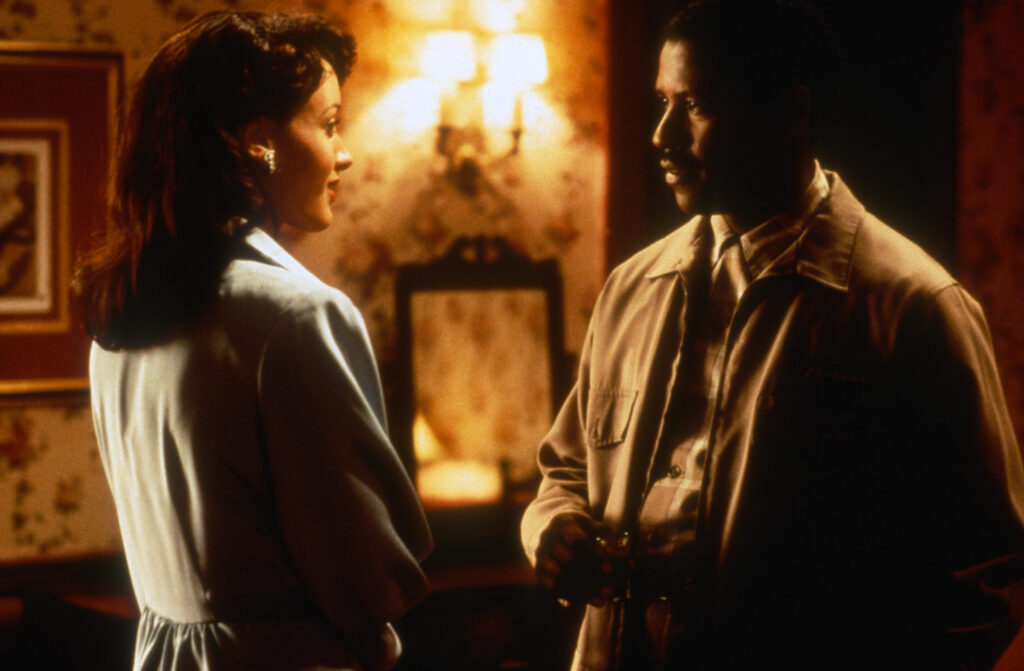
As the story opens, Easy Rawlins (Denzel Washington) is in a bind. Back from service in World War II and the proud possessor of a GI bill-financed mortgage on his very own house, Easy is fired by his white boss on specious grounds. Desperate for money, he agrees to help find a missing woman for a local hood (a memorably sleazy Tom Sizemore) who claims to be working for a former mayoral candidate. Easy’s investigation reveals that the woman has an African-American female friend that he knows, and who finds Easy hard to resist. He gets a lead on the missing woman (Jennifer Beals) but then there is a murder and everything goes pear-shaped. Soon the police and the criminals are both gunning for Easy, tempting him to call in a favor from an old friend named Mouse (Don Cheadle) who has a penchant for extreme violence.

Director Carl Franklin, recognized as a modern film noir maven since he made One False Move, is in complete command of the tone and style of the movie. Even though this was not a big budget production, the 1940s sets, cars, and clothing look smashing, while Elmer Bernstein’s fine score and some outstanding period music add flavor and style. It’s also fascinating to see a rarity in Hollywood films: Post-war Black neighborhoods of Los Angeles brought to life (the local man with mental illness that Easy encounters is beyond perfect as a realistic, humanizing touch). Even if those aspects of the film don’t grab you, Mosley’s source material provides a complex, exciting mystery for Easy to solve, making the movie effective as a detective story as well.

As in Mosley’s books, the African-American point of view alters and thereby freshens up the old tropes of detective fiction. A midnight meeting with a business associate at the pier? Normally no problem, but this time it’s in white-dominated Malibu, and you can see the wariness in Washington’s eyes with every step he takes. Meet a doll-face dame and chat her up? Not so simple when she’s white and there are white men around itching to give you a beat down. The standard “police interrogation of the interfering private eye” bit? It’s a hell of a lot more scary when you realize that the cops could shoot Easy and dump his body somewhere as they never could with a Caucasian detective. And finally, without spoiling the film, the entire mystery turns on race and racism in a powerful way, including how even the most privileged individual white people can end up suffering from the color line they collectively create.

Categories
Action/Adventure Romance Science Fiction / Fantasy

Superman

The undeniable wonder of Richard Donner’s 1978 film Superman can be summed up in one word: Reverence. For decades, comic book fans were dismayed by movie and TV adaptations of the heroic stories with which they grew up. Producers and writers seemed to feel that the material couldn’t stand up on its own. Rather, it had to be made campy (Holy Evil Menace Batman!) or have asinine new characters added or adopt an ironic or juvenile tone. What Donner and Producers Alexander Salkind, Ilya Salkind and Pierre Spengler understood is that the reason untold millions of people around the world love Superman is that it’s a thrilling story with an inspiring central character. In short, it didn’t need some Hollywood type to change it, it needed someone to take it seriously on its own terms and produce it with a real budget and good actors. The result is a superb movie without which many subsequent, highly entertaining comic book hero films (e.g., Spiderman, Captain America, Iron Man) would be unthinkable.

The filmmakers’ respect for the source material is evident in the very first frame, during which a little girl reads some lines from Action Comics #1 (Superman’s 1938 debut) as the velvet curtains of an old style theater open. The camera then glides past the Daily Planet building into outer space, where the audience is treated to a whooshing credit sequence and John Williams’ thrilling, majestic score. This sequence doesn’t typically get discussed when critics debate the best film openings, which I view as rank snobbery: It’s transcendent.

The Superman story is then warmly told, from his origins on the doomed planet Krypton, to his escape to Earth and his Midwest Americana childhood with Ma and Pa Kent (Love these scenes: old pros Glenn Ford and Phyllis Thaxter ease comfortably into the roles of the Kent parents and newcomer Jeff East nicely conveys what it would be like to combine adolescent awkwardness and emotional pangs with budding superpowers). Then of course, Superman moves to Metropolis to work under the guise of a mild-mannered reporter at the Daily Planet, sweetly romances Lois Lane (Margot Kidder, a good choice for the part) and battles the villainous Lex Luthor (Gene Hackman, having and being a good time, while also being appropriately callous).

Superman Movie Review | Movie Reviews Simbasible

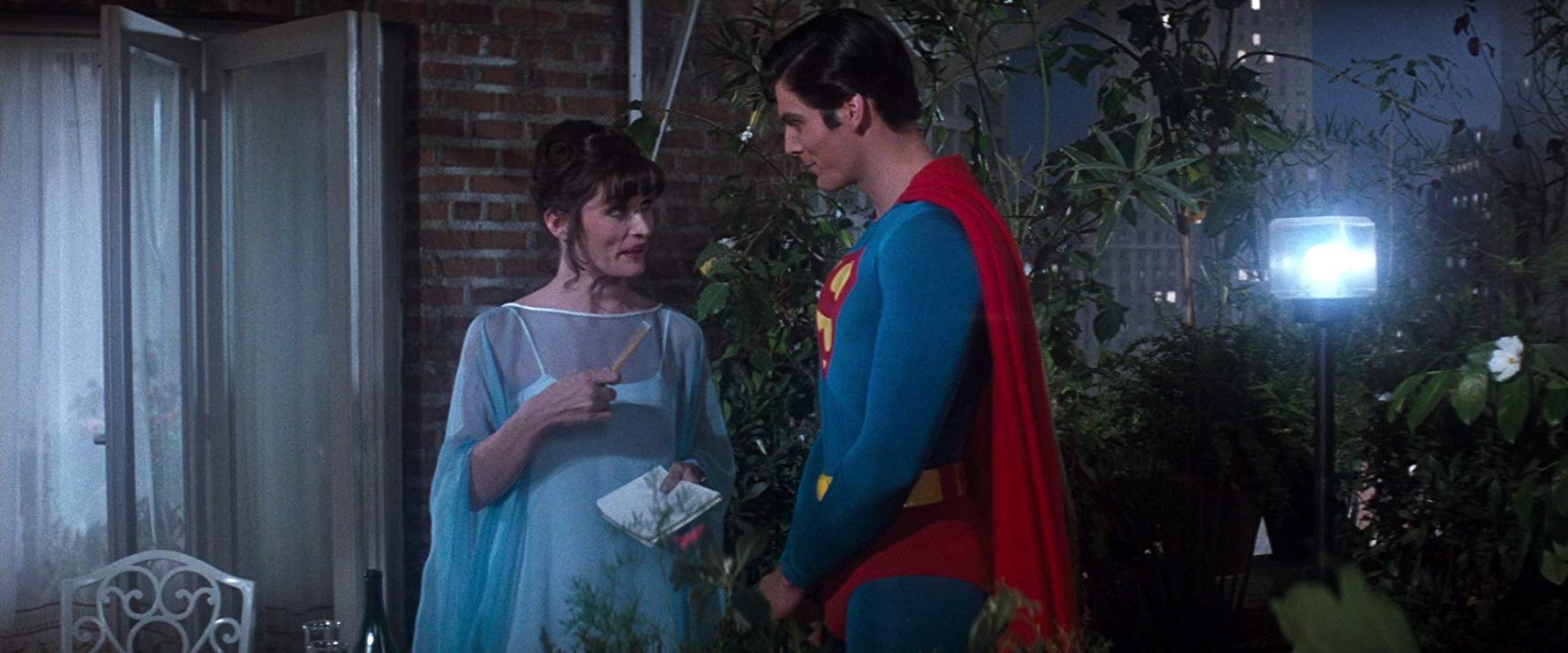
The most unforgettable set piece is Lois Lane’s helicopter disaster, which triggers Superman’s (Christopher Reeve) first appearance. But the romantic scenes and the closing sequence during a massive, Luthor-induced earthquake, are also crowd pleasers.

Though Superman is an uncynical hero who believes in truth, justice and the American Way, and has been sent to Earth from the heavens by his father to save humanity (ahem), this is far from a self-serious film. I still remember vividly the explosion of laughter in the theater when Reeve looks at a modern phone “booth” when he needs to change into costume for the first time. The rapid-fire scenes with Jackie Cooper (as Editor Perry White) and the team at the Daily Planet are also a great deal of fun, almost a bit of Front Page-style screwball comedy interspersed with the overall adventure story. Valerie Perrine and Ned Beatty get some laughs as Luthor’s half-witted assistants. Look fast also for an amusing cameo by Donner as a guy on the street who isn’t sure he believes a man can fly.

Geoffrey Unsworth works miracles combining special effects and live action shots on this film as well as its sequel, Superman II, which was filmed at the same time and is dedicated to his memory (For other film recommendations featuring this gifted cinematographer, see my prior film recommendations here and here). Unsworth’s contribution is one of many reasons why Superman is not just an outstanding movie adaptation of a comic book; it’s a outstanding movie, full stop.

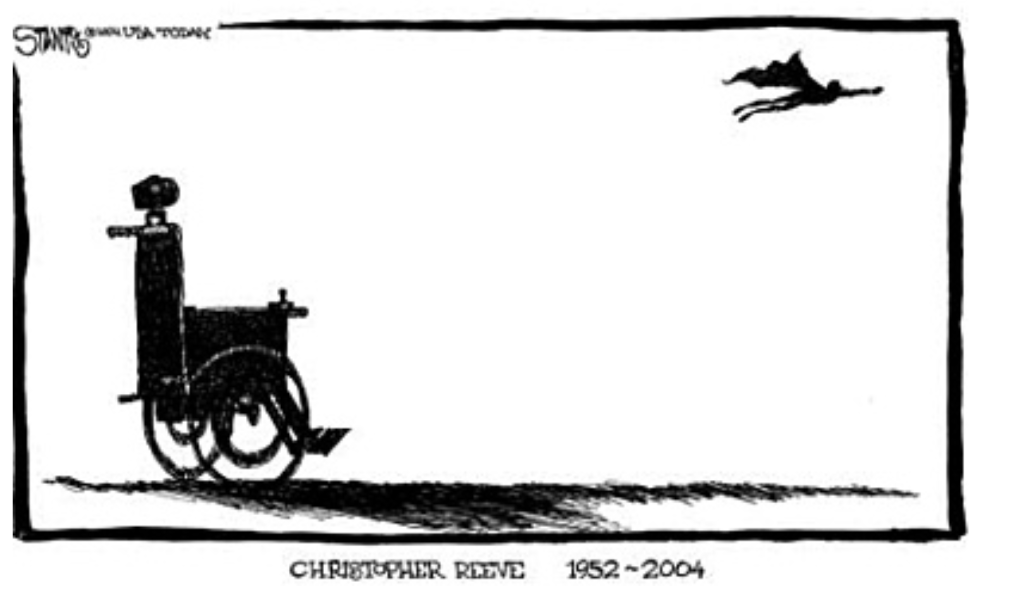
As a closing note, Superman was unquestionably the defining film of Christopher Reeve’s career, so much so that it’s impossible to imagine the movie without him. He passed away in 2004, even more of an inspiration in life than he was as the Man of Steel.

Categories
Action/Adventure Horror/Suspense

The Most Dangerous Game

One Halloween, I was looking for a lurid and creepy pre-code film to recommend. I was tempted by White Zombie but like many films of the period, the existing prints are sadly too beaten up to make the film an enjoyable experience. But then I found a movie that is not only better purely on its merits but has also been skillfully restored: 1932’s The Most Dangerous Game.

Joel McCrea plays a big game hunter who is travelling by yacht in the South Seas. As the ship nears a remote island surrounded by dangerous reefs, the light buoys seem to have been misplaced: They actually lead the ship into the rocks, causing it to sink with all hands aboard other than our hero. He makes his way to a fog-shrouded castle where Count Zaroff (Leslie Banks) welcomes him warmly, introducing himself as a fellow hunter. Zaroff has two other guests, the alluring Eve (Fay Wray) and her boozy brother Martin (William Armstrong). Zaroff used to have two other guests, but they disappeared shortly after he gave them a tour of his trophy room. Would you like to come down and see the prizes from his prior hunts?

Based on a story by Richard Connell that has since been re-used in movies and TV shows a million times, this version is closest to the original material. At a briskly paced 62 minutes, it’s both chilling and thrilling. And for film buffs, added interest is provided by the pre-code elements of sadism, sexual exploitation, gruesome violence and some disturbing “trophies” (There are ethnic stereotypes too, but that was okay with the Hays, Breen and the other people who implemented Hollywood’s Production code).

For me, the early 1930’s most hypnotic and frightening portrayal of a villain with an Eastern European accent isn’t Lugosi’s Dracula, it’s Leslie Banks as the depraved Zaroff. This was Banks’ first film and he is magnetic in a role that could easily have been campy. A injured World War I veteran with a scarred face, Banks’ disfigurement is integrated with his character and gestures in highly effective fashion. The leer Banks gives Wray when telling her that “love” will follow the hunt makes the viewer want to bathe immediately.

Ms. Wray alas is at best okay. At times she overdoes it to an extent that I wonder if she thought it was a silent film. She is mainly there to be lusted after and as her clothing is ripped away during sweaty sprints through the jungle. McCrea is agreeably strong-jawed if not playing a character with much depth. But their performances aren’t critical for a film that is really about a breathless, suspenseful chase, and it delivers the goods on that score in spades. One of the good things about such a short running time is that tension can be maintained through almost the entire movie, as the grip marks in the chair armrests of viewers will prove.

You may notice that co-Director Ernest Schoedsack, score composer Max Steiner and many of the actors were involved in making King Kong and that some of the sets and camera shots look like they are from that famous movie. That’s because the two films were shot at the same time, with the actors being borrowed for Kong in the middle of making The Most Dangerous Game (which funnily enough was more profitable because it had a much lower budget).

The restoration has removed almost all the scratches and damage, and the sound quality is very good. Kudos to the magnificent restorers of Flicker Alley for letting a new generation of film fans enjoy this fine example of pre-code cinema, which otherwise might have literally faded away.

Categories
Action/Adventure British

Charlie Muffin

Charlie Muffin is a terrific British spy movie scarcely remembered in the UK and even less so elsewhere, which is a rotten shame. After appearing on UK Television in 1979, it was barely released in the US under the title “A Deadly Game”. If you are among the many people who doesn’t know about this movie, let me try to persuade you to find this gem of an espionage thriller

The film is set at the twiilight of the cold war. Both the Soviet and British spy services are staffed by wily pros from the glory days who report to ineffectual careerists at the top. Among the old British hands is an insubordinate but brilliant agent named Charlie Muffin. In the title role, David Hemmings, prematurely aged well past his days of sleek beauty, gives us a character who is rumpled, raffish, boozy and extremely charming (Yes, perfect casting there). Working class Charlie is at war with his upper class twit superiors, but finds kinship with the equally clever General Berenkov (Clive Revill), a Soviet spy whom he helped capture.

Meanwhile, a Soviet General shows some interest in defecting to the West. As Charlie’s boss Sir Henry Cuthbertson (Ian Richardson, who assays cold-hearted bastards as well as anyone) and arrogant CIA Director Ruttgers (Sam Wanamaker, giving off just the right mix of parody and malice) struggle to respond, they realize they must reluctantly turn to Muffin for help. As the complex plot plays out, with double and triple crosses aplenty, the suspense mounts until the film comes to an extraordinarily satisfying conclusion.

charlie ntsc muffin - YouTube

The best thing about this movie is Jack Gold’s direction and the uniformly outstanding acting by the cast. The scenes between Berenkov and Charlie are emotionally complex, fascinating and perfectly played. Pinkas Braun, as the defecting Soviet General, has the right air of command leavened by moments of vulnerability and wit. And Ralph Richardson, as a great actor can do, makes a tremendous impression as Charlie’s former (and better) boss, despite being on screen for only a few minutes.

Based on a novel by Brian Freemantle, this intelligent and gripping movie richly merits the time it may take to dig up a copy that you can rent or buy. And in my opinion, it’s even better the second time through.