Categories
Action/Adventure Mystery/Noir Science Fiction / Fantasy

Outland

Disappointed in “Cowboys and Aliens” and looking for a film that does a better job of blending the Western and Sci-Fi genres? Look no further than the gritty and exciting Peter Hyams film Outland. The plot of one decent man fighting a corrupt system while trying to redeem himself at the same time is familiar, but it works very well here due to eye-popping special effects, strong performances, and well-staged action scenes.

I like Sean Connery in the Bond films, but his acting talents are put to far better use in those movies where he has more human imperfections and vulnerabilities (e.g., The Offence, The Hill, Russia House). As a paunchy, middle-aged marshal named W.T. O’Neil, Connery gives us a man battered by family and career disappointments. He is working in a near-lawless, awful mining colony on a remote moon because that’s where someone with his mediocre reputation belongs. In every scene, you can see the weight on his shoulders that comes from lack of self-respect and complete disillusionment with the world.

Frances Sternhagen gives a multi-layered performance as the second-rate doctor who helps the new marshal figure out why a number of miners have been committing horribly violent acts against themselves and their fellow colonists. She nicely conveys a romantic interest in Connery that is covered over with self-protective wisecracks. She knows he is committed to saving his failing marriage but can’t help wishing otherwise. The third primary player in the drama is a memorably sleazy and smug Peter Boyle, as the corporate scumbag who runs the colony. He radiates contempt for Connery in every scene as he uses lacerating words, bribe offers, and, eventually, deadly threats to stop the investigation of the strange epidemic of violence among the miners. James B. Sikking is also good in a supporting role as another unhappy, self-hating marshal who befriends Connery.

The space scenes are extremely well done, with the special effects enhancing rather than distracting from the storytelling. Meanwhile, inside the colony there are saloon style swinging doors, people carrying shotguns, scared locals and a Western feel, as a High Noon style digital clock ticks down to the moment when the next shuttle will arrive, bringing Boyle’s goons to take care of the nosy marshal.

The middle of the movie contains a long, superbly choreographed chase and fight scene that must have been an absolute bear to film. This could have made the final confrontation of the movie a letdown, but the climactic scenes — some of them set in outer space rather than inside the colony — have a distinctive, thrilling feel and style.

Outland was only a modest money maker when it was released in 1981, perhaps because people were expecting another Star Wars. It’s not that and it doesn’t need to be. It stands up very well as a highly successful blend of two beloved film genres, as well as a showcase for the acting and still-formidable action chops of the eminently watchable Sir Sean.

Categories
Action/Adventure British Mystery/Noir

The White Knight Stratagem

The White Knight Stratagem was the final episode of a handsomely produced 2000-2001 British television series that re-imagined the Sherlock Holmes stories. The protagonist of the Murder Rooms: The Dark Beginnings of Sherlock Holmes series was Arthur Conan Doyle (center of photo above) who learns the methods of Professor Joseph Bell (far right) as they solve monstrous crimes. Baker Street Irregulars will enjoy how many of the cases contain elements that ultimately appear in the Holmes canon. The White Knight Stratagem is to my mind the best of the series, which is truly saying something.

The plot centers on an unsolved murder in Edinburgh, upon which Bell and Doyle are called upon to consult. It is soon revealed that the case was preceded by another unsolved murder in which Bell clashed with Lt. Daniel Blaney, a once great police detective now on the skids. Blaney, still on the force, resents Bell’s involvement, and Doyle must try to negotiate the rivalry between these two powerful personalities while simultaneously solving a progressively more complex case.

Categories
Action/Adventure British Mystery/Noir

The Long Arm

If The Long Arm had been one of the films pitched to producers in Robert Altman’s superb film The Player, the pitcher would have said “It’s ‘Father Knows Best’ meets ‘Dragnet’! In London! And we’ll get that British guy to star, you know, uh, what’s-his-name!”.

That ‘British guy’ in this case, would be Jack Hawkins, who embodied for a generation of British men the ideals of decency, strength, courage, and dutifulness leavened with compassion (see here for a warm tribute to him by Simon Heffer). His life was cut short by his addiction to tobacco and he took time off from acting to serve his country during the war, leaving him fewer years than he needed to become an international superstar. But he is fondly remembered in his home country, and has many fans in America as well. To all of them I say that if you like Jack Hawkins, you will like The Long Arm, because he is in virtually every scene and carries the movie end to end.

The plot of this 1956 film juxtaposes the very traditional 1950s family life of a Scotland Yard Detective Superintendent with his dogged pursuit of a master safecracker. The family elements are almost comically dated to modern viewers and are best appreciated as sociological rather than dramatic. The family scenes show how a number of people lived — or at least wanted to imagine that they lived — after the turmoil of the war. Money was not plentiful but Dad was wise and had a job, Mom created a loving home, and Junior was precocious yet respectful.

Jack Hawkins, Stratford Johns, and Arthur Rigby in The Long Arm (1956)

Meanwhile, in the best traditions of the police procedural, Scotland Yard slowly gathers evidence on the bold thief who has been breaking into safes all over the country. How does he get the inside information to prepare his heists? And how does he open such sturdy safes? As the police begin to answer these questions, it becomes clear that their prey is not only extraordinarily clever, but also capable of cold-hearted violence.

Categories
Action/Adventure Comedy Drama

Zero Hour! and Airplane! **Double Feature**

Icebox Movies: Zero Hour! (1957)

This double feature recommendation comes with a strong suggestion for viewing order. You absolutely should watch Zero Hour! first, because once you’ve seen Airplane!, you will have a hard time taking the former film seriously again. And that would be too bad, because it’s a perfectly solid drama/thriller.

Written by Arthur Hailey of Airport fame, 1957’s Zero Hour! stars Dana Andrews as former squadron leader Ted Stryker. I’ve written before about this period in Andrews’ career, during which he labored in B-movies as he struggled with alcoholism (not incidentally, his co-star here, Linda Darnell was in the same boat). Yet he managed to class up these productions with good performances, a strong jaw and leading man looks (albeit a bit drink-ravaged). Perhaps because he himself was a man whose career and life were on a downslope, he is particularly good in Zero Hour! at making the audience sympathetic with Ted Stryker. Following one terrible misjudgment during the war, Ted has been haunted by self-doubt. He has lost the respect of his wife (Linda Darnell) but is consoled by the fact that his son still looks up to him (Raymond Ferrell).

And then, before you can say “contrived plot development”, the Stryker family ends up on an airplane on which many passengers are sickened by bad food. The plane’s captain also falls ill and can no longer fly (The captain is played by Crazylegs Hirsch…a famous athlete playing an airline pilot..I wonder if someone could ever find a way to make fun of that?). A serious, silver haired physician (Geoffrey Toone) who happens to be on board intones somberly that if the passengers are not hospitalized soon, they will die. Meanwhile, the weather is worsening, becoming reminiscent of the horrible conditions during Ted’s failed World War mission. Can Ted shake off his fears, land the plane, and at the same time save his son, who is among the ill? He will have at least some help: on the ground, the hard-headed, no nonsense Capt. Martin Treleaven (Sterling Hayden, as alcohol-soaked at this point in his career as Andrews) has taken command at the airport and is prepared to bring the plane in safely.

OK, it’s a bit of a potboiler, but the acting is fine, the effects are good for the period, and the story is genuinely exciting. And this film is probably the high point of Hall Bartlett’s uneven career as a director; he gets everyone to play things super straight, which you could pull off with a 1950s audience in a way you never could with a modern one.

Which brings me to the 1980 film Airplane! Three very, very funny guys (David Zucker, Jim Abrahams and Jerry Zucker) saw Zero Hour! late at night and apparently laughed all the way through. They then created a movie that is hilarious in its own right and also deserves admiration for being one of the best parodies of a prior movie ever made. If you have just watched Zero Hour!, Airplane! is even MORE funny, if that’s possible. Indeed, some of the most laugh-inducing lines in Airplane! appear as dead serious lines in Zero Hour! (“Looks like I picked the wrong week to quit smoking…”).

Categories
Action/Adventure British Drama

Watership Down

All the world will be your enemy, Prince of a Thousand enemies. And when they catch you, they will kill you. But first they must catch you; digger, listener, runner, Prince with the swift warning. Be cunning, and full of tricks, and your people will never be destroyed.

These words are uttered by an unseen narrator (well-voiced by Sir Michael Hordern) in the magical opening sequence of writer/director Martin Rosen’s Watership Down. The opening presents a creation myth centered on a god called Frith and a prince of rabbits named El-ahrairah. The movie then turns to the story of some of the descendants of the Rabbit Prince, who live in modern day Sandleford and are about to embark on a perilous journey to find a new home.

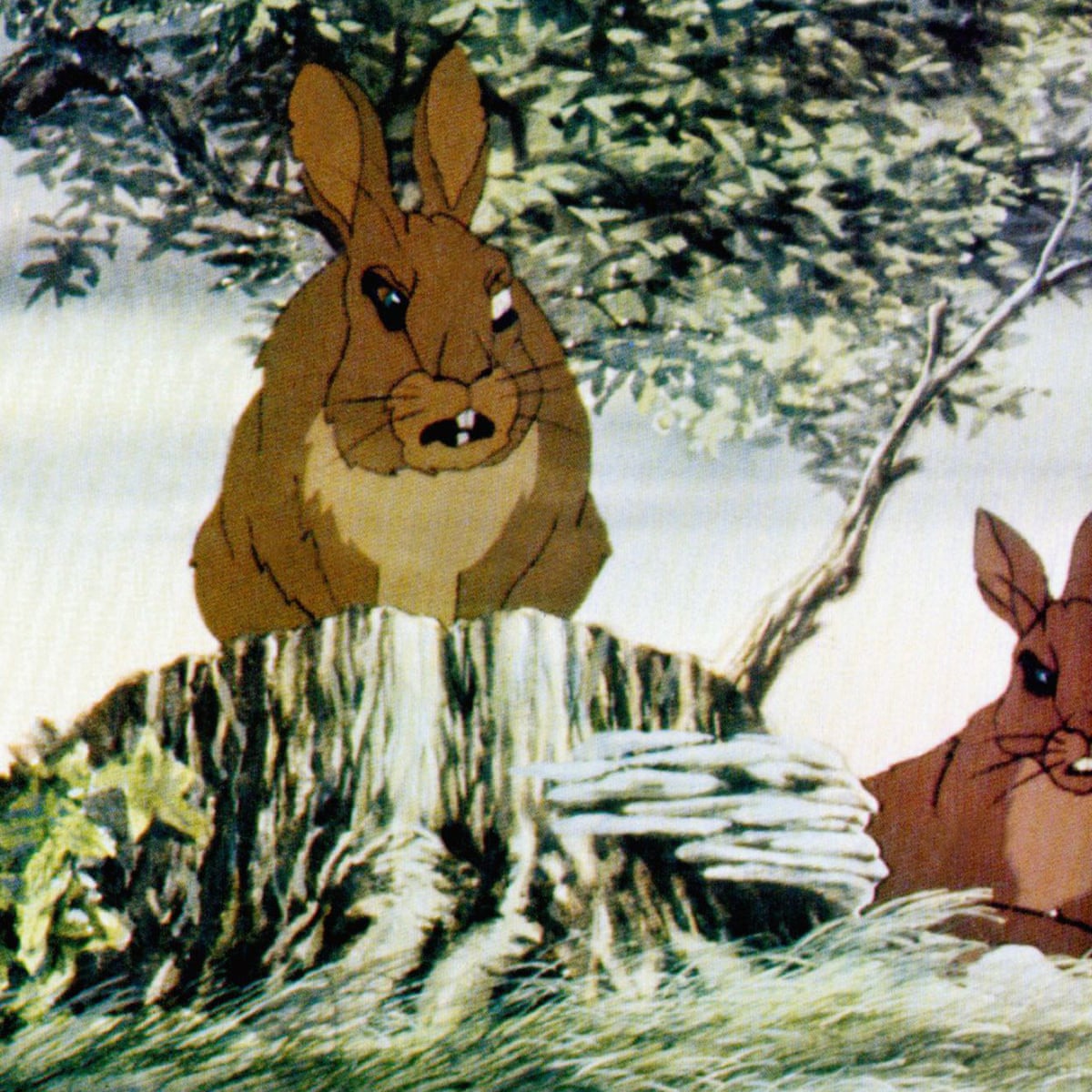
A cartoon movie about bunny rabbits doesn’t sound like the sort of thing that would hold the interest of a thoughtful adult. But give this 1978 movie a chance. Like the Richard Adams book upon which it is based, the film is dark, dramatic, and in parts, engagingly philosophical. Although older children will probably like it, Watership Down is really an animated movie for grown-ups.

The story centers on a warren in which all the rabbits seem happy and safe. Yet a rabbit named Fiver has a prophetic vision of blood and destruction. He and his older brother Hazel cannot get the local rabbit chief to believe them about the danger; indeed the warren’s police (the Owsla) try to suppress their dissent. With a group of fellow rebels, including a powerful former Owsla member named Bigwig, Fiver and Hazel fight their way out of their warren to seek a new home.

Watership Down too violent for tots? Probably, but parents should take  control of the remote | Animation in film | The Guardian

Their journey is filled with hazards and some of the rabbits come to bloody ends. They encounter different warrens with different sociologies and politics, eventually establishing their own independent warren at Watership Down, which Fiver had seen in a vision. But they soon come into conflict with another, imperialistic warren run by the menacing General Woundwart (as scary a villain as one could ask for in a movie about rabbits).

I consider Watership Down the best animated film ever produced in the UK. The rabbits’ faces are expressive and their movements realistic. The story is exciting and contains moments of serious drama. As for music, Art Garfunkel fans will appreciate “Bright Eyes”, which is accompanied here by an appealing animated sequence. And the voice actors, especially John Hurt, are outstanding. My only complaint is the presence of a comic relief bird character voiced by Zero Mostel (it was his final film performance). I suppose that was put in to make the film more kid-friendly…I think it would have better to just go for it and target the film at adults, but YMMV. Even if you don’t like the bird, it’s a small annoyance in what is overall a very good movie.

The trailer is a bit long, but gives a flavor of the film.

p.s. Rosen (and Hurt) went back to the Adams well a few years later to make The Plague Dogs. It drew nowhere near the same audience, probably because it’s significantly grimmer than Watership Down. But it too is an accomplished work.

Categories
Action/Adventure British Drama

The Hill

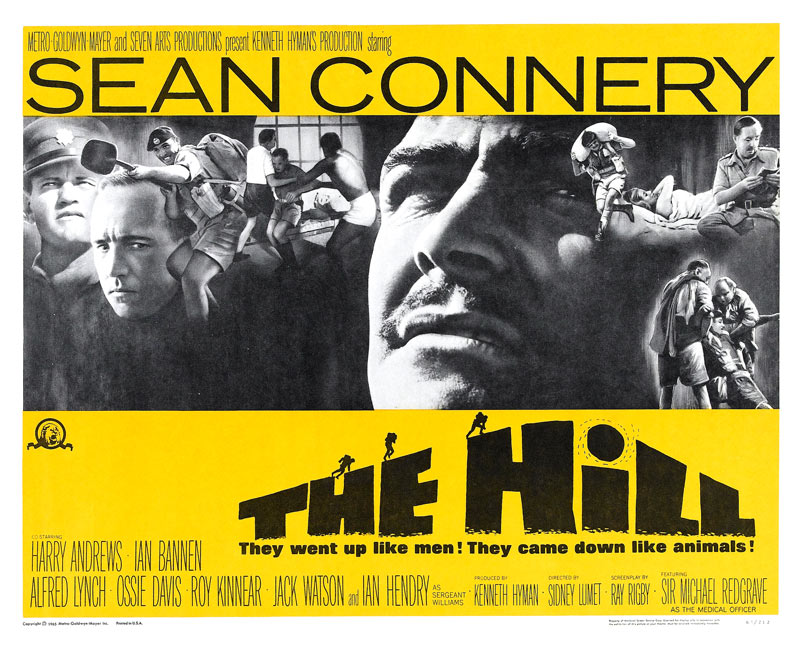
Sidney Lumet’s brutal, gripping 1965 movie The Hill opens with a solitary figure laboring up the man-made torture device that gives the film its title. In one of Oswald Morris’ many mesmerizing crane shots, the man collapses in the North African heat and then the camera begins to move slowly away, off into the distance, abandoning the man and the compound in which he is forced to live. As in the rest of the film, no music is heard, which lets the hopelessness and isolation of the people we are watching sink in.

The story begins with five British soldiers arriving at a military prison. Four of them are privates who have committed various crimes (including Ossie Davis as a West Indian soldier and Roy Kinnear as a fat spiv), but the fifth is something different. Joe Roberts (Sean Connery) was a heroic sergeant major who has been busted down for beating up his commanding officer. Connery, given his first chance as a star to do something different from James Bond, plays the part well, showing how Roberts can be callous in some respects yet gentle in others. He is in emotional agony, for reasons that become clear as the film progresses.

The most complex performance is given by Harry Andrews, as RSM Wilson, who runs the daily operations of the prison. It would have been easy to write and play the character of RSM Wilson as a heartless martinet. But Ray Rigby’s script and Andrews’ acting are much more sophisticated than that. Yes, the RSM can be tough, but he also shows compassion because he is committed to rebuilding the prisoners rather than simply destroying them. He’s a three dimensional person, unlike the newly arrived Sergeant Major Williams (Ian Hendry), who is uncomplicatedly nasty. Ian Hendry, who was by all accounts a piece of work in real life (sadly, he drank himself to death in his early 50s) is convincingly vicious as Williams. As Connery’s character says “Wilson wants to build toy soldiers and Williams wants to break them”.

The prisoners struggle against the harsh prison regime, and also among themselves. But as Williams gets more brutal, causing a tragic incident, they begin to unify in opposition to the screws. They are aided by a diffident medical officer (a solid as ever Michael Redgrave) and a staff sergeant whose motives are interesting to speculate about (Ian Bannen).

Two complaints. The film would have benefited from some tightening in length and from dropping the final stages of evolution of Ossie Davis’ character. His behavior at the end seems a theatrical flourish to please a 1965 audience and not, like the rest of the film, a realistic take on WWII prison life. His performance though, like that of everyone else in the all-male cast, remains top-notch.

It would be an injustice to close on such cavils, however. Sidney Lumet’s “movie as play” style works perfectly in the claustrophobic setting of a prison. Cinematographer Oswald Morris and editor Thelma Connell do brilliant work throughout, particular during the scenes in which the prisoners are forced to climb the hill (In one case, while wearing a gas mask — horrifying). Given its subject matter and tone, this isn’t a date movie…but it’s a great movie.

A closing note on Connery’s evolution: As this critically-acclaimed movie bombed at the box office he saw audiences line up world wide to munch popcorn and watch Thunderball, which began to disgust him with the James Bond franchise and the state of his career. But while he didn’t know it at the time, he had already made the wisest move possible, which was to link up with a great director who saw more to him as an actor than the Bond films revealed (For more on this, see my recommendation of The Offence). 

Categories
Action/Adventure British Drama

The Cruel Sea

To compliment my recommendation of The Long Arm, let me endorse an even better film featuring the wonderful Jack Hawkins. In the high point of his career as a star (although he would go on to have a career as a character actor in upmarket blockbusters such as Lawrence of Arabia, Zulu, and Ben-Hur), Hawkins turns in a powerful, weighty performance as Captain Ericson in 1953’s The Cruel Sea. Scripted by Eric Ambler and based on the well-regarded Nicholas Monsarrat novel of the same name, this is a realistic, exciting and emotionally affecting portrayal of the British Royal Navy’s efforts to protect convoys from the predations of German U-Boats.

As the story begins in 1939, Ericson is called from the merchant marine to captain a corvette with a crewful of amateurs. His second lieutenant, Bennett, is a martinet of questionable ability (Stanley Baker, who really registers here in an early role for which he campaigned after being impressed with the character’s possibilities in the novel), and the junior officers below him were only recently working as barristers, journalists and in other professions that are of no value in naval combat. Ericson must train and lead them while making the terrible life or death decisions that wartime demands (If you want a short, powerful take on the nature and challenges of leadership, the events about 40 minutes into this movie are hard to beat). He is at least encouraged that when Bennett suddenly departs the ship, one of his young officers, Lockhart (Donald Sinden), starts to grow into the kind of officer he can count on.

Meanwhile, the crew have to protect convoys from U-boats, which increasingly gain the upper hand as the war wears on. In these scenes, documentary footage is smoothly blended with shots of the actors to give us the feel of being at sea as storms rage and the terrible possibility of torpedoes is ever-present. There are moments that will have you gripping the armrests and hoping along with the men that they will survive each crisis in which they find themselves.

Categories
Action/Adventure British Drama

Hell Drivers

Having recommended the movie that gave Stanley Baker his first break (The Cruel Sea) and one he produced and starred in once established (Robbery), let me fill in the middle by recommending the thrilling film that made him a star in 1957: Hell Drivers.

The plot is agreeably simple. Baker plays Tom Yately, a tough but moral ex-con trying to go straight. He takes a job at a trucking firm managed by a ruthless boss (William Hartnell, who effectively plays the villain here, albeit of a different type than in Brighton Rock). The business would give OSHA a coronary. The truckers are assigned to ship gravel from a mine to a worksite many times a day, getting paid more money the more trips they make. They respond by driving like maniacs, at significant risk to themselves and others. And they all compete to topple the domineering, violent and reckless “Red” (Patrick McGoohan) as the top driver of the crew. Meanwhile, Tom befriends a kindly, devout Italian driver named Gino (a spot on Herbert Lom) whose girlfriend (Peggy Cummins) begins to put the moves on him.

The driving scenes in this movie are thrillingly shot by the justly revered Geoffrey Unsworth (I’ve praised his work in A Night to Remember, Superman and Unman, Wittering and Zigo). This includes the ultimate driving test from hell for Tom Yatley, in which he is accompanied by a perfectly droll Wilfrid Lawson as the firm’s mechanic. The final confrontation of the film, as Red and Tom have a trucking duel in an abandoned quarry, is particularly well-done and highly satisfying.

Categories
Action/Adventure British Drama

Layer Cake

Layer Cake (2004) where the old criminal boss has a nice library.

Let’s get meta: That’s Sir Michael Gambon sitting in the very chair where I wrote this recommendation of the film in which he and it appear: Matthew Vaughn’s stylish and hard-edged Layer Cake. Gambon plays wily drug kingpin Eddie Temple in one of the great British gangster films (which is saying something, they have been making outstanding movies about guns and geezers over here for three quarters of a century).

The film centers on cocaine middleman “Mr. X”, played convincingly by a pre-James Bond Daniel Craig. One of the many things the film gets right about the illegal drug trade is that it includes people like Mr. X who think they can make big money while remaining untouched by the damage that drugs do downstream and the violence and immorality of the kingpins who call the shots upstream. Mr. X tells himself he is just a businessman whose commodity happens to be illegal, and that he will simply leave the drug trade behind him when he is financially secure. But when drug honcho Jimmy Price (Kenneth Cranham) gives him an unusual assignment, his assumptions are shattered and he quickly gets in way, way over his head. Meanwhile, he develops a serious case of the hots for a low-level gangster wannabe’s girlfriend (played by Siena Miller…rumor has it that she and Craig prepared for their sex scenes together Lee Strasberg-style).

The supporting cast is uniformly strong, with a standout performance by Colm Meaney as a long-time gangster. There are some over-the-top camera shots by Vaughn which some people found self-conscious and annoying, but they work well given the kinetic story line. And Gambon’s soliloquy on “the facts of life” is as quotable and as well-delivered as anyone could ask.

p.s. This film is rated R with an exclamation point, so by all means don’t bring the kids.
p.p.s. Vaughn shot three different endings for this movie, all of which I’ve watched and he definitely picked the right one.

Categories
Action/Adventure British Comedy Horror/Suspense Romance

The 39 Steps

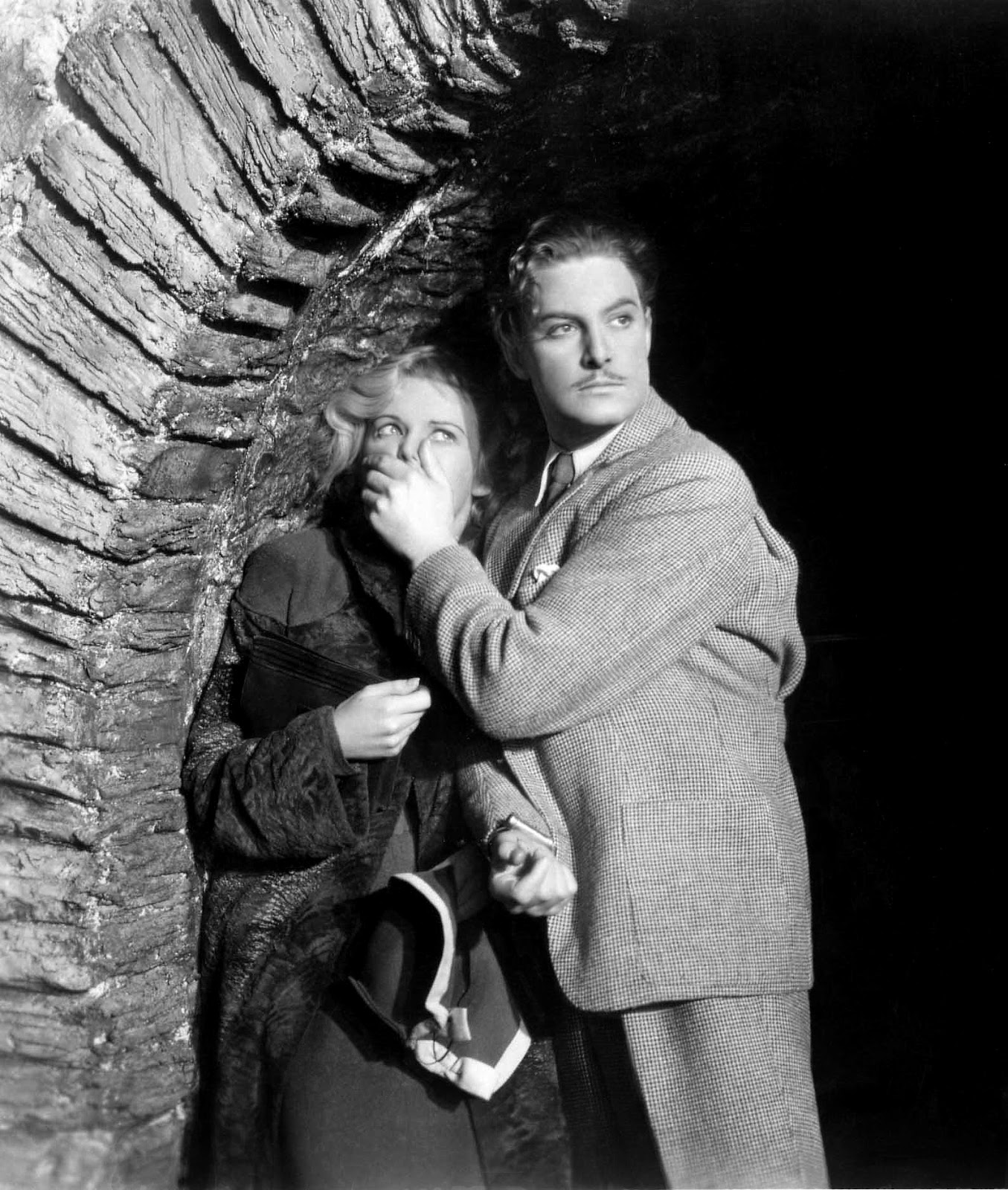
The 39 Steps (1935)

Alfred Hitchcock had a successful directing career in Britain that preceded his American super-stardom. Hitchcock fans rightfully consider the 1935 comedy-romance-thriller The 39 Steps among the very best works of the Master’s “British period”.

Robert Donat cuts a dash as Mr. Hannay, the hero of the film, who tries to save England from the threat of nefarious and crafty foreign agents. As in other Hitchcock films (e.g., North by Northwest, The Wrong Man, The Man Who Knew Too Much,), the central character is an innocent who is pulled into a web of intrigue and danger which he doesn’t understand. But unlike in those darker films, it doesn’t seem to bother him a jot.

“Did this beautiful woman just fire a gun in a crowded theater to evade her pursuers and then tell me that she is an international spy for hire? Well then, let’s go back to my flat for a large whiskey and soda and I’ll cook her up some haddock while she tells me all about it.”

“I seem to have walked into a political rally focused on I know not what and I have been mistaken for the distinguished guest speaker. Well then, jolly good, I’ll give it a go.”

“Am I really handcuffed to yet another beautiful woman as I run through the Scottish Highlands with people trying to shoot me? Well then, I wonder if she’s married or at least broad-minded.”