Categories
Action/Adventure British Drama Mystery/Noir

The Spy Who Came in From the Cold

What the hell do you think spies are? Moral philosophers measuring everything they do against the word of God or Karl Marx? They’re not! They’re just a bunch of seedy, squalid bastards like me: little men, drunkards, queers, hen-pecked husbands, civil servants playing cowboys and Indians to brighten their rotten little lives.

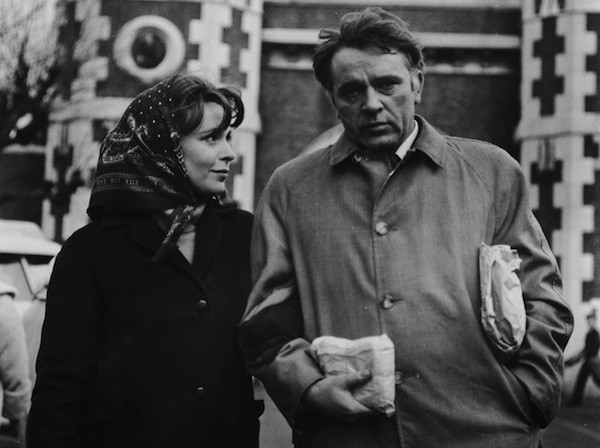
So says disillusioned British secret agent Alec Leamas (Richard Burton) in perhaps the best effort to adapt a John le Carré novel to the big screen: 1965’s The Spy Who Came in From the Cold. The serpentine plot concerns a burnt-out spook who enters a downward spiral of booze, self-hatred and lost faith after a disastrous mission in Berlin. But then it turns out that Leamas’ decline and despair is a ruse (?) play-acted at the behest of his superiors. As planned, he is recruited by the other side and ends up trying to discredit East German intelligence head Hans-Dieter Mundt (A cold, effective Peter van Eyck). Leamas undermines the ex-Nazi by feeding false (??) information to Mundt’s ambitious, Jewish deputy Fiedler (Oskar Werner, very strong here). It’s a difficult, high-risk mission, but Leamas knows that his boss back home is 100% behind him (???).

This may be the most magnificent performance in Richard Burton’s career, and will definitely please all fans of rotting charm. Drinking heavily in real life at the time, he was willing to expose his own capacity for ugliness and decay in a way that many glamorous stars of his era would not have dared to do. He exudes bone crunching hopelessness and isolation in shot after shot: Leamas alone on a park bench, alone in a bar, alone in his bed, alone chained in a cell. He’s devastated and devastating.

A 15 minute sequence of scenes in Britain is a masterclass in cinematic storytelling. It’s unsettling yet fascinating as Leamas repeatedly gets pissed and wanders through empty streets. Ultimately, he savagely beats an innocent man (Did the filmmakers cast for this part Bernard Lee — M from the flashy, unrealistic James Bond series — to make a point?). His copybook blotted, Leamas is judged “turnable” by the other side. After being released from jail, he is recruited by the Soviets in a sleazy men’s club by an unctuous businessman and a pathetic, gay procurer (Robert Hardy and Michael Hordern, respectively, terrific actors who clearly understood that there are no small roles).

The romantic aspects of the story also work well and become more important as le Carré’s ingenious plot unfolds. Claire Bloom is credible and sympathetic as the British would-be communist, who as Leamas puts it believes “in free love, the only kind I could afford at the time”. Leamas’ lacerating disdain for her naiveté reveals the depths of his own self-contempt: She may be immature in her politics but who after all is the one risking his life and doing horrible things in a struggle over the very same politics?
And Then There Were None, The Spy Who Came In from the Cold ...

Rarely has the look of a movie more perfectly captured its mood, and that’s a credit to Oswald Morris. Without any conscious intention, I think I have recommended more films shot by Morris than any other cinematographer. He was a remarkably unpretentious professional who maintained an astonishingly consistent quality in his work for 6 decades (He lived to age 98). It was a bold and brilliant choice to make this movie in black and white, which let Oswald create a washed out look that matches the bleak tone of the story. As much as the excellent acting, what stays with the viewer are Oswald’s shots of complete desolation both during Leamas’ alcoholic, putatively free, British wanderings and his time in East German captivity.

The other delight of this film is that it never condescends to the audience by over-explaining. With each double and triple cross, rather than clumsy exposition, director Martin Ritt simply gives us Burton’s face, as the mind behind it struggles frantically to make sense of the latest shift in the icy wind. A small example of the film’s understated, even at times cryptic, storytelling style is the scene where Fiedler asks for some paperwork from his underling Peters (Sam Wanamaker, memorably creepy). The seated, lame, Wanamaker extends his hand but not far enough. Rather than step forward, Fiedler waits until Peters struggles to his feet and hands it to him. Leamas chuckles derisively. The subtext which the film expects you to understand: Fiedler is the boss but as a Jew, he will never be fully respected by his German underlings. A small moment, a sly moment, a powerful moment, brought across with no comment other than Leamas’ mad laughter at Peters’ expense.

Touches like that are a key reason why The Spy who Came in from the Cold is completely engrossing. Fans of espionage films simply cannot miss this landmark movie.

p.s. If you like this movie, you might enjoy two of my other recommendations. Though not as good as this film The Deadly Affair is a solid effort to adapt le Carré’s first novel to the big screen. And the astoundingly brilliant Tinker, Tailor, Soldier, Spy is the best effort to adapt le Carré to television.

p.p.s. I also recommend Antonia Quirke’s elegiac FT essay on the battered, shattered Richard Burton and his iconic dingy overcoat.

Categories
Action/Adventure British Mystery/Noir

The Scarlet Claw

Of the many film series of the 1930s and 1940s, Sherlock Holmes stood out both for its watchability and its unusual provenance. It was launched at 20th Century Fox in 1939 as a high-end period production. But after two very strong films, The Hound of the Baskervilles and The Adventures of Sherlock Holmes (my recommendation here), Fox unaccountably dropped the series. Enter Universal Studios, who retained the lead actors and moved the series to modern times (Partly for WWII morale building and partly as a cost-cutting measure). Universal made a dozen modestly budgeted Holmes films in rapid succession over the next four years. Financial constraints and breakneck speed of production were no barrier to quality in this case. None of the films are bad and several are outstanding, including 1944’s The Scarlet Claw.

The plot: Holmes and Watson are in Canada, participating in a conference about the occult. Holmes’ open skepticism about the supernatural irritates the organizer, Lord Penrose (Paul Cavanagh). Penrose gets a message that his wife has been murdered, and the meeting is abruptly adjourned. Holmes presently receives a telegram sent by Penrose’s wife just before her death, saying that she feels she is in grave danger and wants Holmes to help her. Despite Lord Penrose’s hostility to him, Holmes sets off for the fog shrouded town of La Mort Rouge, where the locals believe a monster is ripping the throats out of livestock and also people. The monster is targeting particular individuals for some mysterious reason…can Holmes discover the motive behind the grisly crimes and save the next intended victim?

The heart of the Universal series are the triumvirate of Producer-Director (and in the case of The Scarlet Claw, co-screenwriter) Roy William Neill and stars Basil Rathbone and Nigel Bruce. With his mien, delivery and intelligence, Rathbone was born to play the king of detectives and he defined the role for a generation through appearances on radio, television, film and stage. Neill and Bruce decided to make Watson much more comic than he was Doyle’s stories, which irritated some Baker Street Irregulars. If you can let that go and just take the performance for what it is, you will appreciate that Bruce is indeed agreeably funny in the role and also contributes some moments of emotional warmth which balance out his calculating machine of a friend.

The Scarlet Claw (1944): Fear and Flannel | Nitrate Diva

The Scarlet Claw is a high point of the series in part because it feels like an old-fashioned Victorian Holmes story even though it is set in the present day. Unlike in prior entries, Holmes is not battling Nazis but a killer who is (as in many of the films) a pastiche from the original stories. The moody, dark surroundings in rural Canada could easily pass for the Baskerville estate in Dartmoor. Also on display are some first rate make-up and special effects work, which is essential to the story for reasons I will not reveal. The film is also the career highlight of little-known British character actor Gerald Hamer, who makes the most of the opportunity to demonstrate his versatility as a performer. Cavanagh, a handsome, solid B-movie actor with aristocratic bearing who appeared in several films in the series (Including the House of Fear, which not incidentally recycles sets from Sherlock Holmes Faces Death) and also in another of my recommendations, (The Kennel Murder Case) is fully at ease in the role of Lord Penrose. The script is strong and Neill by this point in the series had mastered every aspect of how to create fine Holmesian cinema. The result is a skillfully made, suspenseful mystery.

More generally, as a body of work, the Universal Sherlock Holmes films depart too significantly from the original stories for some people’s tastes, but in performances and atmosphere they stand shoulder to shoulder with the tremendous Soviet Livanov-Solomin and British Granada television versions as high-quality, sustained efforts to adapt Conan Doyle’s beloved stories to the screen. Also, the prints of these films have been beautifully restored by the angels at the UCLA film preservation archive. Scarlet Claw is my favorite, but you could pick up almost any of the Universal series and have a fine evening watching the world’s greatest detective work his magic.

Categories
Action/Adventure British Mystery/Noir

The Blue Carbuncle

Christmas time is here, happiness and cheer, fun for all, that children call, their favorite time of year!

Mine too, not least because there are so many enjoyable Christmas films to recommend, including an episode from Granada Television’s justly revered Sherlock Holmes series: The Blue Carbuncle.

Eccentric, unstable, dashing Jeremy Brett, whose acting (as Edward Hardwicke put it) contained “a whiff of the Edwardian” was an inspired choice to play Holmes in this handsomely produced series. David Burke makes a fine, gentle Dr. Watson in the early episodes, succeeded by an equally good Edward Hardwicke as a flintier sort of Watson in the latter part of the series. The Blue Carbuncle features Burke as Watson, and the byplay between the actors is a marvel, bringing out the warmth of their friendship yet also Holmes’ tendency to talk down to Watson, sometimes with marked asperity.

The plot: It’s Christmas time in London, though the scowling Countess of Morcar is unhappy (Rosalind Knight, putting just the right undercurrent of humour into an overtly Scroogish performance). She finds Christmas a chore in any event, but even moreso when her precious gem, the blue carbuncle, is stolen! Meanwhile, Commissionaire Peterson (Frank Mills) brings a goose to Holmes with a strange story of how he has seen a man lose his treasured Christmas dinner. Through an ingenious series of deductions, Holmes sees that the two mysteries may be connected, but he must race against time as an innocent man (Desmond McNamara) has been framed for the crime, leaving his struggling wife and children in agony as the holiday approaches.

As with the series as a whole, the original material is treated reverently, with many lines lifted straight from the text and the climactic scene nicely staged to match Sidney Paget’s drawing from the original Strand magazine publication of Doyle’s story. And the Christmas spirit is everywhere, in the incidental Victorian-style music, set decor and story elements. Not generally thought of as a Christmas movie, The Blue Carbuncle is a fine appetizer for your family by the fire, before you tuck into your own Yuletide bird.

Categories
British Drama

Scrooge

Scrooge is deservedly a beloved Christmas movie. Like the not dissimilar It’s a Wonderful Life, it came by its standing as a beloved film democratically: Long after it was released generations of people fell in love with it on television. And with very good reason.

The heart of this film is Alastair Sim, whose lack of a 1951 best actor Oscar nomination should make the Academy hang its head in perdurable shame. More than any other movie adaptation of Dickens’ novella, screenwriter Noel Langley’s treatment gives Scrooge a backstory that explains his nature and outlook, making him a more fully developed character. Sim must therefore portray powerful moments of grief, cruelty, pity, parsimony, regret, remorse and manic joy, and he does so in a profoundly effective way. He was so damn good in everything he did (e.g., Green for Danger, another of my recommendations) that it’s hard to say which is his greatest film performance, but this may well be it.

Categories
Action/Adventure British Science Fiction / Fantasy

20,000 Leagues Under The Sea

In my recommendation of Treasure Island, I described how and why Disney started making live-action family films after the war. One of the studio’s greatest films of this period is a dramatic, well-mounted adaptation of Jules Verne’s steampunk classic: 1954’s 20,000 Leagues Under the Sea.

The story opens with sailing vessels being destroyed in the South Seas by a mysterious underwater creature. Is it a kraken, a dragon or something else? At the behest of the U.S. government, a Parisian professor (Paul Lukas), his faithful assistant (Peter Lorre) and a free-spirited sailor (Kirk Douglas) join a military expedition to either find the monster or prove it doesn’t exist. In a fatal confrontation, their ship encounters disaster, which brings them face to face with Captain Nemo (James Mason), his devoted crew, and his extraordinary “submarine boat”.

James Mason as Capt. Nemo | Leagues under the sea, Movie stars ...

Mason, as the tortured, destructive yet also sympathetic Nemo is in top form, adding weight to proceedings that might otherwise have been comic bookish. Lukas, as the brilliant scientist who is both Nemo’s prisoner and his nagging conscience, is an effective foil for Mason. Lorre isn’t given a huge amount to do, but he makes the most of it by being more vulnerable and afraid that the other central players, thereby giving the audience someone with whom to identify.

The special effects were trend setting at the time and still hold up pretty well today, as does the knockout set design on the submarine. It’s particularly hard to forget Nemo playing Bach’s Toccata and Fugue in D Minor on the organ as the Nautilus glides through the ocean deep. Also adding to the striking look of the film is Peter Ellenshaw, who as in Treasure Island does magnificent matte work (the crowded shipyard at the beginning and the Island of Volcania at the end are flawless).

The film has two weaknesses. The first is Kirk Douglas’ endless mugging and preening. I don’t know if Director Richard Fleischer couldn’t control his star’s legendary desire for attention or gave him bad direction, but it gets old pretty quickly. The second is that like many films of the period (e.g., King Solomon’s Mines), this one includes “nature photography” moments that would have dazzled audiences at the time but are pretty slow stuff for a generation that has the web, television and a thousand episodes of Jacques Costeau at its fingertips.

But neither of those flaws stops this from being outstanding family entertainment with exciting action scenes, a strong story, eye-catching visuals and moments of real emotion. It’s great fun for you and the kids on a rainy Sunday afternoon.

I close this recommendation with a must-view clips for film-buffs. The truly spectacular fight with the giant squid in the film version released to theaters was not the first one that was shot. Here is the inferior original, the “Sunset Squid Sequence”.

Categories
British Comedy

Porterhouse Blue

If a little knowledge is a dangerous thing, think how much harm a lot of it could do. That’s the animating spirit of the academically-challenged but gastronomically-unmatched Cambridge college of Porterhouse, as portrayed in 1987’s Porterhouse Blue.

Based on Tom Sharpe’s satirical novel of the same name, this television mini-series centers on the longest-serving employee of the college, Skullion (the beloved British actor Sir David Jason). He and the senior fellows must cope with an ambitious nincompoop, Sir Godber Evans (Ian Richardson), who has been cast off from politics and made the new master of the school. Godber’s motto is “Alteration without change”, but he is an uxorious man very much under the heel of his titled harridan of a wife (Barbara Jefford). She insists that — gasp — women be admitted to Porterhouse! In this and in a hundred other ways, the new arrivals war with the traditionalists, with both sides being played perfectly by the cast for self-puncturing guffaws.

Richardson and Jason sparkle as the leads, as does Charles Gray as a rich, perverted old boy and John Sessions as the one person at Porterhouse who seems keen to get an education. His character, Zipser (allegedly the author’s self-parody), is one of British film’s great comic schmucks. His thesis is on “Pumpernickel as a factor in the politics of 16th century Westphalia”. He is awkward, sexually frustrated and obsessed with the flirtatious older woman who serves as his bedder (Paula Jacobs). His misadventures trying first to obtain — and then to dispose of — several gross of johnnies is uproariously funny.

Fair warning about this movie. If you don’t know anything about Oxbridge life, British society more generally, and can’t make out dog Latin, I would bet that at first Porterhouse Blue could be slow going. But stick with it, because it gets funnier and more accessible as it moves along.

p.s. I have been looking for years for a full translation of the Flying Pickets’ spirited rendition of the ridiculous and delightful Porterhouse college theme song. I have found translations of the first verse, but never the full song. If anyone can point me to a full translation, I would be extraordinarily grateful.

Categories
British Drama

Great Expectations

The great director Sir David Lean is remembered mainly for lushly coloured 70mm epics with big international casts, sweeping stories and long running times (e.g., Lawrence of Arabia, A Passage to India, Bridge on the River Kwai, Dr. Zhivago). But he had a fine career before those triumphs during which he made tightly constructed black and white films with British casts, stories and locations. These early Lean films include two excellent Dickens’ adaptations, one of which is the 1946 version of Great Expectations.

The origins of Lean’s adaptation of the oft-filmed novel are visible in another film I recommend: In Which We Serve. Lean was an accomplished film editor when he got a chance to break into directing alongside Noël Coward on that movie. The cinematographer Ronald Neame is the producer of Great Expectations (and likely an influence on Guy Green’s trendsetting camera work). Bernard Miles and John Mills are back as actors, again adroitly playing off each other with emotional impact. Kay Walsh goes from acting to collaborating with Lean on the screenplay (along with Neame, Anthony Havelock-Allan, and Cecil McGivern), a masterpiece of economy which relates Dickens’ 500-page novel in just 118 minutes. Walsh went on to star in Lean’s excellent Oliver Twist and in private life to become the second in his series of six wives (imagine the alimony payments!). Alec Guinness was not in In Which We Serve, but Great Expectations, his first sizable film role, began his long-running cinematic partnership with Lean. All of this demonstrates what a small community British film was in its glorious period after the war, and the even smaller nature of the network Lean constructed around his own projects.

Categories
Action/Adventure British Drama

The Frightened City

In nearly a century on this earth, Herbert Lom had a long and varied acting career. Born in Prague under the Austro-Hungarian Empire, he achieved screen immortality as the Chief Inspector whom Clouseau slowly drives mad in the Pink Panther films. But before that did excellent work in many high-quality films, most of which unfortunately are largely forgotten today. I have spotlighted his fine performance as the kindly, devout, ill-fated Gino in Hell Drivers. Lom has a completely different role as a cold, clever and super-smooth criminal mastermind in 1961’s The Frightened City.

The Frightened City is a B-movie which doesn’t pretend to be otherwise. The budget is modest and so are the ambitions. But on those terms it delivers as a solid crime melodrama with a great starring role for Lom and excellent supporting work by a then little known Scottish actor who was only a year away from becoming an international superstar: Sean Connery.

The film is set in the London criminal underworld. A wily financier (Lom, conveying the calm of the truly powerful in every scene) figures out that the six biggest gangs could enhance the revenue of their protection rackets by organising themselves as a syndicate. He convinces one gangster (an agreeably lubricious Alfred Marks) to head the syndicate, who in turn recruits a former burglar (Connery) to be the face of the mob to the shops, pubs and restaurants it extorts. All goes well until the gang falls out, leading to a murder that throws the syndicate into turmoil and gives a dogged Scotland Yard detective inspector (John Gregson) the chance he needs to pounce.

The secondary plotline concerns Yvonne Romain as a luscious, ambitious immigrant singer who catches Connery’s eye. They have great chemistry on screen, and the script does a gratifying job of making her craftier than him rather than portraying her as a brainless tart (funnily enough Romain’s real-life husband went on to write the lyrics of several of Connery’s Bond films, including Goldfinger). The other engaging aspect of the story is Connery’s relationship to his former burglary partner (well-played by Kenneth Griffith), who has been crippled in a fall during an attempted break-in. Connery skillfully conveys the guilt he feels about the accident, and how it drives him into the hands of the new, more violent crew who are running the protection racket.

The film is not without weaknesses. Some of the sets look cheap, probably because they are. The script underdevelops its theme of how crime was changing to become more violent and organised and thereby outpacing long-standing law enforcement tactics. As a result, the scenes with the police are a bit slow and stale. And John Lemont’s direction is more reminiscent of a TV show than a movie (on the plus side, if you watch this on DVD instead of in a theater, you are not missing anything). For those reasons, the film goes into the good rather than great category.

As a closing note: Norrie Paramor’s jazzy title song became a big hit for Britain’s premier instrumental group of the era, the Shadows. Just for fun, you can see their totally pukka rendition of the theme on Crackerjack. Love those suits and dance steps!

Categories
British Horror/Suspense

Forgotten Draculas **Triple Feature**

Other perhaps than The Bible and The Sherlock Holmes stories, no book has inspired as many movies as Bram Stoker’s Dracula. Everyone knows the famous Bela Lugosi version, but few people are aware of the versions I am recommending here.

Count Dracula was broadcast on BBC in 1977, and is perhaps closer to the original text than any other version (except that Meena and Lucy are sisters rather than friends, and one of Lucy’s three suitors is omitted). The elegant French actor Louis Jourdan makes a memorable Count Dracula, conveying a mixture of civility, erudition, seductiveness, arrogance, and menace. Equally good are Frank Finlay as a kindly, devout Professor Van Helsing and Jack Shepherd in an unusually sympathetic take on the madman Renfield. Props also to Bosco Hogan for vividly portraying Jonathan Harker’s progressive mental breakdown under the strain of being trapped in Dracula’s castle.

The budget for the BBC production was clearly small, and that shows in some cheap special effects, the lack of any eye-popping sets, and the absence of mega-stars. But within the limits of a television budget, it’s a quality movie, especially the exciting closing confrontation between our heroes and Dracula.

An even better TV adaptation, simply called Dracula, was made in 1973 by Dan Curtis of Dark Shadows fame. His frequent collaborator Richard Matheson departs substantially from the original story in his script, offering a fresh take on the world’s most famous vampire. Dracula, played with panache by Jack Palance, is as much sad as threatening, longing for the normal life he had centuries ago and seeming almost to regret his thirst for human blood. Matheson also strips down the number of characters (e.g., no Renfield, Dr. Seward, Quincy Morris or Arthur Holmwood) in a way that simplifies and helpfully speeds up the storytelling. My only gripe about Matheson’s changes is that Professor van Helsing was turned into a proper Englishman (Nigel Davenport) when he works better as an old-world character steeped in the mythology of nosferatu. Oswald Morris, whose work I have praised many times on this site, again offers fine cinematography, which enhances Curtis’ ability to deliver moments that make viewers hold their breath or let out a scream.

The final forgotten Dracula I would recommend was made by Universal Studios in 1931. You are probably thinking “What does he mean ‘forgotten’, that was the most famous version ever, wasn’t it?”. The English-language version is indeed the most famous, but in the early days of talkies, films were not dubbed for foreign markets. Rather, the studios would shoot the same film twice with a different cast in a different language. That’s how the Spanish-language version of Drácula was made in 1931. Bela Lugosi, Tod Browning et al did their shooting during the day, and then a completely different crew and cast shot the same scenes in Spanish at night.

The Spanish-language crew had a smaller budget, but they also had a distinct asset: They got to see the rushes that the English-language crew had shot that day. This allowed them to replace shots that were dull or didn’t work with new set-ups, and the result is much better camerawork in the Spanish-language version. This version also adds in a few scenes that make the story more coherent. I would not say it’s better than the Lugosi/Browning version, but I would say that on balance it’s just as a good and well worth your time both for itself and for comparative interest with its more famous twin.

This 3 minute video from CineMassacre does a superb job comparing the two productions:

Categories
British Comedy

Time, Gentlemen, Please!

Where to stream Time, Gentlemen, Please! (1952) online? Comparing ...

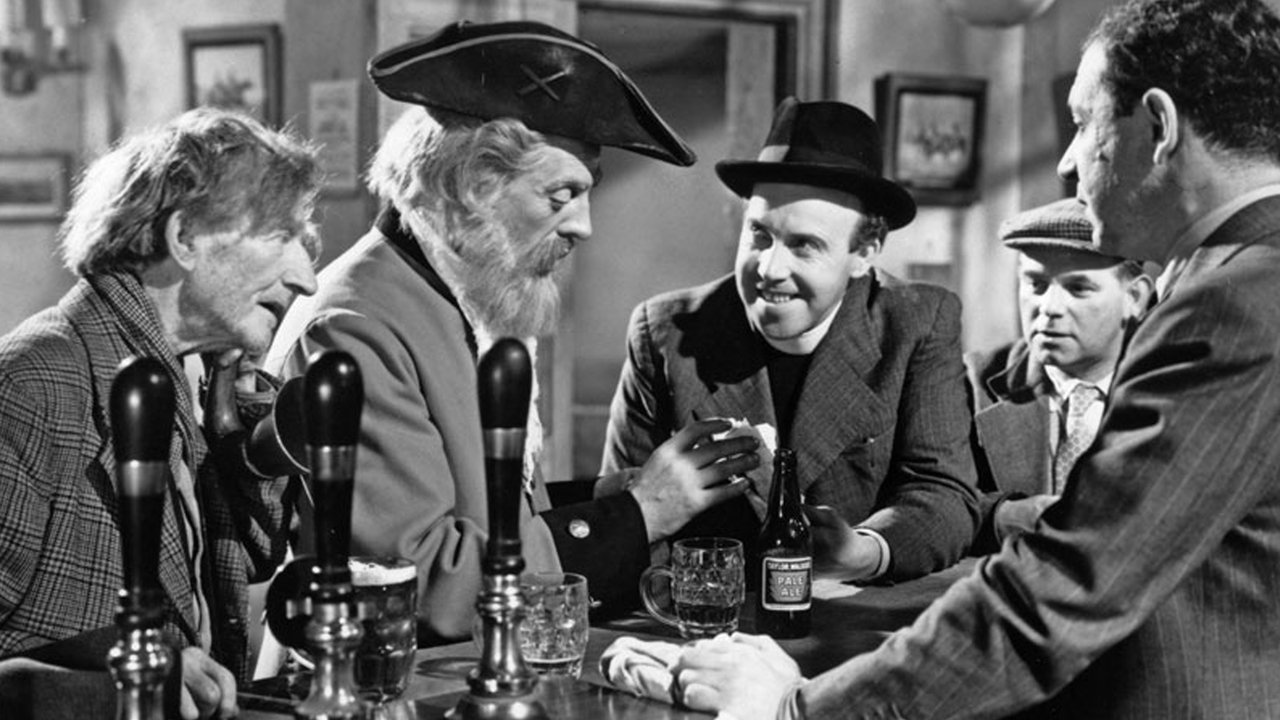
Due to distribution problems, lost celluloid, legal disputes, or bad luck, some excellent films became inaccessible after their debut and eventually fall through the cracks of almost everyone’s memory. 1952’s almost completely forgotten Time, Gentlemen, Please, which isn’t even mentioned in most of my books about film, is a prime example. There were I understand copyright and distribution disputes that kept it from being available after original release for decades. But it’s out on DVD now, and that’s a gift to lovers of British comedy.

The story is set in Essex, specifically in the hardworking town of Hayhoe. Indeed, its 99.9% employment rate has earned it a personal visit by the Prime Minister! The stuffy town council members want to make the employment rate 100% before the PM arrives, but a charming, boozy, Irish rogue named Dan Dance (Eddie Byrne) stands in their way. He has no interest in work, so the prigs in charge stick him in the heretofore unused almshouse, which is run by the dour Mr. and Mrs. Crouch (Ivor Barnard and Thora Hirch). The tables are turned however when a reformist pastor discovers that the town’s founding documents insist that all taxes from the old estates be shared equally among the residents (or, in this case, sole resident) of the almshouses, making Dan the richest man in town, and a candidate for a seat on the town council. The story only gets sillier from there before a most enjoyable denouement.

There are many tremendous character actors in this movie (e.g., Hermione Baddely, Sid Gilbert) but no big stars. The greatest strength of the film is Peter Blackmore’s gut-bustingly funny screenplay, which was based on R.J. Minney’s novel “Nothing to Lose”. Much of the humor comes in the form of the pleasant smiles one gets from “Ye Olde Quaint English Village Full of Eccentrics”, but there are also a number of laugh out loud bits.

The politics of the film are interesting to analyze. If Maggie Thatcher ever saw it, I suspect she would have never stopped throwing up. The hero is willfully unemployed, but rather than resent him sponging off their labour, the townsfolk rally to him and against the local toffs. That was the political mood of the post-war, pro-working stiff, austerity era for many Britons in a way that was not replicated among their American cousins.

Weekend Film Recommendation: Time, Gentlemen, Please! – The ...

I can’t say that Time, Gentlemen, Please! is quite at the level of the great Guinness/Mackendrick Ealing Studios comedies of the period, but it’s almost as good and certainly a highly rewarding film in absolute terms. Please take the trouble to find it; you’ll be richly rewarded for your effort.

p.s. The title is a reference to a pub host’s call at closing time, in an era when watering holes had to close at a certain hour and the patrons were all male.