Categories
Action/Adventure Comedy Mystery/Noir

And Then There Were None


Agatha’s Christie’s tale of 10 strangers on a remote island who are mysteriously killed off one by one has been adapted countless times on stage, on television and on the big screen. But it will be hard to ever top the 1945 version that was the highlight of the otherwise forgettable English-language phase of French film director Rene Clair’s career: And Then There Were None.

The story opens with a wonderful extended non-verbal sequence in which a group of disparate people eye each other curiously on a rowboat that is making its way to a lonely island. They soon discover that they have been invited for a weekend trip from which they are not expected to return. The owner of the mansion in which they are staying had pledged to kill them all as vengeance for their past misdeeds. Who is the killer, and is he — or she — actually one of the guests?

Christie’s story is contrived beyond belief but is so much fun twist by twist that audiences have never cared. The mordant wit is a particular plus throughout, and keeps the audience smiling even as the bodies pile up. The film version uses the more upbeat ending from the stage version rather than the tenebrous wrap up from the book, which was probably a good decision given the wartime audience.

Clair turns in near-Hitchcock level direction in the comedy-romance-suspense vein, and the cast is roses. Barry Fitzgerald and Walter Huston sparkle as the leads, Judith Anderson is brilliant as always as one of the guest/victim/suspects, C. Aubrey Smith offers an agreeably demented take on his Commander McBragg routine, and Roland Young (who was hilarious in my friend Jean O’Reilly’s recommendation of Ruggles of Red Gap) is a hoot as a private detective whose brain works at half speed.

Last but not least among its virtues, this film appeals to a broad age range of audience. I know myself because I watched it twice with a gap of 30 years in between and loved it both times.

And Then There Were None is in the public domain so I embed it here for your viewing pleasure.

Categories
British Comedy Musical

A Hard Day’s Night

Keynote: A Hard Day's Night couldn't contain The Beatles / The ...

The beloved film critic Roger Ebert maintained that what we now remember as the “the 1960s” may actually have started in 1964, as the magnificent sound of George Harrison’s new 12-string guitar opened A Hard Day’s Night.

At the time, it had every promise of being a forgettable flick: low budget, quickly made, unknown director and some trendy band that was probably going to be forgotten in a few years. But faster than you could say “She loves you, yeah, yeah, yeah” emerged movie magic that holds up very well a half century on.

There isn’t much plot (and why should there be?). The Beatles run from screaming fans, dance with admiring birds, make wisecracks and eventually arrive at a big concert, where they drive the on screen and movie theater audience into ecstasy. Along the way they play the title tune, “I wanna be your man”, “Can’t buy me love”, “This boy” and many other wonderful songs. Everything about this movie is as buoyant as the music; the Fab Four were naturals on screen and it’s impossible not to share in their fun.

Looking back, you might think “How hard could it have been to make a good movie with The Beatles?”. But remember that no one knew at the time what enduring, globe-spanning stars the Fab Four would become, and, that most movies starring pop music stars over the years have been shoddily-scripted, boringly-shot, products designed to make a fast buck. Alun Owen could have been lazy and let The Beatles’ charm and popularity sell movie tickets, but instead he wrote a funny, clever, original screenplay that deservedly netted an Oscar nomination.

Meanwhile, Richard Lester and Gilbert Taylor may well have created the modern music video with this film. If you look at typical rock musicals in the 1950s (e.g., Elvis Presley’s films) there are many static set-ups on the musical numbers, almost as if you were watching a big Broadway number on stage in front of you. But the camera is everywhere in a Hard Day’s Night, including a number of shots from the Beatles’ viewpoint during the final concert, which works perfectly for a film that was trying to convey what their lives at the time were like from the inside. The resulting visual look is fresh, exciting and high-energy.

Put it all together and you have not just one of the best rock-and-roll movies ever made, but one of the Silver Screen’s best musicals of any sort.

p.s. Richard Vernon was still in his 30s when he played the stuffy Establishment fellow in the bowler hat who doesn’t approve of our young heroes!

Categories
Comedy Romance

L.A. Story

Ever wonder what the result would be if Steve Martin tried to make a Woody Allen movie? You will wonder no longer after watching 1991’s L.A. Story.

The plot concerns wacky L.A. weatherman Harris Telemacher, who is in a mid-life rut. His extremely high-maintenance girlfriend (Marilu Henner, just perfect) is emotionally distant, his TV job is empty-headed, and something is missing at the heart of his life. But then he gets some mysterious advice from an electronic billboard(!) and wild events of a meteorologic and romantic nature ensue, centered upon a lovely British journalist whom he find irresistible (Victoria Tennant). Meanwhile, L.A. is L.A., and is as much a character as any of the actors in this sweet and funny film.

Martin shines here both as a screenwriter and actor. His script is filled with laughs, including a number of literate in-jokes. It also includes a surprising amount of warmth, which Martin and his then-wife Tennant bring across beautifully as their love develops. Life in L.A. is parodied well, but Martin isn’t as bitter as Woody Allen. The result is more gentle fun-poking than lacerating humor.

This film was an early career success for Sarah Jessica Parker, who is appealing as SanDeE* (Not a typo). People who think that Zoey Deschanel invented the manic pixie dream girl need to see Parker in this film. In the first-rate supporting cast, Patrick Stewart does particularly well as the contemptuous head waiter at L’idiot, Woody Harrelson makes a fine boss/jerk and Richard Grant is sympathetic as Tennant’s lonely ex-husband.

But the producers made one TERRIBLE judgement, which is that they cut for running time’s sake the most funny supporting performance in the film: John Lithgow as agent Harry Zell. His scene re-emerged on cable rebroadcasts and the 15th anniversary DVD re-issue, so try if you can to get your hands on those because Lithgow is absolutely gutbusting.

There are moments when the film may strike some viewers as slowly paced or a bit precious, but it always gets back on track comically and dramatically in short order. Hooray for Steve Martin, who worked on the script for a number of years and managed to capture the foibles and virtues of Los Angeles and its denizens in an affectionate and highly entertaining way.

Categories
Comedy Romance

Annie Hall

Given how many weak movies make a lot of money and garner a pile of laurels, it is particularly satisfying when justice is done and a magnificent film is a hit both with audiences and critics. So it was with 1977’s Best Picture Oscar winner Annie Hall.

The plot is straightforward. A neurotic Jewish comedian from Brooklyn who is a lot like Woody Allen falls in love with a kooky, lovely, endearing Wisconsin girl who is a lot like Diane Keaton. He educates her about his hang-ups, psychoanalysis, death, and ethnic baggage. She educates him about how to lighten up and enjoy life. But it doesn’t last. And then it is on again. And then it is off again. And along the way the audience laughs very hard many, many times. As in Shakespeare plays, there isn’t much new here story-wise, but the execution is an inspiration.

Director/Star Woody Allen was at the time known as a sharp stand-up comedian and a maker of funny, lightweight movies (e.g., Take the Money and Run). No one but Woody knew that he also had the ability to make extremely personal, affecting films with strong dramatic moments combined with his trademark hilarity. This movie launched a new phase of his career which has produced many artistic triumphs.

And as for Keaton, I once quoted former Stanford University President Gerhard Casper saying that “falling in love with Audrey Hepburn was an essential, civilizing experience for all human beings“. For a subsequent generation, the same could have been said of Diane Keaton. Men wanted to take care of her and women wanted to dress like her and a have a cool New York apartment like her. Allen puts incredible faith in Keaton, letting the camera roll and roll as she is alone on screen in several key scenes, and she delivers every time.

I can’t close without posting one of the most famous bits from the film (it ruins nothing of the story), which highlights Allen’s endearingly hostile wit, his chronic and effective breaking of the fourth wall, and his on screen chemistry with his amazing co-star.

Categories
Comedy

Raising Arizona

Edwina’s insides were a rocky place where my seed could find no purchase

In terms of dialogue in American film, we are a long way from Preston Sturges and Ben Hecht. Between the audience becoming younger and the market more international, artful talking has largely been replaced by car chases, explosions and slapstick. Yet in their second film, the amazing, Sturges-loving, Coen Brothers somehow managed to write a passel of quotable lines combined with car chases, explosions and slapstick. The result was zany comic brilliance: 1987’s Raising Arizona.

The plot: Sad sack, inept criminal H.I. McDunnough (Nicholas Cage) thinks his life may be turning around when he weds a no-nonsense police officer named “Ed” (Holly Hunter). But when they discover she can’t have children, they despair for their future. However, a prominent local family is blessed with quintuplets….surely they wouldn’t miss one if someone happened to steal it?

The dialogue, as in other of the Coens’ films (e.g., O Brother, Where Art Thou?), is funny precisely because the quasi-Biblical sesquipedalian lines are voiced by characters who have room temperature IQ. This is coupled with Barry Sonnenfeld’s manic, delightfully silly camerawork, Wile E. Coyote-level chase sequences and WWF-style fights. The over-the-top-and-then-some style of the humor didn’t completely click with audiences and critics at the time, but the film has since accrued deserved respect as a minor classic of comedic cinema.

Nicholas Cage apparently didn’t get along with the Coens on the set and his acting is one-note here (They found their perfect star later in George Clooney). But Holly Hunter, in her career breakout year, is both hilarious and sympathetic throughout. I would put her performance here in a tie for her best ever (along with her star turn as a not entirely different character in The Positively True Adventures of the Alleged Texas Cheerleader-Murdering Mom). In supporting roles, Trey Wilson does rapid fire dialogue as well as Jimmy Cagney, and Sam McMurray gets big laughs as Hi’s boss, a would-be wife-swapper who keeps trying to to tell Polack jokes, but is too stupid to remember the punchlines.

I discovered the Coen Brothers by accident, in an art house theater that was showing a new low budget film made by two unknowns. That film was their superb tale of murder and intrigue, Blood Simple. I am given to understand that they decided in their second time out to make a film that was utterly different from their first in all respects. That showed some artistic courage, and my oh my was it well-warranted.

p.s. Look fast for a reference to my favorite film, Dr. Strangelove, during a scene in a men’s restroom.

Categories
Comedy Drama

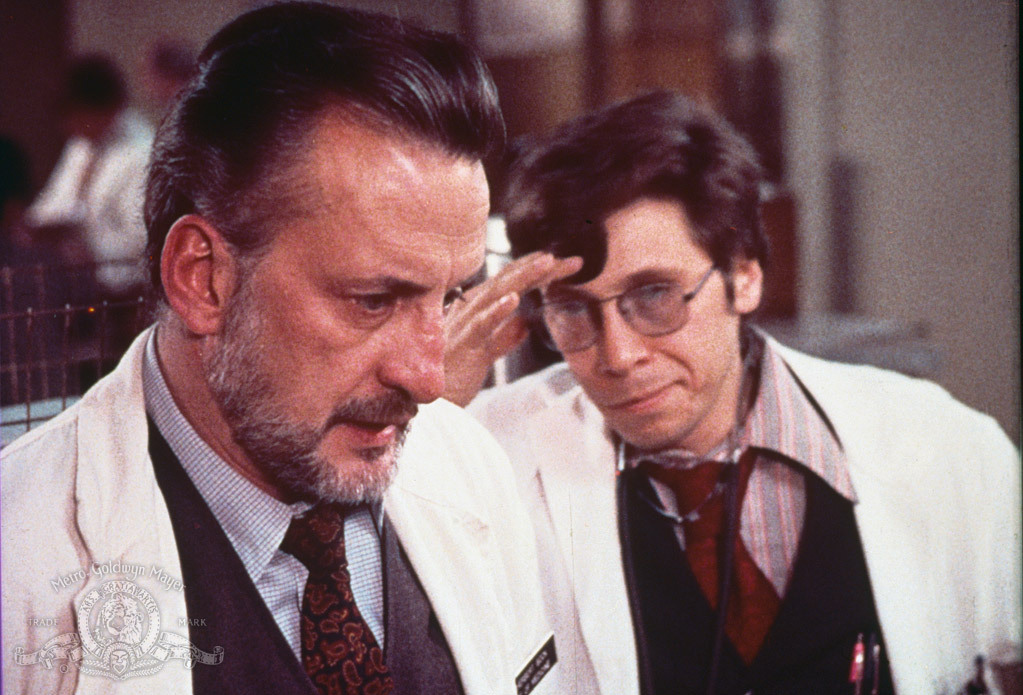
The Hospital

The Hospital (1971)

Over the decades I have worked in hospitals, I have seen countless movies that draw on the drama, humor, joy and frustration that happens every day in the medical world. It’s a tough call, but if pressed to choose my favorite of such films it would be 1971’s The Hospital.

The magnificence of the movie ultimately derives — as is so often the case with the best films — from a sterling script. Even though he died young and was not particularly prolific, Paddy Chayefsky was an extraordinarily influential screenwriter. He wrote unusually realistic, tightly constructed scripts for television plays in the 1950s that he later turned into superb films (Marty is the most famous, but I like The Bachelor Party even better). He went on to achieve two mammoth movie triumphs in the 1970s, of which Network is better remembered but The Hospital is every bit as impressive. He also delivers The Hospital’s pricelessly sardonic opening narration about the trials of a recently admitted patient who is subjected relentlessly to the benefits of modern medicine until he expires.

The heart of story is Dr. Herb Bock, Chief of Medicine, one-time wunderkind of immunology and now a hard-drinking, acutely depressed, and suicidal man who sees himself as a failure in every sphere of life. George C. Scott, an actor of great range (it’s hard to believe that the same man played General Patton, General Buck Turgidson and Dr. Bock), gives a bravura performance as the bearish, pained, raging and pitiable Dr. Bock. He is a classic hero/martyr type who works hard to help everyone else at great cost to himself, and is incapable of accepting the love and support he needs. I have known many Dr. Bock’s in my career, people who would say as he does that “love doesn’t triumph for the middle class — responsibility does”. The collision of an A-list actor with a beautifully-written character, as we have here, is one the most enduring delights of film watching.

On top of his considerable personal problems, Bock’s hospital is under great pressure from two directions. Angry activists are protesting the medical center’s alleged insensitivity to the local community (Chayefsky’s take on much of 1970s activism is bitter, but also hilarious). Meanwhile, why are so many people dropping dead…there couldn’t be a mad killer on the loose, could there? As Bock struggles against overwhelming challenges, he is emotionally upended by a loopy yet appealing hippy who seems to understand him better than he understands himself. Diana Rigg is perfect as said hippy, and she and Scott work together brilliantly, particularly in a long and emotionally complex scene involving suicidal and sexually violent longings.

The script has many laughs, almost all of which come with an undercurrent of anger. The foibles of hospitals and physicians are well-skewered, although in one poignant speech at the end, Scott gives a rejoinder to all the cynicism, which also hits home. The supporting players are very good indeed, including Barnard Hughes in two different parts (only one of which is credited), Nancy Marchand as Head Nurse Christie and Frances Sternhagen as “the bitch from the accounting department” (Sternhagen, whose work I have highlighted before, remains underappreciated as an actress).

The Hospital is one of the great black comedy/dramas of the 1970s and beyond that will resonate profoundly with anyone who has spent much time in a medical center as a staff member or as (the poor dears) a patient.

Categories
British Comedy

Porterhouse Blue

If a little knowledge is a dangerous thing, think how much harm a lot of it could do. That’s the animating spirit of the academically-challenged but gastronomically-unmatched Cambridge college of Porterhouse, as portrayed in 1987’s Porterhouse Blue.

Based on Tom Sharpe’s satirical novel of the same name, this television mini-series centers on the longest-serving employee of the college, Skullion (the beloved British actor Sir David Jason). He and the senior fellows must cope with an ambitious nincompoop, Sir Godber Evans (Ian Richardson), who has been cast off from politics and made the new master of the school. Godber’s motto is “Alteration without change”, but he is an uxorious man very much under the heel of his titled harridan of a wife (Barbara Jefford). She insists that — gasp — women be admitted to Porterhouse! In this and in a hundred other ways, the new arrivals war with the traditionalists, with both sides being played perfectly by the cast for self-puncturing guffaws.

Richardson and Jason sparkle as the leads, as does Charles Gray as a rich, perverted old boy and John Sessions as the one person at Porterhouse who seems keen to get an education. His character, Zipser (allegedly the author’s self-parody), is one of British film’s great comic schmucks. His thesis is on “Pumpernickel as a factor in the politics of 16th century Westphalia”. He is awkward, sexually frustrated and obsessed with the flirtatious older woman who serves as his bedder (Paula Jacobs). His misadventures trying first to obtain — and then to dispose of — several gross of johnnies is uproariously funny.

Fair warning about this movie. If you don’t know anything about Oxbridge life, British society more generally, and can’t make out dog Latin, I would bet that at first Porterhouse Blue could be slow going. But stick with it, because it gets funnier and more accessible as it moves along.

p.s. I have been looking for years for a full translation of the Flying Pickets’ spirited rendition of the ridiculous and delightful Porterhouse college theme song. I have found translations of the first verse, but never the full song. If anyone can point me to a full translation, I would be extraordinarily grateful.

Categories
Comedy Musical

The Rutles: All You Need is Cash

Before A Mighty Wind before Fear of a Black Hat and yes, even before This is Spinal Tap was the first mock rock documentary (or, to paraphrase Marty DiBergi, the first, “if you will, mockumentary”). I am speaking of 1978’s The Rutles: All You Need is Cash.

Monty Python alumnus Eric Idle is in top form as writer/co-director and also on screen, including as Rutles bassist Dirk McQuickly (who bears an eerie resemblance to Paul you-know-who) and as a number of minor characters, including an “Occasional Visiting Professor of Applied Narcotics at the University of Please Yourself, California”. Neil Innes does marvelous work sending up John you-know-who and also by penning some inspired song parodies.

The film reviews the exploits of the “pre-fab four” from their early days in the Cavern in Liverpool, to the naughtiest street in the world in Hamburg to stardom under their eccentric manager Leggy Mountbatten, who loves their tight trousers. Even if you don’t know much about the Beatles, this movie is a laugh-filled treat, not least because so many comedy (including some Saturday Night Live stars from the glory days) and music legends (Mick Jagger and a well-disguised but still recognizable George Harrison) lend their talents at perfect moments. Telling the ridiculous story of The Rutles with an ostensibly straight face and a documentary style only makes it more hilarious, most particularly during a “very expensive” visit to discover the origin of the blues in New Orleans.

If you want to see what a fantastic job Idle and Innes did parodying both the Beatles’ music but also their stage presence and mannerisms, check out this clip of that famous night on the Ed Sullivan show…

p.s. A generation later, Idle revisited the same terrain in Can’t Buy Me Lunch. Not as fresh as the first time around of course, but still a pleasing follow-up to the original.

Categories
Comedy Drama

Slap Shot

George Roy Hill and Paul Newman scored two mega-hit, crowd pleasing films with Butch Cassidy and the Sundance Kid and The Sting (Recommended by Johann Koehler here). When they reunited in 1977, the commercial temptation would have been to more or less repeat themselves. Being highly creative artists, they instead challenged many of their fans’ expectations by making a foul-mouthed, violent, raunchy comedy set during America’s dreary blue collar decline: 1977’s Slap Shot.

Some (though not all) viewers were appalled. But, with critic Gene Siskel being the most well-known example, reactions to Slap Shot have warmed over time to the point that it is today justly regarded as a classic American movie.

The plot: The Chiefs are a minor league hockey team who lose more than they win under aging player-coach Reggie Dunlop (Newman). Meanwhile, the local plant is closing, leading the team’s owner (Newman’s frequent co-star, Strother Martin) to shop the franchise around. His career and marriage on the rocks, Dunlop knows he needs to gin up some victories and some interest for the team. The answer comes in the form of the Hanson brothers, who lead the team into a new style of hockey: Beating the crap out of their opponents! The dirty play pays off as The Chiefs start to win and the fans begin to rally around them. Meanwhile, there is lots of 1970s bed-hopping and retrograde attitudes under threat.

Some may be surprised that the script was written by a woman. But Nancy Dowd, whose brother was a minor league hockey player, knows her way around the game and also around people who use language that would make a sailor’s parrot blush. Hockey fans love the authenticity of the film, not least that Michael Ontkean (As a clean-cut Princeton grad who is the star of The Chiefs and disapproves of dirty play) and many of the other performers were in fact excellent hockey players. The resulting film is funny, rude, politically incorrect, and a jolly good time. Having lived myself though the 1970s de-industrialization of Western Pennsylvania and seen all the leather suits, huge shirt collars, towering heels and other fashion horrors I can vouch for this film’s accuracy about life at the time.

Newman, in a role that was a stretch for him (he apparently rarely even swore in private life), gives a very appealing comic performance as an over-the-hill jock. He also has great byplay with Strother Martin and with Jennifer Warren as his ex-wife. Andrew Duncan is hilarious as a radio announcer with hair from hell. Lindsay Crouse, as Ontkean’s binge drinking wife, delivers a one-note and eventually tedious performance, but all of the other smaller parts are well-turned by the actors.

Last but not least, the scenes of the hockey games are very well done. Everyone can skate and the crushing impacts and high-velocity shots feel real.

Slap Shot will never be shown at a church social or at a gathering of anti-violence activists. As long as that doesn’t put you off, get ready to laugh and be enormously entertained.

p.s. Some fun trivia: can you name ALL the films that Newman and Martin were in together? Martin’s Wikipedia entry claims six such pairings, but I could only come up with five so I am either forgetting one or gasp Wikipedia is wrong about something.

Categories
Comedy

Ruggles of Red Gap (Guest Review)

This film recommendation comes from Dr. Jean O’Reilly, a friend and colleague of mine at the National Addiction Centre at King’s College London. I am indebted to Jean for introducing me to the gut-bustingly funny, wise and sweet film Ruggles of Red Gap, about which she has done serious scholarly work. She can describe the virtues of this 1935 movie gem much better than I can, so let me turn things over to Jean:

Fans of actor Charles Laughton and director Leo McCarey will probably look askance at this choice of film, often regarded as an early, minor success in each man’s career. But it’s a charming film, with Laughton rising to the challenge of a rare comic performance and McCarey settling into the easy style of filmmaking that typified his later career.

Ruggles of Red Gap tells the story of an English gentleman’s gentleman (Laughton) who in 1908 is transported against his will from service in the household of an English earl to the American frontier town of Red Gap, Washington. In his strange new surroundings, Marmaduke Ruggles works as a manservant and dogsbody to the nouveaux riches Egbert and Effie Floud. After living for a time in Red Gap, Ruggles becomes infused with the spirits of democracy and equality and begins to consider abandoning a life of servitude to become his own man.

I love this film because it features, in nascent form, one of the attributes that became a hallmark of McCarey’s mature directorial style: the improvised scene. McCarey’s easygoing, collaborative approach to filmmaking is well documented, including the piano kept on the set for sing-alongs, the jokes and stories he told to lead his cast toward new scenes, and his keen eye for showcasing actors’ skills. He thought nothing of rewriting the shooting script on a whim, or spending a day shooting a new scene that had nothing to do with the storyline but that he thought might surprise viewers. As a result, McCarey’s films tend to be episodic, loosely structured, and peppered with inspired moments not always closely connected to the storyline.