Categories
British Comedy

Time, Gentlemen, Please!

Where to stream Time, Gentlemen, Please! (1952) online? Comparing ...

Due to distribution problems, lost celluloid, legal disputes, or bad luck, some excellent films became inaccessible after their debut and eventually fall through the cracks of almost everyone’s memory. 1952’s almost completely forgotten Time, Gentlemen, Please, which isn’t even mentioned in most of my books about film, is a prime example. There were I understand copyright and distribution disputes that kept it from being available after original release for decades. But it’s out on DVD now, and that’s a gift to lovers of British comedy.

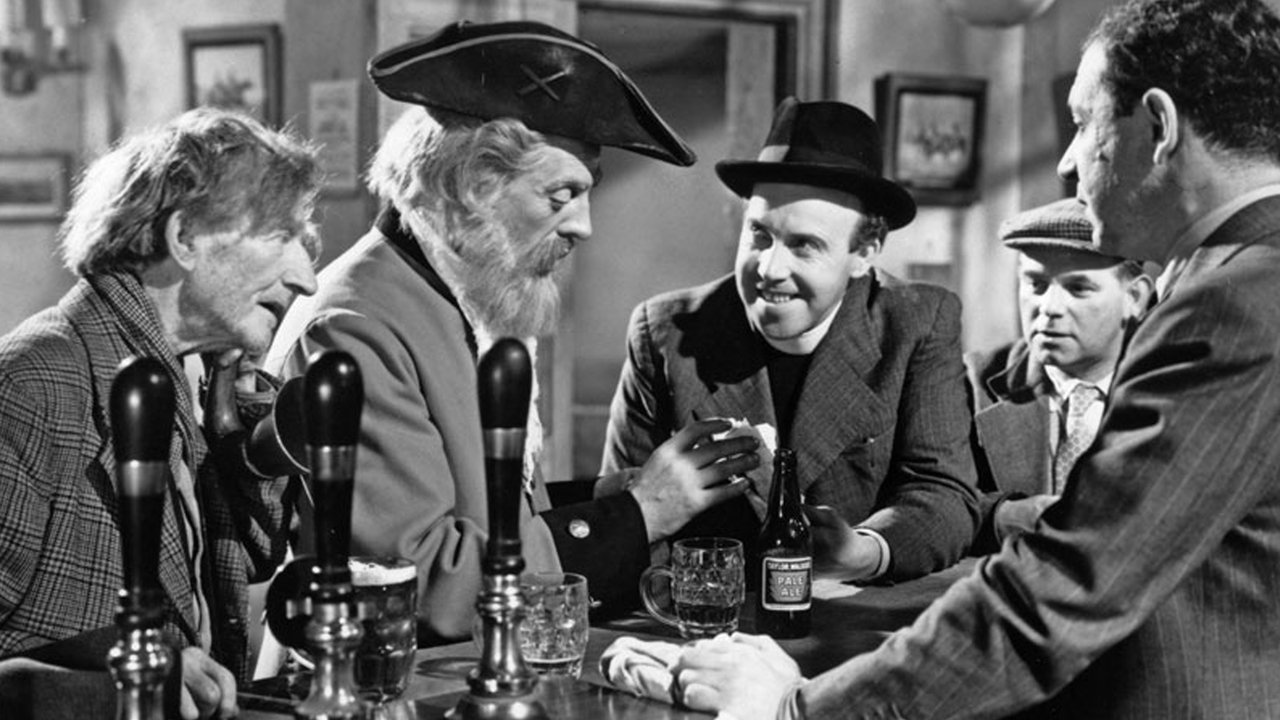
The story is set in Essex, specifically in the hardworking town of Hayhoe. Indeed, its 99.9% employment rate has earned it a personal visit by the Prime Minister! The stuffy town council members want to make the employment rate 100% before the PM arrives, but a charming, boozy, Irish rogue named Dan Dance (Eddie Byrne) stands in their way. He has no interest in work, so the prigs in charge stick him in the heretofore unused almshouse, which is run by the dour Mr. and Mrs. Crouch (Ivor Barnard and Thora Hirch). The tables are turned however when a reformist pastor discovers that the town’s founding documents insist that all taxes from the old estates be shared equally among the residents (or, in this case, sole resident) of the almshouses, making Dan the richest man in town, and a candidate for a seat on the town council. The story only gets sillier from there before a most enjoyable denouement.

There are many tremendous character actors in this movie (e.g., Hermione Baddely, Sid Gilbert) but no big stars. The greatest strength of the film is Peter Blackmore’s gut-bustingly funny screenplay, which was based on R.J. Minney’s novel “Nothing to Lose”. Much of the humor comes in the form of the pleasant smiles one gets from “Ye Olde Quaint English Village Full of Eccentrics”, but there are also a number of laugh out loud bits.

The politics of the film are interesting to analyze. If Maggie Thatcher ever saw it, I suspect she would have never stopped throwing up. The hero is willfully unemployed, but rather than resent him sponging off their labour, the townsfolk rally to him and against the local toffs. That was the political mood of the post-war, pro-working stiff, austerity era for many Britons in a way that was not replicated among their American cousins.

Weekend Film Recommendation: Time, Gentlemen, Please! – The ...

I can’t say that Time, Gentlemen, Please! is quite at the level of the great Guinness/Mackendrick Ealing Studios comedies of the period, but it’s almost as good and certainly a highly rewarding film in absolute terms. Please take the trouble to find it; you’ll be richly rewarded for your effort.

p.s. The title is a reference to a pub host’s call at closing time, in an era when watering holes had to close at a certain hour and the patrons were all male.

Categories
British Comedy Drama Musical

The Ruling Class

I stand outside myself, watching myself watching myself. I smile, I smile, I smile.

It takes courage to make a movie that defies all conventions and challenges the audience. Sometimes, indeed most of the time, the filmmakers fall on their faces. But every once in awhile a group of wildly innovative iconoclasts create something that has the right to be called unique, such as this week’s film recommendation: The Ruling Class.

The story begins with the solid, respectable, fiercely pro-Empire 13th Earl of Gurney (The always watchable Harry Andrews, holding nothing back) putting on a tutu and playing an auto-erotic asphyxiation game that goes awry. Enter greedy potential heirs, but the old coot has left his money to his manservant Tuck and his schizophrenic son Jack (Peter O’Toole). Jack currently believes himself to be the risen Christ, though after a dramatic series of events 2/3 of the way into the film he alters his self-identity in a profound fashion, with deadly results. The story barrels along with equally bizarre twists, punctuated by cast members bursting into song and doing Broadway-style dance numbers! It may sounds like an utter mess, but it’s a sublime piece of cinematic art.

As you would guess, there is a good deal of very black humor in the film. There are also many lighter-hearted laughs courtesy of Alastair Sim as a half-baked bishop (Honestly, he could evoke chuckles reading the phone book) and Arthur Lowe as the suddenly rich, alcohol-soaked Trotskyite butler Tuck, who stays on in his servant role while talking relentless smack to his “betters”.

The film is a triumph of three Peters. Peter Barnes wrote the original stage play and the screenplay, Peter Medak directed, and Peter O’Toole leads a champagne cast by giving an all out performance playing a volatile, complicated, exuberant character. Hats must also be doffed to Jack Hawkins, whose acting I have much praised in prior recommendations (e.g., The Long Arm, The Cruel Sea), and who is in the co-producer’s chair here (alongside Jules Buck).

This film did poor box office in 1972 and seemed to get no middling reviews: Critics loved it or hated it. Likewise, today, I can imagine some intelligent people of good will finding this film contrived, overlong, pretentious, and maybe even obnoxious. But in other modern viewers it will evoke wonder and admiration. If you are open to something completely different, please do give it a look, particularly if you can get your hands on the stunning print available from the Criterion Collection.

p.s. Harlaxton Manor, the magnificent pile where much of the film was shot, was once the site of my employer’s study abroad program.

Categories
Action/Adventure Comedy Drama

Zero Hour! and Airplane! **Double Feature**

Icebox Movies: Zero Hour! (1957)

This double feature recommendation comes with a strong suggestion for viewing order. You absolutely should watch Zero Hour! first, because once you’ve seen Airplane!, you will have a hard time taking the former film seriously again. And that would be too bad, because it’s a perfectly solid drama/thriller.

Written by Arthur Hailey of Airport fame, 1957’s Zero Hour! stars Dana Andrews as former squadron leader Ted Stryker. I’ve written before about this period in Andrews’ career, during which he labored in B-movies as he struggled with alcoholism (not incidentally, his co-star here, Linda Darnell was in the same boat). Yet he managed to class up these productions with good performances, a strong jaw and leading man looks (albeit a bit drink-ravaged). Perhaps because he himself was a man whose career and life were on a downslope, he is particularly good in Zero Hour! at making the audience sympathetic with Ted Stryker. Following one terrible misjudgment during the war, Ted has been haunted by self-doubt. He has lost the respect of his wife (Linda Darnell) but is consoled by the fact that his son still looks up to him (Raymond Ferrell).

And then, before you can say “contrived plot development”, the Stryker family ends up on an airplane on which many passengers are sickened by bad food. The plane’s captain also falls ill and can no longer fly (The captain is played by Crazylegs Hirsch…a famous athlete playing an airline pilot..I wonder if someone could ever find a way to make fun of that?). A serious, silver haired physician (Geoffrey Toone) who happens to be on board intones somberly that if the passengers are not hospitalized soon, they will die. Meanwhile, the weather is worsening, becoming reminiscent of the horrible conditions during Ted’s failed World War mission. Can Ted shake off his fears, land the plane, and at the same time save his son, who is among the ill? He will have at least some help: on the ground, the hard-headed, no nonsense Capt. Martin Treleaven (Sterling Hayden, as alcohol-soaked at this point in his career as Andrews) has taken command at the airport and is prepared to bring the plane in safely.

OK, it’s a bit of a potboiler, but the acting is fine, the effects are good for the period, and the story is genuinely exciting. And this film is probably the high point of Hall Bartlett’s uneven career as a director; he gets everyone to play things super straight, which you could pull off with a 1950s audience in a way you never could with a modern one.

Which brings me to the 1980 film Airplane! Three very, very funny guys (David Zucker, Jim Abrahams and Jerry Zucker) saw Zero Hour! late at night and apparently laughed all the way through. They then created a movie that is hilarious in its own right and also deserves admiration for being one of the best parodies of a prior movie ever made. If you have just watched Zero Hour!, Airplane! is even MORE funny, if that’s possible. Indeed, some of the most laugh-inducing lines in Airplane! appear as dead serious lines in Zero Hour! (“Looks like I picked the wrong week to quit smoking…”).

Categories
Comedy Musical

How to Succeed in Business (Without Really Trying)

An incisive take on the life of corporate suits and their sexy secretaries in 1960s Manhattan, with Robert Morse as the star. No, it’s not Mad Men, but 1967’s toe-tapping, uplifting and funny “How to Succeed in Business (Without Really Trying)”.

Based on the smash Broadway hit, the heart of the film is of course the music. The songwriter is the great Frank Loesser, and some of his most enjoyable pieces are rendered with energy and talent by the cast (“Brotherhood of Man”, “The Company Way”, “I Believe in You”). Bob Fosse’s choreography is consistently creative and the colourful costumes by Micheline enliven every scene.

The agreeably silly script tells the story of an ambitious window washer named J. Pierpont Finch (Robert Morse, whose bravura performance deserved an Oscar nomination) who climbs the corporate ladder with shocking speed, aided by the titular self-help book. He is pursued by Rosemary Pilkington (Cutely played by Michelle Lee), who is every bit as ambitious in love as he is in work. Many veterans of the stage production (including Rudy Vallee) contribute their comic and musical gifts.

David Swift, famous as a Disney animator and TV writer/director, seems an unlikely writer/producer/director for this film. In some ways, one could say it was an easy job because the choreography and cast had mostly been worked out already on Broadway. But on the other hand, adapting a beloved Broadway show to the screen is a big risk for a director because fans of the stage version can get upset at the inevitable changes in the film version. Here they were apparently delighted along with the rest of the movie-going population, so kudos to Swift for a smooth translation of play to screen, and congratulations on what was the high mark of his career as a film maker.

I am embedding one of my favorite numbers from the movie because it always picked me up when I was a lowly graduate student feeling stomped on and disrespected in a really demanding doctoral program. Enjoy.

Footnote: There are two continuity goofs in the opening minutes of the film. Finch pays for his newspaper but grabs the self-help book impulsively without paying for it and the guy running the booth doesn’t react. A few moments later, when he starts from the roof down on the window washing platform, there is another window washer working the other side. But that guy is played by a different actor by the time Finch has descended to the window. Yes…noticing these things means I have seen this movie perhaps too many times. But. Can’t. Stop. Re-Watching. So. So. Entertaining.

Categories
Comedy

My Favorite Year

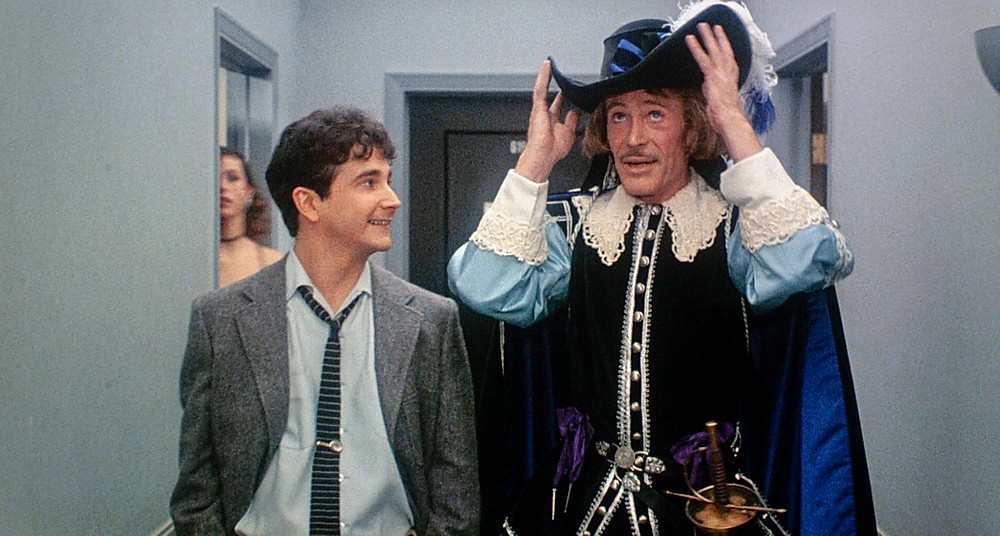
This 1982 star vehicle for Peter O’Toole (playing a drunken, rakish, movie star oddly reminiscent of Peter O’Toole) delivers big laughs as well as some acute observations on the nature of fame. The movie also opens a window into the world of 1950s live television comedy and the people who made it happen.

My Favorite Year – Classic for a Reason

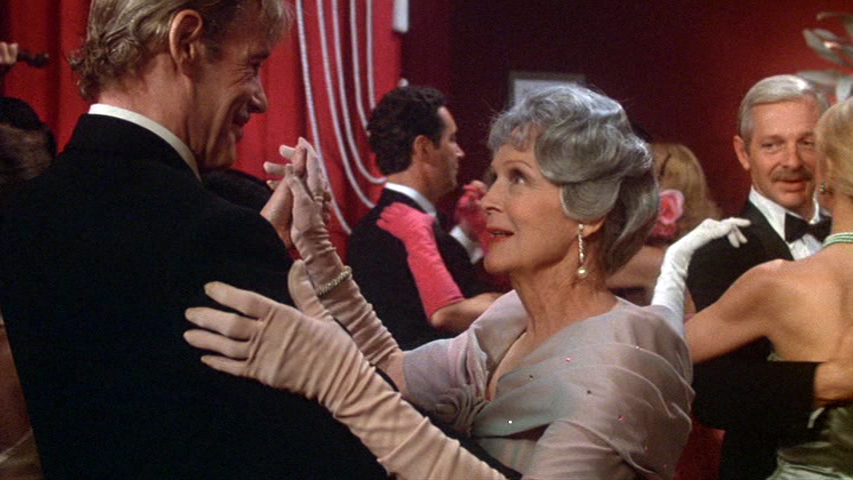
The supporting cast is filled with wily veterans who know how to get the most laughs out of the material. Bill Macy is perfect as the beleaguered head writer, and Joseph Bologna is almost as good as a Sid Caesaresque television star. Another treat: In the sweet scene in which O’Toole dances with an older woman on her wedding anniversary, the role is played by 1930s film star Gloria Stuart (two of her best are Prisoner of Shark Island and The Old Dark House).

My Favorite Year (1982) - A Review

This was Richard Benjamin’s first time out as a director, and it shows a bit. The tone and style of the film are not as consistent as what he would achieve in his films as he became more experienced. Norman Steinberg and Dennis Palumbo’s script, while funny most of the time, also includes some weak gags and slow spots. Can one extremely charming star leap over such weaknesses in a single bound and keep the audience laughing and cheering? In O’Toole’s case, the answer is clearly yes.

p.s. There is an oft-repeated story that this film was inspired by Executive Producer Mel Brooks’ recollections of Errol Flynn doing a guest spot on Your Show of Shows when Brooks was a writer. But as many of the tapes of that show are lost to us, no one to my knowledge has ever confirmed that such an event actually transpired.

Categories
British Comedy

Local Hero

Local Hero streaming: where to watch movie online?

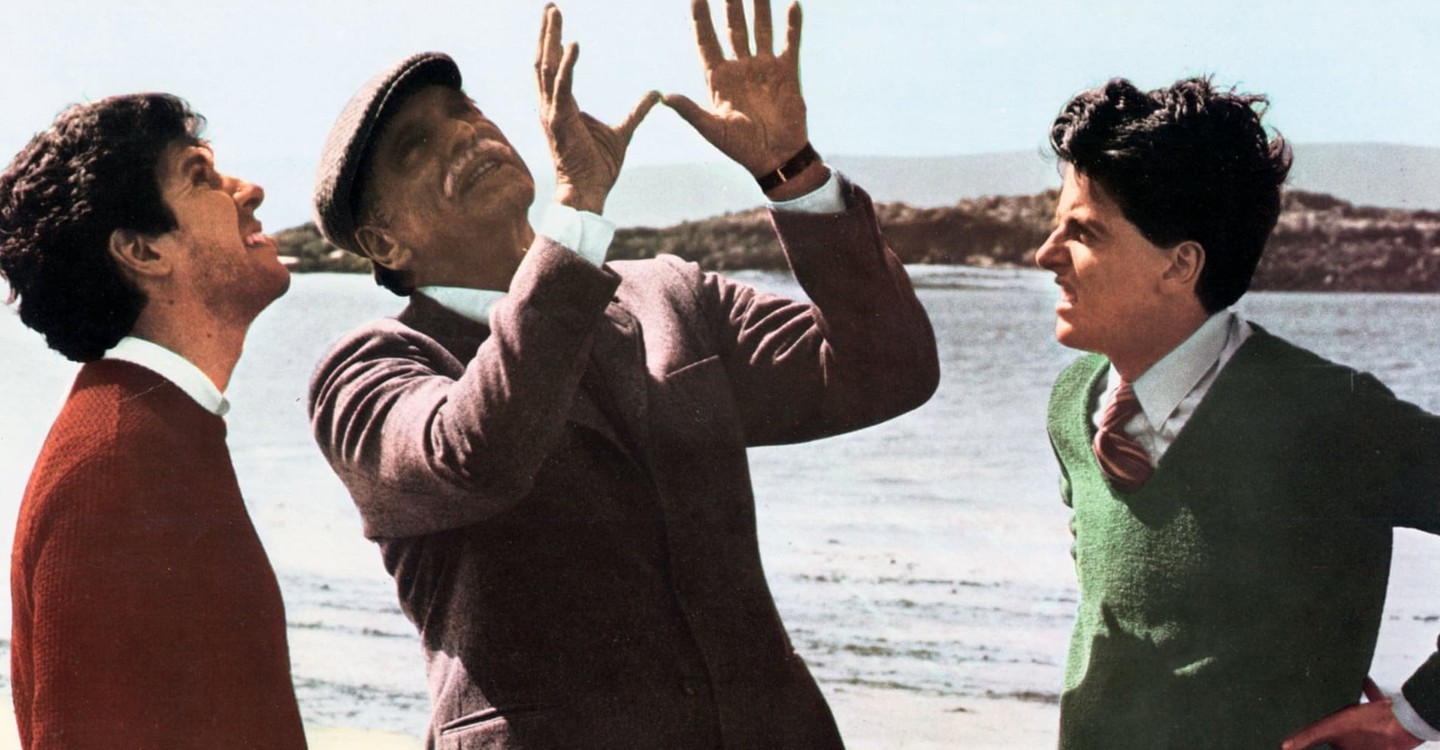
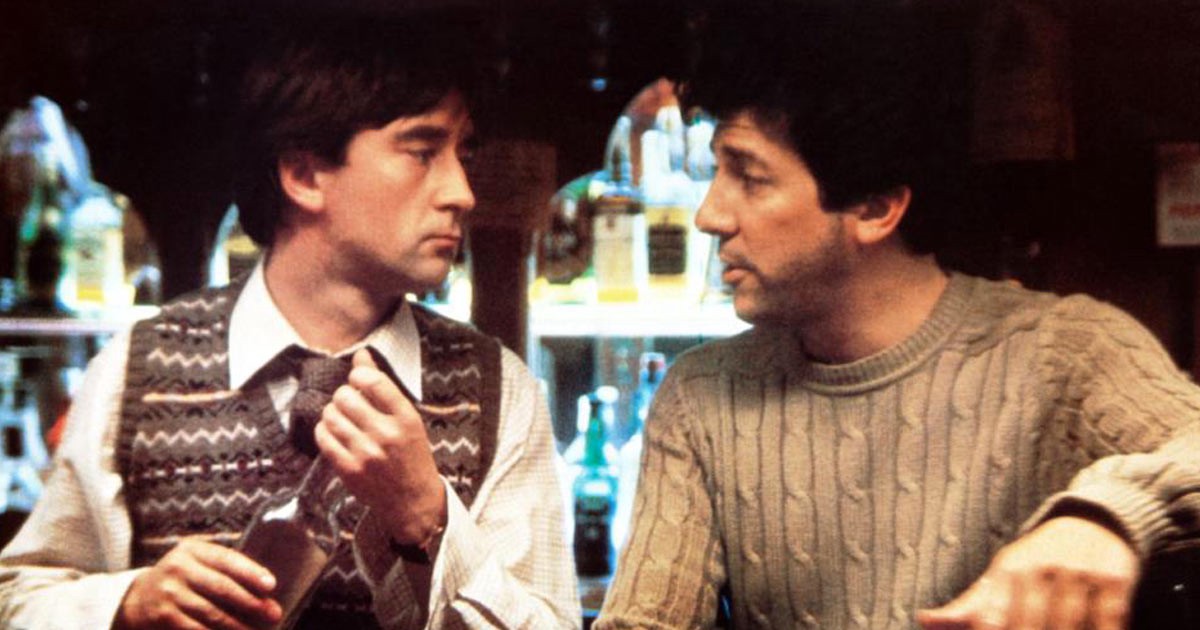
Following the success of his low-budget films That Sinking Feeling and Gregory’s Girl, Scottish film maker Bill Forsyth had the adjective “quirky” hung on him by critics, and it stuck. But there’s a nicer way to describe this talented writer-director’s output: Sweet, original and offbeat. For me, no film in Forsyth’s career better illustrates those qualities than 1983’s Local Hero.

On its face, the plot is simple. Knox Petroleum needs to buy an entire Scottish seaside town in order to further its oil empire, so its all powerful and extremely eccentric President Felix Happer (Burt Lancaster) dispatches a guy named MacIntyre (Peter Riegert) to close the sale, because, well, with a name like that he must understands Scottish people. In a more clichéd film, the quietly noble and down-to-earth townspeople would resist the heartless tyrants of capitalism. I will not spoil the film for you but rest assured that Forsyth is far too creative to follow that tired line of plot, either for MacIntyre and Happer or for the people of the village.

Under Forsyth’s direction, the cast sparkles throughout. Burt Lancaster, like Sean Connery and Clint Eastwood, was wise enough in late life to transition from swashbuckling roles to more age-appropriate fare. His turn as an isolated, slightly daft, stargazing corporate titan is hilarious, particularly his scenes with one of the most abusive psychotherapists in film history.

Criterion Review: Get Ready to Cheer for LOCAL HERO | by Brendan ...

Peter Riegert is very good at playing people who are present in some respects but completely absent in others. Outwardly, his MacIntyre is a financially successful oil acquisitions man. On the inside, he is a lonely person with a bitter break-up behind him and, the film hints, more romantic disappointments to come. His last name is Scottish but even that isn’t real; he no more belongs in Scotland than he does anywhere else. What pulls on his emotions the most about the Scottish town is the wildly satisfying (in every respect) marriage of his hosts at the local B&B. It’s the life he longs for but simply doesn’t know how to create.

Peter Capaldi as Danny Oldsen and Jenny Seagrove as Marina in ...

The charming Jenny Seagrove, whose success in UK film and television unfortunately never translated across the pond, hits the right notes as a scientist with whom Peter Capaldi’s character falls in love (Capaldi, later so good as a thoroughgoing bastard on The Thick of It and In the Loop, is completely different here in the film that first brought him notice). Kudos also to the set designers for Felix Happer’s bizarre and palatial office suite, and to Mark Knopfler of Dire Straits fame for an understated and memorable score.

Like most of Forsyth’s films, there are a few big laughs and many more small ones. Wistful in some ways, joyful in others, this quiet gem of a movie will bring a smile to your face.

Categories
British Comedy Drama

Peter’s Friends

One of my favorite Christmas movies is Kenneth Branagh’s Peter’s Friends. Sometimes glibly dismissed as a “British knockoff of The Big Chill” this 1992 movie is in fact superior in most respects to that film (which not incidentally was itself based on a better, little seen movie, The Return of the Seacaucus Seven).

The plot: Peter (Stephen Fry) has inherited a large estate and house from his recently deceased and very formidable father, whom he hated but now misses. He is also grappling with a serious personal problem — the nature of which is not revealed to the audience until late in the movie — that is causing him great strain. Unable to decide what else to do, he throws a weekend Christmas party for his dear friends from Oxbridge days. Once a young and happy troupe reminiscent of the Footlights (of which many of the actors in the film are alums), Peter’s friends have since run into their own painful challenges in life.

Rita Rudner, who is hilarious as a shallow and unhappy American TV star, wrote the witty script with her husband Martin Bergman. The script also includes some strong dramatic moments, even though it doesn’t quite seem to know how to wrap things up at the very end. Without spoiling the plot, Peter’s Friends also deserves praise as being one of the first major British movies to deal with a particular topic that had been too long avoided.

Director Kenneth Branagh gets the best out of the talented ensemble cast, even though he himself gives only a so-so performance (for whatever reason, with the exception of the Wallander series, Branagh often seems a bit too mannered and self-conscious when he plays modern parts). You are blessed with more than a bit of Fry and Laurie here, as well as good work by Imelda Staunton, Tony Slattery, and Alphonsia Emmanuel. But the best performances of all come from the mother-daughter team of Phyllida Law as the housekeeper-quasi-parent of Peter, and Emma Thompson as a bookish turbo-neurotic who is secretly in love with him. I have never met anyone whose former boyfriend wrote self-help books right up to the moment he committed suicide, but if I did, I would expect her to be exactly like Thompson’s pathetic, nerdy but still very appealing Maggie Chester.

The film’s music is also enjoyable, including hits of the period (by Bruce Springsteen, The Pretenders, and Tears for Fears) as well as a lovely version of Jerome Kern’s “The way you look tonight” sung by the entire cast (Imelda Staunton can really hit a note!). The then-popular music and focus on a particular British generation’s experience could have turned this into a period piece which would age badly, but the many laughs and the moving moments gives Peter’s Friends appeal that extends to the present day.

Categories
Action/Adventure British Comedy Horror/Suspense Romance

The 39 Steps

The 39 Steps (1935)

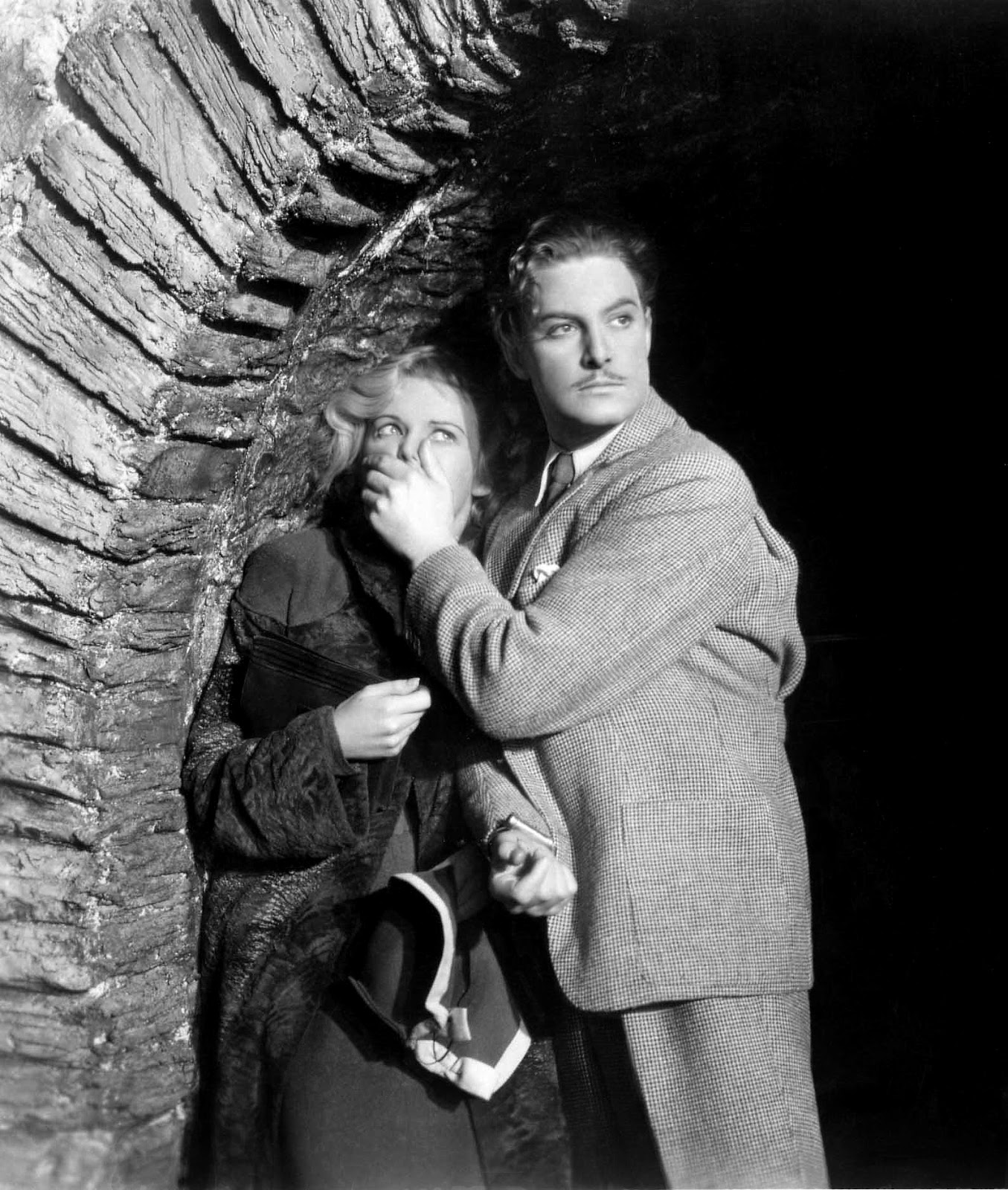
Alfred Hitchcock had a successful directing career in Britain that preceded his American super-stardom. Hitchcock fans rightfully consider the 1935 comedy-romance-thriller The 39 Steps among the very best works of the Master’s “British period”.

Robert Donat cuts a dash as Mr. Hannay, the hero of the film, who tries to save England from the threat of nefarious and crafty foreign agents. As in other Hitchcock films (e.g., North by Northwest, The Wrong Man, The Man Who Knew Too Much,), the central character is an innocent who is pulled into a web of intrigue and danger which he doesn’t understand. But unlike in those darker films, it doesn’t seem to bother him a jot.

“Did this beautiful woman just fire a gun in a crowded theater to evade her pursuers and then tell me that she is an international spy for hire? Well then, let’s go back to my flat for a large whiskey and soda and I’ll cook her up some haddock while she tells me all about it.”

“I seem to have walked into a political rally focused on I know not what and I have been mistaken for the distinguished guest speaker. Well then, jolly good, I’ll give it a go.”

“Am I really handcuffed to yet another beautiful woman as I run through the Scottish Highlands with people trying to shoot me? Well then, I wonder if she’s married or at least broad-minded.”

Categories
Comedy

Murder by Death and The Cheap Detective **Double Feature**

There is an above average Jimmy Stewart movie called No Time for Comedy, in which he is cast as Gaylord Esterbrook. Gaylord writes hilariously funny plays yet feels he should write dramatic productions of greater weight in order to be a “serious writer”…but his effort to do so is disastrous. The movie always makes me think of Neil Simon. When he tries to be dramatic he is often manipulative, soppy, boring or pretentious. Films like “California Suite” make me ape Homer Simpson’s reaction to watching Garrison Keillor (Homer beats the idiot box yelling “Stupid TV! BE MORE FUNNY!”).

But when Simon gets over himself and just tries to be funny, he can be absolutely, rib-ticklingly, delightfully enjoyable. This double feature recommendation highlights Simon at his gutbusting best in two loosely linked comedies directed by Robert Moore: Murder by Death (1976) and The Cheap Detective (1978).

Both films are affectionate parodies of fictional detectives from the movies. Nick and Nora Charles, Charlie Chan, Sam Spade, Miss Marple and Hercule Poirot are sent up in Murder by Death. The Cheap Detective focuses only on Sam Spade (renamed Lou Peckinpaugh) as he works his way through the plots of many Humphrey Bogart classics, including the Maltese Falcon, the Big Sleep and Casablanca. There is murder and intrigue in both films and a plot as well, but who cares?: The purpose is laughter and laugh you will if you have a funny bone in your body.

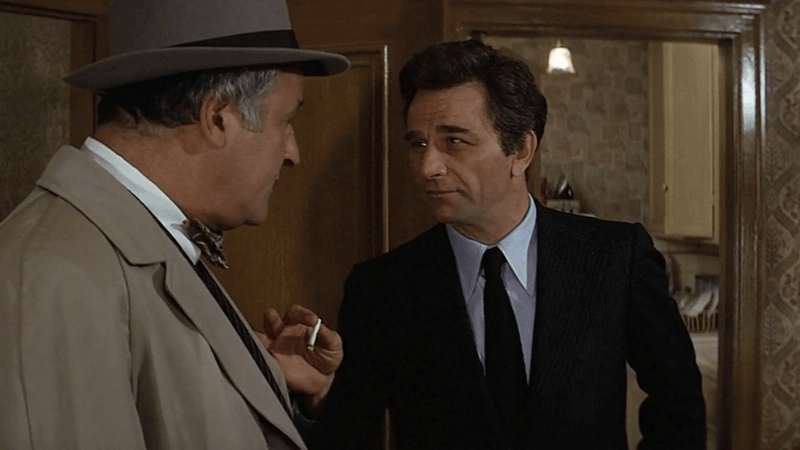
The cast is gold, a simply stunning array of talent (some of whom appear in both movies): Peter Falk, Eileen Brennan, James Coco, David Niven, Maggie Smith, Alec Guiness, Louise Fletcher, Peter Sellers, Marsha Mason, James Cromwell, Nancy Walker, Elsa Lanchester, Sid Caesar and many more. Everyone knows what they are doing and gets every conceivable laugh out of Simon’s scripts.

My favorite bits are hard to choose from such an embarrassment of comedy riches, but I will try. In Murder by Death: The best ever update of “Who’s on First”, featuring a butler named JamesSir Bensonmum and his father Howodd Bensonmum. In the Cheap Detective: Betty DeBoop’s stage number and first encounter with Lou Peckinpaugh (“You made me swallow my gum”).

Categories
Comedy Romance

The Court Jester

Sometimes comedy in the movies gets a bit ahead of current cultural tastes. But the joy of TV re-runs, DVDs, streaming, and the like is that as audience sensibilities catch up, a film whose wit eluded people at the time of its release can be recognized as a comedy classic.

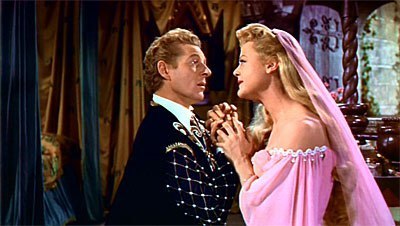
This has been the fate of several big name comedy films made in the 1950s, including the Truman Capote-scripted Beat the Devil, a dud at the time now regarded as a cult classic. An even better example, and one that should be in every discussion of the best comedy scripts in Hollywood history, is 1956’s The Court Jester. A big budget bomb at the time, this film is now deservedly recognized as a complete delight, for laughs, for music, and for a tour-de-force performance by the amazing Danny Kaye.

The chortle-filled script of Co-Producer/Directors Melvin Frank and Norman Panama, like those of Monty Python and The Simpsons much later, piles jokes on top of each other without seeming to mind if many viewers miss some of them. In the typical 1950s comedy film, the dialogue about how “The pellet with the poison’s in the vessel with the pestle” would be THE joke of that scene. And, at one level, that would have been fine, because the wordplay by itself is gutbusting. But why not have Danny Kaye’s armor struck by lightning, causing it to magnetize, to throw some physical comedy on top of the verbal jokes? And again, Python-style, why have boring credits when you could put a bunch of sight gags and a ridiculous song in there as well?

The film is set in Olde England, where crafty royals, dastardly nobles, and noble craftys all involve themselves in the succession of the king. Thrown into the mix is Hubert Hawkins (Kaye) a song-and-dance man who gets intertwined with the plotting and repeatedly gets mistaken for someone else in situations of romance and peril. There is swordplay, there are castles and jousts, there are $4 million in production values (which was a lot of money in the 1950s).

But plot schmott, this is film as fun. And who could be of greater service in that endeavour than Danny Kaye, in one of his finest moments as an entertainer? He handles the physical and verbal humor equally well, seems at home both in the dueling scenes and in romantic moments, and sings and dances as well. Because he doesn’t seem to be taking anything too seriously, it’s very easy to laugh along with him.

Basil Rathbone, as the villainous Lord Ravenhurst, gamely mocks his role in another of my recommendations, The Adventures of Robin Hood. He is an absolute hoot and the final fate of his character is priceless. Mildred Natwick is so funny that I literally cried from watching her expressions and listening to her delivery of great comic lines. And Angela Lansbury, as a besotted adolescent of a princess, shows great comic touch.

We sometimes say “They don’t make ’em like that any more”. But this film deserves a higher compliment, which is that they didn’t make ’em like that then, but they learned how by watching groundbreaking films like this.

Get it?
Got it!
Good.