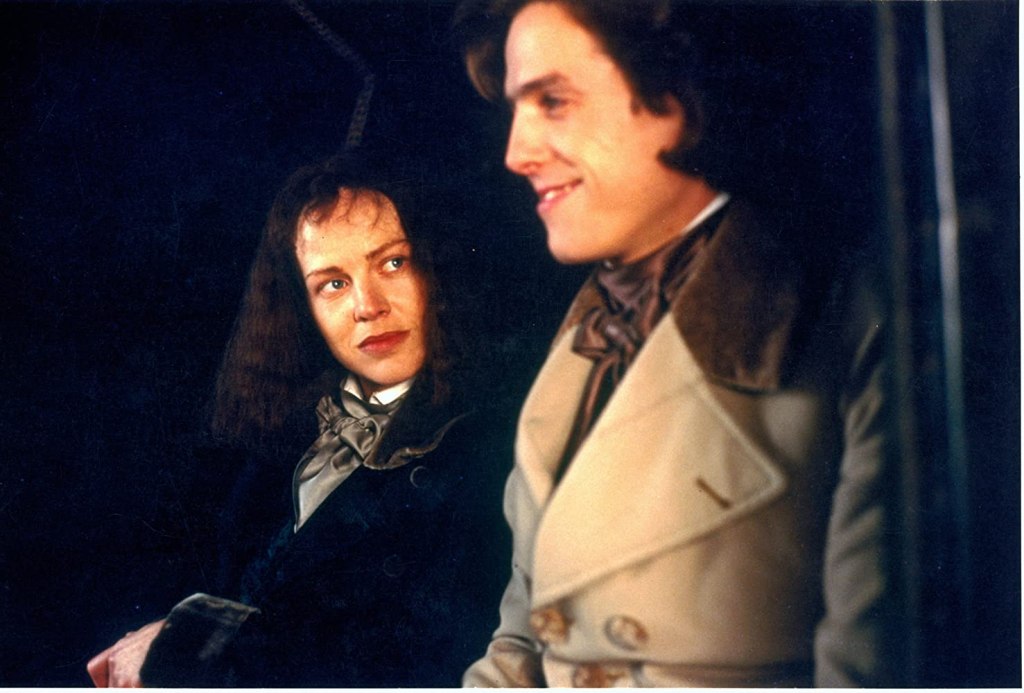
Artistic stars of 1830s Paris are brought vividly to life in the high-spirited and entertaining 1991 film Impromptu. Directed by Tony-winning Sondheim collaborator James Lapine, the film stars Judy Davis in a bravura performance as George Sand. She spends the film avoiding prior lovers (including Mandy Patinkin as Alfred de Musset) and chasing a new one, Frederic Chopin (Hugh Grant, in the sort of gentle and innocent performance that he could credibly give before we all came to know more about him). Liszt (Julian Sands) and Delacroix (Ralph Brown) are also on hand for the frolic, most of which takes place at a French country home presided over by a culture-starved and rather daffy Duchess (Emma Thompson, who is very funny).
If you are one of those film goers who laments the lack of strong, intelligent woman characters in most Hollywood productions, you will find Judy Davis’ performance particularly enjoyable. The screen writer, Sarah Kernochan, is justly known for creating multi-faceted female characters. She and Davis give the audience a George Sand who is complicated, passionate, endearing and also at times maddening. (Not incidentally, in the art imitates life department, Sand here is a brilliant woman absolutely intoxicated by a man’s musical ability, and Kernochan is married to Lapine).
Partly a fictionalized look at high culture and fame and partly a romantic romp, this movie includes not a dull or unappealing moment. The wonderful music and art direction add further pleasure to Impromptu, making it a complete and satisfying piece of cinema.
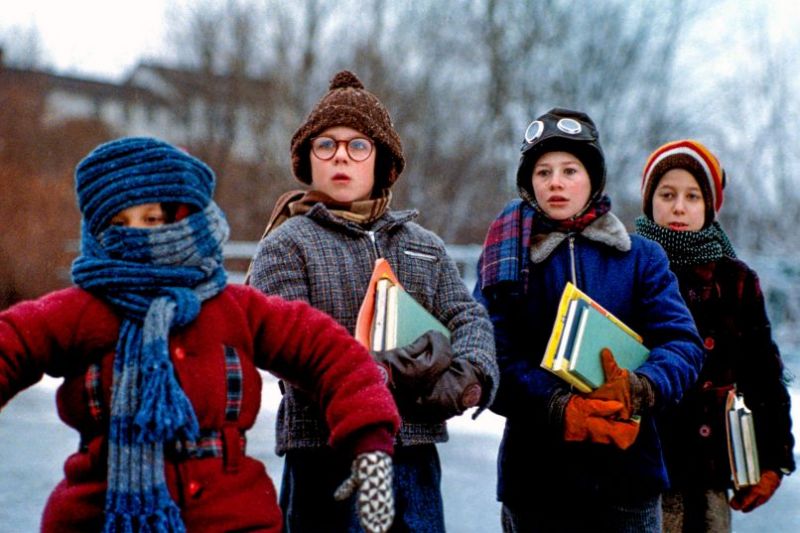
Some mediocre films earn a reputation as “American Classics” entirely because the producers and marketers (or the critics and other members of the chattering class) have so declared them, and the rest of us are cowed into submission. But sometimes a movie attains this status honestly by slowly and steadily building a following because it really deserves one. A Christmas Story very much belongs in the latter, authentic set of American classics. When it was released in 1983, it was shown in less than a thousand theaters and was outgrossed by such unmemorable cinematic products as Porky’s II: The Next Day, Two of a Kind, and High Road to China. But it became more and more popular each year on television (Thank you, Ted Turner) such that you can hardly find anyone today who doesn’t smile at the memory of this warm and funny film.
The great talent behind this movie about a boy’s overwhelming craving for a particular Christmas present is Jean Shepherd, who wrote the script based on his novel “In God we trust. All others pay cash”. He narrates the film while never being seen, apart from a cameo as a grouchy Christmas shopper. Shepherd recollects events as an adult while 12-year old Peter Billingsley, as his younger self (“Ralphie”), gives one of the best comic performances by a child actor in cinema history. Billingsley’s gestures and expressions coupled with Shepherd’s wry narration make a superb comic one-two punch. Daren McGavin and Melinda Dillon are perfect as Ralphie’s very human parents because they are solid actors who also happen to look like real parents (in Hollywood today, the parts would likely have gone to a rap star and a supermodel).
The film charms both because it pokes fun at the silliness of which children are capable (e.g., Ralphie’s rich fantasy life) while also respecting the earnestness of which they are capable (e.g., It *is* a breach of etiquette to go straight to a triple dog dare without an intervening triple dare). A Christmas Story is sweetly nostalgic about childhood without overly romanticizing it. And it holds up very well under repeat viewings, as the countless people who will watch it again this holiday season will attest.
The Music Man is a joyous, funny and romantic musical that has been lifting hearts for decades. Iowa native Meredith Willson laboured for years to fashion the tale of a fast-talking huckster who comes to fleece the small town rubes of River City and finds more than he bargained for, including romance with the lovely local librarian. The role of the would-be con man, Professor Harold Hill, made Robert Preston a huge Broadway star. Cary Grant saw the play many times, and Hollywood legend holds that when he was asked to essay the part of Hill in the 1962 movie adaptation, he responded “Not only will I not accept the role, but if you don’t get Preston to do it I will not even watch the movie”.
Since at least the time of Clara Bow, Hollywood casting directors have debated whether particular actors have “it”. Well, whatever “it” is, Preston’s got “it” in abundance. Hill is not a nice person. He wants to mulct the town into investing in a boys’ band it doesn’t need and he hopes to seduce and abandon the goodly Marian the Librarian along the way. But the second Preston comes on screen, everyone is cheering for him to pull it off. He is not, truth be told, a great singer at the level of Gordon MacRae, but he is a great actor and an irresistible charmer on screen.
If asked to think of a fresh-faced musical film actress with great pipes and screen appeal, most Americans of a certain generation would come up with Julie Andrews, perhaps remembering Shirley Jones only as the mom on a TV show that their kids watched. But Jones, who plays Marian, was a very big star in her day, and deservedly so. And she wasn’t just effective at playing wholesome All-American innocents as in this film and Oklahoma!: She after all won an Oscar for playing a vengeful prostitute in Elmer Gantry. Of the principals of the Music Man, she is far and away the best singer, and she also conveys warmth, fire and depth as Marian, the unmarried small town lass with a much-gossiped about past.
Preston and Jones are the hubs of the show stopping numbers, including “Ya Got Trouble” and “76 Trombones”. Except for Shipoopi, with singing and dancing by Buddy Hackett (Ack! – but at least he makes a good comic sidekick for Preston), there isn’t a less than good song in the film, and the music grows on you with repeated listenings.
It is worth mentioning also, given that so many child stars came to bad ends, that little Ronny Howard has a nice part in the film. He went on as we all know to become one of the great movie directors of his generation, which based on the little singing he does here was a wise decision.
Some NYC and LA-based film critics have read this film as a condemnation of the ignorance and small-mindedness of Iowans, which to me seems like coastal snobbery not borne out by facts. Yes, the people in the town are sometimes petty and are easily taken in by the conniving Professor Hill, but Wilson also shows us that River City is a place of simple decency, youthful idealism and of course honest, redeeming love in the person of Marian. The movie thus stands as one of the three best statements of everything that is good about Iowa (The other two of course being Field of Dreams and the nearly all-white 2008 democratic caucus nominating Barack Obama).
Here is one of the lesser known but still marvelous numbers from the movie, showing off Preston’s smooth con artist ways and the mellifluous voices of the Buffalo Bills.
p.s. Lovers of the Simpsons will appreciate that this film is the source material for the famous Marge vs. The Monorail episode.



 All Good Movies