Categories
Mystery/Noir

Twilight

My name is Harry Ross, and here’s the way my life has gone: First I was a cop and then a private detective. And then…a drunk. Also, in there somewhere, a husband and a father. You’d think with all that, the world would lose its power to seduce. But you’d be wrong.

So intones Paul Newman’s character in this week’s movie recommendation, the deliberately old fashioned 1998 film noir Twilight directed and co-written by the estimable Robert Benton. The film centers on a wealthy Hollywood family comprising former movie stars Jack and Catherine Ames (Gene Hackman and Susan Sarandon) and their teenage daughter Mel (Reese Witherspoon).

Let me pause to note that two sentences into this recommendation and I have already mentioned 5 Academy Award winners!

The plot: After a disastrous effort to take Mel away from a stupid, sleazy paramour (Liev Schreiber), Harry was injured and moved in with the Ames family. He has long since recovered, but sticks around ostensibly because Jack has been diagnosed with cancer. But the truth is he is desperately in love with Catherine. Jack sends him on a mission to pay off someone whom Harry suspects is blackmailing the couple. He cares about both of them, even if he doesn’t completely trust them, so he returns reluctantly to private detective work. Thus begins a tortuous mystery involving murder, betrayal and long-buried secrets.

Though intentionally packed with many 1940s noir elements, the film from another point of view is a twist on the old detective stories in that the classic private investigator (e.g., in The Big Sleep) was an outside critic of his rich and powerful clients, less wealthy but with better judgment and morals. Here, Harry Ross is not much more than a pet, living on the estate of his benefactors, doing menial work and longing for Catherine’s love when he is in fact (as Mel puts it) a bit player in a movie starring other people.

The unmatched cast also includes James Garner, Stockard Channing, Margo Martindale, John Spencer and M. Emmet Walsh (In a vivid part given that he doesn’t even say a word!). Directing such a seasoned and talented group must have been a pleasure for Benton, who clearly has respect for the genre. He also contributed a script with sharp dialogue as well as some well-timed funny lines. Many of the scenes recall either specific 1940s detective films or at least their general style. If that isn’t Old Hollywood enough for you, the Ames house was once the home of Dolores Del Rio and Cedric Gibbons.

Reese Witherspoon and Liev Schreiber were cast I assume in the hopes of bringing in some younger viewers, and perhaps as well for their sex scene, but they bring much more than that to the table. Both are strong performers who pass my newbie test of screen greatness: They are completely at ease in scenes with the established superstars around them.

The only thing that clanged for me in this movie was the introduction about 35 minutes in of a comic sidekick played by Giancarlo Esposito. His character just doesn’t fit the mood of the rest of the picture, and his scenes are the one part of the film where things drag a bit. Other than that, this is for me irresistible viewing and I find it mysterious that it was not a hit with audiences when it was released. I suspect it underperformed because it was aimed at an older audience in an era when said audience did not buy many movie tickets (As the Boomers age, films like this have done better box office, which is fantastic if like me you enjoy films that are aimed at someone other than teenagers and adults who think like teenagers).

Categories
Action/Adventure Mystery/Noir

Ellery Queen Mysteries

In a few minutes, this man is going to be murdered. The question is: who killed him? Was it the frustrated nephew? The spurned housekeeper? The fiancé with a shady past? The willful heiress? Or was it someone else? Match wits with Ellery Queen, and see if you can guess who done it!

Oh what rapture when a high-quality, beloved old TV show re-emerges intact in a digitally remastered, commercial-free DVD set! The superlative television series Ellery Queen which ran on NBC from 1975-1976 is now available in a boxed DVD set comprising all 22 episodes plus the pilot and an informative interview with series co-creator William Link.

Link and Richard Levenson are legends in the TV game for their clever plotting, coruscating dialogue and most of all, unforgettable characters. Their formidable talents are on display in every episode of this series, which draws from the Ellery Queen novels they read growing up (they met in high school and became lifelong best friends and collaborators). Gimlet-eyed viewers will catch a few parallels between Queen and the most famous Link and Levenson creation, Lt. Columbo: Ellery doesn’t shoot or punch anyone, his forgetfulness, occasional clumsiness and gee-whiz manner (which were not elements of the books) leads suspects to underestimate him, and he once even says, while walking away from a suspect he has just grilled, “Oh, there’s one more thing…”.

The series adopts a deliberately old fashioned mystery style, with each episode starting with a “This person is about to be murdered” hook and closing with a “let’s gather all the suspects at the scene of the crime to announce who done it” scene. Victims get murdered in locked rooms and leave cryptic dying clues regarding the killer’s identity. Red herrings look suspicious, private eyes are hard-boiled, newspaper men are cynical and damsels are, well, in distress. Yet the writers also added a fresh twist to the old chestnut formulae: Ellery would look directly at the audience just before the closing scene and announce that he had the solution. He would then allude to a few clues from the story so far (occasionally, too many for my taste) and challenge the audience to solve the mystery. This made the show fun, especially once you had seen a few episodes and knew the drill, because you could try to solve the mystery yourself as you watched: All the evidence was right there in front of your eyes.

The heart of the show is Jim Hutton as Ellery and David Wayne as his father, a widowed police inspector. Both men are skilled actors, perfectly cast. If you smiled to see the nuances of the relationship between Rocky and Jim on The Rockford Files, you will be equally warm to the father-son dynamic here. At times they are like a typical father and son, at other times the son acts like the father to his sometimes truculent and self-neglecting dad (this works particularly well because the towering Hutton looks like he could cradle the diminutive Wayne in his arms), but most of the time they are like a couple of clever little boys running around, solving puzzles, doing good and having fun.

The other tremendously enjoyable aspect of the series is the gallery of guest stars, a mix of old time radio/movie icons (e.g., Ray Walston, Don Ameche, Vincent Price, George Burns, Eve Arden, Walter Pidgeon, Donald O’Connor, Dana Andrews) and experienced television character actors (e.g., John Hillerman, Ken Swofford, Tom Bosley, Betty White). It couldn’t have been too hard to direct such seasoned, talented casts, but that said the direction in the series is several cuts above what one usually sees on television (special shout out to Walter Doniger for “The Adventure of the Wary Witness” and David Greene for the pilot).

Production values are also impressive, with swell-looking cars, clothes and interiors from 1940s New York City. Also to love: Elmer Bernstein’s jazzy big band score played over stylish opening credits.

The series was unusual for its consistently high quality, making it hard to pick favourite episodes, but if pressed I would go with “The Adventure of Miss Aggie’s Farewell” because it so well recalls “Our Miss Brooks” (Eve Arden’s old time radio show whose comedy holds up surprisingly well), and “The Adventure of Caesar’s Last Sleep” because its illuminates the relationship between Ellery and his dad.

Ellery Queen Mysteries is irresistible television. May the corporate pillock who cancelled it after one season burn in eternal hellfire.

Categories
Action/Adventure Mystery/Noir

Devil in a Blue Dress

SFMOMA

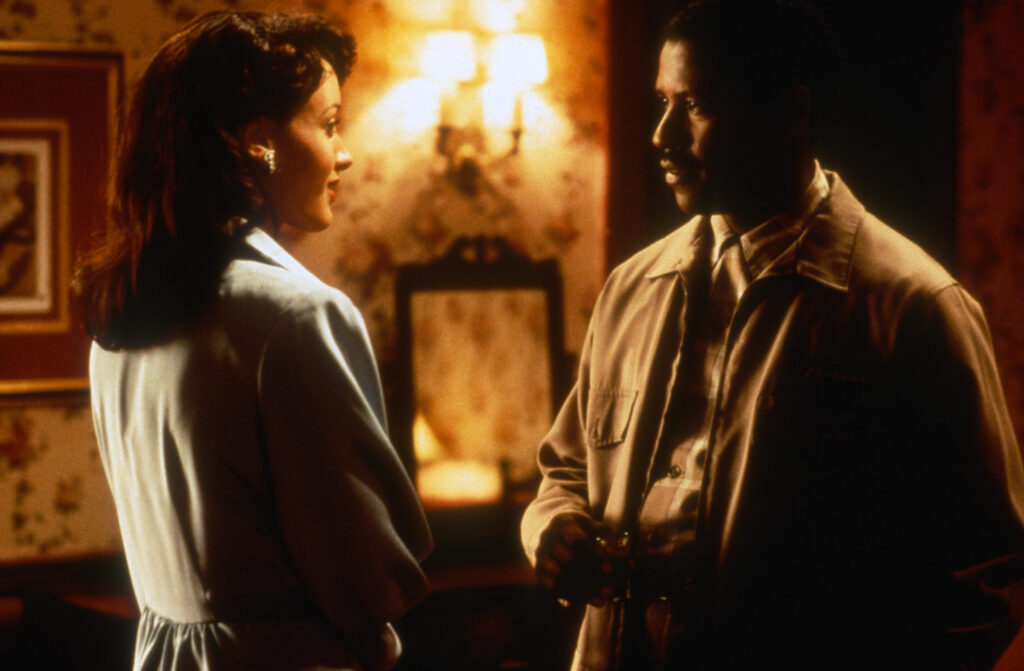
For years, I believed that no one would ever write a Los Angeles detective novel as well as did Raymond Chandler. But then a friend gave me the book Black Betty, which changed my mind. Walter Mosley’s detective, Ezekiel (Easy) Rawlins roams in an atmospheric, corrupt, and dangerous LA just as did Phillip Marlowe, but Easy practices his trade as a Black man in the 1940s. In Mosley’s hands, that difference opens up a world of plot, character, emotion and social comment that countless Caucasian detective novel authors before him never explored. Devil in a Blue Dress is an underappreciated film adaption of Mosley’s novel of the same name.

As the story opens, Easy Rawlins (Denzel Washington) is in a bind. Back from service in World War II and the proud possessor of a GI bill-financed mortgage on his very own house, Easy is fired by his white boss on specious grounds. Desperate for money, he agrees to help find a missing woman for a local hood (a memorably sleazy Tom Sizemore) who claims to be working for a former mayoral candidate. Easy’s investigation reveals that the woman has an African-American female friend that he knows, and who finds Easy hard to resist. He gets a lead on the missing woman (Jennifer Beals) but then there is a murder and everything goes pear-shaped. Soon the police and the criminals are both gunning for Easy, tempting him to call in a favor from an old friend named Mouse (Don Cheadle) who has a penchant for extreme violence.

Director Carl Franklin, recognized as a modern film noir maven since he made One False Move, is in complete command of the tone and style of the movie. Even though this was not a big budget production, the 1940s sets, cars, and clothing look smashing, while Elmer Bernstein’s fine score and some outstanding period music add flavor and style. It’s also fascinating to see a rarity in Hollywood films: Post-war Black neighborhoods of Los Angeles brought to life (the local man with mental illness that Easy encounters is beyond perfect as a realistic, humanizing touch). Even if those aspects of the film don’t grab you, Mosley’s source material provides a complex, exciting mystery for Easy to solve, making the movie effective as a detective story as well.

As in Mosley’s books, the African-American point of view alters and thereby freshens up the old tropes of detective fiction. A midnight meeting with a business associate at the pier? Normally no problem, but this time it’s in white-dominated Malibu, and you can see the wariness in Washington’s eyes with every step he takes. Meet a doll-face dame and chat her up? Not so simple when she’s white and there are white men around itching to give you a beat down. The standard “police interrogation of the interfering private eye” bit? It’s a hell of a lot more scary when you realize that the cops could shoot Easy and dump his body somewhere as they never could with a Caucasian detective. And finally, without spoiling the film, the entire mystery turns on race and racism in a powerful way, including how even the most privileged individual white people can end up suffering from the color line they collectively create.

Categories
Mystery/Noir

The Kennel Murder Case

In Hollywood detective serials of the 1930s and 1940s, it was downright dangerous to be an industrialist, socialite, European baronet, heiress or well-heeled widow: You had precious little chance of surviving until the end credits. On the other hand, appropriate to your upper class status, a suave, well-dressed sleuth who moved in your circles would be on hand to crack the case. The Saint, The Falcon, and Philo Vance are among the above-average movie series that plowed this fertile ground, and one of the very best of the type is The Kennel Murder Case.

It’s from the Philo Vance series (not that it matters, they were fairly interchangeable) and was made in 1933. Along with the usual solid character actors characteristic of the series, it had A-List stars (William Powell and Mary Astor) and the magnificent Michael Curtiz as the Director. And for dog lovers, there is the further appeal of it being the only film to derive as much entertainment value from a dog show as did Best in Show.

The plot: While his own pooch is competing in a high-class canine show, Vance (William Powell) is called in to solve a murder involving a number of the other dog owners. The nasty, much-hated Arthur Coe (Richard Barrat) has been discovered dead in a locked room, with a bullet hole in his head and a gun in his hand. The police think it’s a clear case of suicide. Vance isn’t convinced, and he becomes even less so when another murder victim is discovered. Suspects are everywhere, including the Chinese servant (James Lee) who didn’t want Coe to sell his prized Oriental artifacts, the butler with the shady past (Arthur Hohl), the long-suffering private secretary (Ralph Morgan), the saucy mistress next door (Helen Vinson) and her new lover (Jack La Rue), the niece (Astor) who resented his control of her inheritance and the bankrupt, titled man who wants to marry her (Paul Cavanagh). Also on hand is the always appealing mountain of an actor Eugene Pallette as Police Sergeant Heath, who always seems one step behind Vance but is at least smart enough to listen to him.

The solution to the mystery is more than a little rococo, and your odds of guessing it are as close to nothing as makes no odds. So copy Sergeant Heath’s approach by just sitting back and watching William Powell, as Philo Vance, work his investigative magic.

Categories
Action/Adventure Mystery/Noir Science Fiction / Fantasy

Outland

Disappointed in “Cowboys and Aliens” and looking for a film that does a better job of blending the Western and Sci-Fi genres? Look no further than the gritty and exciting Peter Hyams film Outland. The plot of one decent man fighting a corrupt system while trying to redeem himself at the same time is familiar, but it works very well here due to eye-popping special effects, strong performances, and well-staged action scenes.

I like Sean Connery in the Bond films, but his acting talents are put to far better use in those movies where he has more human imperfections and vulnerabilities (e.g., The Offence, The Hill, Russia House). As a paunchy, middle-aged marshal named W.T. O’Neil, Connery gives us a man battered by family and career disappointments. He is working in a near-lawless, awful mining colony on a remote moon because that’s where someone with his mediocre reputation belongs. In every scene, you can see the weight on his shoulders that comes from lack of self-respect and complete disillusionment with the world.

Frances Sternhagen gives a multi-layered performance as the second-rate doctor who helps the new marshal figure out why a number of miners have been committing horribly violent acts against themselves and their fellow colonists. She nicely conveys a romantic interest in Connery that is covered over with self-protective wisecracks. She knows he is committed to saving his failing marriage but can’t help wishing otherwise. The third primary player in the drama is a memorably sleazy and smug Peter Boyle, as the corporate scumbag who runs the colony. He radiates contempt for Connery in every scene as he uses lacerating words, bribe offers, and, eventually, deadly threats to stop the investigation of the strange epidemic of violence among the miners. James B. Sikking is also good in a supporting role as another unhappy, self-hating marshal who befriends Connery.

The space scenes are extremely well done, with the special effects enhancing rather than distracting from the storytelling. Meanwhile, inside the colony there are saloon style swinging doors, people carrying shotguns, scared locals and a Western feel, as a High Noon style digital clock ticks down to the moment when the next shuttle will arrive, bringing Boyle’s goons to take care of the nosy marshal.

The middle of the movie contains a long, superbly choreographed chase and fight scene that must have been an absolute bear to film. This could have made the final confrontation of the movie a letdown, but the climactic scenes — some of them set in outer space rather than inside the colony — have a distinctive, thrilling feel and style.

Outland was only a modest money maker when it was released in 1981, perhaps because people were expecting another Star Wars. It’s not that and it doesn’t need to be. It stands up very well as a highly successful blend of two beloved film genres, as well as a showcase for the acting and still-formidable action chops of the eminently watchable Sir Sean.

Categories
Action/Adventure British Mystery/Noir

The White Knight Stratagem

The White Knight Stratagem was the final episode of a handsomely produced 2000-2001 British television series that re-imagined the Sherlock Holmes stories. The protagonist of the Murder Rooms: The Dark Beginnings of Sherlock Holmes series was Arthur Conan Doyle (center of photo above) who learns the methods of Professor Joseph Bell (far right) as they solve monstrous crimes. Baker Street Irregulars will enjoy how many of the cases contain elements that ultimately appear in the Holmes canon. The White Knight Stratagem is to my mind the best of the series, which is truly saying something.

The plot centers on an unsolved murder in Edinburgh, upon which Bell and Doyle are called upon to consult. It is soon revealed that the case was preceded by another unsolved murder in which Bell clashed with Lt. Daniel Blaney, a once great police detective now on the skids. Blaney, still on the force, resents Bell’s involvement, and Doyle must try to negotiate the rivalry between these two powerful personalities while simultaneously solving a progressively more complex case.

Categories
Action/Adventure British Mystery/Noir

The Long Arm

If The Long Arm had been one of the films pitched to producers in Robert Altman’s superb film The Player, the pitcher would have said “It’s ‘Father Knows Best’ meets ‘Dragnet’! In London! And we’ll get that British guy to star, you know, uh, what’s-his-name!”.

That ‘British guy’ in this case, would be Jack Hawkins, who embodied for a generation of British men the ideals of decency, strength, courage, and dutifulness leavened with compassion (see here for a warm tribute to him by Simon Heffer). His life was cut short by his addiction to tobacco and he took time off from acting to serve his country during the war, leaving him fewer years than he needed to become an international superstar. But he is fondly remembered in his home country, and has many fans in America as well. To all of them I say that if you like Jack Hawkins, you will like The Long Arm, because he is in virtually every scene and carries the movie end to end.

The plot of this 1956 film juxtaposes the very traditional 1950s family life of a Scotland Yard Detective Superintendent with his dogged pursuit of a master safecracker. The family elements are almost comically dated to modern viewers and are best appreciated as sociological rather than dramatic. The family scenes show how a number of people lived — or at least wanted to imagine that they lived — after the turmoil of the war. Money was not plentiful but Dad was wise and had a job, Mom created a loving home, and Junior was precocious yet respectful.

Jack Hawkins, Stratford Johns, and Arthur Rigby in The Long Arm (1956)

Meanwhile, in the best traditions of the police procedural, Scotland Yard slowly gathers evidence on the bold thief who has been breaking into safes all over the country. How does he get the inside information to prepare his heists? And how does he open such sturdy safes? As the police begin to answer these questions, it becomes clear that their prey is not only extraordinarily clever, but also capable of cold-hearted violence.

Categories
British Mystery/Noir

Green for Danger

If Lt. Columbo had been Scottish, he would have born a strong resemblance to Inspector Cockrill, as wonderfully played by Alastair Sim in 1946’s Green for Danger. In the film role that helped make him a huge star, Sim perfectly essays the role of the dowdy looking, socially clumsy police detective who has a razor sharp mind and a relentless desire to snag his prey.

The setting is a wartime British hospital, where doctors and nurses treat the victims of the German doodlebugs that are wreaking havoc throughout the countryside. When an injured local postman mysteriously dies on the operating table, everyone looks like a plausible suspect. Which member of the surgical team did it? Is the killer Mr. Eden (Leo Genn), the lothario head surgeon? Sister Bates (Judy Campbell), the woman he most recently discarded? Or perhaps it’s Dr. Barnes (Trevor Howard), the doctor with a stain on his medical record?

Particularly if you have the Criterion Collection version, this film is not just entertaining but very easy on the eyes. Much of it was shot indoors, but Cinematographer Wilkie Cooper makes the most of the exterior scenes to give us eye-catching and haunted-looking backdrops that maximize the tension of the story (He had Oswald Morris and Thelma Connell on the team, whose also collaborated on another of my recommendations). With all the wind, trees and shadows, the mood created is reminiscent of horror films in which a small group of desperate people are locked inside a remote and spooky mansion where violent events unfold.

Despite being a murder mystery, the film has many funny moments (especially Sim’s wry dialogue and voiceovers). Sidney Gilliat had already shown his gift for comic thrillers by co-scripting Hitchcock’s The Lady Vanishes. Here he also takes the director’s chair, from which he skillfully keeps the tone right as the story moves from hospital soap opera to murder investigation to amusingly Columbo-esque moments between Cockrill and the suspects. Gilliat gets solid performances from every member of his cast, who do a nice job humanizing characters that might otherwise lapse into stereotype. Gilliat’s script (co-written by Claude Guerney based on Christianna Brand’s novel) invokes a number of coincidences to make everyone look like a suspect and offers a somewhat rococo ultimate explanation for the crimes. But these are time-honored and enjoyable elements of the locked room mystery genre, right down to the climactic re-staging of the crime by Inspector Cockrill.

Categories
British Drama Mystery/Noir

Brighton Rock

The 2010 remake of Brighton Rock got mixed reviews, so I recommend discovering instead the 1947 original, which is both a fine character study and a solid piece of British film noir. Made just after the war by the Boulton Brothers, this story of razor-wielding gangsters was considered shocking in its day. Though a bit dated, it remains worth watching for its strong acting, emotional impact and truly memorable visuals (particularly during some jolting violence).

Scripted by two lions of British cinema, Graham Greene and Terence Rattigan, the plot centers on a small criminal gang led by the cold hearted Pinkie Brown (A genuinely chilling Richard Attenborough). The former boss of the gang has just been murdered and Pinkie is struggling to revenge the loss while fending off internal and external threats to his control. A saintly, pretty young girl named Rose (a pitch perfect Carol Marsh in her film debut) has evidence that can put Pinkie away for a killing, but also, strangely enough, seems to be falling in love with him. Meanwhile he grapples with Catholic guilt at the life he is leading.

Richard Attenborough in "Brighton Rock" (1947) | Brighton rock ...

As in many British dramas of the era, highly experienced actors take every advantage of the smaller roles in this movie. A pre-Dr. Who William Hartnell plays a complicated criminal who is heartless when committing violence yet develops a paternal protectiveness towards Rose. Veteran stage actor Harcourt Williams steals scene after scene as a Shakespeare quoting shyster.

Only quibble: In trying to contrast “carefree tourist Brighton” with the seedy underbelly, the film makers go overboard early in the film with annoyingly upbeat music that detracts from the mood of menace. But that trope fades out after the first 20 minutes or so, leaving the viewer plenty of time to be both fascinated and repulsed by Pinkie Brown and the criminal world which he inhabits.

Categories
Action/Adventure Drama Mystery/Noir

Bullitt

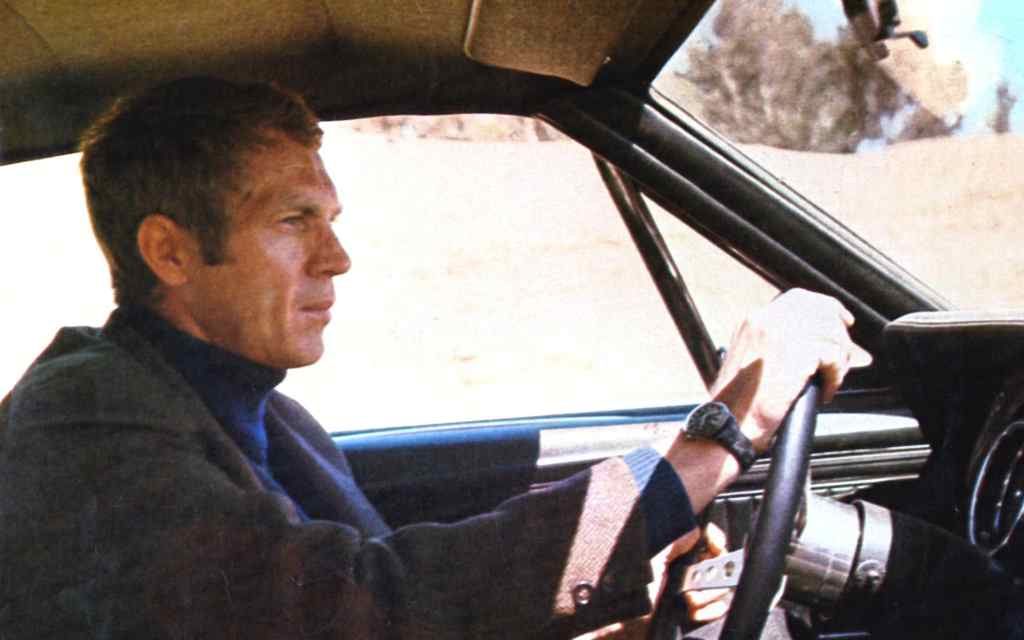
Steve McQueen had an incredible run of hits in the 1960s, which put him in position to start his own production company. Solar Production’s original six film deal with Warner Brothers eventually fell apart and only resulted in one film, but what a film: Bullitt.

The first time through, what stays with most people about this film is the legendary car chase. If you watch carefully, you will notice how cleverly and economically the sequence was filmed. The slow-driving green VW bug that keeps appearing is the tip-off: The same incredible driving stunt was filmed from many different angles and then seamlessly edited to look like a series of death-defying maneuvers.

But the thing to watch in the film is Steve McQueen, in one of his very best roles (the completely original Junior Bonner, which Solar Productions made later, is my other favorite). He is a man detached. With loud, free and colorful 1968 San Francisco all around him he is quiet, controlled and dark. Bullitt has closed himself off emotionally to cope with the horrible things he sees as a police officer. As a result he is almost completely alone in the world,

As a Senator hoping to make his political name as a crime buster, Robert Vaughn is also excellent and almost seems to compete with McQueen over who can underplay his part more. Vaughn, along with Simon Oakland as the police captain who supervises Bullitt, embody Hollywood’s traditional portrayal of the law enforcement establishment which McQueen can react against, allowing him to create something new in cinema: a left-wing coded police officer who was hip and counter-cultural. Jacqueline Bisset, in addition to being easy on the eyes, delivers the goods in her dramatic scenes as the one person to whom Bullitt is willing to be somewhat vulnerable. And the ambience of the film is magnificently enhanced by the visuals of the the City by the Bay and the super-cool score of Lalo Schifrin.

Director Peter Yates, then little known outside Britain, got the job of the strength of his breathtaking car chase sequence in the fine 1967 caper film Robbery. But he obviously had skills well beyond that, including the ability to sprinkle high-octane action sequences into crime films that are more often meditative and character driven. A trilogy of my recommendations, namely this film, Robbery, and The Friends of Eddie Coyle, which Yates made over a fruitful 5-year period, illustrate his talent for smoothly weaving high-key moments into fundamentally low-key movies.

Bullitt works as a detective story, as an action film, and as a character study all at once. And it holds up very well under repeated viewings, so even if you’ve seen it before you can treat yourself again to a classic piece of American cinema.