
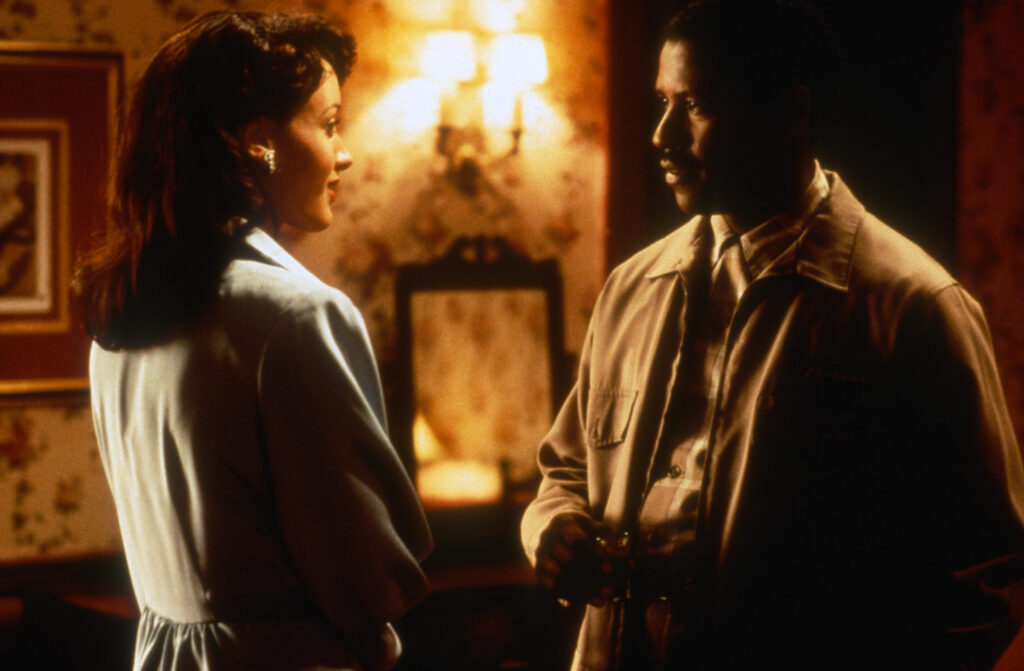
For years, I believed that no one would ever write a Los Angeles detective novel as well as did Raymond Chandler. But then a friend gave me the book Black Betty, which changed my mind. Walter Mosley’s detective, Ezekiel (Easy) Rawlins roams in an atmospheric, corrupt, and dangerous LA just as did Phillip Marlowe, but Easy practices his trade as a Black man in the 1940s. In Mosley’s hands, that difference opens up a world of plot, character, emotion and social comment that countless Caucasian detective novel authors before him never explored. Devil in a Blue Dress is an underappreciated film adaption of Mosley’s novel of the same name.

As the story opens, Easy Rawlins (Denzel Washington) is in a bind. Back from service in World War II and the proud possessor of a GI bill-financed mortgage on his very own house, Easy is fired by his white boss on specious grounds. Desperate for money, he agrees to help find a missing woman for a local hood (a memorably sleazy Tom Sizemore) who claims to be working for a former mayoral candidate. Easy’s investigation reveals that the woman has an African-American female friend that he knows, and who finds Easy hard to resist. He gets a lead on the missing woman (Jennifer Beals) but then there is a murder and everything goes pear-shaped. Soon the police and the criminals are both gunning for Easy, tempting him to call in a favor from an old friend named Mouse (Don Cheadle) who has a penchant for extreme violence.
Director Carl Franklin, recognized as a modern film noir maven since he made One False Move, is in complete command of the tone and style of the movie. Even though this was not a big budget production, the 1940s sets, cars, and clothing look smashing, while Elmer Bernstein’s fine score and some outstanding period music add flavor and style. It’s also fascinating to see a rarity in Hollywood films: Post-war Black neighborhoods of Los Angeles brought to life (the local man with mental illness that Easy encounters is beyond perfect as a realistic, humanizing touch). Even if those aspects of the film don’t grab you, Mosley’s source material provides a complex, exciting mystery for Easy to solve, making the movie effective as a detective story as well.
As in Mosley’s books, the African-American point of view alters and thereby freshens up the old tropes of detective fiction. A midnight meeting with a business associate at the pier? Normally no problem, but this time it’s in white-dominated Malibu, and you can see the wariness in Washington’s eyes with every step he takes. Meet a doll-face dame and chat her up? Not so simple when she’s white and there are white men around itching to give you a beat down. The standard “police interrogation of the interfering private eye” bit? It’s a hell of a lot more scary when you realize that the cops could shoot Easy and dump his body somewhere as they never could with a Caucasian detective. And finally, without spoiling the film, the entire mystery turns on race and racism in a powerful way, including how even the most privileged individual white people can end up suffering from the color line they collectively create.
 All Good Movies