

Burt Lancaster, Kirk Douglas, and Robert Mitchum were born within a few years of each other and found great success in Hollywood in the decades immediately after World War II. They were often cast in similar roles: If you see an American movie from that period featuring a tough as nails cop or PI, a brawny cowboy slugging it out in a saloon, or a strong-jawed soldier saving his platoon or battleship, one or more of them was probably on screen. But by the end of the 1960s when they were all in late middle age, Mitchum had fewer films that would be remembered as classics (Out of the Past and Night of the Hunter being the strongest candidates) to his credit than did his contemporaries, perhaps because he never took his job that seriously (He famously noted that acting can’t be that hard given that Hollywood’s biggest star in its early days was a dog). With a few exceptions, Mitchum’s work in the 1940s-1960s was overall simply not at the level of Douglas or Lancaster (or for that matter Peck or Wayne).
But as he got old, Mitchum got more interesting. His tired eyes began to match the shambling body that carried them, his air of disinterest became more melancholy than insolent. Mitchum’s world-weary Phillip Marlowe in Farewell, My Lovely (my recommendation here) is one of my favorite performances of the mid-1970s, and I would argue that he reached his greatest height just before that in the 1973 movie The Friends of Eddie Coyle.

The plot of the film closely follows the novel by George V. Higgins, who as an Assistant U.S. Attorney in Boston knew the terrain he was describing. Under grey Beantown skies, a gang is pulling off a string of bank robberies using handguns supplied by minor league criminal Eddie Coyle (Mitchum). Coyle purchases the weapons from a better-connected gunrunner (Steven Keats) who also traffics in machine guns. Because Coyle is facing a sentencing hearing for smuggling a truckload of whiskey for his shady bartender (Peter Boyle), he is tempted to give information about the machine guns to an ATF agent (Richard Jordan) in the hopes of a lighter sentence. Coyle doesn’t want to go to prison again at his age, for his own sake and for that of his wife and kids, but he also doesn’t want to be a rat nor accept the risk of harsh punishment if the mob finds out he dropped a dime.
Director Peter Yates follows the compelling formula he established in my recommendations Robbery and Bullitt, namely one exciting scene with cars (in this case an inventive chase in a parking lot) and a lot of low-key atmosphere and acting everywhere else. Sporting a haircut and clothing that looks like it ran him a ten spot all in, Mitchum quietly commands the screen without a whiff of movie star about him. Eddie Coyle is not a particularly good man, but he some sense of duty to his friends and family, and Mitchum makes the audience care about him, defects and all, not least by portraying more vulnerability than toughness.
The supporting cast members all give excellent naturalistic performances that make a life of crime look gritty, unglamorous and even a bit tedious. Combined with ideal use of Boston locations, the movie at times takes on the tone of a docudrama about real world cops and robbers. It’s superb slice of life cinema anchored by the best work of Mitchum’s career.
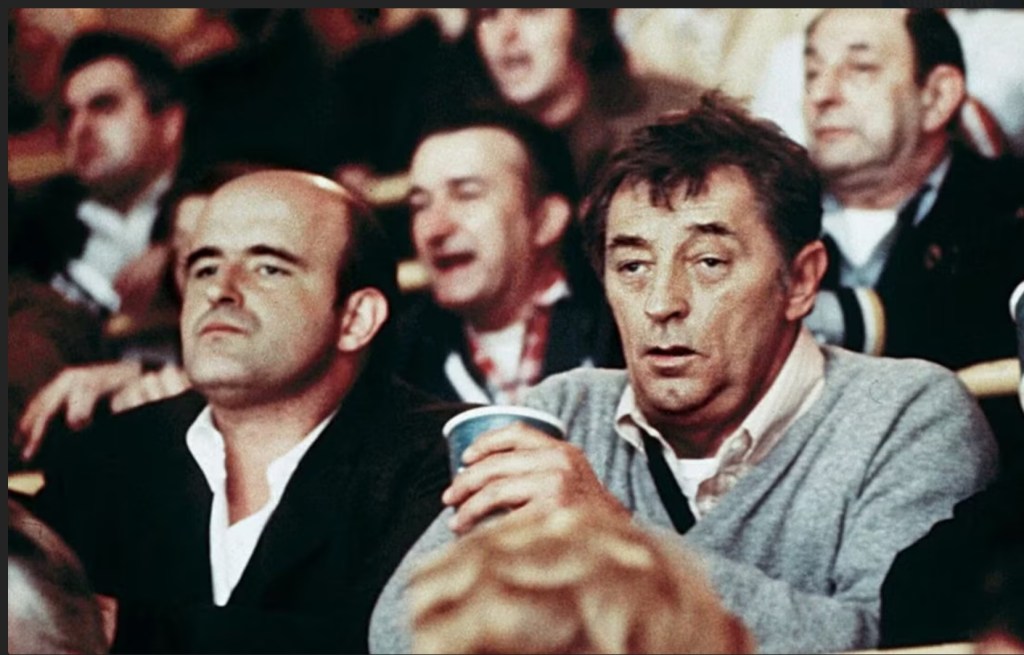
p.s. This movie lost money but has become a cult favorite among film buffs. I assume Quentin Tarantino is one of them given that Steven Keats’ character is named Jackie Brown.

 All Good Movies