
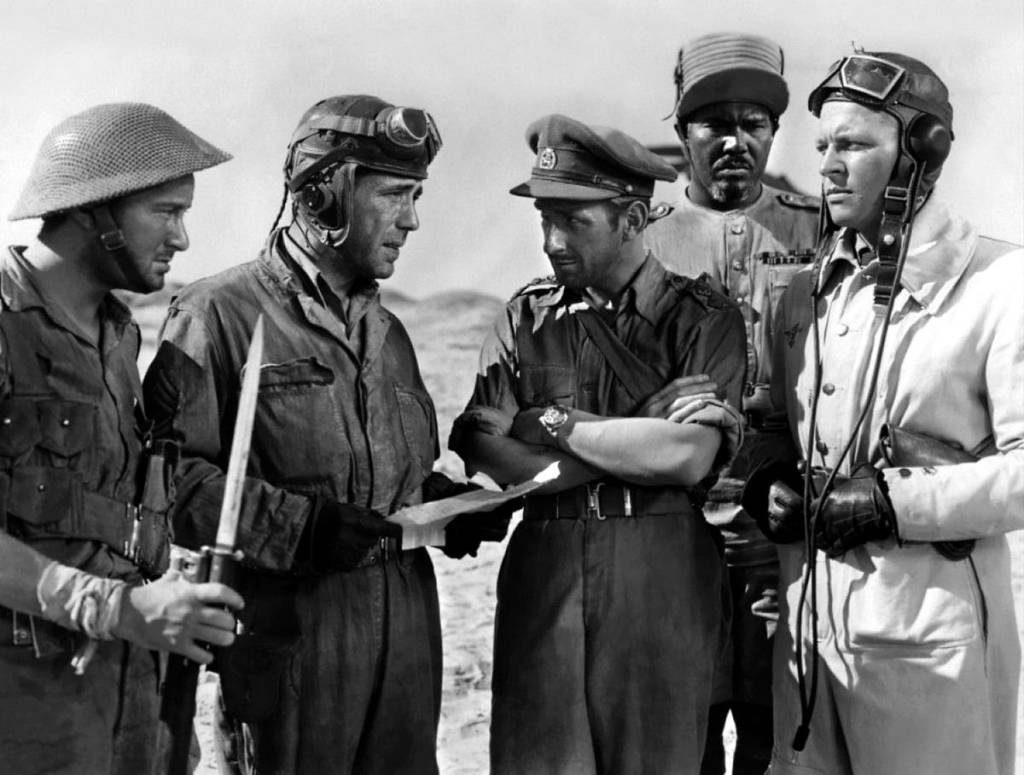
I recommend many famous films on this site, but I also try to call attention to high-quality films that have been largely forgotten. A good example is Zoltan Korda’s desert combat classic Sahara. Lauded upon release, over time it has been eclipsed in most people’s memory by that other North Africa-set Humphrey Bogart movie that was also released in 1943 (Casablanca of course, the best movie produced by the Hollywood studio system – my analysis of its most important line is here). But even in today’s time of a relative peace, this World War II story retains power to entertain and inspire viewers.
The plot: The allies are taking it on the chin in Libya, and a lone surviving tank from a destroyed batallion chugs south across the blazing desert, trying to avoid the Germans and link up with Western forces. The American tank crew is headed by Sergeant Joe Gunn (Bogart), and becomes internationalized as British, French, South African, and Sudanese soldiers separated from their units hitch a ride. The crew also take on an Italian prisoner who, being Italian, is thinking of switching sides (J. Carrol Naish, in an Oscar-nominated performance). Like the Germans who are all around them, this motley crew seeks not just military success but precious water. They set out to find a ancient well, which a dramatically larger, equally parched German force also craves. An electrifying, protracted siege composes the final act.
Part of the greatness of Sahara is how many ways there are to enjoy it. Sahara works as a thrilling combat film with soldiers slugging it out in harsh conditions. Like another or my recommendations, In Which We Serve, it also succeeds as propaganda, with both the dialogue and the performances conveying what was at stake in the war and why the Allies were the good guys and the Nazis were the bad guys (I know there is a school of thought that asks “really, weren’t they all equally bad?”…if that’s you, please go away forever as you are too stupid to appreciate my website). Finally, despite multiple characters bordering on stereotype, Sahara also delivers strong dramatic moments between people under pressure.
In the mid-20th century, when studio executives wanted to make a film about “an American everyman called to heroism by circumstance” they called Bogart. Sahara shows yet again the wisdom of that call. I was particularly moved by Bogart’s delivery of the “big speech before battle”, an absolutely un-King Henry V at Agincourt speech ungirded by democracy, decency, and courage. The rest of the cast, which is all-male (unless you count Lulubelle, the tank) is also strong, and includes several performers who would go on to impressive careers in movies and television (e.g., Lloyd Bridges, Dan Duryea)

I was also pleasantly surprised at the film having a Black hero (well-played by Rex Ingram). Like Casablanca, Sahara presents a world where democracies embrace cross-racial friendship and respect. In the 1940s, this was of course an idealized sentiment…but it’s good to have ideals, and they were certainly different than those of Nazi Germany. Not incidentally, if you listen carefully, you will hear a Nazi that our heroes take prisoner (Kurt Kreuger) refer to Ingram’s character with a racial slur. If you aren’t cheering for Ingram in his final confrontation with Kreuger (which was so realistic that one of the actors was almost knocked unconscious) you don’t have a heart in your chest.
Plaudits go as well to James O’Hanlon, Korda and the soon to be blacklisted John Howard Lawson who wrote the taut, gritty script based on Phillip MacDonald’s novel. Also to love: one of my favorite cinematographers (see here and here), Rudolf Maté, again creates stunning visuals, including cascading sand dunes in bright yet bleak light.
Sahara is a melodramatic movie, but I have to say it got to me. And of course its potency would have been much greater during the war when Americans were fighting and dying alongside Allied soldiers around the world. A beloved film in its era, it deserves broad viewership today.

p.s. This film is partly inspired by a Soviet movie The Thirteen, and has subsequently inspired other films including Last of the Comanches.
 All Good Movies