Categories
Blogs on Film

Artistic and Economic Legacies of a Landmark Antitrust Case

The marked decline in Hollywood’s fortunes in the 1950s and early 1960s (before Scorsese, Coppola, Evans et al saved the day) is usually attributed to the increasing availability of televisions in American homes. This was no doubt a factor, but equally important was a 1948 Supreme Court: United States v. Paramount Pictures. The impact of this antitrust ruling was enormous both for the artistic content of studio movies and for the economic shape of the film industry.

Understanding the case requires an appreciation of the vertical integration of Hollywood’s business prior to the war. You may have noticed that many cities and towns have cinemas with names like “The Paramount”, “The Detroit Fox Theater” and “Warner” (including the hometown theater where I happily misspent a non-negligible portion of my West Virginia childhood). Those theater names are a legacy of the era in which the five major film studios owned the bulk of movie houses in the U.S.

Owning the theaters in which their movies played gave the big studios an extraordinary financial advantage in distribution, which they leveraged further by forcing independently-owned theaters to “block book” their products. If you wanted to show the hot new Bogart picture Casablanca in your independently-owned theater, you were strong-armed into also showing some Warner Brothers-made newsreels, short subjects and probably a low-budget second feature as well. And if you were an independent film producer looking for an audience, you pretty much had to go on your knees before the major studios to gain access to their theaters. The SCOTUS Justices knew an antitrust violation when they saw it, and their 1948 decision in the Paramount Pictures case forced the studios to give up ownership of theaters.

The artistic impact of the high court’s decision is not fully appreciated, even by film buffs. In the old business model, studios had regionalized audiences, which influenced their film production choices. In trying to explain why Broadway style musicals and cosmopolitan comedies were staples at MGM/Loews studio but not at 20th Century Fox for example, you need look no further than where their respective theaters were located: The former were concentrated in New York City and other parts of the Northeast, the latter were mostly further west, often in more rural areas.

Shorn of regionalized audiences, all the studios began playing a national game of pursuing audiences and lost their distinctive artistic approaches. Their products became more homogenized as a consequence.

Economically, the Paramount Pictures decision helped create what my pals Robert Frank and Phil Cook term a “Winner-Take-All-Market” in the movie industry. In the old system, all the studios could ensure at least some ticket sales by putting their own films into their own theaters. As theaters became free entities, competition was nationalized with no floor under what amount any studio might make and not much of a ceiling on what they might realize either.

Funnily enough, it was Paramount that first grasped the implications of the new market when it released The Godfather in a then shocking 400 screens nationwide. Soon afterward, Jaws tripled the size of that release. Both films made money hand over fist, and the blockbuster film era had truly arrived. From then on, a small number of films would make extraordinary profits, whereas the great bulk of films would make little or no money at all.

Categories
Mystery/Noir

Too Late for Tears

I’ve recommended I Walk Alone, a 1948 gangster melodrama directed by Byron Haskin with Lizabeth Scott and Kristen Miller in supporting parts and Burt Lancaster and Kirk Douglas in the leads. The following year, the first three of those talented people re-teamed to make Too Late for Tears. This time around, men move to the back of the room to make space for the women characters, the noir elements are much more pronounced, and the script offers a more tightly constructed and cleverly plotted story. The result is an even better movie, indeed a treasure of the film noir canon.

The plot has so many surprises that it’s hard to summarize without spoliers, so I will confine myself to the set up. The Palmers are driving down a lonely, winding canyon road. Alan Palmer is a straightforward, true blue type who loves and trusts his wife (or so it seems…). Jane Palmer has been married before to a man who committed suicide (apparently…) and complains that she is tired of not having enough money. But she is so happy to have Arthur as her husband that she doesn’t mind that he isn’t rich (or so she says…). And then, a miracle. Another car throws a suitcase full of kale into their back seat and then drives away without explanation. Clearly some mistake has been made and they ought to go to the police, but it’s so so tempting to keep so so much money. And then they see another car pursuing them: Is it driven by the person who was supposed to receive the payoff that has landed in their lap?

To reveal more would be an injustice. Roy Huggins, who later went on to TV Hall of Famedom for The Rockford Files and The Fugitive, deserves roses for his ingeniously plotted script. It keeps the viewer guessing (usually, wrong) and ties up all the loose ends in a satisfying conclusion.

Kristine Miller, as the sister-in-law who has never really trusted Jane Palmer, has some wonderful scenes with Scott where they are pleasant on the surface but clearly jousting underneath. I find it strange that the alluring and talented Miller never became a star, but she said in late life that in the end Producer Hal Wallis “didn’t know what to do with her”. That’s a shame, because with the right vehicle she could have captured the public’s imagination in way she ultimately did not in the 1940s and 1950s.

The male supporting players, Arthur Kennedy as Alan Palmer, Dan Duryea as a slimy grifter and Don DeFore as a man with mysterious motives, turn in solid performances. And Haskins, in contrast to I Walk Alone, seems in full command from the director’s chair, partly no doubt due to experience and partly because he has a stronger storyline this around.

But this movie is first and foremost dominated by Lizabeth Scott, in a knockout performance. She had an unusual life in film. She looks and sounds like a cross between Veronica Lake and Lauren Bacall, and indeed was packaged as a Bacall-type by Hal Wallis. She spent almost her entire career making crime melodramas and film noirs in the 1940s (the fine picture Dead Reckoning with Humphrey Bogart being the mostly widely remembered). And then in the 1950s her career swooned, perhaps because the tabloid press reported that she was a lesbian (Ms. Scott, who lived until 2015, shunned publicity for over a half-century, so her view of what happened remains unknown).

I criticized her somewhat stilted performance in I Walk Alone, but I can do nothing but praise her tour-de-force in Too Late for Tears. She owns the screen, in one of a handful of movies made right after the war that was willing to put a tough woman at the center of the story (for another, see my review of Strange Impersonation). In her words, expressions and physical movements, Scott brings alive a femme fatale of hidden motives, craftiness and tough-as-nails pursuit of money. She’s a nasty, manipulative piece of work such that when a tough male actor like Dan Duryea is clearly shocked and repulsed about how much more brutal she is than he ever could be, the audience nods along, mouth agape.

Comparing this film to I Walk Alone is a good way to learn about the nature of film noir. Although I Walk Alone is often mentioned in books about the genre and Too Late for Tears is not, the latter is a much more fully realized example of the style. Look for example at the washed out set design in the Palmers’ apartment and the lighting and camerawork in Scott’s scenes with Duryea. The bleak view of human nature and the number of characters trapped by irresistible, bad impulses are also defining features of what is probably the most completely developed style of American film (Even though, of course, its precursors are European). Why Too Late for Tears isn’t mentioned in the same breath with other noir classics is a mystery to me, because it ranks with the very best of the genre.

Categories
Drama Mystery/Noir

I Walk Alone

4 Movies Starring Burt Lancaster and Kirk Douglas

Burt Lancaster and Kirk Douglas had remarkably parallel careers. They both made their first film in 1946, quickly became huge international stars, and maintained their cinematic dominance for decades. Both were handsome, athletic men who were also intelligent enough to play parts with nuance and depth. Both ultimately broke away from the studio system to become independent producers. And last but not least, they made seven films together, the first of which is the 1948 crime melodrama I Walk Alone.

The story commences with Frankie Madison (Lancaster) getting out of the joint after a 14 year stretch. He was arrested for bootlegging with Noll “Dink” Taylor (Douglas), but Taylor eluded the cops, never did any hard time and indeed never even bothered to visit Frankie in prison. Frankie’s old friend Dave (Wendell Corey, in a quietly effective performance), who has stayed true to him, is under Dink’s thumb as the bookkeeper of his swanky nightclub. Frankie feels entitled to half of the club, but Dink isn’t feeling generous. Dink sends his moll, a singer in the club (Lizabeth Scott) to sweet-talk Frankie; he’s lost interest in her anyway because he wants to marry a blue blood (a sultry and perfectly bitchy Kristine Miller) who will secure his place among the posh people.

The emotional power of the film comes from the conflict between Frankie and Dink. Lancaster’s Frankie is a pacing, rough cut ex-con who would like nothing better than to slug it out. Douglas’ Dink is all suaveness and reassurance, an oleaginous modern businessman who claims to have left the world of guns and fists. This contrast produces the best scene in the movie, in which Lancaster shows up with some thugs to take over the club by force, and Douglas humiliates him by explaining that because of multiple holding companies and escrow agreements, there is nothing to take over (without a vote of the board and amendment of the by laws of course). As Dink himself says, Frankie is a dinosaur, unable to cope with the realities of the modern world. But Dink still fears him enough to commit a terrible crime and frame his former pal as the culprit.

There are some flaws in this film. It was Byron Haskin’s first directorial outing, and he doesn’t seem in full control of the material. He got much better later, for example in another of my recommendations, Treasure Island. This isn’t Lizabeth Scott’s best work either. She seems one-note off in I Walk Alone, for a reason I cannot guess (Bad direction from Haskin, maybe). Charles Schnee was a great script writer (The Bad and the Beautiful, starring Kirk Douglas, being one of his gems). His script here includes some pungent dialogue but the story drags at times, particularly in the second half. But no matter what slow spots intrude on the viewer’s enjoyment, the film always roars back to life as soon as the two lions of post-war cinema are tussling on the screen again.

As a note on the actors, this was the fourth film for both men and they apparently spent little time with each other off-screen. Their friendship/rivalry was to blossom much later during the making of Gunfight at the O.K. Corral. About 10 years ago, I had the good fortune to hear from Douglas’ own lips that the rivalry was largely a studio and trade press invention, when in reality they had always been good friends. But who knows or cares? Whatever their personal relationship was like off screen, they were a terrific duo onscreen.

Categories
Action/Adventure British

Treasure Island

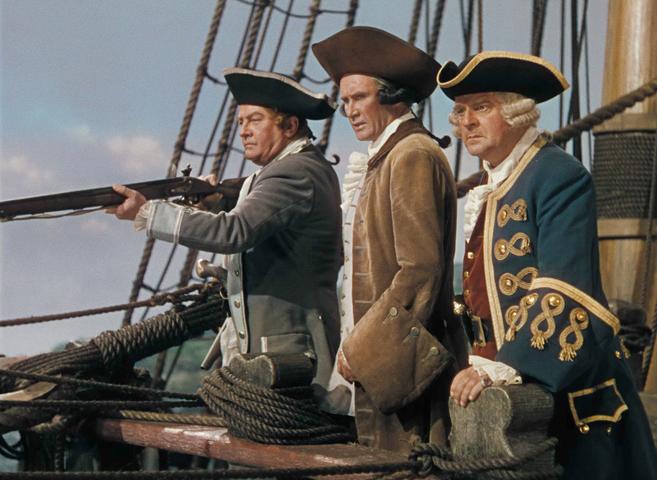
Yarrrrrrrrrr! Movie pirates didn’t have heavy West Country accents before Robert Newton’s famous turn as Long John Silver in the 1950 version of Treasure Island. Disney’s first-ever live action film is aimed squarely at school age boys, but is also pleasant for grown-ups to revisit on a rainy Sunday afternoon. The film’s production values hold up well even 60 odd years on, and, while even older, R. L. Stevenson’s 1883 story (with some amendments) retains its charm and excitement even for modern audiences.

The story opens with young Jim Hawkins tending the bar in his mother’s inn (She herself nor any other significant female character appears in the film, so we are truly in boyland here). In comes Black Dog, a menacing Pirate in search of Captain Billy Bones, who is hiding out at the inn. After Black Dog leaves, Billy Bones gives young Jim a treasure map and tells him to flee before the pirates return. Jim confides in two honorable adults, Squire Trelawny and Dr. Livesy. Our heroes set sail in search of pirate treasure, not realizing that the old sea dog they have hired as the cook is the dread Long John Silver, and most of the crew are his own bloodthirsty band of brigands! Thems that die’ll be the lucky ones, arrrrhh!!! Adventure, thrills and some welcome moments of humor and humanity ensue.

Treasure Island - Is Treasure Island on Netflix - FlixList

The emotional heart of the film are Long John Silver (Robert Newton) and Jim Hawkins (Bobby Driscoll). The good adults led by Squire Trelawny are uniformly noble and brave, the pirates (other than Long John) are uniformly nasty and craven. With that as a flat background, Silver and Hawkins really come to life. Long John is the only adult of complex character in the story, being in some ways cunning and greedy but in other respects moral and kind. And because Jim is the only character who travels between the worlds of the oh-so-good-heroes and the oh-so-evil pirates, he becomes a finely shaded character too, particularly as he learns to appreciate that his sometimes-friend Silver is neither a thoroughgoing villain nor a worthy role model.

Newton’s flavourful acting makes this film hum and is worthy of admiration. A less professional actor would have condescended to only a half-hearted or one-dimensional performance, seeing a “children’s film” as beneath him. But Newton goes all in, bless his cotton socks. He will likely always be cinema’s iconic Long John Silver and Silver will certainly always be his most famous role even though he turned in many strong performances in his career (e.g., as Bill Sykes in David Lean’s fine adaptation of Oliver Twist). Newton never makes Silver so evil that the audience can just hate him outright (as hammier actors have in other adaptations of Stevenson’s novel), but neither does he minimize the cruel aspects of the character that make him scary and thereby provide much of the tension of the story.

Categories
Drama Mystery/Noir

Strange Impersonation

Let’s get one thing out of the way up front: The only plot elements in Strange Impersonation that are not utterly predictable are completely preposterous. But everything else is right in the under-appreciated Anthony Mann’s 1946 noirish tale of two formidable women locked in intellectual and romantic combat.

The film was made just after the war, and could be interpreted in light of women’s changed roles and the desire of some people to change them back. Our heroine, Nora Goodrich (Brenda Marshall, in a multi-faceted performance) is an independent, brilliant researcher. When her suitor, Dr. Steven Lindstrom (William Gargan) tries to kiss her in the lab she withholds her lips and admonishes “Please dear, science.” Her able assistant, Arline Cole (Hillary Brooke, in her best film role other perhaps than Woman in Green), is a different sort of woman. Arline can’t understand how Nora is putting her career ahead of marrying Dr. Lindstrom. During a dangerous experiment, Arline proves to be the ultimate frenemy; disfigurement, murder, plastic surgery, stolen identity, and romantic double dealing ensue.

Lindstrom’s character is actually too dull for these powerhouse women to be fighting over, so forget him and enjoy the sparks between the female leads. Hillary Brooke was a much better actress than her appearances on the Abbott and Costello show let her demonstrate, and her malicious charm is in full flower here. The film’s budget looks to have been about 50 cents, but Mann makes the most of it by setting up some intriguing camera shots and keeping the pacing brisk. Props to the UCLA Film Restoration team for their work on the now sharp-looking print of this old movie.

A great film? No. A good film that is worth 68 minutes of your time? Absolutely yes.

Categories
Blogs on Film

Over and Out: Another Odd Movie Trope

I have written about movie tropes such as the the tell-tale cough of death and the bullet that throws a 200 pound adult across a room. I was reminded of another while watching my sons play with hand held walkie-talkies.

The little boy on the other end says “Over and out!” after each transmission. He’s seen it on TV and movies a thousand times. Soldiers do it. Pilots do it. Secret agents do it.

But no one in real life does.

“Over” means that you have finished your message and are expecting a response. “Out” means you have finished your message and are ending the conversation. “Over and out” is thus an oxymoron.

Categories
Blogs on Film Uncategorized

Bob Hoskins’ Retirement

My sympathies to Bob Hoskins, who has been diagnosed with Parkinson’s Disease and will retire from acting. Although best known for tough guy roles, he was an actor of tremendous range who could also be endearing, gentle and funny on screen.

His breakout performance in “The Long Good Friday” is his best work, indeed one of the most potent star turns in the history of gangster films. I recommended it here, and recommend it again to all Hoskins fans who will be missing him on screen and wishing him well with his illness.

Categories
Action/Adventure British Drama

The Long Good Friday

British film director John “Frenzy” Mackenzie directed another of my recommendations, Unman, Wittering and Zigo, but will be best remembered for the thrilling, brutal gangster classic, The Long Good Friday.

Many American viewers struggle with the opening scenes of this 1980 film because the slang comes fast and some of the Cockney accents are thick. Also, the film’s only significant flaw is that its opening scenes are confusing as characters and plot elements are thrown at the viewer one after the other in overly rapid succession. (Indeed, even at the end, as with The Big Sleep, it is hard to tie up every loose end in your mind).

But you will forget all that the moment that Bob Hoskins arrives — or rather, explodes — onto the scene accompanied by Francis Monkman’s pulsating score. As mobster Harold Shand, Hoskins dominates his scenes, projecting power, ambition and the ever-present threat of violence. And he’s far more interesting than the typical mobster in that he fantasizes about being a captain of legitimate industry. Seeing his speech about the planned development of the Canary Wharf area as his boat moves down the Thames, his head framed perfectly by the Tower Bridge in the background, is like watching James Cagney play Margaret Thatcher.

The other thing that makes Harold interesting is that his gun moll is no dim-witted tart, even though her part was written that way in the original script. Helen Mirren is at her very best as the smarter, classier half of the criminal couple at the center of the movie. Thankfully the filmmakers realized that casting Mirren just for her looks would have been a gross under utilization of her intelligence and acting skills. She has a meaty, fascinating part and she makes the most of it.

As the film opens, Harold is trying to launch a legitimate business empire but is thwarted when his criminal empire suddenly comes under attack. But by whom? He has already killed everyone who could take him on, right? Or has he somehow created a powerful new enemy?

This is the best British gangster film since Get Carter and it’s even better the second time through once you understand the labyrinthine plot. Note for trivia fans: this was Pierce Brosnan’s first film – he had no lines and didn’t even meet the stars (He’s looking at the camera in the back seat, not Hoskins, in those knockout final scenes).

p.s. Like Monty Python’s Life of Brian, this film only made it to theaters through the support of rock legend George Harrison!

Categories
Action/Adventure British Drama Mystery/Noir

Get Carter

How appealing an actor is Sir Michael Caine? Put it this way: While watching him play Colonel Steiner in The Eagle Has Landed, a lot of otherwise sensible film goers find themselves rooting for the Nazis.

In the classic 1971 Brit gangster film Get Carter, Caine’s likability and magnetism are in full flower, as he somehow makes us care about and even identify with Jack Carter, a thoroughly nasty mob enforcer bent on revenge. In the dreamlike opening of the film, we learn that Carter works for some sleazy, Kray-esque London crime lords who discourage him from investigating the death of his brother in Newcastle. Jack wasn’t close to his brother — indeed as the film progresses we find out he treated his brother horribly — yet something in Jack can’t accept his sibling’s mysterious death.

He heads to Newcastle on his own, a very risky proposition given the rough criminals who run the city (led by John Osborne — yes THAT John Osborne, in a quirkily effective performance). But it’s no more risky than seducing and planning to run off with his boss’ girlfriend (A stunning and believable Britt Ekland), which Carter is also doing as he tries to determine how and why his brother died. Indeed, Carter seems drawn to danger: The more threats he receives to drop his investigation the more determined he becomes to pursue it to its conclusion.

Carter also has to contend with an old rival named Eric (Ian Hendry). As a Newcastle criminal with “eyes like piss holes in the snow”, Hendry well portrays a mixture of fear and loathing of Carter, which is apparently what he felt for Caine. On the set, Hendry was sometimes drunk and openly bitter about Caine’s greater success as a star, and those emotions come out to advantage in the two men’s performances.

The other star of this film is the city of Newcastle, which is dear to me both because I lived there and because I grew up near Pittsburgh, Pennsylvania at a time when it too was a struggling industrial city on the skids. Newcastle is bleak and tough, but also has character and spirit. The feeling Geordies have for Get Carter is remarkable. A group of them even tried to stop the city from tearing down an old car park because it appeared in one of the movie’s many memorable confrontations (photo above) between Carter and the gangsters of Newcastle.

A young Mike Hodges came out of nowhere to brilliantly direct this gritty and involving film on a breathless 45 day shooting schedule. Hodges’ background in making television documentaries on location was of great use here. He chose Newcastle as the site of the story, personally scouted and picked the shooting locations, and gives the film a completely unglamorized, realistic feel. Many directors would have overdone the violent scenes, but Hodges understood that fewer and less graphic scenes (often coupled with quick cuts) have more impact, especially with a star like Michael Caine who can go from controlled cool to pure savagery and back at the drop of a hat.

The clip I am posting is not strictly speaking a trailer. Rather, it’s the great Roy Budd playing his super-cool theme music, accompanied with scenes from the movie. If you have seen the film before, look fast for an important co-passenger on the train with Carter as he heads north.

p.s. Hodges made another excellent gangster film many years later with Clive Owen, Croupier.

Categories
Blogs on Film

Movie Trivia Quiz

Question 1: What famous movie includes the first film appearance of Jeff Goldblum (as a vicious thug), one of the first screen roles of Christopher Guest (as a police officer), and was long rumored — apparently incorrectly — to be the first screen appearance of Denzel Washington?

What a Character Blogathon: How Arthur Kennedy Changed my ...

Question 2: I have recommended the film noir Too Late for Tears, in which appeared Arthur Kennedy. Today he may be best remembered for playing the Lowell Thomas-inspired character of Jackson Bentley in Lawrence of Arabia, but he for decades gave good performances in films and on stage without ever becoming a classic leading man. What distinction does this talented actor share with Claude Rains? Hint: It makes them both markedly different from Walter Brennan.

Question 3: Internet Movie Database has brief descriptions of various films. Here is the one for Casablanca.

Set in unoccupied Africa during the early days of World War II: An American expatriate meets a former lover, with unforeseen complications.

Sometimes, the films described are so strange sounding I can hardly believe they are real, and that is the seed from which this quiz grows. Below are five short film descriptions of the horror/sci-fi genre. Three of them are real descriptions from IMDB whereas the other two I made up. Try to guess which is which.

A) A lesbian college couple becomes stranded in the middle of nowhere with a pack of orphaned Nazi zombie breeders hellbent on their demise.

B) When an island off the coast of Ireland is invaded by bloodsucking aliens, the heroes discover that getting drunk is the only way to survive.

C) Two awkward Martian teenagers infiltrate the Texas Chili Cook Off and try to reunite their squabbling parents at the same time.

D) After making a pact with a witch to win a high school tennis tournament, the class nerd is terrorized by blood-sucking tennis balls that can only be defeated by a magical silver racket.

E) Aliens resurrect dead humans as zombies and vampires to stop humanity from creating the Solaranite (a sort of sun-driven bomb).

ANSWERS ANSWERS ANSWERS ANSWERS ANSWERS

Question 1: They were all in the 1970 Charles Bronson vehicle, Death Wish.

Question 2: Both Kennedy and Rains endured the frustration of being nominated for a best supporting actor Oscar four times and never winning. Brennan was also nominated four times, but took home the Academy Award three times.

Question 3:

A) REAL. The film is Blood Soaked.

B) REAL. The film is Grabbers.

C) FAKE.

D) FAKE.

E) REAL. It’s Ed Wood’s so bad it’s good classic Plan 9 from Outer Space.