Categories
Action/Adventure Drama Mystery/Noir

Bullitt

Steve McQueen had an incredible run of hits in the 1960s, which put him in position to start his own production company. Solar Production’s original six film deal with Warner Brothers eventually fell apart and only resulted in one film, but what a film: Bullitt.

The first time through, what stays with most people about this film is the legendary car chase. If you watch carefully, you will notice how cleverly and economically the sequence was filmed. The slow-driving green VW bug that keeps appearing is the tip-off: The same incredible driving stunt was filmed from many different angles and then seamlessly edited to look like a series of death-defying maneuvers.

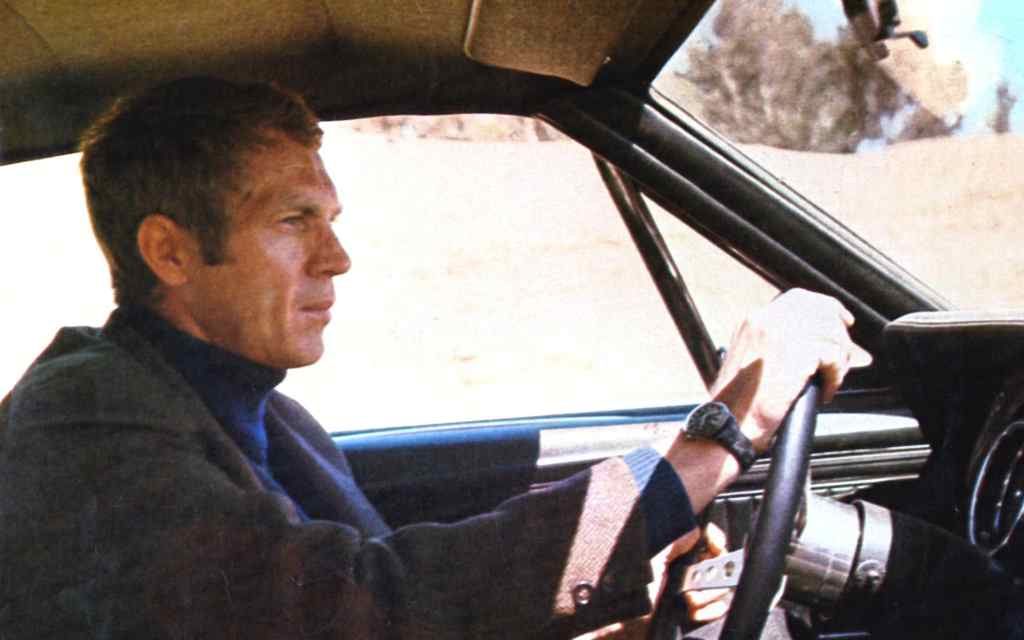
But the thing to watch in the film is Steve McQueen, in one of his very best roles (the completely original Junior Bonner, which Solar Productions made later, is my other favorite). He is a man detached. With loud, free and colorful 1968 San Francisco all around him he is quiet, controlled and dark. Bullitt has closed himself off emotionally to cope with the horrible things he sees as a police officer. As a result he is almost completely alone in the world,

As a Senator hoping to make his political name as a crime buster, Robert Vaughn is also excellent and almost seems to compete with McQueen over who can underplay his part more. Vaughn, along with Simon Oakland as the police captain who supervises Bullitt, embody Hollywood’s traditional portrayal of the law enforcement establishment which McQueen can react against, allowing him to create something new in cinema: a left-wing coded police officer who was hip and counter-cultural. Jacqueline Bisset, in addition to being easy on the eyes, delivers the goods in her dramatic scenes as the one person to whom Bullitt is willing to be somewhat vulnerable. And the ambience of the film is magnificently enhanced by the visuals of the the City by the Bay and the super-cool score of Lalo Schifrin.

Director Peter Yates, then little known outside Britain, got the job of the strength of his breathtaking car chase sequence in the fine 1967 caper film Robbery. But he obviously had skills well beyond that, including the ability to sprinkle high-octane action sequences into crime films that are more often meditative and character driven. A trilogy of my recommendations, namely this film, Robbery, and The Friends of Eddie Coyle, which Yates made over a fruitful 5-year period, illustrate his talent for smoothly weaving high-key moments into fundamentally low-key movies.

Bullitt works as a detective story, as an action film, and as a character study all at once. And it holds up very well under repeated viewings, so even if you’ve seen it before you can treat yourself again to a classic piece of American cinema.


Categories
Blogs on Film Uncategorized

Finding and Enjoying Older Movies

My knowledge of recent pop culture does not go much beyond being excited about this Bob Bailey guy who recently took over from John Lund in the lead part of Yours Truly, Johnny Dollar. Most of my film recommendations can thus sometimes be hard to find. When I was writing for Washington Monthly magazine, some people would write me and ask for suggestions about where to find older movies. Let me offer a few ideas.

First, although I do not myself watch television, I am given to understand that there are channels that regularly feature older films. One of them is Turner Classic Movies (TCM), which also has a website packed with reviews and commentary on the films the channel shows. Another, American Movie Classics, has broken away from exclusive reliance on showing old films but still includes hours a days of classic film programming. A third possibility is IFC, which shows a mix of classic films as well as arty, offbeat and independent productions, including a number I have recommended.

Second, a number of fine films have had their copyrights lapse and are available for free viewing. One place to find most of them is The Internet Archive. I have recommended many public domain films, including Railroaded!, Nanook of the North, And Then There Were None and He Walked by Night.

Third, there are services on line that show films either in exchange for watching a few ads, or, charge an annual entry free that gives you unlimited access to their library. Examples include Hulu.com, Imdb.com, and Crackle.com. I personally sign up each year for Amazon Prime, which has let me discover or re-watch many films that I have recommended or plan to recommend here. Netflix doesn’t seem to carry as many older films, as far as I can tell.

Fourth, consider buying DVD amalgamations of old movies. Here is one of many examples: 100 mystery movies for twelve bucks! Sure, some of them are stinkers, but if even only a third of them are good you are gaining fine movie viewing for less than a buck a film.

When sifting through old films that you purchase in this way or see scheduled on TV or a pay for service website, how do you pick the ones you will like? Rotten Tomatoes is one of many sites that provides useful guidance at no charge, as can a used movie guidebook (e.g., by Leonard Maltin or Roger Ebert) which you can usually find in bookstores for a couple bucks. Also of course, you can go through this site’s list of recommendations for ideas.

Happy viewing!

Categories
Blogs on Film Uncategorized

R.I.P. Lauren Bacall, the Star Who Almost Wasn’t

Lauren Bacall, Star of Hollywood and Broadway, Dies at 89 - ABC News

Of the notable Hollywood people who died in 2014, Lauren Bacall is the one I will miss the most. Most of the obituaries about her left out something quite important about the evolution of her career. The typical account noted that her triumphant debut film with Bogart, To Have and Have Not , was followed by glorious success the following year in The Big Sleep. But what happened is more complex than that.

The Big Sleep was completed on January 12, 1945 and was shown to troops on U.S. military bases. To Have and Have Not was released to American audiences a few weeks after that. Normally, the Big Sleep would have been released to U.S. audiences immediately after or even concurrently with the big hit debut film of a star. That would have dampened Bacall’s career because in the original version (a good but not great movie), she just doesn’t have the sass and zing on display in To Have and Have Not. Coupled with the poor reviews she received for Confidential Agent later that year, she could easily have ended up as a one hit wonder.

But the war of course was ending in 1945, and Warner Brothers realized it had to rush all its war-related films into theaters right away. As a result, The Big Sleep was set aside and American stateside audiences did not see it in 1945. Bacall’s agent, Charles Feldman, used his considerable muscle in the interim to have major rewrites and reshoots done on The Big Sleep. Some scenes without her were cut, some were redone to be sexier and more fun, and this entirely new scene was created. It works even better than it might otherwise have because the two stars were by then madly in love and newly married. Bacall here shows off the sultry persona that entranced countless men, including me. What a woman! She will be greatly missed.

Categories
Blogs on Film Uncategorized

The Real Motive Behind Babette’s Feast

In the well-loved art film Babette’s Feast, the central character spends her entire lottery winnings to make one spectacular meal for her guests. It is portrayed as an act of marvelous generosity by a poor person who loves to cook and loves to give.

But Alan Jacobs points out the surprising fact that Isak Dinesen’s book rejects munificence as a motive. When her sated sisters thank her for giving up the chance the escape poverty for their sake, Babette is withering in response:

Babette gave her mistress a deep glance, a strange glance. Was there not pity, even scorn, at the bottom of it?

“For your sake?” she replied. “No. For my own.”

She rose from the chopping block and stood up before the two sisters.

“I am a great artist!” she said.


Categories
Action/Adventure British Drama

In Which We Serve

Pour yourself a small gin or a nice cup a tea, stiffen your upper lip, turn off the wireless (radio, that is) and watch one of the best films ever released in a time of war: 1942’s In Which We Serve. Made almost single-handed by Noël Coward (with some directorial assistance from the legendary David Lean), this is an unabashedly patriotic tribute to the Royal Navy, told as “the story of a ship”, the HMS Torrin. The primary purpose of the film is to encourage a nation facing annihilation, and it clearly succeeds in that respect. But it’s also — even today — moving, exciting and worthy of admiration as a piece of cinema.

The story telling style is reminiscent of Coward’s magnificent Cavalcade. Rather than following a strictly linear narrative, the film instead presents a series of recollections by different characters, all of whom are literally clinging to life after their ship has been torpedoed. In flashback scenes, they recall their families, their friends, and most of all their experiences on the H.M.S. Torrin. It’s stirring stuff. The Dunkirk rescue operation and the battles near Crete are brought vividly to life, using a well-edited mix of documentary footage and scenes shot for the film.

Noël Coward’s Mountbatten-esque performance (the two remarkable men were good friends) as Captain Kinross is probably a bit too mannered to be completely accessible to most viewers. The heart of the film is much more Bernard Miles as CPO Hardy and John Mills as his nephew by marriage, ordinary seaman Blake (Following this movie, Mills became a David Lean favorite, and won a best supporting actor Oscar under Lean’s Direction almost 30 years later). They and the other perfomers playing junior officers, ordinary seaman and family members back home are more vulnerable and therefore particularly sympathetic for the audience. We admire the formidable Kinross from an emotional distance but the “average” fighting men and their loved ones on the home front have more common humanity, particularly as we witness their courage, their fears and their loves.

In Which We Serve (1942) | From The Dam Busters to Dunkirk: the 31 ...

The film does not skimp on the horrors of war, including the terror of combat and the grief at losing loved ones. If you can’t shed a tear during the scene in which Blake tells CPO Hardy the latest news from home, call a cardiologist immediately because you are missing a vital organ from your chest.

The Brits and indeed the world were up against it when this film was made, so don’t expect cynicism, unhappy families or emotional breakdown by the characters (Even Richard Attenborough, as a coward, mans up in the end). A more realistic take on the war was possible after it was all over and people had the security to look back with a more gelid eye (see for example my recommendation of 1953’s The Cruel Sea). But none of that takes away from the power of this straight-faced tonic for the people of Britain at a time of unimaginable peril. It’s a triumph for Coward and the whole cast, who received a special and much deserved Academy Award for their efforts.

In Which We Serve is in the public domain and you can watch a high-quality copy for free by clicking here.

Categories
Blogs on Film Uncategorized

Money is Small and Light in the Movies

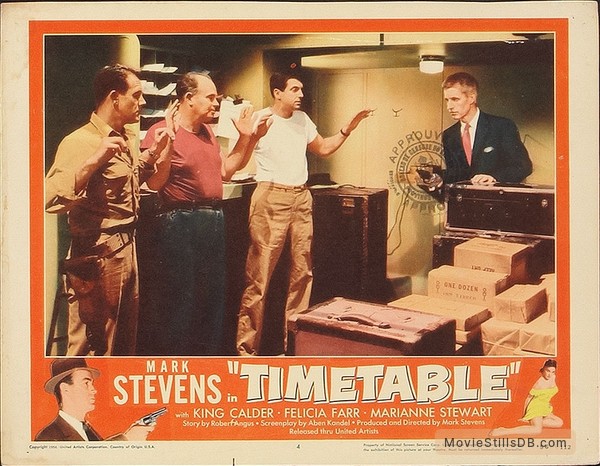
Time Table - Lobby card

I recommend Mark Stevens’ excellent 1956 film noir Timetable. There’s a funny movie trope during the robbery scene portrayed above. After the robber blows the safe, he steals “$500,000 in small bills”. The money is contained in two small satchels each about the size of a woman’s purse, which he almost daintily lifts and then tosses into his suitcase.

In real life, a piece of US currency is .0043 inches thick and weighs about a gram. If we assume the average “small bill” in 1956 is a $10 note and that the bills are all perfectly pressed flat with no wrinkles, the stack of bills should have been 17.92 FEET high and would have weighed just over 110 pounds!

But in the movies, money is small and light. Countless caper films (e.g., Heat) feature people nimbly running around with zillions of dollars in their small, lightweight satchels.

Someday I hope to see a film that undoes this trope, for example by having a kidnapper not be strong enough to lift the suitcase with the ransom in it, or having a car axle bend under the weight of the multi-billion dollar haul in the back seat.

Categories
Blogs on Film

John Leach Helped Make Spy Movies Cool

John Leach has passed away. He was a multi-talented composer and musician with many artistic achievements to his credit. He also made a small but important contribution to the ambience of the spate of espionage films that emerged from Britain in the 1960s and eventually became a world wide phenomenon.

The theme music of many of these movies featured sonorous notes — at times evocatively asynchronous — that came from a cimbalom, a hammer dulcimer from Hungary that Leach mastered. The musical touchstone is the theme to The Ipcress File (Michael Caine’s superb first outing as Harry Palmer). The music was written by the legendary John Barry with Leach adding his own magic, and the resulting style was widely copied in later films using either a cimbalon or other instruments that could generate a similar effect (e.g., the plucked strings of a piano or a properly tuned electric bass guitar).

When I hear those intoxicating notes, I see in my mind a hundred ultra-cool, glumly professional spooks in overcoats, walking down dark streets and battling it out with their opposite numbers in The East. Music really can help define and enrich a film genre. Well done Mr. Leach. R.I.P.

Categories
Blogs on Film

Overused Movie Trope #267: No-o-o-o-o-o-o-o-o-o-o-o-o-o-o-o!!!

Suffering through The Hobbit: An Unexpected Journey on an airplane some years ago, I noticed a movie trope that is even more overused (and is much more annoying) than “over and out” the tell-tale cough of death and bullets that throw people across rooms upon impact.

The scene: Thorin sees his father slain in combat and the camera zooms in on his face and then we go to slo-mo as he yells “No-o-o-o-o-o-o-o-o-o-o-o-o-o!!!!!!”.

How many zillion times have I seen that in a movie? I thought, and has it ever really worked?

And how long before I have to watch this stale bit of film making again?

Answer, in the closing scenes of The Hobbit, a scant 8 hours later (I’m estimating by how it felt), Thorin is about to be killed by a big orc and so the camera zooms in on Bilbo’s face, and we go to slo-mo as he yells “No-o-o-o-o-o-o-o-o-o-o-o-o-o!!!!!!”.

I wish every time a screenwriter and director agreed they were going to re-use this trope, someone sitting in on the script meeting would do what all the people in this youtube clip do.

Categories
Blogs on Film

Making a No Budget Movie

The movie adaptation of some of my wife’s poetic short stories has just been entered into the very intense competition to appear at Cannes. They have categories for big budget, mid budget and low budget. And then below that are films like ours, in which a large cast and crew donated their time because they wanted to be a part of an artistic project that excited and fulfilled them.

Huge congratulations to Director Jeff Wedding, who laboured for six years to make A Measure of the Sin a 16mm reality. As the trailer below demonstrates, technology has democratized film making: You don’t need millions of dollars to create cinematic art.

Categories
Blogs on Film Uncategorized

Impress Audiences Quickly, Or Else

Watching a movie once required a significant investment of time. You had to page through the newspapers to find the ads, decide what you wanted to see, look at showtimes until you found one that worked with your schedule, travel to the theater, buy a ticket and travel home afterwards. Today, just sitting here in my living room I can watch thousands of films with the click of a button over the Internet, or for that matter can reach out and grab any of the hundreds of DVDs on my bookshelf.

It’s therefore incredibly easy to switch away from one movie you are not enjoying to a different choice. This simply wasn’t possible in the old days. If you didn’t like how a movie was going you would probably sit through it anyway because of sunk costs (travel time, ticket purchase) and because the alternative film might be a week away. Even if you were watching the movie on television, there were not that many channels then and there probably wasn’t much else to switch to.

In the days when you were more or less stuck with one movie to watch, it was easier for movies to overcome really bad openings. Poseidon Adventure was a smash hit at the box office, but its opening 20 minutes are almost comically dreadful. The film opens on a doomed ship, with each key character getting serial ham-handed introductions of their stereotypical back story. The Simpsons parodied the opening moments of the film thus:

Marge: What a fascinating cross-section of humanity. You got the lonely, but lovable loser…

Jeff (sitting with dolls of Charlie’s Angels): Hello, Angels. Your mission today involves going undercover at a wet t-shirt contest. (pours his water over the dolls) Just get you wet… (grins)

Marge: Maybe not so lovable.

Lisa: And you got the elderly Jewish couple making their first trip to Israel.

Wife of Old Jewish Man: Our son Shlomo is working on a kibbutz in Haifa. We’re schleppin’ him some kreplach.

Old Jewish Man: We’re Jewish all right.

This dreadful narrative “technique” is accompanied by painfully wooden acting. In particularly, Leslie Nielsen, as the Serious, Strong-Jawed Ocean Liner Captain with Integrity, seems to be parodying himself as he later would do so well in The Naked Gun…but his part here is putatively dramatic rather than comic.

And yet, about 20 minutes into this torment, the boat flips over and the movie becomes one heck of a good time as the survivors try to travel its length and escape. There are good special effects, exciting action scenes, some suspense, some existential weight, and some hard to forget visuals of upside down kitchens, bathrooms etc.

It would be hard to persuade a modern viewer to sit through those first 20 minutes when there are a thousand other film choices a touch of the button away. Now, of course there is nothing wrong with film makers not making a bad opening 20 minutes, but what about films that take some time to develop but are more rewarding as a result, such as Vertigo? Would a film maker be as likely today to risk telling a story that was initially confusing (e.g., The Long Good Friday), or challenging, or leisurely in pace?

Directors and producers want their films to be watched and watched in their entirety for artistic and commercial reasons. In an age of so much choice they must feel more pressure to put more action/sex/plot twists in early so that people don’t flip around to another cable channel or Internet streaming site. They must also feel some pressure to be ingratiating rather than challenging to their audience.

I’d be curious to hear the perceptions of people who have been watching movies for a long time whether they perceive any trend toward “front-loaded” narrative structure in movies as film makers compete ever more intensely for viewers with countless other easily accessed options.