Categories
Action/Adventure Mystery/Noir

Railroaded!

Anthony Mann is justly revered by film buffs for his noir westerns with Jimmy Stewart, but he alo essayed more traditional urban noirs. One of the best is his 1947 low-budget triumph, Railroaded!.

The film opens with a high-voltage portrayal of a blown stickup, as some luckless bad guys fail to get away clean while robbing a gambling joint, despite having inside help. But the heart of the story comes after the opening fireworks, as the lead gunman (John Ireland) and his boozy floozy (Jane Randolph, who excelled in these kinds of roles) frame an innocent man (a sympathetic Ed Kelly) for the crime. A police detective (a pre-Leave it to Beaver Hugh Beaumont) at first isn’t convinced that the guy in the frame is innocent, but is persuaded to investigate by the attractive, goodly sister of the accused (Sheila Ryan). Action, suspense and romance ensue.

This film was made on Poverty Row, which churned out low-budget B-movies until its business underpinnings were destroyed by the Paramount Supreme Court Case, which I have written about before. The budgets of Poverty Row studios were too small and the films were shot too quickly to consistently achieve quality, but these studios were also a playground for talented people who went on to better opportunities later, including Anthony Mann. The Poverty Row studios were also more comfortable pushing the envelope with the censors, an example in Railroaded! is that when the slatternly Randolph and the saintly Ryan meet in this movie, they get into an extended brawl! (Nice touch by the way: They were dressed in inverted colors for the fight, Ryan all in sinful black, Randolph in angelic white).

Railroaded!, in addition to being an exciting story on its own terms, shows how creative filmmakers can overcome low budgets. They were smart enough to cast the tough and credible up-and-comer John Ireland when he was still a cheap date, just before his star was about to shine in Red River and All The King’s Men. The noir lighting and plenty of closeups keep the viewers from contemplating the cheap props and sets. And Mann’s brisk pace (the film is not much more than an hour long) stops anyone from thinking too hard about some of the less plausible aspects of a script, which would have benefited from one more rewrite to iron out some plot contrivances.

By the way, Hugh Beaumont isn’t the only person in this tough, dark crime movie who went on to inordinately wholesome TV stardom. Ellen Corby, who later became Grandma Walton, appears uncredited as Mrs. Wills.

In summary, this is a remarkably solid and entertaining movie given that its budget was probably around two bits. I believe the poverty row studio movies are in the public domain at this point, so I am posting Railroaded! right here for you to enjoy.

Categories
Action/Adventure British Mystery/Noir

The Scarlet Claw

Of the many film series of the 1930s and 1940s, Sherlock Holmes stood out both for its watchability and its unusual provenance. It was launched at 20th Century Fox in 1939 as a high-end period production. But after two very strong films, The Hound of the Baskervilles and The Adventures of Sherlock Holmes (my recommendation here), Fox unaccountably dropped the series. Enter Universal Studios, who retained the lead actors and moved the series to modern times (Partly for WWII morale building and partly as a cost-cutting measure). Universal made a dozen modestly budgeted Holmes films in rapid succession over the next four years. Financial constraints and breakneck speed of production were no barrier to quality in this case. None of the films are bad and several are outstanding, including 1944’s The Scarlet Claw.

The plot: Holmes and Watson are in Canada, participating in a conference about the occult. Holmes’ open skepticism about the supernatural irritates the organizer, Lord Penrose (Paul Cavanagh). Penrose gets a message that his wife has been murdered, and the meeting is abruptly adjourned. Holmes presently receives a telegram sent by Penrose’s wife just before her death, saying that she feels she is in grave danger and wants Holmes to help her. Despite Lord Penrose’s hostility to him, Holmes sets off for the fog shrouded town of La Mort Rouge, where the locals believe a monster is ripping the throats out of livestock and also people. The monster is targeting particular individuals for some mysterious reason…can Holmes discover the motive behind the grisly crimes and save the next intended victim?

The heart of the Universal series are the triumvirate of Producer-Director (and in the case of The Scarlet Claw, co-screenwriter) Roy William Neill and stars Basil Rathbone and Nigel Bruce. With his mien, delivery and intelligence, Rathbone was born to play the king of detectives and he defined the role for a generation through appearances on radio, television, film and stage. Neill and Bruce decided to make Watson much more comic than he was Doyle’s stories, which irritated some Baker Street Irregulars. If you can let that go and just take the performance for what it is, you will appreciate that Bruce is indeed agreeably funny in the role and also contributes some moments of emotional warmth which balance out his calculating machine of a friend.

The Scarlet Claw (1944): Fear and Flannel | Nitrate Diva

The Scarlet Claw is a high point of the series in part because it feels like an old-fashioned Victorian Holmes story even though it is set in the present day. Unlike in prior entries, Holmes is not battling Nazis but a killer who is (as in many of the films) a pastiche from the original stories. The moody, dark surroundings in rural Canada could easily pass for the Baskerville estate in Dartmoor. Also on display are some first rate make-up and special effects work, which is essential to the story for reasons I will not reveal. The film is also the career highlight of little-known British character actor Gerald Hamer, who makes the most of the opportunity to demonstrate his versatility as a performer. Cavanagh, a handsome, solid B-movie actor with aristocratic bearing who appeared in several films in the series (Including the House of Fear, which not incidentally recycles sets from Sherlock Holmes Faces Death) and also in another of my recommendations, (The Kennel Murder Case) is fully at ease in the role of Lord Penrose. The script is strong and Neill by this point in the series had mastered every aspect of how to create fine Holmesian cinema. The result is a skillfully made, suspenseful mystery.

More generally, as a body of work, the Universal Sherlock Holmes films depart too significantly from the original stories for some people’s tastes, but in performances and atmosphere they stand shoulder to shoulder with the tremendous Soviet Livanov-Solomin and British Granada television versions as high-quality, sustained efforts to adapt Conan Doyle’s beloved stories to the screen. Also, the prints of these films have been beautifully restored by the angels at the UCLA film preservation archive. Scarlet Claw is my favorite, but you could pick up almost any of the Universal series and have a fine evening watching the world’s greatest detective work his magic.

Categories
Action/Adventure Mystery/Noir

Point Blank

The above is one of the many memorable shots (accompanied by even more memorable sound!) in this week’s film recommendation, Director John Boorman’s outstanding 1967 US debut film: Point Blank. Point Blank weds the style and techniques of 1960s experimentalism with the traditional gangster/crime melodrama, with unique and unforgettable results.

The film begins with a literal bang, pulling us into a world of brutality and revenge. And then a strange, almost unbelievable story begins as a criminal named Walker who by all rights should be dead (Lee Marvin, in a powerhouse performance) somehow overcomes his fate and launches a ferocious, violence-filled pursuit of former navy buddy Mal Reese (John Vernon, in a strong cinema debut) and his own faithless wife (Sharon Acker, also very good) who betrayed him during a stick-up. He is aided by the mysterious Mr. Yost (Keenan Wynn) who appears at odd moments to provide advice, speaking to no one but Walker. Is Yost a ghost? Is what we are seeing all the fantasy of a dying man, or is it real? I’ve seen this film multiple times and I still can’t decide; I also can’t stop re-watching this magnetic piece of art.

Adding to the atmosphere is radical use of color that recalls Red Desert. Watch carefully the progression of monochromatic scenes in this film (at left is one of the “yellow” scenes with screen siren Angie Dickinson playing Walker’s sister-in-law), which resonate with Walker’s emotions and the state of his quest. Distorted microphone effects, camera shots and the like are also used to tremendous effect, as are dreamlike scenes without any dialogue (or in one case, only half of a conversation, an amazing improvisation by Marvin). Phillip Lathrop contributes many moody, lonely camera shots that further accentuate the film’s tone. The story, which was based on a Donald Westlake novel, also pushes the boundaries of the period, with graphic violence and the strong suggestion of a sexual link between the two male leads.

The studio executives hated the movie that their young director had created, but Lee Marvin used his enormous star power to ram it down their throats as is. There was clearly more to the man than his drunken brawler image. I can’t say enough good things about what he and Boorman created…don’t miss this one, and have fun analyzing it afterwards!

p.s. Intriguing interview with Boorman about his career available here.

Categories
Action/Adventure Mystery/Noir

The Chase

The Chase is an obscure, strange, yet compelling 1946 film noir. Made through low budget studio Monogram but released by United Artists, this off-beat movie is not for all tastes, but has developed a cult following among fans of the genre.

Based on a Cornell Woolrich’s pulp crime novel, the film tells the story of Chuck Scott (Robert Cummings), a down-on-his-luck ex-GI who finds a wallet full of lolly on the street. After enjoying a hearty, much-needed breakfast, he nobly returns the wallet to its owner, a psychopathic gangster named Eddie Roman (played with presence and menace by Steve Cochran). He is such a boy scout that he even confesses his use of some of the money to eat. Roman is impressed and amused, and hires “Scotty” to be his driver, over the reservations of his sinister right-hand man Gino (Peter Lorre). But nothing in noir is ever that simple, especially once Scotty meets Eddie’s glamorous, lonely and desperate wife Lorna (Michèle Morgan, in an alluring and elusive performance). In their extended drives together, she tells Scotty that she longs from escape from her brutish husband…if only some man would take her away from all this…

The key development of the story is a twist that has delighted some viewers over the years, and confused and disappointed others. I am in the former camp, as everything that happens is consistent with the central character’s personality and motivation, and because expressionism, darkness, forbidden fantasies and dream-like atmosphere are as noir as noir can be.

There is much to enjoy in this film, including some thrilling high-speed driving sequences in an unusual car that instantiates the sadomasochistic, dominating nature of Eddie Roman. Peter Lorre, in a role few people remember, steals every scene he is in as Roman’s aide-de-camp. Franz Planer’s tenebrous photography, particularly in Roman’s house (including a wine cellar you’d be well advised not to enter…) establishes the mood of doom in which the film revels. Also fun for film buffs: The Chase is a perfect film to analyze and argue about over unfiltered cigarettes and bourbon afterwards.

The Chase is in the public domain, so you can legally watch it for free right here.

p.s. Many people know that the train station gun battle in Brian De Palma’s The Untouchables is an homage to the spectacular Odessa Steps sequence in Battleship Potemkin. It could well be that De Palma’s opening sequence with gangster Al Capone and the barber was inspired by a similar scene early in The Chase.

p.p.s. SPOILER ALERT: While the extended dream sequence is occurring, there is a tip-off, namely Cummings’ suit. Running through the streets of steamy Havana, battling bad guys and being chased by the cops, his white suit, shirt and tie are immaculate in every scene. No wrinkles, no perspiration, no dirt. You could think of this as the character’s fantasy of himself as a rescuing hero/angel, particularly when contrasted to the demeaning outfit the former solider wears as the chauffeur to a hoodlum.

Categories
Action/Adventure Mystery/Noir

Kansas City Confidential

In the years after the war, actor John Payne, director Phil Karlson, and producer Edward Small collaborated in various configurations, yielding a solid run of modestly-budgeted, high quality films. The post-war period saw many movies merge elements of film noir with the traditions of the gangster melodrama, including the first collaboration of these three men: 1952’s Kansas City Confidential.

At one level, this is a superb heist film (which allegedly influenced Quentin Tarantino’s conception of Reservoir Dogs). A masked criminal mastermind half-recruits, half-bullies three lowlifes into pulling off an armed robbery. All of them wear masks and thus are unknown both to the police and to each other. The mastermind instructs them to hide out until the money is laundered, and gives them a secret method of identifying each other when the time is ripe for the payout. Meanwhile, an ex-con, ex-GI (Payne, playing two noir archetypes in one!) who was at the wrong place at the wrong time gets pinched by the police. He escapes their clutches and decides to pursue the gang, though whether he wants them brought to justice or just desires a piece of the pie is not immediately clear.

This film is proof-positive that you don’t need much money to make a solid, entertaining film, and the complete lack of pretension to anything else is one of Kansas City Confidential’s charms. The script has some satisfying twists and moments of delicious tension. All the performances are very good, particularly Jack Elam as a twitchy, chain-smoking criminal, Preston Foster as an embittered ex-cop with both a brutal and a soft side, and Payne as a cynical tough guy out for some sort of redemption. George Diskant’s camerawork, particularly in the first half, is striking, with effective use of close-ups and lighting to let the actors act and the dark mood to suffuse the audience. The film’s viewpoint is bleak: The cops are not much better than the criminals, to extent that they are even different people at all.

John Payne’s career is almost a noir story in itself. He was originally an upbeat singer and dancer in light-hearted films and was also of course a star of the heartwarming Miracle on 34th Street. But a few years after the war he changed into a tough actor with great physical presence and a clipped style of delivering dialogue. He was very smart about the film business as a business (and shrewdly cleaned up a packet in Hollywood due to wise investments) and may therefore have grasped that the war shifted filmgoers’ taste toward darker movies that would begin to supplant sunnier fare. Whatever the reasons for his transformation, he was very effective both as a smiling song-and-dance man in love with the All-American girl as well as in the hard bitten roles he later took on. Truly, an actor of significant range.

Happily, Kansas City Confidential is in the public domain and you can therefore legally watch it for free here at Internet Archive.

p.s. Payne, Karlson, and Small also collaborated on another of my recommendations, 99 River Street.

Categories
Action/Adventure Drama Mystery/Noir

99 River Street

There are worse things than murder. You can kill a man one inch at a time.

Another of my recommendations, Kansas City Confidential, brought together Director Phil Karlson, Producer Edward Small and Actor John Payne in 1952. They re-teamed the following year to make another fine film: 99 River Street.

Payne is compelling as ultra-hard-luck Ernie Driscoll, a former boxer turned cab driver. In the opening scene, which is a pre-Raging Bull master class in how to convey the violence of boxing on film, Ernie is on the verge of becoming champion when he gets a bad break. And the bad breaks keep coming for the rest of the movie, in his marriage to his ice-cold beauty of a wife (Peggie Castle, at her best), in his friendship with a manipulative aspiring actress friend (Evelyn Keyes, on fire here), and in his battles with some ruthless jewel thieves who want to destroy him for reasons he can’t understand. His only consistent source of support is his former manager, a dispatcher at his cab company (played sympathetically by Frank Faylen, who played a cab driver in many Hollywood films and apparently got promoted).

If this film noir/gangster melodrama deserves one adjective it’s brutal. There are many scenes of physical violence, filmed with unusual realism (My favorite is Payne’s torture by and knock down drag out with a karate chopping jewel thief played by tough guy Jack Lambert). The emotional violence is even more pronounced, particularly in a long, gripping sequence in which Driscoll is played for a chump by a group of “theater people”. The tragedy of Payne’s character is that while he once was a master of his violent nature, frustrations and failures have led him to become a slave to it, preventing him from being happy in his achingly simple new life ambition of moving from hack work to becoming the owner of a filling station. Payne and Karlson are well up to the challenge of bringing across Driscoll’s emotional flaws and vulnerabilities, while at the same time making him completely credible in the many physical confrontations of the story.

The movie also gives the audience a fine bunch of criminals to root against. Brad Dexter (the guy from The Magnificent Seven whose name few people can recall) is both scary and smooth as the jewel thief who frames Payne for a terrible crime. Lambert exudes the menace that served him so well in his decades as a heavy in films and on television. Eddy Waller is even scarier in a different way as a criminal who has a kindly manner but in fact is a cold-blooded killer. The final, extended confrontation at 99 River Street of the protagonists versus the villains is thrilling and satisfying.

The only weakness of this movie is the final two minutes, a tacked on “where are they now?”-style epilogue that is too upbeat and pat given the tone and content of the rest of the film (The otherwise perfect Sideways had the same flaw). It was unlike Karlson and Small to pull a punch, but it doesn’t diminish 99 River Street as a gritty, gripping piece of cinema.

Categories
Action/Adventure Drama Mystery/Noir

Bend of the River and The Naked Spur **Double Feature**

Caftan Woman: The James Stewart Blogathon: Bend of the River (1952)

Nobody can hate like a good man, and maybe that’s why Jimmy Stewart was so magnetic and moving in the hard-bitten Westerns he made with Anthony Mann after World War II. Stewart was a huge star at the outbreak of the war, during which he served with distinction. When the All-American, gee-whiz nice guy every dad hoped his daughter would bring home returned from military service, he was different, the country was different and his films didn’t do great box office. He might easily have appeared on a few TV shows and then drifted into retirement, as did many stars of his generation.

But two magnificent directors saw other qualities in Stewart, including a capacity for rage, bitterness, grief, longing, cynicism and violence. One of them remains famous (Hitchcock), the other, sadly, has mostly been forgotten. His name was Anthony Mann, and you could summarize much of his ouevre worse than saying it was “film noir goes west”.

Their first collaboration, the 1950 movie Winchester ’73, remains famous today because it was a massive hit that revived the then somnolent Western genre. It’s entertaining on any dimension, but for Stewart fans it’s particularly fascinating to see the darkness in his acting. When Stewart’s grief-ridden character (Lin McAdam) mashes Dan Duryea’s face into the bar and painfully twists Duryea’s gun arm, the rage in Stewart’s eyes is frightening; Duryea looks scared that Stewart is really going to hurt him.

The next two Mann-Stewart collaborations are somewhat less known today, which is too bad because they allow Stewart to go deeper into less seemly human emotions. They also both deliver thrilling action scenes. I offer them here as double feature recommendation: 1952’s Bend of the River and 1953’s The Naked Spur.

Western Noir: James Stewart in BEND OF THE RIVER (Universal ...

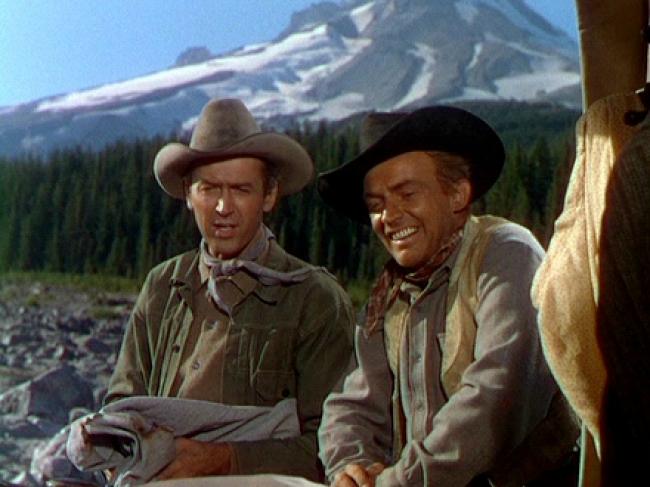
In Bend of the River, Stewart plays Glyn McLyntock, a former Kansas raider now helping a family of good-hearted pioneers settle in Oregon. They know nothing of his past, but slick gunman Emerson Cole (Arthur Kennedy) who becomes attached to their party, does. Cole too seems to want to go straight, and helps defend the party as they make their perilous journey. The pioneers warn McLyntock that a bad man is always bad, and therefore Cole cannot be trusted, but McLyntock knows that he himself needs redemption just as much as Cole does. Ultimately, the pioneers are betrayed by unscrupulous villains, and Stewart, with his old violent nature returning, must try to settle the score.

As foils, Kennedy and Stewart play off each other effectively, and Rock Hudson also does well as a (ahem) charming dandy from San Francisco (Rock liked to watch his own movies with gay friends and laugh at the subtext — they must have chuckled here when he tells a smitten young woman to go away because he wants to be with the men). The violence is extreme for the early 1950s, with dozens of people being wounded or killed on screen. What is unfortunately not out of place in the early 1950s are some mercifully brief but still off-putting scenes with Stepin Fechit as a stereotypical African-American character. But to close on a positive note, the scenery is gorgeous and everyone seems to know how to handle horses and guns, including during the climactic shootout.

The Naked Spur features another psychologically damaged Stewart character who cannot accept that what is lost is lost forever, no matter how much vengeance you take. With able assistance from Mann and two other noir icons (Ralph Meeker of Kiss Me Deadly and Robert Ryan of The Set-Up), Stewart delivers a cowboy movie with psychic weight. The film’s emotional dynamic is the reverse of Bend of the River. Instead of a once bad man trying to be accepted by good people by showing how good he is now, Stewart plays a once good man telling good people that they should not accept him anymore. That’s what makes Stewart and Janet Leigh’s heartfelt closing scene a knockout.

In addition to being a movie star and director, Clint Eastwood is a student of film history, and I am going to give him the last word on the multi-talented, multi-dimensional Jimmy Stewart:

Categories
Action/Adventure Drama Romance Science Fiction / Fantasy

Excalibur

As a filmmaker, John Boorman really goes for it. He has an idiosyncratic perspective on the diverse material he films, and carries it to the limit. Sometimes this has led to abject disaster (e.g., the incomprehensible, pretentious and unintentionally risible Zardoz). But more often than not Boorman’s courage as a filmmaker has resulted in fresh, exciting cinema, such as Point Blank, one of the very best films I have recommended on this site. 1981’s Excalibur is almost as strong and every bit as original as that classic.

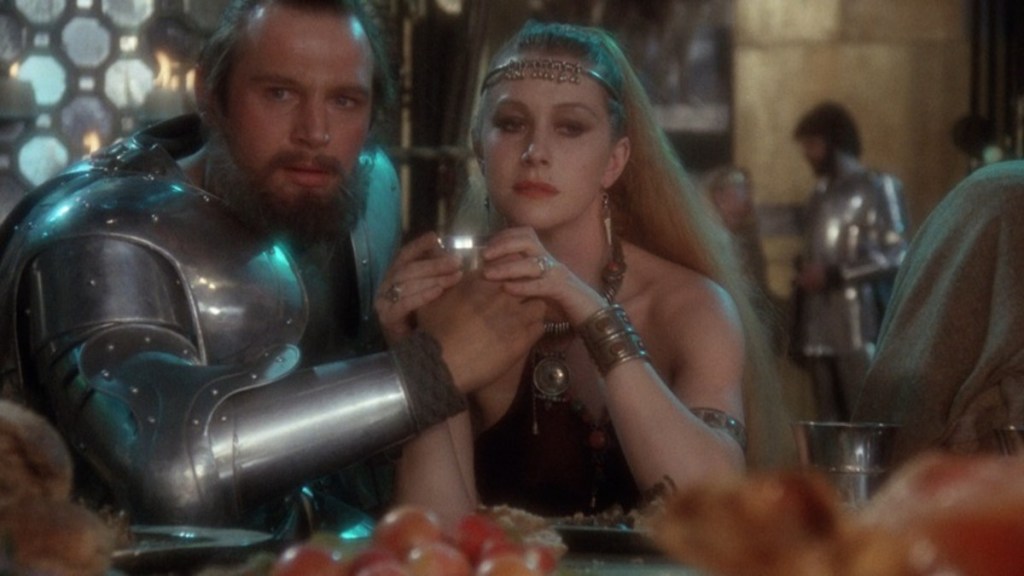
Excalibur re-tells the hoary tale of King Arthur, his wizard/mentor Merlin, his knights of the round table and his tragic love triangle with Guinevere and Lancelot. Boorman keeps roughly to the classic Malory version of the story, but tells it in his own inimitable way, with bloody battles, plenty of sex, and even at times a bit of camp (some of the over-the-top moments may have drawn a few chuckles that Boorman didn’t intend). Excalibur illustrates beautifully how a talented artist can breathe new life into familiar material.

The most memorable character in the film is Merlin, played with gusto by Nicol Williamson, who gives the most eccentric portrayal of an Arthurian Wizard since John Cleese essayed Tim the Enchanter. His Merlin is a cranky, cryptic, wise and powerful oddball who alternates between helping his human charges (First Uther Pendragon and then his son Arthur) and upbraiding them for their frailties. The film develops his rivalry/romance with Morgana le Fay more than has any other Arthurian adaptation, which was a wise move given that the ageless and subtle actress Helen Mirren is on hand to play the enchantress who longs for King Arthur’s downfall.

The production values are spectacular and the battle scenes feel real. Rather than people leaping around in plate mail whilst nimbly fencing with longswords, the combat is often slow and clunky. Indeed, the actors visibly strain under the weight of their weapons and armor. Also to admire: Future superstars (Patrick Stewart, Liam Neeson) giving solid performances as knights. Cherie Lunghi and Nicholas Gray also register as the doomed lovers Guinevere and Lancelot, and it’s a shame their film careers didn’t take off after this movie was made.

Ultimately of course, this is Boorman’s movie, and whether it captivates you or not depends directly on whether you are willing to travel along with him as he develops his personal vision of Le Morte d’Arthur. Most viewers will find that while there are a few bumps on that journey, it’s an immensely rewarding trip with one of Britain’s great filmmakers.

Categories
Action/Adventure British Mystery/Noir

The Blue Carbuncle

Christmas time is here, happiness and cheer, fun for all, that children call, their favorite time of year!

Mine too, not least because there are so many enjoyable Christmas films to recommend, including an episode from Granada Television’s justly revered Sherlock Holmes series: The Blue Carbuncle.

Eccentric, unstable, dashing Jeremy Brett, whose acting (as Edward Hardwicke put it) contained “a whiff of the Edwardian” was an inspired choice to play Holmes in this handsomely produced series. David Burke makes a fine, gentle Dr. Watson in the early episodes, succeeded by an equally good Edward Hardwicke as a flintier sort of Watson in the latter part of the series. The Blue Carbuncle features Burke as Watson, and the byplay between the actors is a marvel, bringing out the warmth of their friendship yet also Holmes’ tendency to talk down to Watson, sometimes with marked asperity.

The plot: It’s Christmas time in London, though the scowling Countess of Morcar is unhappy (Rosalind Knight, putting just the right undercurrent of humour into an overtly Scroogish performance). She finds Christmas a chore in any event, but even moreso when her precious gem, the blue carbuncle, is stolen! Meanwhile, Commissionaire Peterson (Frank Mills) brings a goose to Holmes with a strange story of how he has seen a man lose his treasured Christmas dinner. Through an ingenious series of deductions, Holmes sees that the two mysteries may be connected, but he must race against time as an innocent man (Desmond McNamara) has been framed for the crime, leaving his struggling wife and children in agony as the holiday approaches.

As with the series as a whole, the original material is treated reverently, with many lines lifted straight from the text and the climactic scene nicely staged to match Sidney Paget’s drawing from the original Strand magazine publication of Doyle’s story. And the Christmas spirit is everywhere, in the incidental Victorian-style music, set decor and story elements. Not generally thought of as a Christmas movie, The Blue Carbuncle is a fine appetizer for your family by the fire, before you tuck into your own Yuletide bird.

Categories
Action/Adventure

Die Hard

One of the great self-referential pop culture moments of recent years occurred on the TV show 30 Rock, when Jack Donaghy (Alec Baldwin) portentously intoned “When Alexander saw the breadth of his domain he wept for there were no more worlds to conquer….Hans Gruber”.

Alan Rickman’s deliciously evil, funny, cultured, intelligent, and violent Hans Gruber is the ultimate Yuletide movie villain. Unlike the Grinch, he is never redeemed. He would shoot Mr. Potter through the head in style, blow up Scott Farkis with gelignite, and hurl Heat Miser from an 80 story skyscraper. He is officially only the second lead in 1988’s Die Hard, a Christmas movie for all members of your family who like watching things explode.

Die Hard' turns 30: Our 30 favorite pop-culture references

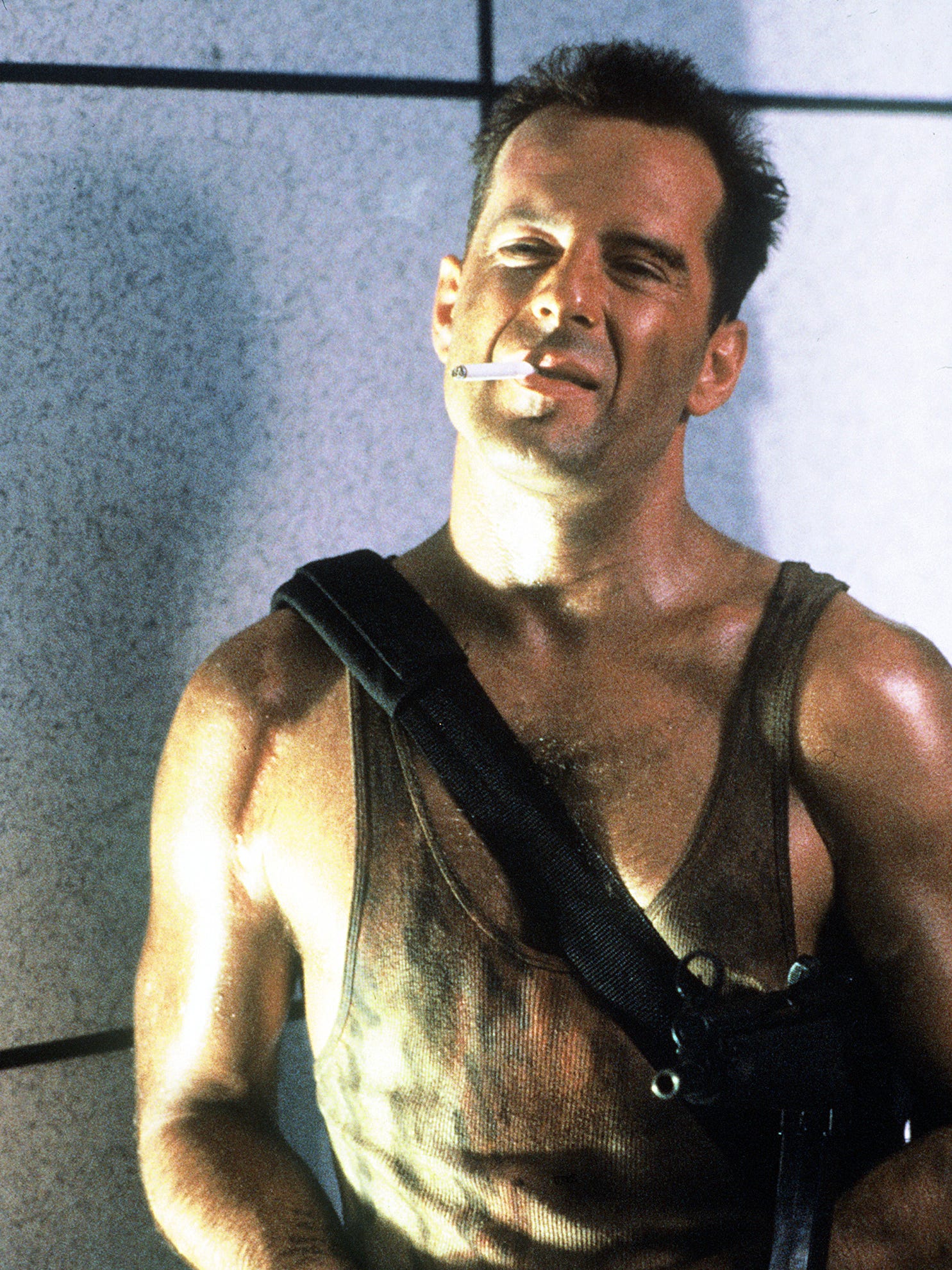
The plot: Rough and ready New York cop John McLain (Bruce Willis, ostensibly the star of the film and certainly good in the role) has come to sunny L.A. for Christmas to try to repair his rocky marriage to his wife Holly (Bonny Bedelia). Holly has taken a dream job at the Nakatomi corporation, returned to using her maiden name (ouch!), and thrived as a corporate executive without John around. But before they can get back to serious bickering, John and Holly have to deal with an international team of super-terrorists (think of them as like the EU, but competent) who take over the Nakatomi building. John has his wisecracks, his courage and lots of guns, but the bad guys are more numerous and have cooler accents, especially their master planner and leader Hans (Rickman).

This is a rock ’em sock ’em action film leavened with many pricelessly funny lines, most of them voiced by Willis or Rickman. The plot has many surprising twists and turns as Hans’ plan unfolds, McLain throws spanners into the works, and then Hans adapts, contingency by carefully planned contingency. Not much in the way of traditional holiday themes, but there are some gifts and Santa hats and pine trees and such around, so you can pass this off as a Christmas film if you wish, you orphan of a bankrupt culture.

After you have watched this thrilling movie, you might consider what you would do for a dying friend who had a special last request…