Categories
British Drama Horror/Suspense

Unman, Wittering and Zigo

I have recommended the film Flirting, in which sadistic masters torment the new students in a boys’ school. I now turn the tables by recommending a film in which a new teacher John Ebony (David Hemmings) and his wife Silvia (Carolyn Seymour) are terrorized by the fifth form from hell. The last three students on the class roll are Unman, Wittering and Zigo, but Zigo is always absent, even going back to the time when the teacher that Ebony is replacing, Mr. Pelham, fell to his death (by accident?).

Director John Mackenzie of Long, Good, Friday fame made this creepy, nasty, thriller in 1971. He was aided immeasurably by master cinematographer Geoffrey Unsworth, who contributed some dazzling and disturbing point of view shots in the opening sequence as well as during the most horrifying scene in the film (which I will not spoil by describing other than to say, don’t bring the kids to this one).

The nefarious school boys (who include some actors who went on to distinguished careers including Michael Kitchen and Michael Cashman) are hard for the viewer to keep straight but that actually works, along with skillful editing, to make them seem less a group of individuals than a multi-headed hydra snapping relentlessly at Mr. Ebony. Hemmings, who also produced, is good as the pitiable Ebony, including in those scenes where he starts destroying himself with alcohol (perfect casting there, sadly enough. Hemmings left us too soon).

Unman, Wittering and Zigo (1971) | Nostalgia CentralWhile struggling with the boys ostensibly below him in the hierarchy, Ebony must also cope with the headmaster, played by Douglas Wilmer with just the right amount of Old Brit unctuousness overlaying snobbery and cold-heartedness. Although the scenes with the boys are chilling, the pre-dinner drinks scene with the Ebonys, another master and his wife and the headmaster, make one’s skin crawl in an entirely different way.

The final third of the movie is not entirely satisfying in terms of logical plotting, but the film still delivers a consistent air of menace that gets under your skin. Certain ambiguities in the story invite debates about the interpretation of this film; to avoid spoiling the movie for those who haven’t seen it, I have placed my own nagging questions about this movie after the jump (i.e., Don’t read the rest of this unless you have seen the film, it will ruin it for you).

Categories
British Comedy Drama

Peter’s Friends

One of my favorite Christmas movies is Kenneth Branagh’s Peter’s Friends. Sometimes glibly dismissed as a “British knockoff of The Big Chill” this 1992 movie is in fact superior in most respects to that film (which not incidentally was itself based on a better, little seen movie, The Return of the Seacaucus Seven).

The plot: Peter (Stephen Fry) has inherited a large estate and house from his recently deceased and very formidable father, whom he hated but now misses. He is also grappling with a serious personal problem — the nature of which is not revealed to the audience until late in the movie — that is causing him great strain. Unable to decide what else to do, he throws a weekend Christmas party for his dear friends from Oxbridge days. Once a young and happy troupe reminiscent of the Footlights (of which many of the actors in the film are alums), Peter’s friends have since run into their own painful challenges in life.

Rita Rudner, who is hilarious as a shallow and unhappy American TV star, wrote the witty script with her husband Martin Bergman. The script also includes some strong dramatic moments, even though it doesn’t quite seem to know how to wrap things up at the very end. Without spoiling the plot, Peter’s Friends also deserves praise as being one of the first major British movies to deal with a particular topic that had been too long avoided.

Director Kenneth Branagh gets the best out of the talented ensemble cast, even though he himself gives only a so-so performance (for whatever reason, with the exception of the Wallander series, Branagh often seems a bit too mannered and self-conscious when he plays modern parts). You are blessed with more than a bit of Fry and Laurie here, as well as good work by Imelda Staunton, Tony Slattery, and Alphonsia Emmanuel. But the best performances of all come from the mother-daughter team of Phyllida Law as the housekeeper-quasi-parent of Peter, and Emma Thompson as a bookish turbo-neurotic who is secretly in love with him. I have never met anyone whose former boyfriend wrote self-help books right up to the moment he committed suicide, but if I did, I would expect her to be exactly like Thompson’s pathetic, nerdy but still very appealing Maggie Chester.

The film’s music is also enjoyable, including hits of the period (by Bruce Springsteen, The Pretenders, and Tears for Fears) as well as a lovely version of Jerome Kern’s “The way you look tonight” sung by the entire cast (Imelda Staunton can really hit a note!). The then-popular music and focus on a particular British generation’s experience could have turned this into a period piece which would age badly, but the many laughs and the moving moments gives Peter’s Friends appeal that extends to the present day.

Categories
British Horror/Suspense

Curse of the Demon

Director Jacques Tourneur didn’t make many movies and is largely forgotten today, but he has a cult following of which I am a part. He made horror films such as I Walked with a Zombie, film noirs such as Out of the Past, and films that exist somewhere in between, such as 1957’s suspenseful and scary Curse of the Demon.

The plot of the film pits hard-headed American psychologist Dr. John Holden (Dana Andrews) against sinister British cult leader Dr. Julian Karswell (a deliciously malevolent yet courtly Niall McGinnis), who claims to have magical powers. Holden is investigating the mysterious death of a colleague who, like himself, was trying to debunk Karswell’s claims. Karswell tells him calmly that his colleague was destroyed by the curse of the demon, and that a similar curse has been placed on Holden and will end his life in just a few days. Holden at first laughs this threat off, but then begins to experience a series of unnerving events that cause him (and the audience) to becoming increasingly scared that the curse of the demon is real.

Night of the Demon ****½ | Wonders in the Dark

As detailed in Carl Rollyson’s first-rate biography of Dana Andrews (recommended here), this handsome, broad shouldered actor looked like he had decades of stardom ahead of him in the 1940s, but he developed a serious alcohol problem that drove his career southward before he finally got into stable recovery around 1970. In some of his scenes here, he looks a little shaky and pale and one wonders if that is acting or not, but in either case, it works perfectly as Dr. Holden begins to unravel psychologically. Peggy Cummins, who commanded the screen in another of my recommendations (Hell Drivers), is surprisingly bland here as Holden’s fellow investigator and love interest. Instead, the sparks come in the scenes between Andrews and McGinnis. Their debates about science versus superstition are among the highlights of this film (The photo above is from my favorite such scene, which Tourneur brilliantly set at a children’s party in which Karswell is wearing a clownish magician’s costume).

As you would expect for Tourneur, there are lots of noirish visual touches, including abundant shadows and deep focus shots of people walking alone down empty corridors and streets. It all works perfectly to maximize emotional tension in this classic chiller.

This film is sometimes entitled “Night of the Demon” and sometimes “Curse of the Demon” depending on whether you’ve got hold of a US or UK print. In any event, the thing to ensure is that you have the full 95 minute version and not one of the chopped up shorter prints that are around.

N.B. Spoiler Alert, stop reading here you haven’t seen the film. Tourneur was unhappy with how unambiguously the final version of the film makes clear that the demon was real. He wanted to show the demon either not at all or so quickly that the movie would not take a clear position on whether there was such a creature or whether it only existed in the minds of its victims (A conclusion echoed in Andrews’ final line in the film about how it’s better not to know whether there was such a creature). But Tourneur was overruled by the producers, who took control of the two demon scenes on the film. In the final scene, Tourneur had clearly set up the smoky, clacking train to be the cue that convinced Karswell that the demon was after him, and the (not bad for the time) demon effects are now superimposed on that. Note also in the first appearance of the demon, the demon is not necessary to the death that occurs, so again Tourneur had set up everything to keep the demon’s existence ambiguous. Whether it would have worked better Tourneur’s way is a matter for debate. I suspect it would have been a very good, hair-raising film either way.

Categories
Action/Adventure British Drama

Layer Cake

Layer Cake (2004) where the old criminal boss has a nice library.

Let’s get meta: That’s Sir Michael Gambon sitting in the very chair where I wrote this recommendation of the film in which he and it appear: Matthew Vaughn’s stylish and hard-edged Layer Cake. Gambon plays wily drug kingpin Eddie Temple in one of the great British gangster films (which is saying something, they have been making outstanding movies about guns and geezers over here for three quarters of a century).

The film centers on cocaine middleman “Mr. X”, played convincingly by a pre-James Bond Daniel Craig. One of the many things the film gets right about the illegal drug trade is that it includes people like Mr. X who think they can make big money while remaining untouched by the damage that drugs do downstream and the violence and immorality of the kingpins who call the shots upstream. Mr. X tells himself he is just a businessman whose commodity happens to be illegal, and that he will simply leave the drug trade behind him when he is financially secure. But when drug honcho Jimmy Price (Kenneth Cranham) gives him an unusual assignment, his assumptions are shattered and he quickly gets in way, way over his head. Meanwhile, he develops a serious case of the hots for a low-level gangster wannabe’s girlfriend (played by Siena Miller…rumor has it that she and Craig prepared for their sex scenes together Lee Strasberg-style).

The supporting cast is uniformly strong, with a standout performance by Colm Meaney as a long-time gangster. There are some over-the-top camera shots by Vaughn which some people found self-conscious and annoying, but they work well given the kinetic story line. And Gambon’s soliloquy on “the facts of life” is as quotable and as well-delivered as anyone could ask.

p.s. This film is rated R with an exclamation point, so by all means don’t bring the kids.
p.p.s. Vaughn shot three different endings for this movie, all of which I’ve watched and he definitely picked the right one.

Categories
Action/Adventure British Comedy Horror/Suspense Romance

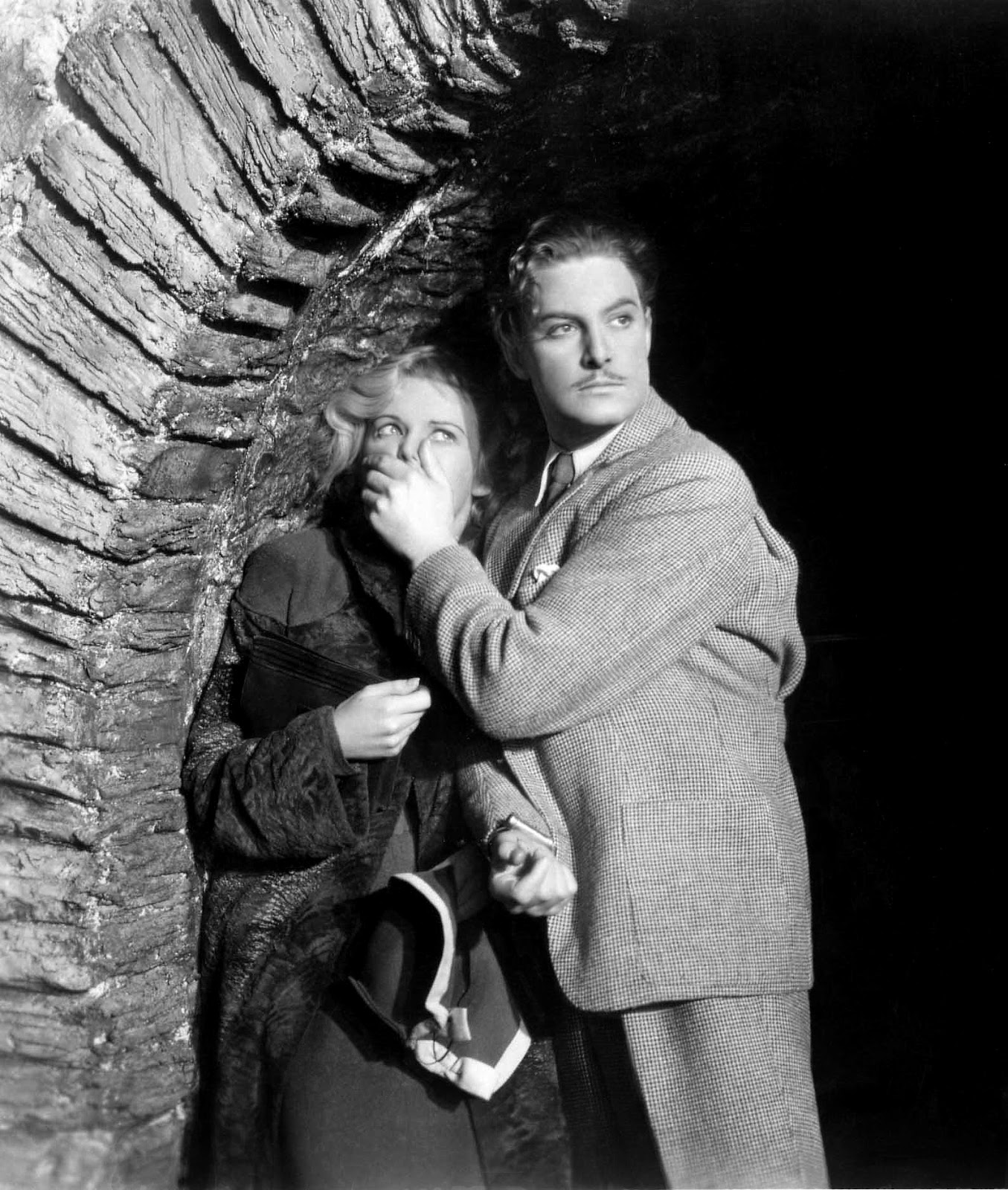
The 39 Steps

The 39 Steps (1935)

Alfred Hitchcock had a successful directing career in Britain that preceded his American super-stardom. Hitchcock fans rightfully consider the 1935 comedy-romance-thriller The 39 Steps among the very best works of the Master’s “British period”.

Robert Donat cuts a dash as Mr. Hannay, the hero of the film, who tries to save England from the threat of nefarious and crafty foreign agents. As in other Hitchcock films (e.g., North by Northwest, The Wrong Man, The Man Who Knew Too Much,), the central character is an innocent who is pulled into a web of intrigue and danger which he doesn’t understand. But unlike in those darker films, it doesn’t seem to bother him a jot.

“Did this beautiful woman just fire a gun in a crowded theater to evade her pursuers and then tell me that she is an international spy for hire? Well then, let’s go back to my flat for a large whiskey and soda and I’ll cook her up some haddock while she tells me all about it.”

“I seem to have walked into a political rally focused on I know not what and I have been mistaken for the distinguished guest speaker. Well then, jolly good, I’ll give it a go.”

“Am I really handcuffed to yet another beautiful woman as I run through the Scottish Highlands with people trying to shoot me? Well then, I wonder if she’s married or at least broad-minded.”

Categories
British Drama Mystery/Noir

Brighton Rock

The 2010 remake of Brighton Rock got mixed reviews, so I recommend discovering instead the 1947 original, which is both a fine character study and a solid piece of British film noir. Made just after the war by the Boulton Brothers, this story of razor-wielding gangsters was considered shocking in its day. Though a bit dated, it remains worth watching for its strong acting, emotional impact and truly memorable visuals (particularly during some jolting violence).

Scripted by two lions of British cinema, Graham Greene and Terence Rattigan, the plot centers on a small criminal gang led by the cold hearted Pinkie Brown (A genuinely chilling Richard Attenborough). The former boss of the gang has just been murdered and Pinkie is struggling to revenge the loss while fending off internal and external threats to his control. A saintly, pretty young girl named Rose (a pitch perfect Carol Marsh in her film debut) has evidence that can put Pinkie away for a killing, but also, strangely enough, seems to be falling in love with him. Meanwhile he grapples with Catholic guilt at the life he is leading.

Richard Attenborough in "Brighton Rock" (1947) | Brighton rock ...

As in many British dramas of the era, highly experienced actors take every advantage of the smaller roles in this movie. A pre-Dr. Who William Hartnell plays a complicated criminal who is heartless when committing violence yet develops a paternal protectiveness towards Rose. Veteran stage actor Harcourt Williams steals scene after scene as a Shakespeare quoting shyster.

Only quibble: In trying to contrast “carefree tourist Brighton” with the seedy underbelly, the film makers go overboard early in the film with annoyingly upbeat music that detracts from the mood of menace. But that trope fades out after the first 20 minutes or so, leaving the viewer plenty of time to be both fascinated and repulsed by Pinkie Brown and the criminal world which he inhabits.

Categories
Action/Adventure British Drama

In Which We Serve

Pour yourself a small gin or a nice cup a tea, stiffen your upper lip, turn off the wireless (radio, that is) and watch one of the best films ever released in a time of war: 1942’s In Which We Serve. Made almost single-handed by Noël Coward (with some directorial assistance from the legendary David Lean), this is an unabashedly patriotic tribute to the Royal Navy, told as “the story of a ship”, the HMS Torrin. The primary purpose of the film is to encourage a nation facing annihilation, and it clearly succeeds in that respect. But it’s also — even today — moving, exciting and worthy of admiration as a piece of cinema.

The story telling style is reminiscent of Coward’s magnificent Cavalcade. Rather than following a strictly linear narrative, the film instead presents a series of recollections by different characters, all of whom are literally clinging to life after their ship has been torpedoed. In flashback scenes, they recall their families, their friends, and most of all their experiences on the H.M.S. Torrin. It’s stirring stuff. The Dunkirk rescue operation and the battles near Crete are brought vividly to life, using a well-edited mix of documentary footage and scenes shot for the film.

Noël Coward’s Mountbatten-esque performance (the two remarkable men were good friends) as Captain Kinross is probably a bit too mannered to be completely accessible to most viewers. The heart of the film is much more Bernard Miles as CPO Hardy and John Mills as his nephew by marriage, ordinary seaman Blake (Following this movie, Mills became a David Lean favorite, and won a best supporting actor Oscar under Lean’s Direction almost 30 years later). They and the other perfomers playing junior officers, ordinary seaman and family members back home are more vulnerable and therefore particularly sympathetic for the audience. We admire the formidable Kinross from an emotional distance but the “average” fighting men and their loved ones on the home front have more common humanity, particularly as we witness their courage, their fears and their loves.

In Which We Serve (1942) | From The Dam Busters to Dunkirk: the 31 ...

The film does not skimp on the horrors of war, including the terror of combat and the grief at losing loved ones. If you can’t shed a tear during the scene in which Blake tells CPO Hardy the latest news from home, call a cardiologist immediately because you are missing a vital organ from your chest.

The Brits and indeed the world were up against it when this film was made, so don’t expect cynicism, unhappy families or emotional breakdown by the characters (Even Richard Attenborough, as a coward, mans up in the end). A more realistic take on the war was possible after it was all over and people had the security to look back with a more gelid eye (see for example my recommendation of 1953’s The Cruel Sea). But none of that takes away from the power of this straight-faced tonic for the people of Britain at a time of unimaginable peril. It’s a triumph for Coward and the whole cast, who received a special and much deserved Academy Award for their efforts.

In Which We Serve is in the public domain and you can watch a high-quality copy for free by clicking here.

Categories
Action/Adventure British

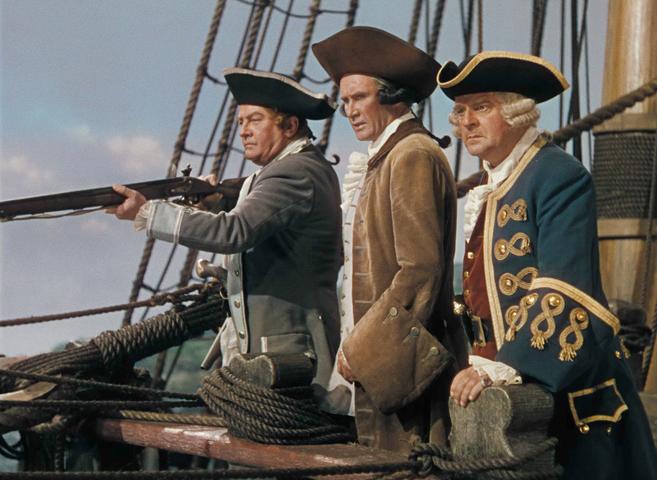
Treasure Island

Yarrrrrrrrrr! Movie pirates didn’t have heavy West Country accents before Robert Newton’s famous turn as Long John Silver in the 1950 version of Treasure Island. Disney’s first-ever live action film is aimed squarely at school age boys, but is also pleasant for grown-ups to revisit on a rainy Sunday afternoon. The film’s production values hold up well even 60 odd years on, and, while even older, R. L. Stevenson’s 1883 story (with some amendments) retains its charm and excitement even for modern audiences.

The story opens with young Jim Hawkins tending the bar in his mother’s inn (She herself nor any other significant female character appears in the film, so we are truly in boyland here). In comes Black Dog, a menacing Pirate in search of Captain Billy Bones, who is hiding out at the inn. After Black Dog leaves, Billy Bones gives young Jim a treasure map and tells him to flee before the pirates return. Jim confides in two honorable adults, Squire Trelawny and Dr. Livesy. Our heroes set sail in search of pirate treasure, not realizing that the old sea dog they have hired as the cook is the dread Long John Silver, and most of the crew are his own bloodthirsty band of brigands! Thems that die’ll be the lucky ones, arrrrhh!!! Adventure, thrills and some welcome moments of humor and humanity ensue.

Treasure Island - Is Treasure Island on Netflix - FlixList

The emotional heart of the film are Long John Silver (Robert Newton) and Jim Hawkins (Bobby Driscoll). The good adults led by Squire Trelawny are uniformly noble and brave, the pirates (other than Long John) are uniformly nasty and craven. With that as a flat background, Silver and Hawkins really come to life. Long John is the only adult of complex character in the story, being in some ways cunning and greedy but in other respects moral and kind. And because Jim is the only character who travels between the worlds of the oh-so-good-heroes and the oh-so-evil pirates, he becomes a finely shaded character too, particularly as he learns to appreciate that his sometimes-friend Silver is neither a thoroughgoing villain nor a worthy role model.

Newton’s flavourful acting makes this film hum and is worthy of admiration. A less professional actor would have condescended to only a half-hearted or one-dimensional performance, seeing a “children’s film” as beneath him. But Newton goes all in, bless his cotton socks. He will likely always be cinema’s iconic Long John Silver and Silver will certainly always be his most famous role even though he turned in many strong performances in his career (e.g., as Bill Sykes in David Lean’s fine adaptation of Oliver Twist). Newton never makes Silver so evil that the audience can just hate him outright (as hammier actors have in other adaptations of Stevenson’s novel), but neither does he minimize the cruel aspects of the character that make him scary and thereby provide much of the tension of the story.

Categories
Action/Adventure British Drama

The Long Good Friday

British film director John “Frenzy” Mackenzie directed another of my recommendations, Unman, Wittering and Zigo, but will be best remembered for the thrilling, brutal gangster classic, The Long Good Friday.

Many American viewers struggle with the opening scenes of this 1980 film because the slang comes fast and some of the Cockney accents are thick. Also, the film’s only significant flaw is that its opening scenes are confusing as characters and plot elements are thrown at the viewer one after the other in overly rapid succession. (Indeed, even at the end, as with The Big Sleep, it is hard to tie up every loose end in your mind).

But you will forget all that the moment that Bob Hoskins arrives — or rather, explodes — onto the scene accompanied by Francis Monkman’s pulsating score. As mobster Harold Shand, Hoskins dominates his scenes, projecting power, ambition and the ever-present threat of violence. And he’s far more interesting than the typical mobster in that he fantasizes about being a captain of legitimate industry. Seeing his speech about the planned development of the Canary Wharf area as his boat moves down the Thames, his head framed perfectly by the Tower Bridge in the background, is like watching James Cagney play Margaret Thatcher.

The other thing that makes Harold interesting is that his gun moll is no dim-witted tart, even though her part was written that way in the original script. Helen Mirren is at her very best as the smarter, classier half of the criminal couple at the center of the movie. Thankfully the filmmakers realized that casting Mirren just for her looks would have been a gross under utilization of her intelligence and acting skills. She has a meaty, fascinating part and she makes the most of it.

As the film opens, Harold is trying to launch a legitimate business empire but is thwarted when his criminal empire suddenly comes under attack. But by whom? He has already killed everyone who could take him on, right? Or has he somehow created a powerful new enemy?

This is the best British gangster film since Get Carter and it’s even better the second time through once you understand the labyrinthine plot. Note for trivia fans: this was Pierce Brosnan’s first film – he had no lines and didn’t even meet the stars (He’s looking at the camera in the back seat, not Hoskins, in those knockout final scenes).

p.s. Like Monty Python’s Life of Brian, this film only made it to theaters through the support of rock legend George Harrison!

Categories
Action/Adventure British Drama Mystery/Noir

Get Carter

How appealing an actor is Sir Michael Caine? Put it this way: While watching him play Colonel Steiner in The Eagle Has Landed, a lot of otherwise sensible film goers find themselves rooting for the Nazis.

In the classic 1971 Brit gangster film, Caine’s likability and magnetism are in full flower, as he somehow makes us care about and even identify with Jack Carter, a thoroughly nasty mob enforcer bent on revenge. In the dreamlike opening of the film, we learn that Carter works for some sleazy, Kray-esque London crime lords who discourage him from investigating the death of his brother in Newcastle. Jack wasn’t close to his brother — indeed as the film progresses we find out he treated his brother horribly — yet something in Jack can’t accept his sibling’s mysterious death.

He heads to Newcastle on his own, a very risky proposition given the rough criminals who run the city (led by John Osborne — yes THAT John Osborne, in a quirkily effective performance). But it’s no more risky than seducing and planning to run off with his boss’ girlfriend (A stunning and believable Britt Ekland), which Carter is also doing as he tries to determine how and why his brother died. Indeed, Carter seems drawn to danger: The more threats he receives to drop his investigation the more determined he becomes to pursue it to its conclusion.

Carter also has to contend with an old rival named Eric (Ian Hendry). As a Newcastle criminal with “eyes like piss holes in the snow”, Hendry well portrays a mixture of fear and loathing of Carter, which is apparently what he felt for Caine. On the set, Hendry was sometimes drunk and openly bitter about Caine’s greater success as a star, and those emotions come out to advantage in the two men’s performances.

The other star of this film is the City of Newcastle, which is dear to me both because I lived there and because I grew up near Pittsburgh, Pennsylvania at a time when it too was a struggling industrial city on the skids. Newcastle is bleak and tough, but also has character and spirit. The feeling Geordies have for Get Carter is remarkable. A group of them even tried to stop the city from tearing down an old car park because it appeared in one of the movie’s many memorable confrontations (photo above) between Carter and the gangsters of Newcastle.

A young Mike Hodges came out of nowhere to brilliantly direct this gritty and involving film, one of only two great movies he made in his long and uneven career (the other is Croupier). Many directors would have overdone the violent scenes, but Hodges clearly understood that fewer and less graphic scenes actually have more impact, especially with a star like Michael Caine who can go from controlled cool to pure savagery and back at the drop of a hat. It makes his character, and the film, fraught with electrifying menace.

The clip I am posting is not strictly speaking a trailer. Rather, it’s the great Roy Budd playing his super-cool theme music, accompanied with scenes from the movie. If you have seen the film before, look fast for an important co-passenger on the train with Carter as he heads north.