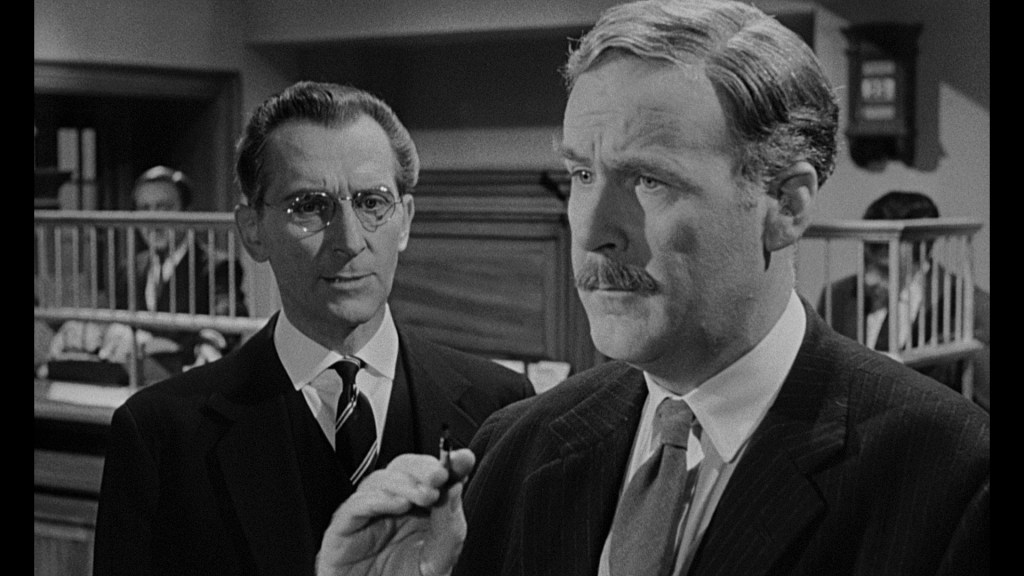
Hammer Studios sometimes ventured out of the horror genre with impressive results, as I described in my recommendation of Taste of Fear, Another fine example, which ranks as one of the best B-movies in British history in any genre, is the suspenseful bank heist picture Cash on Demand.
Made as cheaply as chips in 1961, the story centers on small town British bank manager Harry Fordyce (Peter Cushing). Harry is tight as wax in his work, and cold and demanding towards his staff. His only evident humanity is his love for his wife and young son. When the smooth, well-dressed Colonel Gore Hepburn (André Morell) of the bank’s insurer visits to conduct a surprise security inspection just before Christmas, Harry is initially confident that his operation will pass with flying colors. But he could not be more wrong about what is to unfold, both for the bank and also for himself and his family.
Hammer benefited from the British tradition of actors taking seriously small parts in low-budget films in a way Hollywood stars often would not. Cushing digs into his role with professionalism, allowing us to care about and eventually even to feel sorry for someone who at first seems hard to take. The rest of the cast is also very good, and it’s a particular pleasure to see Richard Vernon, usually slotted into one-dimensional Establishment roles (at which he excelled, including in Goldfinger and A Hard Day’s Night), essay a character with more depth. As Fordyce’s underling Pearson, Vernon is still of course playing a respectable type, but his junior bank manager has vulnerability and dignity, particularly in his loyalty to his co-workers.
Consistent with its modest budget and origins as a TV play, the entire movie is shot in just a few rooms of the bank. But the cast and little known director Quentin Lawrence use the claustrophobia to amp up the tension as a clever and malicious plot unfolds. It’s another fine demonstration that you don’t need a hundred millions dollars to make a good movie: In the case of this superb film, it was less than 40,000 pounds.
At RKO during World War II, Ukrainian-American producer Val Lewton developed a signature horror film style that influenced many subsequent filmmakers and also helped launch some notable Hollywood careers (e.g., Directors Jacques Tourneur, Robert Wise, and Mark Robson). Lewton didn’t have the big budgets that let Universal Studios parade all those magnificent monsters across elaborate sets, so he often relied on the audience’s imagination of terrors they could only dimly see in the shadows (or just as often, only hear, for example in the famous swimming pool scene in Cat People). Boris Karloff, tired of making monster movies at Universal, admired Lewton’s work and made a trio of films with him. The first to be released features what is arguably the finest performance of Karloff’s career: The Body Snatcher.
The plot of this eerie 1945 film derives from the Robert Louis Stevenson story of the same name, which in turn was inspired by the Burke and Hare murders in 1820s Edinburgh. Dr. Wolfe McFarlane (Henry Daniell), a famous physician with a murky past, teaches medicine to would-be doctors, including the idealistic young student Donald Fettes (Russell Wade). Anatomical teaching requires the dissection of cadavers, which under the law are available in quite limited supply. This constrains the ability of physicians to acquire the skills that would allow them to help people like Georgina Marsh (Sharyn Moffett), a paralyzed little girl whose mother (Paula Corday) begs McFarlane and Fettes to operate on her daughter’s spine. But to attempt such a delicate operation would require careful study of a recently deceased person…maybe cabman John Gray (Karloff) could engage in a gruesome side hustle? Suspense, chills, and moral dilemmas ensue.
Lewton gave future multiple Oscar-winner Robert Wise his first chances to direct, and Wise’s ability to draw our good performances, maintain tone, and create a compelling storytelling canvas is evident even at this early point in his career. Wise and cinematographer Robert De Grasse give us an ominous looking Edinburgh, wreathed in shadow and dread (Funnily enough, in a budget-saving move that prefigured Roger Corman, the filmmakers re-used the sets of The Hunchback of Notre Dame, on which Wise had worked as an editor). The crisp script of Phillip MacDonald (with added polish by Lewton) artfully uses dialogue to reveal hidden emotions and motives, and builds tension well in the short running time that was a financial necessity.
Henry Daniell as usual gives a strong performance as a character with significant shortcomings who is also in many ways admirable. But the towering performance in the film comes from Karloff as the menacing, resentful Gray. When he’s not delivering malicious words with a cunning smile and a faux-unctuous manner he’s convincingly meting out sociopathic violence. Great horror performances, like great comic performances, are too often overlooked. Karloff didn’t even get a Oscar nomination for Best Actor for his stellar work here, so hang your head (again) Academy of Motion Picture Arts and Sciences.
The sole disappointment of this film is that Bela Lugosi, in his last pairing with Karloff, has only a small part, perhaps because his addictions were destroying his health. He is fine in his role as one of McFarlane’s servants and his scenes with Karloff crackle, but it’s still too bad this legend of horror wasn’t able to do more on screen at this point in his career.
It would be very unjust to close on that sad note, when there is so much to appreciate in this gripping and atmospheric tale of murder and medicine. The Body Snatcher is an excellent film both as entertainment and as a 78-minute showcase of the horrifying gifts of Val Lewton and Boris Karloff.
p.s. The story of Burke and Hare was re-told in the solid 1960 British film The Flesh and the Fiends starring Peter Cushing and Donald Pleasance (the more graphic “Continental Version” is the one to see).
Hammer Studies is deservedly admired for the generally fine horror and suspense movies it began producing in the 1950s (including my recommendations The Devil Rides Out and Taste of Fear). But a lesser known British studio, Amicus Productions, was also productively tilling the same soil. Most notably, it revived the horror anthology form created by the 1945 classic Dead of Night. Amicus’ founders Max Rosenberg and Milton Subotsky produced all seven of these films, and Subotsky also often wrote the scripts (though some were penned by the Robert Bloch of Psycho fame). None of the Amicus “portmanteau” movies were bad, and some of them were very good, including 1965’s fun and scary Dr. Terror’s House of Horrors.
Dr. Terror’s House of Horrors set the pattern for these films, bringing together horror movie stalwarts (Actors Cushing, Christopher Lee, Michael Gough and Director Freddie Francis), young actors looking to move up (Donald Sutherland, Roy Castle) as well as old hands familiar to the audience whose current asking price was within the modest budget (Max Adrian, Bernard Lee). Like all these films, a contrivance — in this case a shared train journey with a mysterious fortune teller named (ahem) Dr. Schreck (Peter Cushing) — links together segments that run about 15 minutes, each with a different storyline and main character.
Subotsky’s script gives us five stories to enjoy, a couple of which illustrate how horror and comedy can make a fine cocktail. The first features an architect (Neil McCallum) returning to the spooky old house in which he grew up at the request of the wealthy widow who purchased it from his family (Ursula Howells). In the course of planning a remodel for the widow, he makes a shocking discovery in the (naturally) dark and cobweb-filled basement…
The second story, about a family returning from holiday to discover a sentient and dangerous vine growing on their property, is lighter in tone particularly because Bernard Lee of Bond movie fame straight-facedly plays the head of what is apparently a government agency focused on botanical threats to civilization (I bet you didn’t even know such a thing existed). The third tale is also on the lighter side and features Roy Castle as a musician who learns the dangers of cultural appropriation. It mixes some lively musical numbers in with the voodoo.
The last two stories are the best. Lee is perfect as a condescending art critic who inflicts a serious injury on a painter he despises (Gough). But you have to “hand” it his victim for his ability to seek vengeance from beyond the greave. The mechanical effects in this story are unnerving, especially because Lee credibly sells the terror in what otherwise could have been farcical proceedings.
The final tale features Sutherland as a junior doctor whose new bride (Jennifer Jayne) has rather unusual tastes. The closing line of this story, uttered by Adrian, is laugh out loud funny.
Just as each individual segment ends with a kicker, so does the movie itself, tying the five tales together with a spectral bow. Citizen Kane it is not, but entertaining Dr. Terror’s House of Horrors definitely is.
p.s. Another horror anthology film with this title was released during the war, apparently with sketchy provenance including potentially violating copyright by inserting bits of other, better movies. No print survives, and everything I have read about that film indicates that’s for the best.
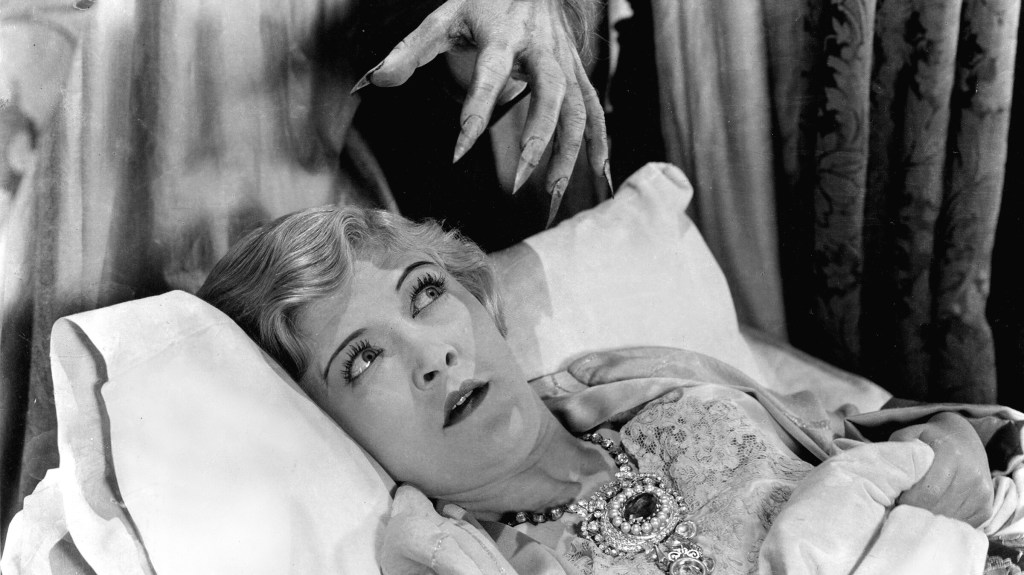
God bless film restorers. When I first saw the Hollywood film that established the template for haunted house movies, I thought it was an above average flick, but I couldn’t recommend it because the scratched up, herky-jerky quality of the available print detracted so much from the viewing experience. But cinematic magicians at the Museum of Modern Art later rolled out a beautiful restoration with superb visuals and an evocative new score, leading me on second viewing to enthusiastically recommend the 1927 version of The Cat and the Canary.
Based on John Willard’s hit Broadway play, every plot element of this film will sound stale to modern audiences because of being copied so many times. But here goes: At midnight twenty years after the death of eccentric millionaire Cyrus West, his surviving family members gather at his spooky old mansion to hear the reading of his will. To everyone’s surprise, Cyrus leaves everything to his niece Annabelle, but with the strange stipulation that she is only his heir if she is judged sane by a physician who will visit before dawn. A menacing storm then traps everyone overnight just as they learn that Cyrus’ ghost is said to walk the grounds, a homicidal maniac has escaped from a nearby prison, and a fabulous diamond collection may be hidden somewhere in the house (Otherwise, looks like a pretty dull evening…).
Of course it’s all a bit silly, but that’s intentional. This is not a slasher film: it’s as much intended to evoke chuckles as shivers, and it does that very well with a fast-moving story that combines agreeable farce with some high-tension scenes. Laura La Plante, as the imperiled Annabelle, is the biggest star in the film, and she’s certainly toothsome and appealing. But the most memorable performance is given by Martha Mattox as the housemaid/caretaker Mammy Pleasant. She creepy and funny, a bit of precursor to Judith Anderson’s famous turn in Rebecca. Creighton Hale, looking a bit like Harold Lloyd, is also winning as a fellow who has to overcome his fear to save the day and win our heroine’s favor in the process.
Producer Carl Laemmle did many wise things through his “Universal Monster Movie” years, both silent and talkie, and one of the wisest was bringing Paul Leni to Hollywood. Leni was a master of German expressionist sensibility who knew how to make the style accessible to American audiences. Shooting in tinted black and white and mixing in some double exposure shots, he created the look you can see in almost every subsequent “Old Dark House” movie (including of course, The Old Dark House).
Among other flourishes, I believe this movie has one of the first dolly shots in cinema history (Alfred Hitchcock’s The Lodger, which came out six months earlier and which I also recommend, is usually credited as the first). Indeed, if you contrast The Cat and the Canary with another one of my recommendations, the early talkie horror Murder by the Clock, you can see how much more camera and actor movement late silents had than early talkies because they were not constrained by fixed point, low-quality microphones.
Leni would go on to make another one of my recommendations The Man Who Laughed. The Cat and the Canary isn’t in the league of that all-time classic in significance or artistry (what is?), but its got more than enough scares, laughs, and fun to keep you entertained any dark and stormy evening. And you can watch the glorious restored print any time for free at The Internet Archive.
p.s. This film has been remade many times under the same and different titles, but as I’ve seen none of those versions I only vouch for the original.
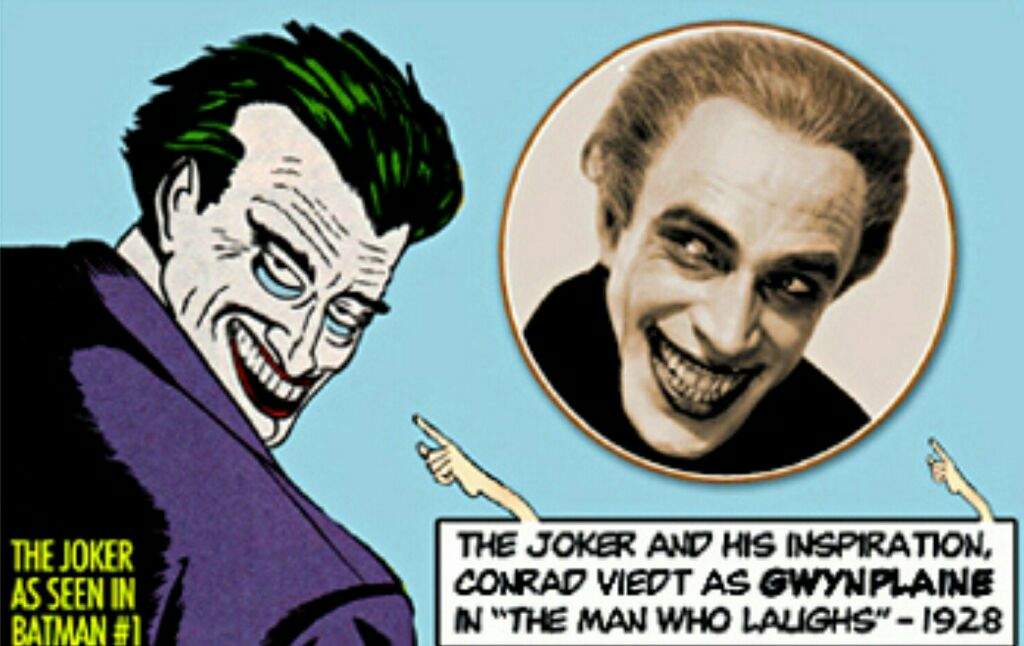
When people recall Universal Studio’s famous run of monster movies, they generally think of the fine films that began appearing in the 1930s (e.g., Dracula, Frankenstein, et al). But those talkies are actually the second generation of what producer Carl Laemmle began in the silent era. The opulent Lon Chaney classics The Hunchback of Notre Dame and The Phantom of the Opera did huge box office telling the stories of disfigured, lovestruck, scary, yet also sympathetic monsters. Laemmle wanted to return to the well one more time with a different Victor Hugo novel as source material. Chaney was tied up at MGM, so Laemmle recruited a German actor (Conrad Veidt) and director (Paul Leni) steeped in that nation’s expressionist film tradition to create a unique treasure of the genre: The Man Who Laughs.
The plot of this 1928 gem: When an English nobleman refuses to submit to the King, he is put to death and his only child, Gwynplaine, is turned over to a horrific gypsy clan (For which Victor Hugo created the term “Comprachicos”) that mutilates the young to turn them into profitable circus freaks. Gwynplaine’s face is carved into a permanent, ghastly, grin and he is abandoned. As he walks alone on a wintry night (This is my favorite expressionist shot in the movie, see below) he discovers a blind baby girl in the arms of her dead mother. Miraculously, the starving and half-frozen children are taken in by a kindly travelling entertainer named Ursus (Cesare Gravina). Grown to adulthood, the lovely, gentle, Dea (Mary Philbin) and Gwynplaine (Veidt) perform in Ursus’ plays, in which Gwynplaine becomes famous as “The Man Who Laughs”. The two also fall in love, but Gwynplaine cannot believe that Dea would want to marry him if she could see his bizarre visage. Meanwhile, a royal advisor (Brandon Hurst in a wonderfully wicked performance) finds out that Gwynplaine is the last surviving heir of a Lord, which presents threats and possibilities for court intrigue, particularly regarding a lustful, wayward Duchess (Olga Baclanova).
This is a visually stunning film, because of the haunted camerawork of Gilbert Warrenton, the art direction of Charles Hall, Thomas O’Neill, and Joseph Wright, the expressionist sensibilities of Leni, Jack Pierce’s make-up wizardry, and Laemmle’s willingness to open the checkbook for sets, props, and a cast of thousands just as did on his Lon Chaney films. Released at the end of the silent era, this film could easily have been a talkie, except that with his prosthetic teeth and grin, Veidt could not speak clearly. The filmmakers compromised by adding a synched soundtrack with rich music, some sound effects, and a love song to accompany the visuals.
As in another of my recommendations, The Cabinet of Dr. Caligari, Conrad Veidt demonstrates that a great actor does not need words to convey a range of emotions. But that understates his achievement, because Veidt makes the audience feel Gwynplaine’s sadness, love, fear, and self-hatred despite having only half of his face available to him. Of many good performances in the film, many of them delivered by veterans of the Lon Chaney films, the other that stands out for me is Olga Baclanova’s. Her role as a sexually assertive aristo is a reminder that prior to the Hayes Code and the rise of domestic dramas after World War II, movies dealt with women’s sexuality far more candidly than they did for decades afterwards.
A couple of the plot developments aren’t motivated quite convincingly, but J. Grubb Alexander’s adaptation of Hugo’s novel more than makes up for it with its humanity. This is particularly true in a heartrending scene in which the circus performers go to extraordinary lengths to try to convince Dea that Gwyneplaine is still near her when in fact he is imprisoned.
I will close by sharing two other wonderful things to know about The Man Who Laughs. First, it has been beautifully restored. Second, it is in the public domain and you can watch it for free right here.
p.s. One person who took inspiration from this movie was Bob Kane, creator of Batman.
p.p.s. I wonder if when this film was shown in Britain in 1928, the audience laughed at one character’s expressed outrage at the thought of the House of Lords admitting a clown.
Among bank heist movies are some gems that inject a clever plot twist or perspective that livens up the otherwise familiar contours of the subgenre, including Inside Man, Charley Varrick, and JCVD. In 1978, a small Canadian film earned a place among such worthies by crafting a story that is as much a character study as a caper film: The Silent Partner.
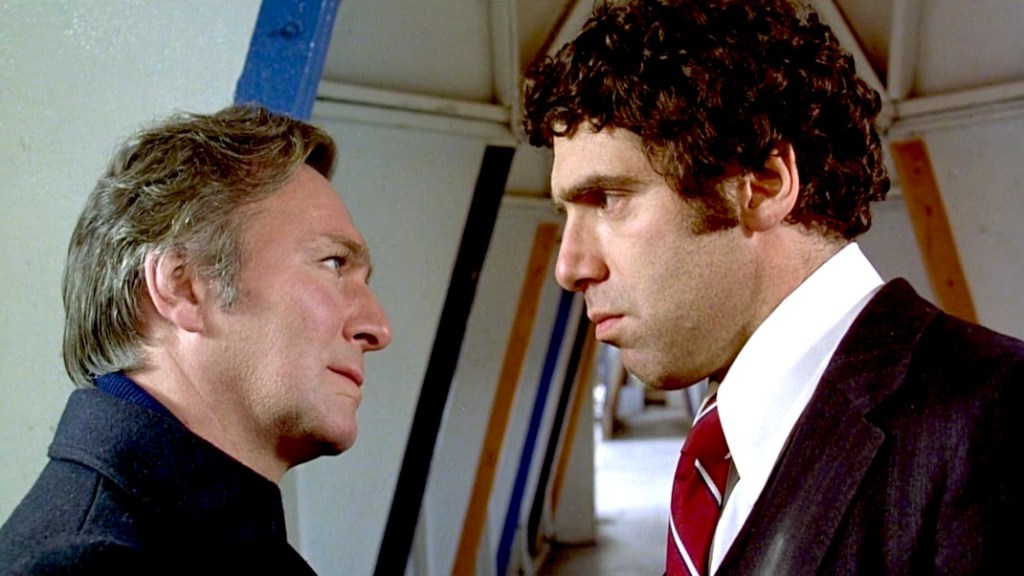
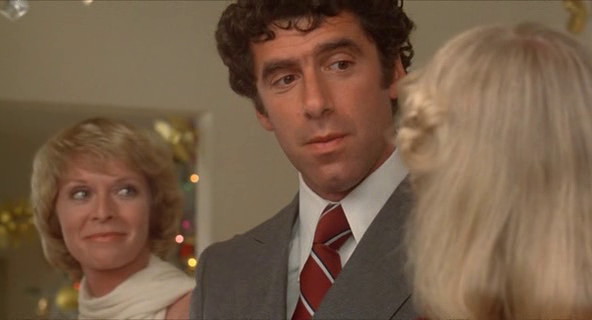
Like Charley Varrick, The Silent Partner features a bank robbery that hides another crime. In this case, that crime is pulled off by a seemingly mild-mannered bank clerk named Miles Cullen (Elliot Gould). When a hardened criminal Harry Reikle (Christopher Plummer) attempts a stick up, Miles gives the robber a pittance and secretly pockets most of the bank’s money himself! But the sadistic Harry doesn’t take kindly to being duped, commencing a tense and dangerous battle of wits between the two men.
Elliot Gould is in good form here playing a man who is continually underestimated by others. Gould makes credible Miles’ increasing confidence in his criminality and also his sexuality. He is matched by Plummer’s disturbingly good turn as a slightly fey yet clearly vicious sociopath. Susannah York, as a co-worker who is both romantically interested in yet confused by Miles, and Céline Lomez as a sexy woman of intrigue, add erotic sparks to the story. Indeed, there is a lot of sex laced throughout the film — including, Plummer makes us sense — some sexual fascination with Miles by Harry.
There’s a lot of talent around these actors. Daryl Duke, mainly a television director, makes the most of his chance to helm a motion picture. I felt he let the pace slacken a bit too much about 2/3 of the way through, but his storytelling skills and ability to establish tone are impressive. Screenwriter Curtis Hanson and cinematographer Billy Williams showcase the talent that would eventually bring them Oscars (For L.A. Confidential and Gandhi, respectively). Jazz legend Oscar Peterson provides a fine score.
It all adds up to one of most original and gripping bank heist movies ever made. The Silent Partner succeeds both as a thrilling crime film and also as a portrait of how an “ordinary” person can summon remarkable reserves when pushed to the limit.
p.s. Look closely for John Candy as a bank employee who pursues the office floozie.
p.p.s. There is one extremely violent scene in this movie (you will know it when you see it) that Daryl Duke hated so much that he refused to shoot, but the producers put it in anyway without him.
Because haunted house movies have been a staple of cinema for nearly a century, it’s hard for filmmakers to find fresh ways to grip audiences with that mixture of cobwebs, dark hallways, creaking doors, and restless spirits that makes for an enjoyably horrifying night at the movies. In 1980, a Canadian film nevertheless managed to summon up some of that old black magic in a scary, effective thriller: The Changeling.
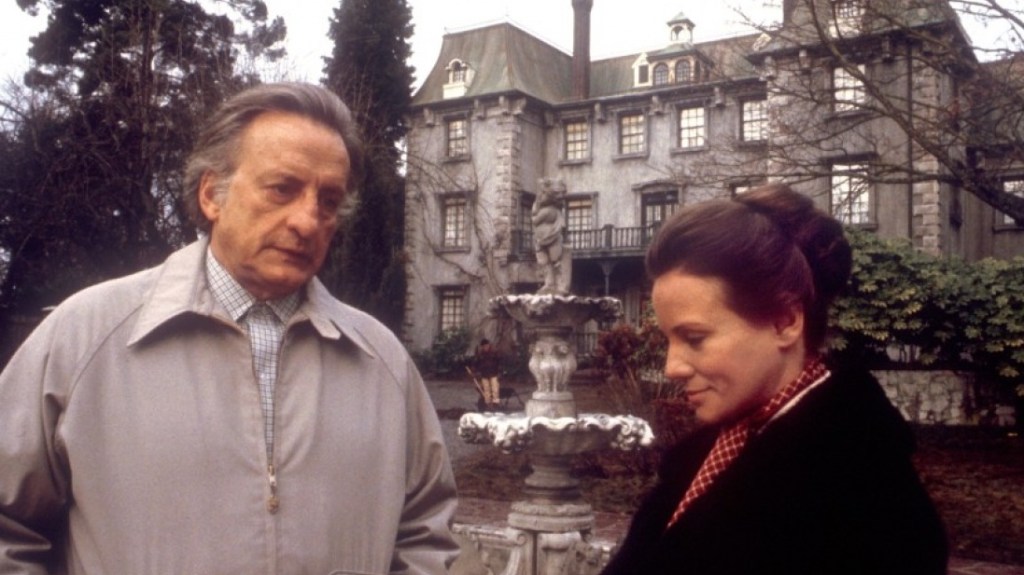
The story opens with composer John Russell (George C. Scott) undergoing an unspeakable family tragedy. Disoriented and wracked with grief, he retreats to an old mansion which is rented to him by a representative of the local historical society (Trish Van Devere). But before you can say “poltergeist” strange phenomenon evince themselves in the old dark house, unnerving Russell but also driving him to investigate a mystery every bit as unsettling as his own personal tragedy. What happened in this foreboding pile, and how does it connect to a wealthy and powerful politician (Melvyn Douglas)?
Director Peter Medak (who also helmed another of my recommendations, The Ruling Class) knows how to frighten an audience with style, pacing, and mood rather than cheap jump scares. He and cinematographer John Coquillon also effectively use a nice mix of extended trolley shots, deep focus, changes in camera perspective, and other techniques to keep the audience agreeably wound up and off-balance.
George C. Scott strikes the right emotional notes in the lead, as someone bewildered by loss and in need of a new purpose. He and Van Devere, who were married in real life, do a particularly fine job of portraying halting middle aged attraction. The audience senses they are both interested in each other but for their own reasons are unable to act on their feelings, and so they sublimate them into a shared quest into the supernatural. Melvyn Douglas, continuing the late life acting success he enjoyed (see for example my recommendation of I Never Sang For My Father) also registers in a role of a sort of villain who is also sort of sympathetic.
There are moments when Russell Hunter’s story, as scripted by William Grey and Diana Maddox is a bit confusing, but it’s fundamentally clever, creepy, and engaging. The result is a very worthy entry in the haunted house genre that scooped up many awards in its native country, including for production designer Trevor Williams, who gives us a haunted house set, to, uh, die for.
Before Aliens, before Starship Troopers, before The Swarm, even before Tarantula (my recommendation here), Hollywood discovered that bigging up bugs into a threat to humanity could translate a prevalent human anxiety into a nerve-jangling cinematic experience. The year was 1954 and the movie has since became revered as a trendsetting sci-fi classic: Them!
As I have said many times on the site, I love films that put the audience immediately into the story without ponderous context-setting. Them! is a master class in the art. The film opens with a little girl (Sandy Descher), visibly in shock, walking mutely across the New Mexico desert. She is rescued by police, led by the brave and compassionate Sgt. Ben Peterson (James Whitmore). The cops investigate, finding homes torn open, people dead or missing, and a suspicious quantity of spilled sugar. When the horrifying nature of their atomically-charged adversary becomes apparent, the authorities call in a stout FBI agent (James Arness), an eccentric, elderly myrmecologist (Edmund Gwenn), and his equally scientifically gifted daughter, who is also a dish (Joan Weldon). A thrilling humanity vs. super-insect war ensues.
Hollywood has always had prestige directors who make big budget, A-list films. But in the era when many people went to the movies every week, the studios also needed competent, no name directors who could efficiently deliver movies of all forms on a tight schedule. Gordon Douglas was cut from that cloth: he directed 27 films for Warner Brothers in the 1950s alone, most of which were modestly budgeted films destined to be second features in theaters for a couple weeks and then be forgotten. But he could make a very good movie when he was given the tools, as was here courtesy of original story writer George Worthing Yates, adapter Russell Hughes, and screenwriter Ted Sherdeman. His artistically outstanding decision was to direct the first 30 minutes of this movie like a ghost story set in the eerie expanses of sand-swirled desert. After one of the most famous big reveals in sci-fi film history, the story then becomes a more conventional “bug hunt”, but Douglas handles that form well enough to bring the audience along with him.
Whitmore and Arness’s characters don’t make much sense, in that they start out as a highway patrolman and FBI agent and end up practically running the U.S. military’s anti-ant operations. But they are strong-jawed enough to be upstanding and believable action heroes. As a daffy but brilliant professor, Gwenn adds some welcome humor, and Weldon is credible as a confident and intelligent woman (not many of those in movies of this period) who catches Arness’ eye while also helping save our species.
The other attraction here are the Oscar-nominated special effects. By modern CGI standards, they are of course laughable. But at the time, they were pathbreaking. And in any event, part of appreciating old monster movies is finding the charm of the craft of SPFX creators in a pre-high-tech environment.
Of all the talented people I mention on this website, I don’t think any name appears more often than Richard Matheson. Working almost entirely within the science-fiction/horror genre, this prolific writer managed to tell stories that entertained a broad audience while also being consistently intelligent and in some cases also conveying considerable psychic weight. No adaptation of his work illustrates better than the classic 1957 movie The Incredible Shrinking Man.
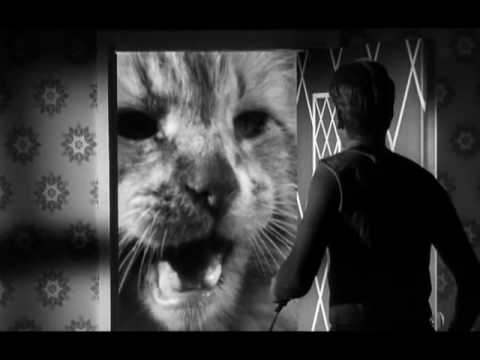
The plot: The Careys, an attractive, happy, married couple are out boating when a mysterious fog on the water scatters a strange, shimmering material on Scott (Grant Williams). Six months later, after being exposed to some pesticide, his body begins to shrink, inch by inch. Doctors conclude that some sort of chemical or radiological malady has afflicted Scott; they can slow it down but not stop it. Helplessly and bitterly, Scott becomes smaller physically as well as in other respects: he can no longer hold a job, becomes resentful and controlling of his wife Louise (Randy Stuart), and is widely mocked. His resentment turns to terror when he is left alone in the house with the family cat and subsequently trapped in a dank basement with one of the scariest spiders in screen history.
There’s much to admire in this film both technically and thematically. The production design and special effects are trend-setting, and six decades later still impress and unnerve modern audiences. Williams and Stuart, whose subsequent careers surprisingly did not flower, deliver strong performances as ordinary people coping with extraordinary stress on themselves and their marriage. And director Jack Arnold turns in the best effort of his career.
But what really makes the movie is Matheson’s story, which he published as a novel and then co-adapted with Richard Allen Simmons for the screenplay (although Matheson did not value Simmons’ changes and refused to share an on screen credit with him). The story’s strengths include a highly original premise, believable dialogue, crisp plotting, and engaging philosophic themes.
Many people read this film as being about threatened post-war masculinity, seen for example in Scott’s anxiety over becoming smaller than Louise, his inability to provide financially for her, and him eventually being forced to live in a dollhouse she sets up for him. Although it’s never made explicit, the couple’s sexual relationship also ends, and there’s something pathetic yet touching in the protagonist going from being a virile, confident, 6 footer in the opening scene to showing sudden, desperate interest in a pretty, pint-sized circus performer (April Kent)….until he shrinks below her size too. Yet the film works just as well as a more general reflection on the human search for meaning in the face of our trivial place in the universe and the inevitability of death. There is no dialogue during the closing third of the movie, only Scott narrating his existential predicament, which ultimately is surprisingly profound, even moving.
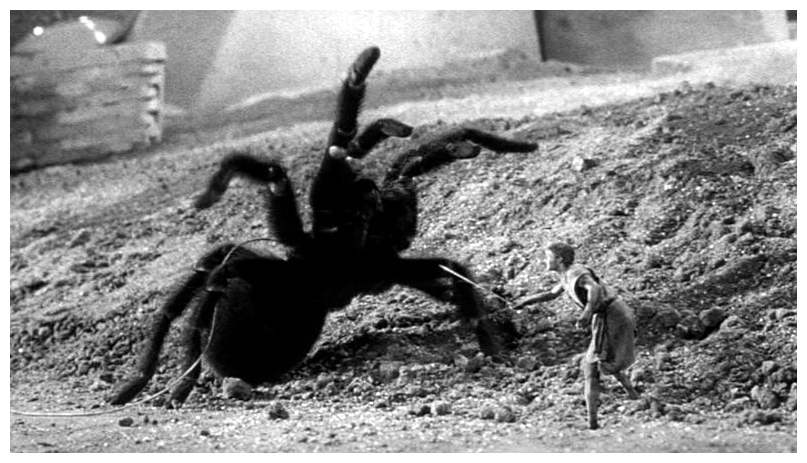
I have also a recommended Jack Arnold’s comparatively lightweight but quite entertaining B-movie Tarantula, about a giant spider who terrorizes a town (There’s a movie legend that Arnold used the same tarantula in this film, which seems implausible). It’s thought-provoking to reflect on why a giant tarantula chasing normal sized people in that movie is less scary than a normal sized tarantula chasing a miniaturized man here. Partly it’s the camerawork, which makes the audience see the spider and everything else in the basement from Scott Carey’s vulnerable perspective. The other part is the extreme isolation of the character. In Tarantula, there are many people who are towered over by the spider, whereas here Carey is utterly alone not only in the battle but in the universe, a recurring theme in the work of the legendary Richard Matheson.
I went through an enjoyable spate of watching early John Carpenter movies. Dark Star is an endearing ultra-low budget movie which highlights the emerging talent of Carpenter and Dan O’Bannon and will likely always have a place in college sci-fi film festivals. But it’s too unpolished and uneven for me to recommend. In contrast, his next movie, made in 1976 with a larger (if still small in absolute terms) budget, is taut, thrilling, and well-acted from end to end: Assault on Precinct 13.
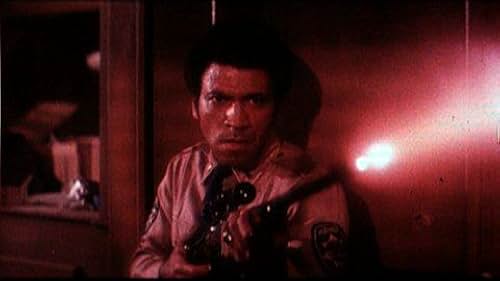
The spare plot is a stripped-down of version of Rio Bravo, with 40% less running time and a focus on action more than the relationships between the characters (Carpenter is clearly a fan of the legendary Howard Hawks, echoing him here as well as in The Thing). Highway Patrol Lieutenant Ethan Bishop (Austin Stoker) is given the ostensibly ho-hum assignment of overseeing the closure of a near-abandoned police station. But of course it couldn’t be that easy: a vicious, well-armed street gang converges on the station to avenge the killing of some of their members by the police as well as by an enraged civilian whose family they victimized. After the gang’s initial assault kills the few remaining police officers, Stoker can only rely on a worldly secretary (Laurie Zimmer) and two prisoners (Darwin Joston and Tony Burton) to hold off the horde. Superb action and suspense follow.
Carpenter boils everything down to the essentials here: the desperate human will to survive, how danger can draw out courage in some and fear in others, and how shared risks can make enemies learn to trust each other. He matches that thematic simplicity with a no-nonsense visual style and fat-free storytelling. And he draws effective performances from his no name cast, further attesting to his talents as a director.
The excruciating tension of the siege on the station comes in part from the zombie-like nature of the gang members (Indeed, Carpenter has acknowledged the influence of George Romero’s Night of the Living Dead on his script). The gang members barely speak in this movie, being a mindless, remorseless, deadly mob akin to those Carpenter summoned up so well in The Fog, Ghosts of Mars, and They Live. Their intended victims, like the audience, want to know why the villains are they way they are, but there is no sensible or reassuring answer: they want to kill, they will not stop, and that is all.
Carpenter really did it all here, writing a tight script with solid dialogue, crisp plot lines and some moments of black humor (including the now legendary “ice cream” scene). His characters aren’t well-developed, but are real enough so that you root for them. Also worthy of comment: Carpenter made an intriguing and I think productive decision to bend reality by making the street gang multi-racial, as are the defenders of precinct 13, thus avoiding what might have been ugly overtones if the dueling sides had been racially monotone. He also composed one of his best scores and even, under the stage name John T. Chance (John Wayne’s character in Rio Bravo) did the editing, which not incidentally is terrific, particularly in the actions scenes. Like Roger Corman, Carpenter was underappreciated for many years before being recognized as a masterful filmmaker. Assault on Precinct 13 shows that his talent was evident from the earliest days of his career.
p.s. I didn’t see the 2005 remake of this film and based on reviews I don’t want to.









 All Good Movies