Categories
British Horror/Suspense

Masque of the Red Death

Low budget film genius Roger Corman once said the two films he was proudest of were The Intruder (a searing film about racism and civil rights which I recommended here) and the superb horror movie Masque of the Red Death.

Corman had been enchanted by Edgar Allen Poe stories since reading The Fall of the House of Usher at age 11. After directing a number of schlock black-and-white films made in 10 day shoots, he persuaded James Nicholson and Samuel Z. Arkhoff to let him do a Poe adaptation and to make it a “big budget” movie: Not only would it be in color, but he would have 15 whole days to shoot it! With his usual brilliance at spotting affordable talent, Corman cast as the lead Vincent Price, an actor who otherwise might have faded into obscurity along with his youthful good looks. The Fall of the House of Usher proved a big money maker, and an enduring cinematic collaboration was born (Corman, Price and Poe, often joined by other terrific horror actors and writers).

I have recommended the Corman-Price-Poe film Tales of Terror, which while a lot of fun is not as impressive cinematically as Masque of the Red Death. The latter was filmed in the United Kingdom because the government at the time had a film production subsidy policy, giving Corman more to work with financially than usual. The film also benefited from the cinematographer being the gifted Nicholas Roeg, one of the many soon to be famous film artists who was nurtured in the university of Roger Corman. Couple those virtues with Corman’s scrounging ability — he recycled much of the opulent set of Becket here — and you have the best looking of any of the Corman-Price-Poe films.

The plot of this 1964 release comes from the Poe story of the same name, with a subplot drawn from Poe’s Hop-Frog. The story opens in a foggy forest in Medieval Italy, where a mysterious figure cloaked in red foretells of a coming plague (His face is never seen, and I assumed his wonderfully sonorous voice was provided by the late Christopher Lee, but it turns out to be John Westbrook). Meanwhile, the rich, cruel, Satan-worshiping Prince Prospero terrorizes the peasants, and casts a lustful eye in particular on a lovely, impoverished lass named Francesca (played by Paul McCartney’s one-time beau Jane Asher). As the plague spreads through the land, Prospero’s castle fills up with both his greedy courtiers and his unwilling prisoners. Debauchery and nastiness ensue, coupled with ample surrealism and existential dread for good measure.

Corman was utterly in command of his material by this penultimate entry of his Poe cycle, and benefited from a strong script by R. Wright Campbell and the legendary Charles Beaumont (co-creator of the Twilight Zone). The almost hallucinatory ambiance of the film makes it both uniquely unnerving and a foreshadowing of the more experimental film style that would flower as the 1960s went along (including the moments when Corman strains for artiness a bit too much). As for the actors, this may be Vincent Price’s most impressive horror performance: he dominates every one of his scenes. Of the many good supporting performances, particular praise is in order for the little-known Skip Martin. As Hop-Toad, a wronged dwarf who seeks revenge, Martin conveys impressive emotional power. He had the bad luck to work in the pre-Peter Dinklage era where good parts for little people were virtually never written into films, but at least he made the most of his opportunity to shine here.

Masque of the Red Death succeeds as a horror film and also as an art house drama. Congratulations to Corman and his crew, as well of course to the magnificent Edgar Allen Poe.


Categories
Action/Adventure Foreign Language Horror/Suspense Mystery/Noir

Män Som Hatar Kvinnor

image

The left-wing Swedish author Stieg Larsson had a strange and remarkable life. As a teenager, he witnessed some of his friends commit gang rape, and was haunted thereafter both by guilt about his failure to intervene and the omnipresence of violence against women. As a journalist he was unknown outside of Sweden when he died suddenly at the age of 50, but soon became one of the most widely read authors on Earth when his Millenium triology was posthumously published. The first filmed adaptation of Larsson’s crime novels is the unforgettable 2009 Swedish television mini-series Män Som Hatar Kvinnor.

Though known as “The Girl with the Dragon Tattoo” to Americans, the original Swedish title actually translates as “Men who Hate Women”, which better describes what this film is about: a ferocious, unforgettable, superheroine battling some of the slimiest and scariest misogynists in film history (which is saying something).

Noomi Rapace knocked the film world on its ear with her four-barreled performance as Lisbeth Salander, a social misfit with a history of trauma, a genius for computer hacking, and an invincible survival instinct. Events bring Salander together with crusading journalist Mikael Blomkvist (Michael Nyqvist, nicely underplaying his part), who is attempting to solve the long-ago disappearance of a little girl in a remote Swedish village that is icy in more ways than one. Along the way they encounter enormous human ugliness (almost all of it male), perplexing clues, and life-threatening risk.

Having not read Larsson’s books, I cannot evaluate the faithfulness of Rasmus Heisterberg and Nikolaj Arcel’s screenplay to the original story. But I certainly aver that it’s a fine bit of writing, rounding out each character and having them bounce off each other in ways that advance the story. The relationship between Salander and Blomkvist is particularly refreshing because it completely reverses the gender role conventions of the genre. The mystery/thriller elements are also fairly well-done, keeping the audience puzzling over the solution at times and on the edge of their seat at others.

MV5BMTYwMTg1OTU5Nl5BMl5BanBnXkFtZTcwNTU4NDAyMw@@._V1_SX640_SY720_

As photographed by Eric Kress, Northern Sweden is a bleak and lonely physical environment populated by bleak and lonely people, amongst whom some true monsters can easily hide. The film could easily have been a downer if not for the breathtaking power of Salander’s character and Rapace’s performance. Multi-layered female roles are sadly uncommon in movies; the worldwide embrace of Lisbeth Salander shows that audiences are hungry for more.

p.s. This review is based on the 180 minute version that played on Swedish television (later edited down into a shorter film for release in theaters). The 2011 English-language remake has a bigger budget with bigger stars (including a miscast Daniel Craig as Blomkvist) and is certainly a polished piece of work, but not quite as effective as the original.

Categories
Action/Adventure Horror/Suspense Mystery/Noir

The Parallax View


The horrifying assassinations of the 1960s generated countless conspiracy theories that continued to rattle about in the 1970s, particularly after Watergate further damaged the public’s faith in once-respected institutions. During this period, Alan J. Pakula was arguably the film maker who most effectively translated the public’s anxieties onto the screen. The two best known of his “paranoia triology” are the Oscar winners Klute and All the President’s Men. But don’t overlook the less commonly recalled but very fine member of the troika: 1974’s unnerving The Parallax View.

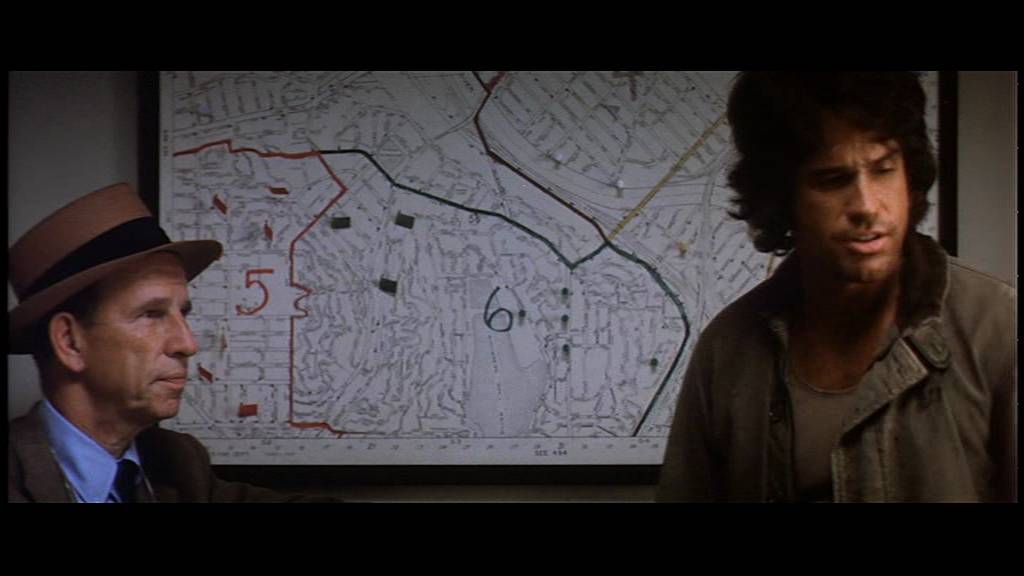
The film’s opening sequence, set at the top of Seattle’s space needle, grabs viewers by the throat. What seems a banal political event suddenly turns violent, and through a series of rapid cuts the audience is as disoriented as the terrified characters on screen as they wonder what exactly they just saw. In the ensuing months, many of the witnesses come to premature ends, leading raffish journalist Joe Frady (Warren Beatty) to investigate, against the advice of his hard-headed, fatherly editor (Hume Cronyn, effortlessly at home in his role). Frady discovers that a mysterious corporation is recruiting sociopathic killers and goes undercover to investigate. He seems to be making progress in infiltrating the nefarious cartel, but is he really just walking into the web of a hungry spider who is spinning all the strands?

Alan J. Pakula's “The Parallax View” | Wonders in the Dark

The Parallax View provides moments of high suspense and also carries off well that essential of paranoia films: The exchanges between the lead character and the trusted friend who thinks the “conspiracy” is all imagined (Nice touch: Cronyn’s office is crammed with memorabilia from his work with the Boy Scouts). The performances are believable throughout, which helps the film survive its more credibility-straining moments.

The late Gordon Willis, one of the most respected cinematographers of the 1970s, gives the film a distinctive look appropriate to its tone. There are many long, lonely shots taken far from the action, along with Willis’ signature fondness for shadows. The opening and closing shots, of government investigatory commissions proclaiming “nothing to see here, move along, there’s no conspiracy” as the camera moves in and out, ultimately arriving at a dark, distorted anamorphic image, are perfect bookends for the film. Combined with the movie’s minimalist use of sound, Willis’ superb work suffuses the movie with a sense of unease.

The film is not without shortcomings. As in some other Pakula films (e.g., Consenting Adults), certain plot elements can’t survive strict logical scrutiny. How can second-rate journalist Joe Frady drive like a NASCAR champion and fight like James Bond? Why doesn’t he ever have deadlines at his newspaper and why, beyond the needs of the script, does his editor keep handing him piles of cash to pursue his story? Another potential weakness: Joe Frady is not that appealing of a person, so if you really don’t like Warren Beatty as a star, you may not feel much sympathy for the protagonist.

Flaws notwithstanding, Parallax View is an effective, disturbing piece of cinema. Its perspective is ultimately gloomy, but that doesn’t diminish its entertainment value or emotional impact one iota. This is a movie that stays with you, like a microphone the CIA has attached to your cell phone.

p.s. For those of you who are not old enough to remember and therefore might find one key scene of this film unbelievable: In the 1970s, you really could board an airplane without a ticket and check luggage onto a flight on which you were not yourself a passenger. Also, there was good service in coach. Really.

Categories
Horror/Suspense Science Fiction / Fantasy

Invasion of the Body Snatchers (1956 Version)

Invasion of the Body Snatchers | film by Siegel [1956] | Britannica

For political paranoia, it’s hard to top a movie that is at once a sci-fi chiller, a B-movie classic, and an utterly unnerving destruction of any ability you may have to trust the people around you. It’s the legendary original adaptation of Jack Finney’s Invasion of the Body Snatchers.

Made for peanuts in 1956, the film tells the story of a seemingly peaceful small California town where nothing ever happens. In the only starring role of his career, Kevin McCarthy plays town doctor Miles Bennell, who begins encountering a number of patients claiming that their loved ones are no longer who they used to be. They look exactly the same, but something’s not quite right about them. Dr. Bennell offers these worriers the standard reassurances about learning to relax, getting enough shut eye etc. It seems to work at first. The people who were once complaining soon become every bit as pleasant and vacant-looking as the loved ones they were so recently fretting over. Indeed, it is amazing how much better people feel when they just…go…to…sleep.

As strange events compound, Dr. Bennell and the woman he loves (Dana Wynter) realize that a sinister force is rapidly taking over the community and it’s almost impossible to tell who is afflicted and who is not. When they discover the extraterrestrial source of the change in the townspeople, they realize that their own lives are in danger and that it will be hard to convince anyone in the wider world that what they have seen is more than a figment of their imaginations.

My Name is Julia Ross (recommended here) is often cited as the prototype of a fine film made on a low budget; this B-movie is another sterling example of cinematic brilliance on the cheap. The only real expenses of consequence were the then ground breaking special effects. The town in which the movie was filmed — Sierra Madre — was used in its natural form; there are no fancy sets. Director Don Siegel went on to significant cinematic fame but the cast are unknowns and character actors who stayed unknowns and character actors. Producer Walter Wenger was an established figure in Hollywood, but his career was almost over when he made this movie. But none of that matters: This is grade A entertainment, loaded with suspense, shocks, and solid performances.

The meaning of the story has been much debated over the years. Some have seen it as a parable about the dangers of Communist infiltration. Others see it as a warning about conformity in the era of McCarthy. I never met Jack Finney, but I know some of his close friends and members of his family. When asked, they describe him as a New Deal liberal and no one’s Red baiter. They don’t think he wrote the story as political allegory but simply as a good story.

You can certainly enjoy this nail-biter as Finney thought of it. But it will also resonate with you emotionally if you’ve been in a situation where you felt that everyone but you was in on a joke you hadn’t been told or where you felt persecuted for being different. The most disturbing thing about the film is how banal and pleasant the enemies are. Like the worst of the world’s villains, they don’t see themselves as evil. Rather, they think they are doing everyone else a favor by bringing them under their tent.

Invasion of the Body Snatchers deserves its reputation as a classic film. Don’t miss it!

p.s. Carolyn Jones who has the second female lead part here, went on to play Morticia on television’s The Addams Family.

p.p.s. The studio suits tacked on a more upbeat “epilogue” when the film was released, but it’s thankfully gone from most modern prints.

Categories
Horror/Suspense Mystery/Noir

My Name is Julia Ross and Dead of Winter **Double Feature**

The 1941 novel The Woman in Red has been used as the basis of a film twice, with a four-decade gap between versions. As a special double feature, I recommend both adaptations: 1945’s My Name is Julia Ross and 1987’s Dead Of Winter.

My Name is Julia Ross was a modestly budgeted Columbia production with a 12-day shooting schedule. But at that point in his career, director Joseph Lewis was used to churning out a C-picture a week on Poverty Row. To have a B-movie budget was for Lewis a major upgrade in resources that allowed him to show how much talent he had. Clocking in at just over an hour, the film serves up noirish gothic suspense and a career-best performance by Nina Foch as the title character. She’s an American living in London who answers a job advertisement placed by a seemingly gentle old woman (a deliciously evil Dame May Whitty). Julia thinks she will be working as a personal assistant, but instead is promptly drugged, kidnapped and moved to a remote mansion on the Cornwall coast where everyone calls her by a different name and acts as if she’s married to a knife-obsessed weirdo (George Macready, who was made for these sorts of roles)! But the villains have not figured on how brave and resourceful is their prey…

My Name is Julia Ross is often cited by critics as being the perfect demonstration that you can make a fine movie on a low budget. The script and performances are solid and the brisk pacing keeps the viewer engaged throughout. Burnett Guffey, a future Academy Award winner, contributes moody and at times even eerie photography, and Lewis’ influence on shot selection is also easily evident (He loved to shoot actors through wagon wheels and fences, here there are shots through the newels of a staircase and the iron bars of a secured window). It is not surprising that the movie more than returned its modest budget and put Lewis on the path to even greater successes (Most notably, the simply amazing Gun Crazy, which features a central character with a fetish that resembles Macready’s here).

Many years after My Name is Julia Ross was released, Marc Shmuger and Mark Malone re-imagined the story considerably in Dead of Winter, making the lead character an actress desperate for work (Mary Steenburgen, who has fun playing three different characters). She is interviewed for a role by an inordinately polite and at the same time somehow disturbing assistant (Roddy McDowell, who steals the film) to an alleged film producer (Jan Rubes). In the midst of a raging, isolating winter storm, they bring her to a remote New England mansion and ask her to shoot a scene in which she impersonates Julie Rose, an actress whom they claim has had a nervous breakdown and needs to be replaced on a major film production currently underway. But as the audience we know that Julie has been murdered, and our heroine is falling into a web of danger.

Some of the plot twists and shocks in the film are anticipatable, but others are complete, effective surprises. As you would expect from a modern film, there is more graphic violence than in the original, but it’s not at all overdone. As in the original, it’s rewarding to see a strong, smart female lead character and also have a few moments of black humor. The one significant weakness of Dead of Winter is its length. If director Arthur Penn had to work with Joseph Lewis’ budget, I suspect he would have cut the first 11 minutes of set-up and character backstory and opened the film instead with the Steenburgen’s first meeting with McDowell. That would have made a better movie because the film as made can’t keep the audience in suspense throughout its 100 minute running time, even though the climax is truly nail-biting.

As a set, the two versions of this story make an entertaining and suspenseful double feature. Also, for film buffs, watching these films back to back is a chance to appreciate how the production of movies has changed over the decades.

p.s. Some trivia for you: Gene Wilder’s 1984 film The Woman in Red was based not on the book but a French movie).

p.p.s. Steenburgen’s husband in Dead of Winter (William Russ) is apartment bound because his broken leg is in a cast, but he can at least look out his window and take photos with his high-end camera…I think we know to which classic movie this is an allusion!

Categories
British Horror/Suspense Mystery/Noir

Obsession

In my recommendation of Dear Murderer, I described my fondness forBritish films in which brutal people say awful things with perfect manners and diction. Another fine example of the “Terribly sorry old chap, but I’m afraid I’m going to have to kill you” school of Brit Noir is 1949’s Obsession.

Like Dear Murderer, the film revolves around a beautiful, faithless wife (Sally Gray) whose urbane, intelligent cuckold (Robert Newton) seeks indirect vengeance by trying to kill one of her lovers in a fashion that the police will never uncover. Gray is at her most alluring…and her most cold. If there were any doubt as the film progresses, the final scene makes clear her character’s utter selfishness, and she puts it over in a manner worthy of noir’s most memorable femme fatales.

Robert Newton, as a calculating, vindictive psychiatrist plotting the perfect murder, is even better. It’s hard to believe that his suave, perfectly tailored character is the creation of the same actor who made “Arrrrhhh!” the byword of would be pirates everywhere (see my recommendation Treasure Island for details). Because he is ostensibly the victim of his wayward wife and conducts himself so politely, it’s possible to feel sorry for him until about half way through the film, when a critical scene with a little dog makes you realize that he is, like his spouse, a thoroughly nasty piece of work.

Obsession (1949) British Politeness, A Hot Water Bottle & A ...

Phil Brown, remembered today only as Luke Skywalker’s Uncle Owen in Star Wars, is serviceable as the doomed lover, though a stronger actor might have been able to do more in the many face-offs he has with Newton. Naunton Wayne — for once not co-cast with Basil Radford — comes off better as a dogged Columbo-type detective, and also skillfully injects some comic relief into the otherwise grim story.

The other key presence here is director Edward Dmytryk, who was essentially exiled to Britain during the McCarthy witch hunts. He had a smaller budget to work with than what he was no doubt used to in Hollywood, but he gets everything possible out of the small cast and few sets as the film unfolds.

If you have trouble finding a copy of Obsession, look for it under an alternate title that was adopted at some point after its release: The Hidden Room. Any required extra hunting effort on your part will be well-rewarded by this finely-crafted piece of cruel and suspenseful entertainment.

p.s. Look fast for Stanley Baker (whose films I recommended here, here and here) as a cop on the beat.

Categories
Horror/Suspense Mystery/Noir

Psycho


Part of Alfred Hitchcock’s magnificence as a filmmaker stemmed from his restlessness. He ruled 1950s cinema, delighting both audiences and critics with big budget, suspense-and-romance movies shot in glossy color. The studio heads at Paramount Pictures expected that for the final film he was contracted to shoot for them, he would go back to the well that had made him world-famous and Paramount executives very rich. But the suits misjudged the genius’ desire to keep pushing the envelope rather than repeating himself. Hitch announced that he wanted to make a low-budget, black-and-white horror film based on the exploits of a real-life serial killer. The studio execs wouldn’t touch it, so he got the money together on his own and used the crew from his Alfred Hitchcock Presents television show to shoot the movie. The result was a trendsetting, nerve-shredding masterpiece: 1960’s Psycho.

The story opens with Marion Crane (an achingly vulnerable Janet Leigh) and her lover (John Gavin) discussing how they can never get married because of the financial constraints they face. Enter one of Hitchcock’s most inspired MacGuffins: $40,000 in cash that Marion is entrusted by her boss to deposit in the bank. Impulsively, she steals the money and drives to visit her lover, getting lost on a lonely road in a rainstorm. Fortunately, she finds an empty motel, where she meets Norman Bates (Anthony Perkins, in his signature role). The lonely young man tends the failing motel, while also watching over his emotionally disturbed mother. As shown in one of the movie’s many beautifully scripted and acted scenes (with evocative incidental music), Marion and Norman connect with and at the same unnerve each other:

I was blessed to see Psycho many years ago with no idea of the plot or legend of this film, and for that reason I will reveal no more of the story other than to say that it’s a masterclass in horror and psychological tension, with coruscating performances, direction and camerawork (The staircase sequence with private investigator Arbogast and the subsequent shot of Norman carrying his mother down to the fruit cellar are both technical marvels). The famous score by Bernard Herrmann is one of his best, and amps up the terror almost beyond belief. Credit also must go to screenwriter Joseph Stefano for realizing that Robert Bloch’s novel had to be significantly altered to work as a film, particularly in terms of building out the backstory of Marion Crane and re-conceptualizing the character of Norman Bates. Stefano also deserves credit for writing one of only a handful of scripts in Hollywood history where the protagonist switches in the middle of the movie, yet keeps the audience glued to their seats.

It is difficult to appreciate today how challenging it was for Hitchcock to get this film past the censors in 1960, but to give you one example of how strict the prevailing norms were, this is the first American movie to show someone flushing a toilet (Think of the children!). There is of course much more here than that to upset the censors, but Hitch mostly got the sexuality and graphic violence he wanted, thus pre-figuring what the 1960s would later bring in a flood to movie audiences. As ever, the Master was ahead of the curve.

p.s. With the aid of fellow director Barry Levinson, Mel Brooks brilliantly parodied the most famous scene in Psycho in his 1977 film High Anxiety.

p.p.s. The 2012 film Hitchcock focuses heavily on the making of this movie. Although it garnered mixed reviews, I thought that Anthony Hopkins and Helen Mirren have rarely been better.

Categories
Horror/Suspense Mystery/Noir

The Hitch-Hiker

Ida Lupino was a central figure in the breaking of the all-male lock on the Hollywood director’s chair. While she was looking for a new project to make with her then-husband Collier Young, she met one of the men who had been kidnapped and forced to drive through Mexico by spree killer Billy Cook. That inspired her (and co-screenwriter/producer Young) to make the first film noir directed by a woman: 1953’s The Hitch-Hiker.

The story is straightforward and crisply told. Wonderfully, there is none of the extended, needless expository “set-up” of the characters and story of which too many film makers are enamored. Rather, the movie opens with a solitary figure walking slowly along a highway, looking for a ride. His face is off-camera. A car stops to pick him up, and moments later we see the same car on a dark side road, with dead bodies next to it. The solitary figure, face still obscured, harvests wallets and jewelry from the corpses. And then we see two pals on a fishing trip pick up a hitchhiker, who draws a gun and tells them to drive to Mexico. Somewhere along the way, he announces blandly that he is going to kill them too. From there, the movie is a three-handed nail biter, with William Talman as the hitchhiker and Frank Lovejoy and Edmund O’Brien as the luckless captives. Lupino keeps the brutal tale moving quickly and tells it an unromantic, unadorned style reminiscent of one of her mentors, Raoul Walsh.

Like most people, I only knew William Talman as the Prosecuting Attorney who got his head handed to him every week by Perry Mason. But there was more to the man than the role of Hamilton Berger let him show. As the gun-toting, sadistic Emmett Myers, he’s truly chilling. Yet like most bullies, he conveys an undercurrent of weakness and fear. It’s a pity Talman’s addiction to tobacco took him away from us at such an early age, leaving The Hitch-Hiker as the only big screen work for which he is even occasionally remembered.

O’Brien is credible as the more macho of the kidnappers, who chafes at Talman’s psychological terrorism and keeps looking for a way to confront him. But the more complex performance is by Frank Lovejoy, whom Lupino seems to have coached to play his part more like O’Brien’s wife than friend. He cooks, he tends injuries, he loves children, he counsels patience and he better endures Talman’s taunts that the captives are soft and unmanly. Yet when the need arises, Lovejoy is heroic. I wonder if Lupino saw herself this way. In any case, I doubt that a male director/scriptwriter would have crafted Lovejoy’s part in this complex and compelling fashion.

The film is also a master class in noir cinematographer, with Nicholas Musuraca behind the camera. The eerie shots of Talman’s menacing face floating in the dark in the back seat with the two terrified captives harshly lighted and staring at the camera are unforgettable. But Musuraca also puts paid to the idea that film noir camerawork has to be all about shadow. Noir is a mood and not just a lighting style. The lonely, glaring shots of the car rolling through the bleak desert utterly isolated under the burning Mexican sun are just as much iconic noir as are all the dark scenes. Musuraca is revered in film noir uber-buff circles, but not widely respected beyond that, perhaps because his oeuvre was so enormous that he inevitably worked on some zero-budget tripe. But with this film, the trend-setting noir Stranger on the Third Floor and his movies with Jacques Tourneur (also once unappreciated), he has the basis to accrue a stronger reputation over time.

The Hitch-Hiker is a minor classic of the noir genre and a feather in the cap for Lupino, Young and everyone else involved. After this gripping movie, you may find yourself hesitant to ever again slow down and pick up that guy with his thumb out on the side of the road.

Categories
Horror/Suspense

Grip of the Strangler

When Jean Kent died, I decided to watch one of her films that I had never seen, and came away happy that I did. In one of her many roles as a naughty British lass, Kent is a chanteuse/madam threatened by a serial killer apparently risen from the grave in this week’s film recommendation: Grip of the Strangler (aka The Haunted Strangler).

This 1958 film has a wonderful backstory involving Boris Karloff. Alex and Richard Gordon grew up loving Karloff in the classic Universal horror films made before the war. When the Gordons were young adults, Karloff’s cinema stardom had faded but he was still working on the London stage. The two fanboys approached their idol, and ever the gentlemen, Karloff treated them kindly. When the great man was 70, the Gordons had the chance they had always dreamed of to produce a movie for him.

The plot is spooky and engaging, mixing elements of Dr. Jekyll and Mr. Hyde, Jack the Ripper and even Frankenstein. You can also see the beginnings of a return to sexual explicitness in British cinema here, particularly in the scenes in Kent’s bawdyhouse (the champagne spill scene with pinup model Vera Day has to be seen to be disbelieved). But those elements work well in the story, which concerns a moralistic late-Victorian Era social reformer (Karloff) who believes a strangler of attractive women is still at large in the streets of London. He’s a hothouse flower of a man who faints when he sees abuse of prisoners, is terrified of rats and is extremely ill at ease interacting with a woman of Kent’s sensually confident ilk. Yet he is also unaccountably obsessed with the strangler’s brutal sex crimes.

It’s not a big budget film, but you largely wouldn’t know it. Director Robert Day started his career as a cinematographer and clearly learned how to use shadows, fog and lighting to keep the audience from noticing any economies in set design and art direction. The professionalism of the cast helps a good deal too. There are some actors who can’t seem to do a B-movie without somehow conveying to their fans “wink wink, I’m phoning in my part just so you know I’m above all this”. But such self-indulgence was unheard of in this era of British film and the result is a much better movie.

Kent is clearly at home in her showy part, even though it is unfortunately smaller than it could have been. Karloff is nothing less than brilliant, conveying his character’s admixture of desire and repression, rage and sadness.

This is not a widely-known film outside of the horror film buff community. But it has captured some important supporters, most notably The Criterion Collection, who have made a pristine print available for you to enjoy.

p.s. SPOILER ALERT: Karloff’s physical transformation is even more impressive when you learn that he did it without makeup!

p.p.s. If you like Jean Kent, I would also recommend Anthony Asquith’s 1950 Rashomon-meets-noir movie The Woman in Question, in which she does well playing the “same” character as perceived very differently by the other main characters.

Categories
Horror/Suspense

Murder by the Clock

Murder by the Clock (1931)

In its early days, Hollywood turned out some engaging films about ghoulies, ghosties, long-legged beasties and things that go bump in the night. Let me offer an admittedly off-beat film recommendation from the early days of talkies: 1931’s Murder by the Clock.

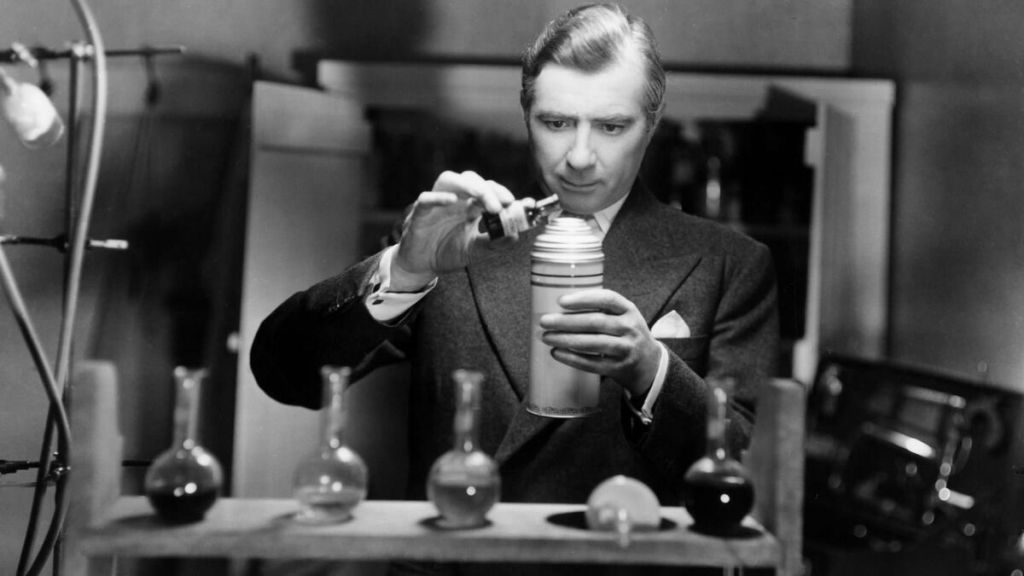
The plot centers on the Endicotts, a wealthy family in decline. The parsimonious matriarch of the clan, Julia Endicott (Blanche Friderici), lives in fear of a Poe-style premature burial and laments the fact that her direct heir is a musclebound half-wit (Irving Pichel, in a quasi-Frankenstein Monster sort of role). Julia reluctantly decides to leave the family fortune to her drunken, ne’er do well nephew (Walter McGrail). But his scheming, sexually voracious wife (Lilyan Tashman) isn’t in a mood to wait for Julia to die of natural causes, and begins using her considerable feminine wiles to get multiple men to work her evil will. Murders and mystery ensue.

Fair warning: Movie sound technology was not well-developed when this film was made. Microphones on the set were few in number, often in fixed positions and of low quality. As a result, actors had to talk more slowly and clearly and not move around too much as they did so. This understandably comes across as stilted to modern audiences. But as with the famous Lugosi/Browning Dracula which came out the same year, if you can let those limits of early talkies go and just enjoy a scary story well told, Murder by the Clock will greatly entertain you.

In style and plot, this film is an agreeable cross between the haunted house pictures of prior years and the monster movies that were just becoming popular (like Dracula, Frankenstein also came out in 1931). The other enormous appeal of the movie is the campy, vampy work of Tashman, in a part that screams “pre-Hays Code”. Dressed in a series of outfits that leave little to the imagination, she sexually disables virtually every male character in the story (Tashman was apparently a sexual dynamo in real life as well, though her energies were usually directed at women rather than men, allegedly including Greta Garbo). Tashman has a lot of fun going way over the top and it’s intentionally funny for the audience too, as were many of the classic monster movies of the 1930s.

The atmospheric photography is another asset of Murder by the Clock, and amplifies the mood effectively. That’s a credit to Karl Struss, one of the first famous cinematographers, who worked with many of the early giants: Murnau, Griffith, DeMille and Chaplin. Struss gives fans of scary movies what they want: eerie shots of dusty secret corridors, foggy graveyards, and killers skulking through abundant shadows

If you just can’t stand the technically-imposed limitations of early talkies, this movie is not for you. But otherwise Murder by the Clock offers creepy, campy fun as well as being of historical interest for its look and pre-Hays code salaciousness.

p.s. Pachel went on to direct an ever better pre-Hays code film that I recommended here two years ago, The Most Dangerous Game. Note also that Murder by the Clock is in the public domain, and you ought to be able to find it for free online.