
Categories
Horror/Suspense

Suspiria

Italian producer/director/writer Dario Argento has been an international force in horror films for half a century. His “art house slasher movies” began incorporating supernatural elements in the mid-1970s (e.g., the psychic character in Deep Red) and went further in that direction in his best film, the ultra-stylish, ultra-bloody, and ultra nerve-jangling Suspiria.

The plot: American dancer Suzy Bannion (An intrepid and likeable Jessica Harper) arrives in Germany to attend an exclusive ballet school. Everything at the bizarrely designed and decorated school is wrong from the very first, with students disappearing, teachers engaging in strange behavior and an atmosphere of menace suffusing every room. As Suzy begins to investigate her mysterious surroundings, she comes to suspect that some supernatural evil is at the heart of the school and that it will not rest until she is destroyed.

If you judge horror films in the most elemental way, i.e., how scared will I be?, this 1977 movie is a triumph of the genre. In ways large and small, Argento keeps the audience on edge with very little relief. As in his other films, there is some astonishingly over-the-top gore. But the unique, suspenseful mood of this film is created mainly by an invasive, eerie score, extensive use of anamorphic lenses and other camera trickery, madcap set design and a vivid color scheme (with the accent on red of course…). Even the second time through when I knew what was going to happen, I was still holding my breath and tensing my muscles as I rooted for Suzy to overcome the extraordinary dangers she confronts.

Argento made his bones in a subgenre of Italian film called giallo. One can see those influences here, but its a significant departure from giallo traditions that elevates Suspiria. Giallo typically features strong male characters while portraying women as either psychologically disturbed and dangerous, or, stupid and helpless (the latter type is often murdered in graphic and sometimes sexualized fashion). Argento’s first film, The Bird with the Crystal Plumage, was a big hit in Italy in 1970 and was stylishly made (of course), but its misogyny is off-putting. By 1975’s Deep Red, which more or less reworked the same plot, his protagonist is still male but the female co-lead has gone from being pathetic to competent. In Suspiria, we get an Argento film in which every redoubtable character — good and bad — is a woman. This may sound a strange thing to say about a guy who made slasher movies, but becoming more feminist made Argento and even better filmmaker.

Suspiria (1977) Drinking Game and Podcast | Alcohollywood

All that said, the script of the film is remarkably uneven. Certain scenes emerge from nowhere and plot points come and go. For example, a young man at the school shows interest in Suzy and the audience wonders whether a romance will develop. Will he help her survive the terrors she faces? But like other story threads in the film, this one vanishes with no explanation. Maybe the editor was in a slashy mood himself, but I suspect these discontinuities are simply the result of Argento being more interested in theatrics than the underlying story.

In that respect, Suspiria reminds me of no film more than John Stahl’s famous “Technicolor noir” Leave Her to Heaven. Both movies overcome numerous script problems with incredible sets, atmospheric music, intentionally overstated color schemes and a strong leading female performance. Though different in other ways, both prove that sometimes in cinema, style really can triumph over substance. That’s certainly the case for Suspiria, making it ideal horror viewing for those who are not faint of heart.
Categories
Drama Foreign Language Horror/Suspense

Onibaba


When movie aficionados think of Japan, their minds typically turn to Akira Kurosawa. That’s understandable, as one could make a plausible case for him being the best director in the history of cinema. But Kurosawa is far from the only brilliant filmmaker to hail from the Land of the Rising Sun. Another is writer-director Kaneto Shindô, the creative force behind Onibaba.

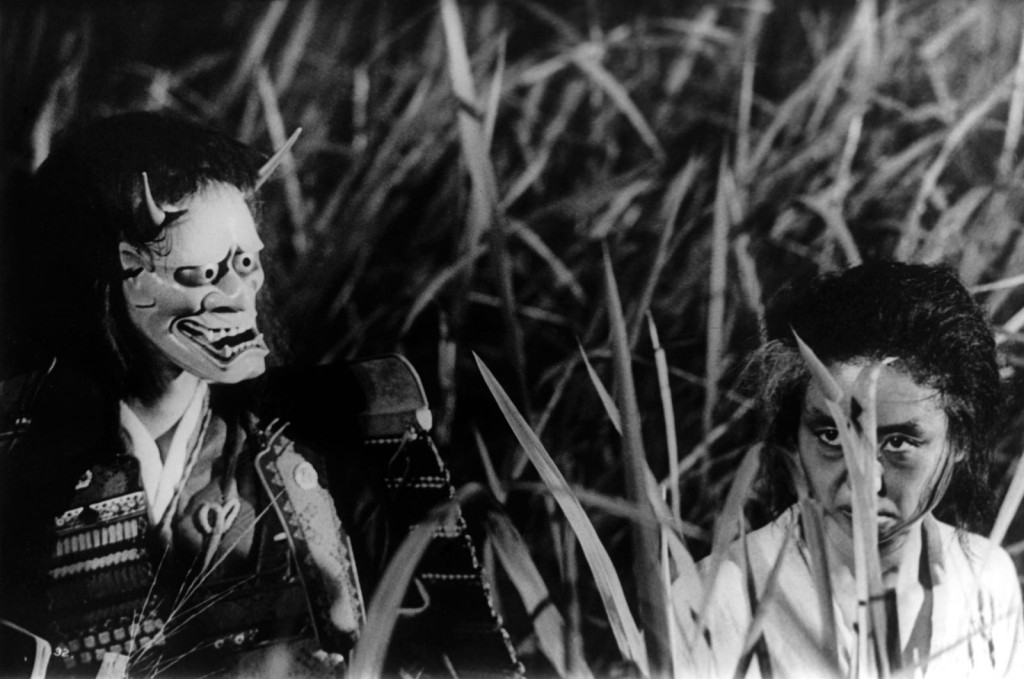
Shot in lustrous black and white under demanding conditions in 1964, Onibaba is a primal, sensual and eerie story of human beings struggling to survive. Emphasizing the mythological nature of the tale and its universal themes, the two central characters do not even have names. The older woman and her young daughter-in-law eke out a living in a swamp by murdering unfortunate soldiers who are lost or are fleeing the battles that rage across 14th century Japan. Strong, complex women characters were one of Shindô’s hallmarks, and he chose brilliant actors here to essay the roles: Nobuko Otowa (his real-life wife) and Jitsuko Yoshimura.

Onibaba (1964) | The Criterion CollectionInto this small, brutal world eventually comes a disruptive force, an ex-soldier played by Kei Satô who informs the women that the link between them is gone: the older woman’s son is dead and the younger woman is therefore now a widow. The ex-soldier moves into the swamp, while keeping a lustful eye on the young woman, whose own uncontrollable sexual yearnings are memorably dramatized by her racing through the tall, undulating susuki grass (truly, the grass forest is the film’s fourth character). The older woman is consumed both by her own sexual frustration and her fear that the young woman will leave her, ending the bloody partnership that allows her to survive. So she concocts an unusual scheme to disrupt the relationship, which backfires as the movie takes a supernatural turn that will resonate with those viewers who are familiar with Buddhist folklore.

myReviewer.com - Review for Onibaba (Masters of Cinema)This is a raw film about how human beings’ animal nature emerges under harsh conditions. On display are unbridled lust, jealousy, greed and violence. Even the way the characters eat suggests animality. Hikaru Hayashi’s one-in-a-million score, a mix of Taiko, jazz and ghostly notes from wind instruments, is the perfect marriage of music with celluloid. Kudos are also in order for cinematographer Kiyomi Kuroda for achieving technical brilliance on a hot, rainy and swampy set (It was so brutal that Shindô allegedly refused to pay the rebellious crew unless they finished the shoot). Like Saed Nikzat, Kuroda has the confidence to hold a still long shot and let the audience experience the environment and characters rather than forcibly directing our attention by moving from one quick cut to another. This is especially effective in his hypnotic, sensual images of the ever-swaying susuki grass forest.

Although the film is perhaps 10 minutes too long, Onibaba is completely original and fascinating. It’s also rather unsettling in the best artistic sense of that word. To fully enjoy this classic of Japanese cinema, try to get your hands on the gorgeous Criterion Collection re-issue.

Categories
Horror/Suspense Mystery/Noir

Lured

No doubt you have often said “I’d love to watch a 1947 Douglas Sirk movie starring Lucille Ball and Boris Karloff that was a remake of a French film and was re-made again a half century later with Lucy’s part played by Al Pacino.” Okay, you’ve never said that, but nonetheless I gave you Lured.

The film tells the exciting story of the hunt for a serial killer who finds his young female victims though the newspaper’s “personal column” (This eventually became the title of the movie in the US after the Production Code censors ruled that “Lured” sounded too much like “Lurid”!). The fiendish villain taunts the police by sending them poems about his next intended victim. When another young woman is murdered, her plucky pal and fellow dance hall gal (Lucille Ball) feels it’s her duty to help a police inspector (Charles Coburn) catch the killer. Shadowed discreetly by a police minder (George Zucco), she starts answering ads in the personal column, which leads to dates which are by turns funny, disappointing and disturbing. Meanwhile she finds herself falling for a smooth-as-silk impresario (George Sanders) who with his business partner (Cedric Hardwicke) runs a chic club in which she hopes to audition as a dancer after the mystery is solved. But as she tries to decide whether to trust her beau enough to tell him of her work with the police, evidence emerges that he may somehow be connected to the case!

Many people only know Ball as Lucy Ricardo, but in fact she turned in some good performances in dark, dramatic films prior to ruling American television comedy for a quarter century. Lured and The Dark Corner are the best of her film noir work.

Ball had the fortune to launch her film career in a period when it was acceptable for female performers to be both funny and physically attractive. For most of the last half of 20th century, these attributes were often perceived as incompatible by entertainment moguls: Actresses were usually pigeon-holed as comic or sexy, but not both. My favorite example of this phenomenon was that Phyllis Diller was once going to do a Playboy spread as a joke, but when they took the photos it turned out that she looked beautiful under that house dress. The project was therefore shelved. Tina Fey and Amy Poehler are among the stars of today who have helped break down this constraint, restoring the possibility for other women to essay more multi-dimensional roles like Ball did in the late 1940s.

Ball is only one of the performers in Lured from whom Sirk got the very best. George Sanders played the sophisticated British rake in many movies and he does it yet again here. But so what? He’s very fun to watch doing what he does best. Coburn as the police inspector is appealing, particularly in his father-daughter style interactions with Ball. George Zucco, normally cast as a villain, shows a fine comic touch. Karloff is only on screen for one extended sequence, but nearly steals the movie as a deranged, grief-stricken has-been obsessed with the past. Last but not least, Hardwicke does well in perhaps the most complex part as Sanders’ business partner. The subtext of his emotions regarding Sanders and Ball is brought out subtly, in a way that clearly eluded the censors at the time. That is also a testament to Douglas Sirk, who loved to tell overtly conventional stories with implicit, then unacceptable, undertones that only some of the audience appreciated.

Lured is also a fine-looking picture, as you would expect when the camera in the hands of William H. Daniels. Sirk clearly influenced at least some of the shot framings, as they strongly prefigure the scene compositions he would employ in his 1950s heyday.

Lured does have some problems with tone and pace. It’s effort to mix comic, suspenseful and disturbing elements simply doesn’t always work. There are also some draggy moments that should have been left on the cutting room floor. One has to ask as well why the movie is set in London when it clearly was not shot there and Coburn’s police inspector sounds thoroughly American. Collectively, these flaws keep Lured in the good rather than great category.

If the story of Lured appeals to you, you might enjoy the other two above-average efforts to adapt it to the screen: The 1939 French movie Pieges directed by Robert Siodmak, and the 1989 U.S. film Sea of Love with Al Pacino and Ellen Barkin.

p.s. Look fast for Gerald Hamer in an uncredited small role in the dance hall early in the film. He was an essential part of another of my recommendations: The Scarlet Claw.

Categories
Horror/Suspense

Tales of Terror

Low budget whiz Roger Corman revered Edgar Allen Poe and brought his stories to a new generation through film. The best known is probably Masque of the Red Death (my recommendation here), but most of them are rewarding, including Tales of Terror.

This 1962 film is a trilogy of stories based on four different Poe stories: Morella, a pastiche of The Black Cat and The Cask of Amontillado, and The Facts in the Case of M. Valdemar. The stories are well-employed in the script of the late, great Richard Matheson, whose ability to infuse new, um, blood, into hoary tales I have praised many times. Vincent Price anchors the film with three lead performances, which vary in tone from lugubrious to frothy to sepulchral.

Price is joined by two aging stars who still know how to deliver the goods. Peter Lorre makes a fine boozy bully in The Black Cat and Basil Rathbone lends gravitas to the role of Carmichael, the hypnotist who tries to hold Valdemar at the point of death in the final story. The roles of the women characters however are comparatively flat, with the female performers cast mainly for their looks.

Many horror films, including some of the most famous, include some element of camp, and Tales of Terror is very much in that tradition. Price and Lorre enjoy themselves enormously in The Black Cat, inviting the audience to laugh at them as much as be frightened by the murderous proceedings. As a viewer, you should bring eggs for this part of the film, because these guys are bringing the ham.

In addition to the tension and fear generated by the three stories, the film makes for good horror viewing because Corman, as always, was experimenting as he went along. Some novel special effects are on display, all of which work pretty well. On the small screen, some of the Cinemascope trickery at the screen edges will be lost, so see this one on the big screen or in letterbox format if you can.

In some people’s minds, Corman is nothing but a schlock merchant, but that’s not fair to him. Like Richard Rodriguez, he has a genius for improvising in a low-budget environment. He shot movies on the sets of other movies while they were being torn down, writing a script each night to take advantage of whichever set would be gone by the end of the next day. He told Peter Bogdanovich that “Boris Karloff owes me a few days of filming, let’s make something out of that”, which became the nail-biting Targets. And he also helped launch many future superstars, including Jack Nicholson, Peter Fonda, Charles Bronson, Jonathan Demme, Martin Scorsese, Ron Howard, and Francis Ford Coppola. I was absolutely delighted when Hollywood finally woke up and gave the 83-year old Corman an Academy Award for Lifetime Achievement, because he’s long been the kind of disruptive, creative force that the film industry needs to maintain its vitality.

Categories
Foreign Language Horror/Suspense

Vampyr

Some film historians consider Carl Theodor Dreyer cinema’s most visionary director. His talent is on vivid, memorable display in the pioneering 1932 horror classic Vampyr.

The story, which Dreyer and co-writer Christen Jul adapted in part from the writings of Sheridan Le Fanu of Carmilla fame, concerns a student of the occult named Allan Grey. Grey arrives at a French town with a blank expression on his face that suggests he might be dreaming. He checks into a small hotel and is startled when a strange man enters his room and gives him a package “to be opened upon my death”. Grey wanders around the hotel, where he encounters a creepy doctor and his elderly female companion, as well as dancing shadows and a one-legged old soldier. Travelling through the town, Grey witnesses the murder of the strange man, leading him to open the package. It contains a book relating the story of the vampyr, one of which is currently menacing the village. The vampyr’s victims include a lovely young woman who catches Grey’s eye and whom he wants to save. As Grey tries to battle the fiend and its accomplices, he experiences disorienting visions and mysterious events that may daze the viewer as well, but at the same time will compel attention.

As the film was destined for release in France, Germany, and England, Dreyer kept dialogue to a minimum to avoid language challenges. Instead, he tells the story through unforgettable images: A strange metal sculpture against cloudy skies, an inside-the-coffin view of a live burial, a mysterious figure with a scythe, a relentless downpour of deadly flour, the visible carnal hunger of an incipient vampyr, and shadows that move independently of their casters. The novel visual effects are many, including double-exposure, shooting through cheese cloth and other trickery.

No film I have seen quite captures the inner logic of nightmares as well as Vampyr. In our scary dreams, events often seem nonsensical, yet we encounter characters who are completely undisturbed at the maddeningly illogical proceedings. They proceed in their own bizarre course and we proceed along with them because we have no choice but to obey the rules of our nightmare. That is the journey on which this film takes the audience, and it’s completely original and masterfully executed.

It’s a tribute to Dreyer’s directorial skills that he got effective performances out of an almost entirely amateur cast, including colorful bon vivant Nicolas Louis Alexandre, Baron de Gunzburg who bankrolled the project and appears under the name Julian West. The other critical ingredient is the groundbreaking camerawork of the legendary Rudolph Maté. The resulting film is probably too “arty” for some tastes, but most viewers will find it stays with them for a long time.

p.s. The public domain version of this film is available for free on Internet Archive and is watchable, but you will enjoy yourself much more if you view the Criterion Collection restored version, which is leagues better in terms of visual quality.

Categories
Horror/Suspense

The Howling (Plus a Trivia Quiz!)

There may be only one film that’s more packed with references to other horror films than Scream: Joe Dante’s 1981 cult favorite, The Howling.

Originally intended as a straight-ahead werewolf film, it was changed significantly in tone by a late-arriving co-screenwriter, the ever-creative John Sayles. Sayles kept the scary bits, but added a pile of in jokes and satiric moments (including one with himself as a coroner). The result was unsatisfying to some viewers, but the movie returned its modest budget many times over as horror fans embraced it enthusiastically.

The story opens with earnest, All-American TV reporter Karen White (Dee Wallace) putting herself in danger to help capture a serial killer who has developed an obsession with her. Despite police backup (actually, BECAUSE of police backup), things go horribly awry and she is psychologically traumatized. With the support of her ex-Stanford football star husband Bill Neill (Christopher Stone) she seeks treatment from a pompous psychiatrist who emphasizes the need to release the beast within (Patrick Macnee). He sends Karen and Bill to “the colony” an Esalen-type retreat, for healing. What the innocent couple don’t know is that the colony is a den of werewolves, and before you can say “Aaahooooooooo” they are both being terrorized by a motley assortment of lycanthropes!

The budget apparently prevented the casting of any A-listers, but the performers do a serviceable job, especially MacNee, who gamely spouts 1970s psychobabble, and the sultry Elisabeth Brooks, who memorably redefines the term “maneater”. But the real stars are Sayles’ parade of little gags (everyone eats Wolf Chili and drinks Wolf’s Liquor; look fast also for a copy of Ginsberg’s Howl), and the astonishing person-to-wolf transformations of Rob Bottin. Bottin leaves the CGI-dependent special effects artists of today in the dust with his extraordinarily scary work here.

The film has some flaws. After a gripping opening 20 minutes, it shifts the pace to neutral for too long before revving up a thrilling final act (In fairness, the film is over 30 years old, so perhaps a little flab in the middle is forgivable). I can understand also that the smart-alecky script may elude some viewers or seem to precious to others. But for horror movie buffs, The Howling is a fun screamfest that will enliven your Halloween.

And, now A TRIVIA QUIZ, with answers after the jump, with all the questions deriving from Sayles’ script flourishes.

  1. MacNee’s character is named George Waggner. The real Waggner directed what horror classic?
  2. One member of the colony is named Erle Kenton, after the director of the spooky 1945 movie House of the Dracula. The actor playing Kenton in The Howling was actually IN that movie. Who is he?
  3. Early in the film, when Karen White is in a phone booth waiting to meet serial killer Eddie Quist, a tall man stands just outside the door. Is he waiting to use the phone, or is he the killer, blocking her escape? Well, when he turns to face the camera he is revealed to be which famous horror movie director?
  4. Stone’s character is named after R. William Neill, who directed what great horror “team-up” movie?
  5. Noble Willingham plays a character named Charlie Barton. Barton directed what famous comedy-horror mashup?

ANSWERS

  1. The Wolf Man
  2. John Carradine
  3. Roger Corman.
  4. Frankenstein meets the Wolf Man
  5. Abbott and Costello meet Frankenstein

Categories
Horror/Suspense

The Wicker Man

Not long after the Callan TV show ended (My recommendation here), Edward Woodward starred in an unconventional low-budget horror film that has no monsters or ghosts, includes almost no night time scenes, blood, gore or special effects, yet is unquestionably harrowing: 1973’s The Wicker Man.

The plot: Uptight, devout and dedicated Police Sergeant Howie (Edward Woodward) arrives alone by seaplane at a small Scottish island to investigate reports that a little girl has gone missing. He finds a strange community of back-to-nature types who claim never to have heard of the girl, much to Howie’s frustration. He is further inflamed by their paganistic world view, sexual expressiveness and apparent disregard for his authority as a representative of HMG. He eventually meets the head of the community, Lord Summerisle (Christopher Lee), who confounds him further even while ostensibly supporting his quest to find the missing girl. His anger and anxiety mounting, Howie presses his investigation to the limit, but matters become only more maddening and much, much more dangerous.

It’s easy to see why Christopher Lee, who has made almost 300 films, declared that this was the best one he was ever in. He, Woodward, and the actors in other key roles (Diane Cilento and Britt Ekland) give performances that are somehow both realistic and otherworldly at the same time. And Anthony Shaffer’s script has the perfect set-up for suspense: A man absolutely alone in a strange place that he cannot understand and in which no help is available.

In addition to being scary, The Wicker Man is also sensually pleasurable. It features among other sexually charged moments one of the most erotic and original seduction scenes in the history of film. The soundtrack is also rich and stimulating. It would have been easy to simply have the music of the islanders be a recycled collection of old Celtic folk songs, but instead Paul Giovanni composed authentic sounding music that adds immeasurably to the atmosphere.

Warning: This film had an unhappy history post-production, with many cuts being made both by studio suits who didn’t get the film and morality police who hated the sex. The lack of respect for the film at the time is best expressed by the fact that the negative ended up buried beneath the M4 motorway (not a joke, sadly). Work very hard to get as long a cut as you can; Wikipedia has an account of all the versions here.

I hope you will take the time to discover this cult classic of British horror cinema. After the jump, I offer an interpretational addendum for those of you who have already seen it.

SPOILER ALERTSPOILER ALERT READ NO FURTHER IF YOU HAVEN’T SEEN THE MOVIE

When I first saw The Wicker Man many years ago, I read it incorrectly. As Sergeant Howie yells out Biblical verses while being burned alive by Lord Summerisle and his happy, dancing pagan followers, I took the filmmakers to be implying moral equivalence, i.e., one religious zealot destroying another. But when I re-watched the film to prepare for this review, I realized I had misapprehended Anthony Shaffer’s script. Yes, Howie is judgmental, moralistic and a bit of a prig, but his goal is to save an innocent child, and he pursues it with bravery and intelligence. In contrast, the pagans are cold-blooded, calculating murderers. Shaffer’s protagonist thus dies a martyr’s death at the hands of his theological enemies, not as their equal, but as their moral better.

Categories
Horror/Suspense Mystery/Noir

Dial M for Murder

I have recommended a clutch of Hitchcock films (Notorious, Psycho, The 39 Steps, and The Lodger), but omitted some of his best known. Some of his classic films (e.g., Rear Window) have been written about so much that I can’ t think of anything novel to add. Others exceed my powers: I’ve seen Vertigo a dozen times but still can’t fully explain why it is one of the greatest works of art of the latter half of the 20th century, though I know in my heart that it is.

So let me recommend a film you may have missed, which is usually considered a minor success of The Master: 1954’s Dial M for Murder. The movie had a strong foundation because it was based on an extremely well-crafted hit play by Frederic Knott (who also wrote the screenplay for the movie version).

The story is a simple one: A tennis-playing effete British smoothie (Ray Milland) discovers that his glamorous wife (Grace Kelly, elegant and effective) is carrying on a passionate love affair with a broad-shouldered American (an appropriately manly Robert Cummings), so he decides to murder her. But rather than do the deed himself, he seeks the help of an intermediary, leading things to go horribly awry…unless of course he can clean up the mess by framing his wife for a terrible crime.

When film directors adapt plays, they typically insert scenes of exteriors, use many long shots and wide shots and trolley shots etc., in order to give the audience a cinematic experience. Hitchcock did just the opposite, shooting almost entirely on a single set, and using camera placement within it to keep things fresh. The claustrophobic framing adds to the tension of the film while somehow never coming across as stagy.

The highlight of this film is the astonishing performance of Ray Milland as Tony Wendice, the suave and unflappable villain. He won a Best Actor Oscar for The Lost Weekend, but I think he’s even better here. Even when he cruelly and cleverly blackmails an old college mate (Anthony Dawson) into participating in his murder plot, he is ever calm and smiling, the perfect British upper class sort. It is that emotional tone in his performance, combined with Hitchcock’s directorial genius, that makes the famous closing scene of this film so memorable.

The foil for Tony Wendice isn’t really his romantic rival Mark Halliday (Cummings), but the intelligent, moral Chief Inspector Hubbard. He is played by John Williams, never a huge star but someone Hitchcock used over and over in movies and TV shows because he consistently gave solid and intelligent performances. Williams is at his best here, nicely leavening his hard-headed cop role with touches of warmth and humour.

In summary: Fantastic source material, fantastic director, fantastic cast – what’s not to like?

p.s. You may wonder why such a short movie has an intermission. This film was originally made in 3-D, and the intermission was to give a chance for those theaters with only two cameras to load the next two parallel reels. I regret very much never having seen the 3-D version, because Hitchcock allegedly used the technique in a more creative, less gimmicky way than did other film makers. The most famous 3-D moment was the extreme closeup of Ray Milland’s finger dialing M. To get the shot right, they built a gigantic phone and a huge paper-mache finger tip! In any event, unlike most 3-D movies, it’s perfectly watchable without the 3-D effects.

Categories
Action/Adventure Horror/Suspense Science Fiction / Fantasy

Night Slaves and The Screaming Woman **Double Feature**

ABC MOVIE OF THE WEEK COLLECTION" - 18 DVDS - COMPLETE UNCUT - TV ...

I generally don’t recommend made-for-TV movies because they generally aren’t worth watching (With some exceptions, such as Stephen King’s It). But there was a quality series of such films in the 1970s known as the “ABC Movie of the Week”. It gave audiences memorable moments such as Karen Black being stalked by an evil doll in Trilogy of Terror, Elizabeth Montgomery doing some ruthless ax work au naturale in The Legend of Lizzie Borden and Dennis Weaver battling a mysterious truck driver on a lonely road in Duel (An early Spielberg triumph).

I recommend two lesser known but still solid Twilight Zone-esque entries in this series of television movies: Night Slaves and The Screaming Woman.

Night Slaves is based on a novel by Jerry Sohl, a veteran TV writer for Twilight Zone, Alfred Hitchcock Presents and Outer Limits, among others (including the original Star Trek). Familiar plot elements from those worthy programs are all here: A mysterious isolated location, strange experiences, and a central character who can’t tell if he has stumbled across something bizarre and sinister or in fact is losing his mind.

James Franciscus and Lee Grant play Clay and Marjorie Howard, a toothsome married couple who are taking a vacation from the big city in order to help them recover from a recent trauma. Clay was in a terrible auto accident in which he suffered a head injury and two other people were killed. The Howards chance upon a sleepy little town and take a room for the night. But ’round midnight, Clay wakes up to see all the townspeople gathering in a trance-like state and then leaving town. He looks for Marjorie and finds that she too has become a glassy-eyed zombie. He receives cryptic clues about what is happening from an alluring stranger (Tisha Sterling) but she disappears before he can demand a full explanation. When Clay awakens the next morning, the town is apparently back to normal and everyone thinks his head injury has caused him to hallucinate the events he reports having witnessed. Is he going crazy, or is the town in the grip of some malevolent force of which its people are unaware?

The story unfolds slowly enough to be suspenseful without ever dragging — indeed like all the movies in the ABC series the whole thing runs only about 70 minutes. The actors are all believable and, as in a good Outer Limits episode, the resolution is clever and satisfying.

With made-for-TV flicks, I keep to my “B-movie standard” for cinematic releases, i.e., I don’t expect such movies to be more than they reasonably can be and frankly dislike it when they try. For that reason, the “TV elements” of Night Slaves don’t bother me, e.g., the set is clearly a studio back lot used in a million oaters, the reflected camera lights are visible in the store windows on one of the night shots, and there are some static one camera set ups that would have been replaced with more captivating cinematography if this were a big budget product for the big screen. If you can’t accept those sorts of things, don’t bother with this one. But if you can appreciate a solid TV movie as such, Night Slaves is quality entertainment.

An even better film along similar lines is The Screaming Woman, starring Olivia De Haviland in a role that you could consider a follow-up to The Snake Pit. She plays a wealthy woman named Laura Wynant who has just returned from the sanitarium after a mental breakdown. As she walks the grounds near the remnants of a bulldozed old smokehouse, she thinks she hears a woman calling for help from underneath the ground. As with Night Slaves, The Screaming Woman is based on a terrific writer’s (Ray Bradbury) story that depends on a character convincing other people that what has been witnessed is not an insane fantasy.

It’s pleasant as always to watch Joseph Cotten work (He plays Laura’s attorney) and the visuals of the screaming woman are effectively eerie. And the direction, by the accomplished Jack Smight, gets the most from the script and the actors. Again, it’s a TV movie, but it’s a fine TV movie indeed.

Categories
Action/Adventure Horror/Suspense

The Most Dangerous Game

One Halloween, I was looking for a lurid and creepy pre-code film to recommend. I was tempted by White Zombie but like many films of the period, the existing prints are sadly too beaten up to make the film an enjoyable experience. But then I found a movie that is not only better purely on its merits but has also been skillfully restored: 1932’s The Most Dangerous Game.

Joel McCrea plays a big game hunter who is travelling by yacht in the South Seas. As the ship nears a remote island surrounded by dangerous reefs, the light buoys seem to have been misplaced: They actually lead the ship into the rocks, causing it to sink with all hands aboard other than our hero. He makes his way to a fog-shrouded castle where Count Zaroff (Leslie Banks) welcomes him warmly, introducing himself as a fellow hunter. Zaroff has two other guests, the alluring Eve (Fay Wray) and her boozy brother Martin (William Armstrong). Zaroff used to have two other guests, but they disappeared shortly after he gave them a tour of his trophy room. Would you like to come down and see the prizes from his prior hunts?

Based on a story by Richard Connell that has since been re-used in movies and TV shows a million times, this version is closest to the original material. At a briskly paced 62 minutes, it’s both chilling and thrilling. And for film buffs, added interest is provided by the pre-code elements of sadism, sexual exploitation, gruesome violence and some disturbing “trophies” (There are ethnic stereotypes too, but that was okay with the Hays, Breen and the other people who implemented Hollywood’s Production code).

For me, the early 1930’s most hypnotic and frightening portrayal of a villain with an Eastern European accent isn’t Lugosi’s Dracula, it’s Leslie Banks as the depraved Zaroff. This was Banks’ first film and he is magnetic in a role that could easily have been campy. A injured World War I veteran with a scarred face, Banks’ disfigurement is integrated with his character and gestures in highly effective fashion. The leer Banks gives Wray when telling her that “love” will follow the hunt makes the viewer want to bathe immediately.

Ms. Wray alas is at best okay. At times she overdoes it to an extent that I wonder if she thought it was a silent film. She is mainly there to be lusted after and as her clothing is ripped away during sweaty sprints through the jungle. McCrea is agreeably strong-jawed if not playing a character with much depth. But their performances aren’t critical for a film that is really about a breathless, suspenseful chase, and it delivers the goods on that score in spades. One of the good things about such a short running time is that tension can be maintained through almost the entire movie, as the grip marks in the chair armrests of viewers will prove.

You may notice that co-Director Ernest Schoedsack, score composer Max Steiner and many of the actors were involved in making King Kong and that some of the sets and camera shots look like they are from that famous movie. That’s because the two films were shot at the same time, with the actors being borrowed for Kong in the middle of making The Most Dangerous Game (which funnily enough was more profitable because it had a much lower budget).

The restoration has removed almost all the scratches and damage, and the sound quality is very good. Kudos to the magnificent restorers of Flicker Alley for letting a new generation of film fans enjoy this fine example of pre-code cinema, which otherwise might have literally faded away.