Categories
Foreign Language Horror/Suspense

The Cabinet of Dr. Caligari

Film buffs are one of the few groups of people who have extremely positive associations with the words “Weimar Republic”. The German film industry had an embarrassment of talent and explosive creativity in the 1920s. The Cabinet of Dr. Caligari is one of a number of innovative German movies of the era that profoundly influenced whole swaths of 20th century film worldwide: .

It’s a story within a story, told by a man named Francis (Friedrich Fehér) after he sees “his betrothed” walk by in a daze. They have shared an amazing experience he says, and then the film transitions to his bizarre tale of a carnival sideshow that features a fortune-telling somnambulist. The sideshow is operated by the mysterious Dr. Caligari (a magnetic Werner Krauss) who seems to have control over the sleepwalker Cesare (Conrad Veidt). The creepy Cesare blandly informs a carnival patron that he will die at dawn, and the prediction comes true! It’s one of a series of murders that have been terrorizing the countryside. But who is the killer, and what will happen to the fetching damsel in distress (Lil Dagover) whom Francis and his friendly rival Alan (Hans Heinrich von Twardowski) are trying to woo? Strap yourself in for cinema’s first horror film AND the first film with a twist ending (and what a twist!).

Made by Robert Wiene in 1919 or 1920 (depending on which film guide you believe), The Cabinet of Dr. Caligari remains one of the most visually striking films in history. Expressionist artists Hermann Warm, Walter Röhrig and Walter Reimann produced a set design to die for, with light and shadows physically painted onto the walls and floors, twisted furnishings, canted windows and doors, and chiaroscuro galore. It’s a madman’s dreamscape, a physical expression of a warped psychology. Many of the actors move in a stylized way (Caligari recalls a scuttling spider, Cesare a cross between a mod dancer and the Frankenstein monster), further heightening the atmosphere of unreality. And it all would have looked even more mesmerizing at the time because the film was tinted rather than being in pure black and white.

Like the best art of this type, the unreality expresses a greater reality. Every one who has been in some bureaucratic backwater office to complete arcane paperwork under the oversight of an imbecile sees the truth in the design of the town clerk’s office in this movie. The cell at the police station conveys the complete desolation of the wrongly accused. And we have all met leaders of organisations whose personality and outlook are completely captured in the interior of the insane asylum director’s office.

Categories
British Horror/Suspense

Forgotten Draculas **Triple Feature**

Other perhaps than The Bible and The Sherlock Holmes stories, no book has inspired as many movies as Bram Stoker’s Dracula. Everyone knows the famous Bela Lugosi version, but few people are aware of the versions I am recommending here.

Count Dracula was broadcast on BBC in 1977, and is perhaps closer to the original text than any other version (except that Meena and Lucy are sisters rather than friends, and one of Lucy’s three suitors is omitted). The elegant French actor Louis Jourdan makes a memorable Count Dracula, conveying a mixture of civility, erudition, seductiveness, arrogance, and menace. Equally good are Frank Finlay as a kindly, devout Professor Van Helsing and Jack Shepherd in an unusually sympathetic take on the madman Renfield. Props also to Bosco Hogan for vividly portraying Jonathan Harker’s progressive mental breakdown under the strain of being trapped in Dracula’s castle.

The budget for the BBC production was clearly small, and that shows in some cheap special effects, the lack of any eye-popping sets, and the absence of mega-stars. But within the limits of a television budget, it’s a quality movie, especially the exciting closing confrontation between our heroes and Dracula.

An even better TV adaptation, simply called Dracula, was made in 1973 by Dan Curtis of Dark Shadows fame. His frequent collaborator Richard Matheson departs substantially from the original story in his script, offering a fresh take on the world’s most famous vampire. Dracula, played with panache by Jack Palance, is as much sad as threatening, longing for the normal life he had centuries ago and seeming almost to regret his thirst for human blood. Matheson also strips down the number of characters (e.g., no Renfield, Dr. Seward, Quincy Morris or Arthur Holmwood) in a way that simplifies and helpfully speeds up the storytelling. My only gripe about Matheson’s changes is that Professor van Helsing was turned into a proper Englishman (Nigel Davenport) when he works better as an old-world character steeped in the mythology of nosferatu. Oswald Morris, whose work I have praised many times on this site, again offers fine cinematography, which enhances Curtis’ ability to deliver moments that make viewers hold their breath or let out a scream.

The final forgotten Dracula I would recommend was made by Universal Studios in 1931. You are probably thinking “What does he mean ‘forgotten’, that was the most famous version ever, wasn’t it?”. The English-language version is indeed the most famous, but in the early days of talkies, films were not dubbed for foreign markets. Rather, the studios would shoot the same film twice with a different cast in a different language. That’s how the Spanish-language version of Drácula was made in 1931. Bela Lugosi, Tod Browning et al did their shooting during the day, and then a completely different crew and cast shot the same scenes in Spanish at night.

The Spanish-language crew had a smaller budget, but they also had a distinct asset: They got to see the rushes that the English-language crew had shot that day. This allowed them to replace shots that were dull or didn’t work with new set-ups, and the result is much better camerawork in the Spanish-language version. This version also adds in a few scenes that make the story more coherent. I would not say it’s better than the Lugosi/Browning version, but I would say that on balance it’s just as a good and well worth your time both for itself and for comparative interest with its more famous twin.

This 3 minute video from CineMassacre does a superb job comparing the two productions:

Categories
Drama Horror/Suspense

A Christmas Carol

One of the most memorable adaptations of A Christmas Carol is a short, animated film of the same name. Made in 1971 by animation icons Richard Williams, Ken Harris and Chuck Jones, this is by far the most eerie and dark version of the much-filmed Dickens classic.

Despite being condensed to 25 minutes, this Oscar-winning film’s storytelling will be comprehensible even to people unfamiliar with the original. Adding immeasurably to the production are the voice talents of two actors from the best live action version of the old chestnut (Alastair Sim and Michael Hordern, who reprise their 1951 roles as Scrooge and Marley, respectively).

But the real star here is the animation, which was inspired by illustrations in early editions of the book (especially the Victorian era drawings of John Leech). The images are lugubrious and scary yet hard to look away from, not unlike Goya’s Pinturas Negras. I first saw this film as a child and the visual of “ignorance and want” haunted my imagination for years. The film makers accentuate the power of the animation by employing arresting pan and zoom shots that are extremely effective both as storytelling devices and as setters of mood.

The threnodic tone of the film does not stop the essentially positive message of the story from emerging brightly in the end. Ebenezer Scrooge’s transformation to a life of charity and decency remains uplifting, perhaps even moreso for the considerable terrors of the night before.

Categories
British Drama Horror/Suspense

Unman, Wittering and Zigo

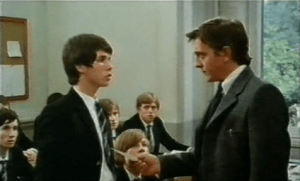
I have recommended the film Flirting, in which sadistic masters torment the new students in a boys’ school. I now turn the tables by recommending a film in which a new teacher John Ebony (David Hemmings) and his wife Silvia (Carolyn Seymour) are terrorized by the fifth form from hell. The last three students on the class roll are Unman, Wittering and Zigo, but Zigo is always absent, even going back to the time when the teacher that Ebony is replacing, Mr. Pelham, fell to his death (by accident?).

Director John Mackenzie of Long, Good, Friday fame made this creepy, nasty, thriller in 1971. He was aided immeasurably by master cinematographer Geoffrey Unsworth, who contributed some dazzling and disturbing point of view shots in the opening sequence as well as during the most horrifying scene in the film (which I will not spoil by describing other than to say, don’t bring the kids to this one).

The nefarious school boys (who include some actors who went on to distinguished careers including Michael Kitchen and Michael Cashman) are hard for the viewer to keep straight but that actually works, along with skillful editing, to make them seem less a group of individuals than a multi-headed hydra snapping relentlessly at Mr. Ebony. Hemmings, who also produced, is good as the pitiable Ebony, including in those scenes where he starts destroying himself with alcohol (perfect casting there, sadly enough. Hemmings left us too soon).

Unman, Wittering and Zigo (1971) | Nostalgia CentralWhile struggling with the boys ostensibly below him in the hierarchy, Ebony must also cope with the headmaster, played by Douglas Wilmer with just the right amount of Old Brit unctuousness overlaying snobbery and cold-heartedness. Although the scenes with the boys are chilling, the pre-dinner drinks scene with the Ebonys, another master and his wife and the headmaster, make one’s skin crawl in an entirely different way.

The final third of the movie is not entirely satisfying in terms of logical plotting, but the film still delivers a consistent air of menace that gets under your skin. Certain ambiguities in the story invite debates about the interpretation of this film; to avoid spoiling the movie for those who haven’t seen it, I have placed my own nagging questions about this movie after the jump (i.e., Don’t read the rest of this unless you have seen the film, it will ruin it for you).

Categories
British Horror/Suspense

Curse of the Demon

Director Jacques Tourneur didn’t make many movies and is largely forgotten today, but he has a cult following of which I am a part. He made horror films such as I Walked with a Zombie, film noirs such as Out of the Past, and films that exist somewhere in between, such as 1957’s suspenseful and scary Curse of the Demon.

The plot of the film pits hard-headed American psychologist Dr. John Holden (Dana Andrews) against sinister British cult leader Dr. Julian Karswell (a deliciously malevolent yet courtly Niall McGinnis), who claims to have magical powers. Holden is investigating the mysterious death of a colleague who, like himself, was trying to debunk Karswell’s claims. Karswell tells him calmly that his colleague was destroyed by the curse of the demon, and that a similar curse has been placed on Holden and will end his life in just a few days. Holden at first laughs this threat off, but then begins to experience a series of unnerving events that cause him (and the audience) to becoming increasingly scared that the curse of the demon is real.

Night of the Demon ****½ | Wonders in the Dark

As detailed in Carl Rollyson’s first-rate biography of Dana Andrews (recommended here), this handsome, broad shouldered actor looked like he had decades of stardom ahead of him in the 1940s, but he developed a serious alcohol problem that drove his career southward before he finally got into stable recovery around 1970. In some of his scenes here, he looks a little shaky and pale and one wonders if that is acting or not, but in either case, it works perfectly as Dr. Holden begins to unravel psychologically. Peggy Cummins, who commanded the screen in another of my recommendations (Hell Drivers), is surprisingly bland here as Holden’s fellow investigator and love interest. Instead, the sparks come in the scenes between Andrews and McGinnis. Their debates about science versus superstition are among the highlights of this film (The photo above is from my favorite such scene, which Tourneur brilliantly set at a children’s party in which Karswell is wearing a clownish magician’s costume).

As you would expect for Tourneur, there are lots of noirish visual touches, including abundant shadows and deep focus shots of people walking alone down empty corridors and streets. It all works perfectly to maximize emotional tension in this classic chiller.

This film is sometimes entitled “Night of the Demon” and sometimes “Curse of the Demon” depending on whether you’ve got hold of a US or UK print. In any event, the thing to ensure is that you have the full 95 minute version and not one of the chopped up shorter prints that are around.

N.B. Spoiler Alert, stop reading here you haven’t seen the film. Tourneur was unhappy with how unambiguously the final version of the film makes clear that the demon was real. He wanted to show the demon either not at all or so quickly that the movie would not take a clear position on whether there was such a creature or whether it only existed in the minds of its victims (A conclusion echoed in Andrews’ final line in the film about how it’s better not to know whether there was such a creature). But Tourneur was overruled by the producers, who took control of the two demon scenes on the film. In the final scene, Tourneur had clearly set up the smoky, clacking train to be the cue that convinced Karswell that the demon was after him, and the (not bad for the time) demon effects are now superimposed on that. Note also in the first appearance of the demon, the demon is not necessary to the death that occurs, so again Tourneur had set up everything to keep the demon’s existence ambiguous. Whether it would have worked better Tourneur’s way is a matter for debate. I suspect it would have been a very good, hair-raising film either way.

Categories
Action/Adventure British Comedy Horror/Suspense Romance

The 39 Steps

The 39 Steps (1935)

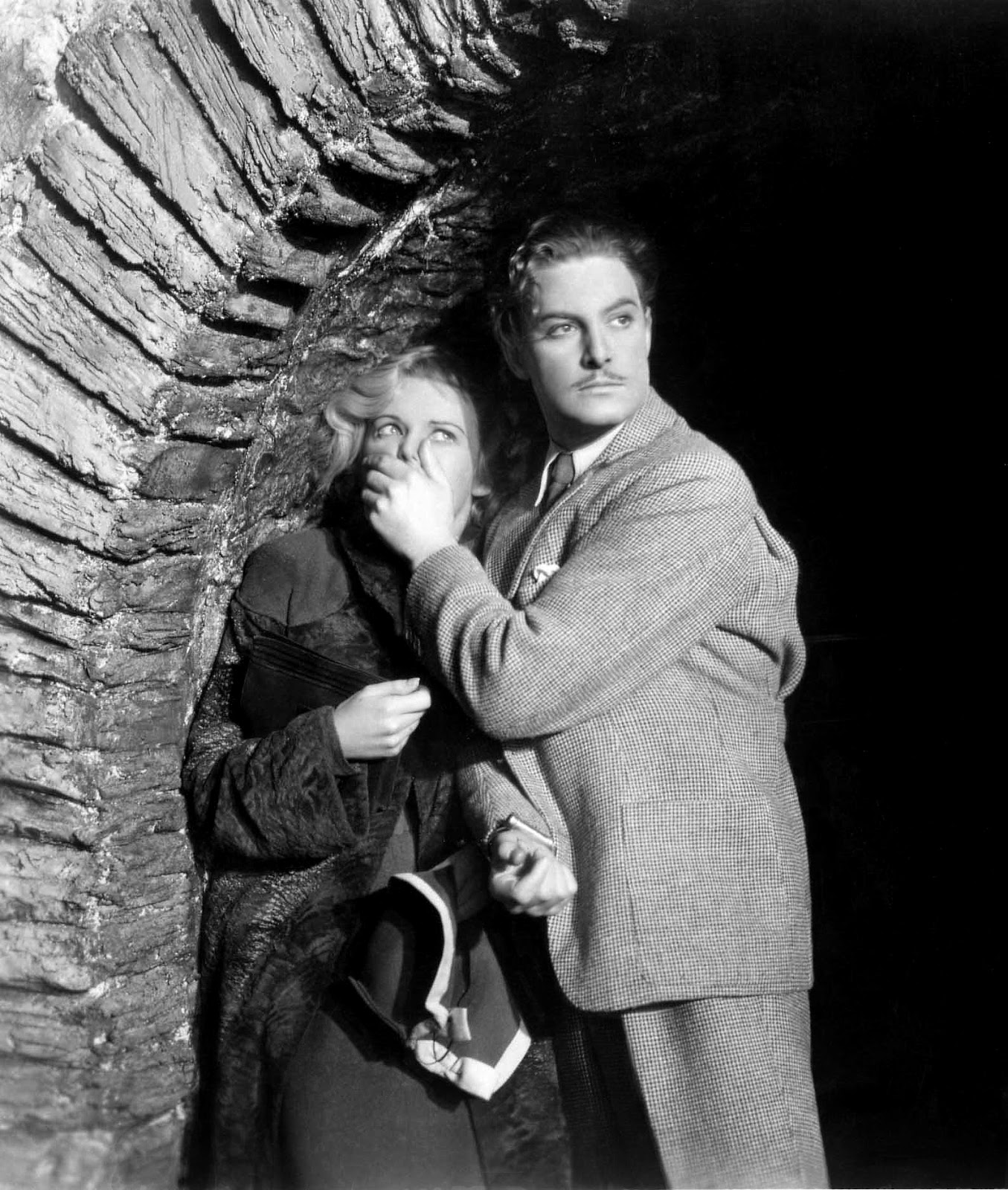
Alfred Hitchcock had a successful directing career in Britain that preceded his American super-stardom. Hitchcock fans rightfully consider the 1935 comedy-romance-thriller The 39 Steps among the very best works of the Master’s “British period”.

Robert Donat cuts a dash as Mr. Hannay, the hero of the film, who tries to save England from the threat of nefarious and crafty foreign agents. As in other Hitchcock films (e.g., North by Northwest, The Wrong Man, The Man Who Knew Too Much,), the central character is an innocent who is pulled into a web of intrigue and danger which he doesn’t understand. But unlike in those darker films, it doesn’t seem to bother him a jot.

“Did this beautiful woman just fire a gun in a crowded theater to evade her pursuers and then tell me that she is an international spy for hire? Well then, let’s go back to my flat for a large whiskey and soda and I’ll cook her up some haddock while she tells me all about it.”

“I seem to have walked into a political rally focused on I know not what and I have been mistaken for the distinguished guest speaker. Well then, jolly good, I’ll give it a go.”

“Am I really handcuffed to yet another beautiful woman as I run through the Scottish Highlands with people trying to shoot me? Well then, I wonder if she’s married or at least broad-minded.”

Categories
Horror/Suspense

It

Most made-for-television movies are disappointing. Most movies based on Stephen King books, likewise. But here’s a nightmare-inducing film that overturns both those rules: The 1990 adaptation of It. Ask an adult who saw it many years ago what they remember and you may hear, after a shudder, the half-whispered words “That clown…”.

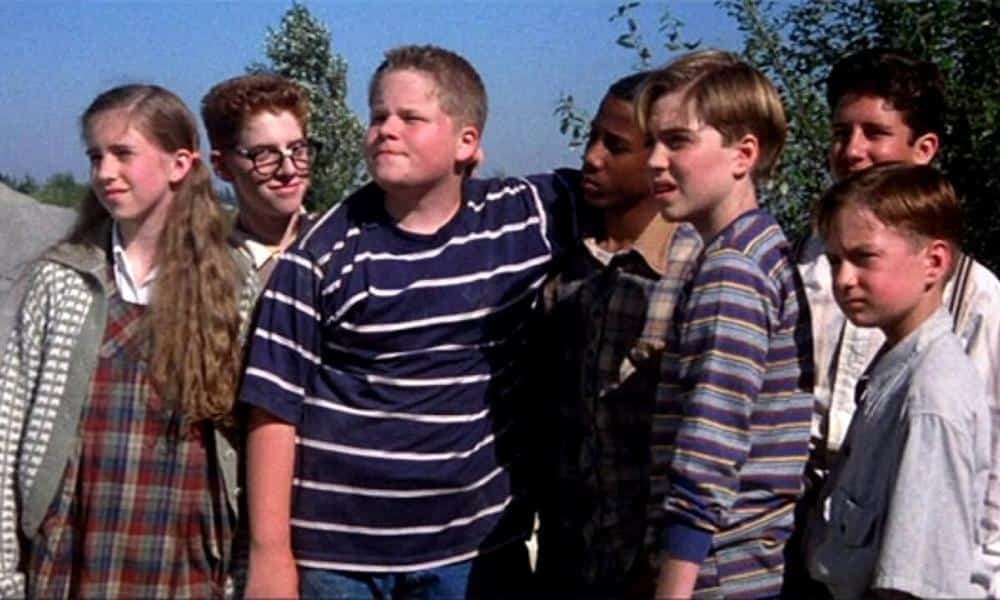
The plot (including the ending) is a bit inscrutable at times, but it runs something like this: In 1990, in the small town of Derry, Maine, a horrifying clown named Pennywise (A ghoulishly good Tim Curry) is preying on children. One adult resident of the town, Mike Hanlon (Tim Reid, who like the many other experienced adult TV actors in this film is solid throughout), begins to remember that he and his friends were terrorized by Pennywise as children. He contacts each of them, now successful adults, and they too awaken from a strange amnesia. They suddenly recall that as socially rejected kids, self-dubbed “The Loser Club”, they banded together to successfully combat Pennywise. Now they know that Pennywise is but one manifestation of a deeper, darker force which slumbers beneath the town, re-awakening every 30 years to feed again. “It” has returned, and The Loser Club must reunite to save the children of Derry and also conquer the demons that haunt them as adults.

A Member Of The Losers' Club From The 1990 'IT' Miniseries Has A ...

The film is structured in two parts, which were originally shown over two nights on television. In the first, we meet the central characters as children, battling It in 1960. The second part focuses mainly on the adults in 1990. However, this section of the movie cannily injects flashbacks to the 1960 part of the story, which helps hold interest over the 3+ hour running time because the child actors are so compelling and the scenes with Pennywise menacing the children are so chilling.

There are many shocks and screams here, but as with much of King’s best work (e.g., Stand by Me), there are also remarkable insights into the world of children and warm portrayals of life-changing friendships. The small budget shows here and there: Not all the special effects are first-rate and there are no Hollywood mega-stars in view. But the story is gripping enough, the actors appealing and talented enough and the scares plentiful enough to make It one of the best horror films in television history.

And remember: “They all float!”