In 1944, Andrews and his frequent co-star Gene Tierney, Director/Producer Otto Preminger and Cinematographer Joseph LaShelle made Laura, a classic film of high society longing, love and murder. Take that same foursome, move the story setting down significantly in economic strata and add a dose of brutality and you have 1950’s Where the Sidewalk Ends.
The story, as conveyed through one of Ben Hecht’s many outstanding scripts, centers on Police Detective Mark Dixon (Andrews). Dixon’s hatred of gangsters is legendary, and leads him to relentlessly un-Miranda-type behavior toward thugs. He has a particular grudge against mob boss Tommy Scalise (an oleaginous Gary Merrill), for reasons that are revealed during the film. While investigating a murder in which Scalise is involved, Dixon loses his temper one time too many, resulting in a tragic death which he tries to cover up. He hopes to frame Scalise, but suspicion instead falls on an innocent man (sweetly played by Tom Tully) whose dishy daughter (Tierney) turns Dixon’s head. The dark story twists like a knife from there, up to and including the very last scene.
The film has some superb noir cinematography, with the standout shot being a long, fixed point take of a car with Dixon and some mobsters in it approaching and entering a car elevator (in which LaShelle cannily placed the camera) and then rising up off the screen as the men in the car eye each other suspiciously. There are also a number of arresting shots that draw the viewers’ attention to two distinct points on the screen. My favorite is when Andrews is about to tell Tierney the truth but then turns toward the viewer, his face partly shaded. She then talks over his shoulder at the camera, as his face is transfixed with shame and doubt. Preminger set up many scenes this way in his career, challenging the viewer to track both external action and internal reactions in the same shots.
Who gets the credit for these effective framings and the movie’s overall cool look? I have written about how some directors are more controlling than others of the camerawork. Preminger was a legendary martinet on the set, so one can presume at least some of the photography set ups were his idea. On the other hand, LaShelle was an excellent cinematographer not just in the half dozen films he made with Preminger but also without him: He was nominated for an Oscar nine times! So credit both of them for an effective collaboration, especially LaShelle because Preminger could be such a domineering artist.
The duty of the prosecutor is to seek justice, not merely to convict.
1947’s Boomerang!, based on a real-life murder case that was never solved, stands out among Hollywood’s many courtroom dramas due to its excellent acting, unusual plot structure and creative storytelling style.
The crime that provides the basis for the movie occurred in Bridgeport, Connecticut in 1924, but because the town refused to allow Boomerang! to be filmed there, nearby Stamford was used instead. The basic facts of the original case are all present in the film. A priest is publicly executed by a gunshot to the head and the killer escapes before shocked witnesses can react. A manhunt and tremendous pressure on the police and local politicians ensue. Eventually the police arrest a drifter, a war veteran familiar with firearms and in possession of a .32 caliber handgun such as was used in the murder. He initially asserts his innocence but confesses to the crime after an extended pre-Miranda Era grilling by police detectives. The pressure is on for a quick conviction and sentencing, but the state’s attorney (in real life, future Attorney General of the United States Homer Cummings) begins to doubt the guilt of the accused.
The film is an early effort of Elia Kazan, and shows the flowering inventiveness of a young filmmaker on his way to a glittering career. Montage sequences are skillfully employed both to move the story along and also to provide local color. We don’t just see the usual newspaper headlines “Murder Suspect Arrested!” racing across the screen. Instead the montages also cut between little moments: Woman gossiping about the crime on the back stoop, men who vaguely match the description of the killer being arrested by police, ordinary people eyeing each other suspiciously on the street. Combined with shooting on location, these sequences do much to deepen the film’s realistic style.
Richard Murphy’s script, based on Fulton Oursler’s Reader’s Digest article about the real case, adds some elements that are uniquely suspenseful. Through an early scene with the priest followed by some meaningful closeups later, viewers are signaled about the true identity of the murderer. Thus, unlike in films where the audience is on the edge of their seats wondering if someone is guilty, the tension is focused instead on whether mob pressure will result in the conviction of an innocent man. Further, by inventing context about local machine politics, including giving the defendant an attorney who wants him to be convicted, the script shifts attention away from what will happen when the case is tried and centers its conflict on the morality of one character: When absolutely everyone is rooting for a conviction and the consequences of not securing it could be personally disastrous, what should a state’s attorney do when he thinks the police have the wrong man?
Dana Andrews was born to play characters like the state’s attorney, and this is one of his best roles. When he meets the accused (Arthur Kennedy, very good as usual) in jail, he expects a perfunctory post-confession meeting. But when he begins to learn the other side of his story, the doubt and sympathy subtly and irresistibly grow on Andrews’ face. He was so good at calibrating his reactions that you could imagine everyone in the audience thinking they were the one person who noticed that something was roiling beneath the surface polish. Kazan was of the method school and wanted more histrionics from the naturalistic Andrews, which goes to show that even A-list directors are wrong some of the time.
An actor more to Kazan’s liking, Lee J. Cobb, makes a big impression here as a gruff, tough yet ethical police detective. There are a few scenes when Kazan lets the camera linger on him for a few moments after the dialogue has ended, and each time Cobb gives some look or non-verbal gesture that nicely conveys his thoughts and feelings. Jane Wyatt, as Andrews’ wife, has the right touch in the domestic scenes: They are absolutely credible as a loving, long-married couple. Ed Begley is also compelling as a slimy local businessman with a selfish interest in a quick conviction, and Karl Malden makes a good cop, just as he would again with Andrews in Where the Sidewalk Ends (Recommendation here).
The last act of the film, which takes place in a packed courtroom, shows how a superstar can dominate the screen (if you want a similar, more recent example, check out Paul Newman’s courtroom closing argument in The Verdict). Standing center stage and looking devastating in a natty dark suit (WHY WHY WHY did American men ever stop dressing this way?), Andrews has 95% of the dialogue, with the other actors mainly being window dressing. It could have been stagy, but Andrews sells it with invincible credibility, giving the audience an exciting and satisfying wrap-up of every loose end in the story.
Dan Duryea, sometimes called “the heel with sex appeal” was usually cast as a second lead or a one-dimensional villain (For example in the outstanding noir Too Late for Tears, recommended here). But in 1946, he landed a leading part that let him show that he could portray complex characters with competing motives: Black Angel.
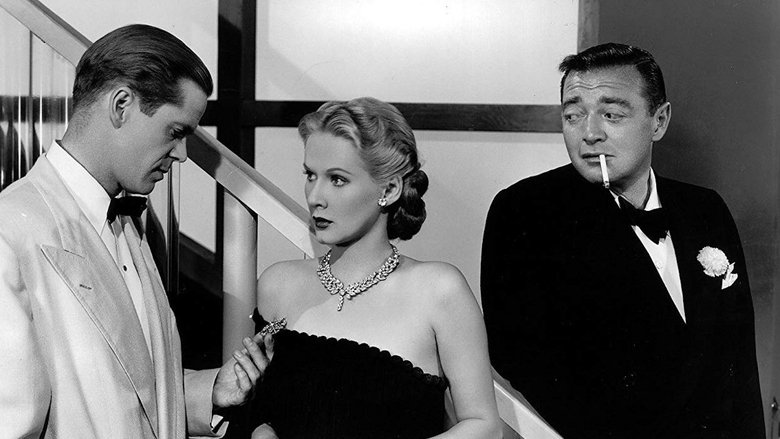
Duryea plays Martin Blair, an alcoholic once-successful tunesmith/piano player who has been on the decline since he was dumped by his beautiful but thoroughly self-absorbed and evil wife Mavis (Constance Dowling). Still carrying a torch for his ex, Martin tries to visit her at her apartment on their wedding anniversary but is ejected by the doorman. Before walking away, he notices a suspicious looking character (Peter Lorre) being admitted to Mavis’ apartment. Later in the evening, yet another man, Kirk Bennett (John Phillips) enters Mavis’ apartment, also apparently looking for love. He finds her strangled body, leading the police, in the form of no nonsense Captain Flood (Broderick Crawford), to slap the cuffs on him. Bennett is sentenced to die, but his heroic and devoted wife Catherine (June Vincent) believes he is innocent (of murder, anyway). She rouses Blair from his latest bender and the two set off to find the real killer. Suspense, romance and some fantastic plot twists ensue.
As you might have guessed, this film is a bit overplotted, but every scene engages due to the quality of the acting and the fine work of Director/Producer Roy William Neill, who is best known for his masterful adaptations of Sherlock Holmes (I recommended one of them here). I consider Black Angel Duryea’s finest hour, because he has so much to do and does it all well. After his early scenes of drunken desperation he sobers up and does a tremendous job conveying his growing but frustrated love for Catherine even while he knows they are both working to save her husband.
As for Peter Lorre, there’s something about him as an actor that whenever he walks into a movie with a long cigarette just barely hanging out of his mouth, the audience knows they are going to be entertained. If there exists a film that doesn’t benefit from his presence, I don’t know what it is. Last but not least, June Vincent is moving as the wife who will do anything to save her wayward husband, most memorably in her wordless, teary recognition that she is going to have to get between the sheets with Lorre’s character if she is ever to learn the truth.
Paul Ivano’s photography is generally workmanlike, with two notable exceptions. Both the opening tracking shot/dissolve from Duryea on the street to Mavis’ apartment building and the closing alcoholic memory sequence are creative and arresting. On a different note (pun intended), the well-executed musical sequences are smoothly integrated into the story and enhance the movie’s mood. It all adds up a highly satisfying night at the movies for noir films as well as for cinema goers more generally.
p.s. If you like this excellent film noir you might also enjoy another of my recommendations, The Chase, which like Black Angel is a loose 1946 adaptation of a Cornell Woolrich novel that features fine supporting work by Lorre, again with one of those cigarettes hanging on to his upper lip for dear life.
The James Bond films made Sean Connery an international superstar, but presented him few challenges as an actor. In the midst of Bondmania, desperate to avoid typecasting and to take on more substantial roles, Connery began collaborating with Director Sidney Lumet. This resulted in one financially successful and entertaining film (The Anderson Tapes), but more importantly led to Connery turning in two critically-praised, Oscar-worthy performances that hardly anyone saw. The first was one of my recommendations, The Hill. The second gets roses from me too: The Offence.
The back story of this far-too-rarely-seen 1972 movie reveals much of Connery’s psychology at the time, as well as his star power. He had walked away in disgust from the Bond enterprise, and his replacement (George Lazenby, not as bad an actor as reputed but also no Connery) had not had the same box office draw. United Artists was so desperate for their superstar’s return to Bondage that they offered him whatever he wanted. He could have insisted on the world’s biggest paycheck, but instead he demanded that United Artist support two low-budget art house films! One was to be a Connery-directed adaptation of Macbeth, which would have been a Scottish treat and was unfortunately never made. The other was The Offence, which everybody concerned made for art’s sake because they knew there was no way in the world this film would garner even 1% of the box office receipts of the Bond films. The modestly-paid cast and crew worked like dogs to complete the entire shoot in less than a month (Connery himself allegedly put in up to 20 hours a day). The resulting labor of love is a shattering cinematic experience.
The plot centers on disillusioned, angry and unstable Detective Sergeant Johnson (Connery). In the visually distorted, almost dissociative opening sequence that reflects the tortured workings of his mind, the audience sees that Johnson has just beaten a suspected child molester. He snaps out of his rage and realizes what he has done, but it’s too late. The suspect is being taken to hospital and may well die. We then learn the background: A monster has been victimizing little girls and getting away with it time and again despite the efforts of the police. Another girl is kidnapped and raped, but ultimately found by DS Johnson. But rather than regard him as a rescuer, she reacts in terror to him, leading something inside him to snap. The smug, posh suspect who is eventually brought in gets under Johnson’s skin even more, causing him to lose control, although we do not learn the reasons why until the film’s devastating final act.
After this opening, the movie then turns into a three-act play, with each act being a two-hander (This staginess is the film’s only flaw; given more time and money I suspect Lumet could have escaped the story’s playhouse origins as he did in other films adapted from the stage). First is Connery and his long-suffering wife (Vivien Merchant), then Connery and the investigating senior officer (Trevor Howard), and finally Connery with the suspect (Ian Bannen).
The acting in these three scenes is a revelation. Vivien Merchant absorbs Connery’s brutality but is unable to reach her husband, making him even more rageful but also more pathetic. In a scene of fewer than 15 minutes the two actors let the viewer grasp everything about the long agonies of this unhappily married couple and how they have disappointed and torn at each other over the years. The scene with Howard is almost as good, but is topped by the astounding concluding act with Ian Bannen (who was also brilliant alongside Connery in The Hill). Bannen and Connery play off each other magnificently in a cat-and-mouse game during which each experiences fear of, hatred for and yet also some identification with the other.
No doubt you have often said “I’d love to watch a 1947 Douglas Sirk movie starring Lucille Ball and Boris Karloff that was a remake of a French film and was re-made again a half century later with Lucy’s part played by Al Pacino.” Okay, you’ve never said that, but nonetheless I gave you Lured.
The film tells the exciting story of the hunt for a serial killer who finds his young female victims though the newspaper’s “personal column” (This eventually became the title of the movie in the US after the Production Code censors ruled that “Lured” sounded too much like “Lurid”!). The fiendish villain taunts the police by sending them poems about his next intended victim. When another young woman is murdered, her plucky pal and fellow dance hall gal (Lucille Ball) feels it’s her duty to help a police inspector (Charles Coburn) catch the killer. Shadowed discreetly by a police minder (George Zucco), she starts answering ads in the personal column, which leads to dates which are by turns funny, disappointing and disturbing. Meanwhile she finds herself falling for a smooth-as-silk impresario (George Sanders) who with his business partner (Cedric Hardwicke) runs a chic club in which she hopes to audition as a dancer after the mystery is solved. But as she tries to decide whether to trust her beau enough to tell him of her work with the police, evidence emerges that he may somehow be connected to the case!
Many people only know Ball as Lucy Ricardo, but in fact she turned in some good performances in dark, dramatic films prior to ruling American television comedy for a quarter century. Lured and The Dark Corner are the best of her film noir work.
Ball had the fortune to launch her film career in a period when it was acceptable for female performers to be both funny and physically attractive. For most of the last half of 20th century, these attributes were often perceived as incompatible by entertainment moguls: Actresses were usually pigeon-holed as comic or sexy, but not both. My favorite example of this phenomenon was that Phyllis Diller was once going to do a Playboy spread as a joke, but when they took the photos it turned out that she looked beautiful under that house dress. The project was therefore shelved. Tina Fey and Amy Poehler are among the stars of today who have helped break down this constraint, restoring the possibility for other women to essay more multi-dimensional roles like Ball did in the late 1940s.
Ball is only one of the performers in Lured from whom Sirk got the very best. George Sanders played the sophisticated British rake in many movies and he does it yet again here. But so what? He’s very fun to watch doing what he does best. Coburn as the police inspector is appealing, particularly in his father-daughter style interactions with Ball. George Zucco, normally cast as a villain, shows a fine comic touch. Karloff is only on screen for one extended sequence, but nearly steals the movie as a deranged, grief-stricken has-been obsessed with the past. Last but not least, Hardwicke does well in perhaps the most complex part as Sanders’ business partner. The subtext of his emotions regarding Sanders and Ball is brought out subtly, in a way that clearly eluded the censors at the time. That is also a testament to Douglas Sirk, who loved to tell overtly conventional stories with implicit, then unacceptable, undertones that only some of the audience appreciated.
Lured is also a fine-looking picture, as you would expect when the camera in the hands of William H. Daniels. Sirk clearly influenced at least some of the shot framings, as they strongly prefigure the scene compositions he would employ in his 1950s heyday.
Lured does have some problems with tone and pace. It’s effort to mix comic, suspenseful and disturbing elements simply doesn’t always work. There are also some draggy moments that should have been left on the cutting room floor. One has to ask as well why the movie is set in London when it clearly was not shot there and Coburn’s police inspector sounds thoroughly American. Collectively, these flaws keep Lured in the good rather than great category.
If the story of Lured appeals to you, you might enjoy the other two above-average efforts to adapt it to the screen: The 1939 French movie Pieges directed by Robert Siodmak, and the 1989 U.S. film Sea of Love with Al Pacino and Ellen Barkin.
p.s. Look fast for Gerald Hamer in an uncredited small role in the dance hall early in the film. He was an essential part of another of my recommendations: The Scarlet Claw.
Have you been sleeping with my wife, my dear chap?
Yes old man I’m afraid I have been. Cigarette?
Thanks awfully. You realize old bean that I’ll have to murder you of course.
I’d think very little of you if you didn’t. Care for some Scotch?
I have a weakness for Brit movie dialogue that is completely savage in message while being unctuous in delivery. Such lines are the most delicious aspect of Ray Milland’s murderous character in Dial M for Murder (recommended here), and they are also a virtue of the equally suave-and-nasty Dear Murderer.
Made by the Box family in 1947 during the brief life of Gainsborough Studios in South London, the film stars the smooth Eric Portman as a man who discovers that his flash, icy wife has been stepping out on him while he has been in America. In the movie’s best scene, he visits the man whom he has discovered is her lover (Dennis Price), and after some perfectly mannered exchange of pleasantries, announces that he is going to murder him. Things do not go quite to plan however, not least because wifey hasn’t been limiting herself to one beau. It only gets colder and nastier from there, with plot twists aplenty and entertainment value to spare.
Portman and Price’s urbane, scary face-off is brilliantly done, and it is a shame that it wasn’t the first scene, which would have started the film off with a bang (The first scene instead is some unneeded background exposition to explain how the infidelity was discovered..I so dislike it when filmmakers don’t just tell the story from the get go). An irony of the scene for modern audiences is that the actors playing the two men battling over their shared love of a woman were both gay. It would have been interesting to be a fly on the wall afterwards to hear the actors discuss between themselves how they played the scene and how they felt about it.
As for the woman herself, Greta Gynt is a revelation as the twisted, narcissistic wayward wife. Like Lizabeth Scott in No Time for Tears (passionately praised here) Gynt plays a far more scary character than the murderous men around her. The delight on her face when she realizes that desire for her has led one man to murder another is chilling. Few Americans have heard of Gynt because despite significant success in British films in the 1930s and 1940s, she never caught hold in Hollywood. After you have seen this film, you will want to put in the effort to find more of her movies.
Even as film noirs go, this one is pretty dark. There are only two morally decent characters, neither of whom is very interesting. You may find yourself rooting for some bad people at least some of the time, even if by the end you are glad they get what they had coming to them.
Many movies start out creative and intriguing but then at some point lapse into formulaic filmmaking, thereby disappointing the viewer. Mark Stevens’ 1956 film noir Timetable is an admirable example of the reverse phenomenon, a movie that starts out in familiar territory but ends up somewhere far more engaging: .
The film opens with an ingeniously plotted robbery on a train, pulled off by an icily calm physician (Wesley Addy, a durable TV actor who is very good here in a rare big screen appearance). The case is investigated by a seasoned by-the book police detective (played Joe Friday-style by King Calder) and an eminently respectable insurance investigator named Charlie Norman (Mark Hopkins). For the first 20 minutes, Timetable is a solid but unremarkable police procedural as the two heroes track down the robbers. But then comes a superb twist that drives the story into deep film noir territory, allowing Aben Kandel’s script to dig into themes of lust, middle-class alienation and deceit. The next hour of the film is thus unexpectedly suspenseful and powerful, raising the movie into recommendation-worthy territory.
I admire the control Mark Stevens took over his career in the 1950s. He was stuck in a “road company leading man” spot with the big studios, so much so that even when he anchored a good film he got fourth billing! (The Dark Corner). So he struck out on his own by directing, producing and starring in his own movies, including Timetable, where he does good work in all three capacities.
A few other notes about the film. Jack Klugman, as a luckless criminal named Frankie Page, made his big screen debut here. This is also Felicia Farr’s first film, but she was underutilized I think. Finally, on a silly note, this movie inspired an essay on how little money weighs in the movies.
My belief is that Timetable is in the public domain, so I am going to post it right here for you to enjoy. It’s 80 minutes well-spent.
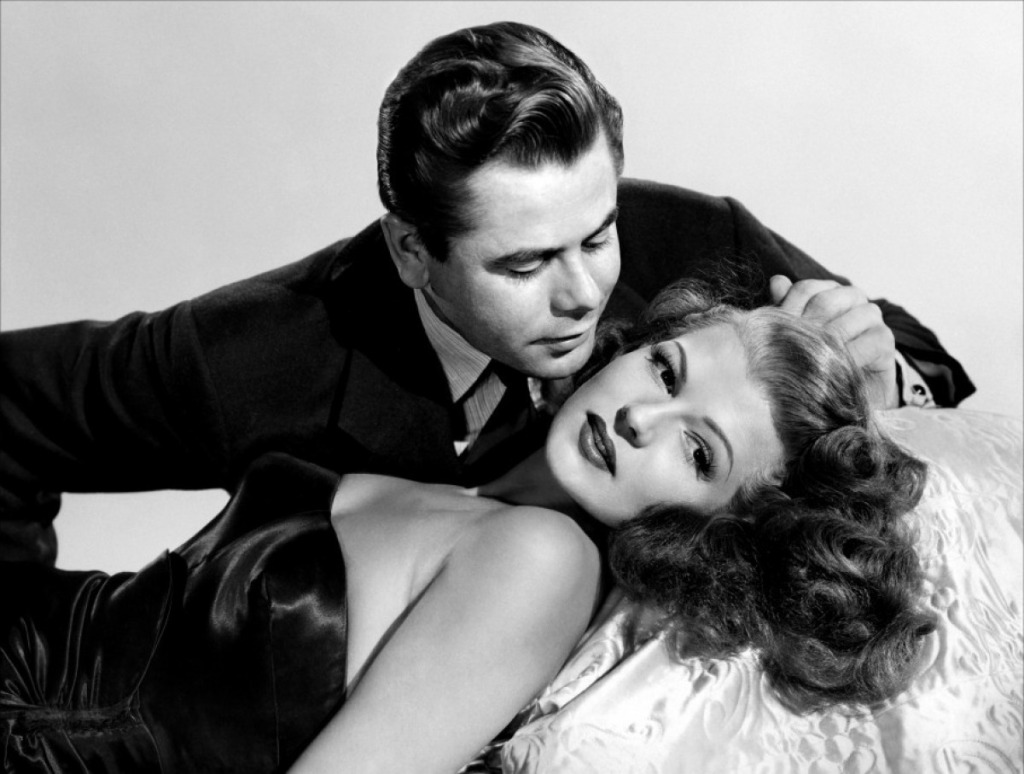
Rita Hayworth was a big singing and dancing star of musicals in the early 1940s, but the film that made her an international sex bomb (literally) wasn’t released until 1946: Gilda.
The plot, which echoes Casablanca in a number of respects, concerns a love triangle in a faraway land, in this case, Argentina. Johnny Farrell (Glenn Ford) is a cocky grifter who is on his uppers. He is saved from a mugging by a mysterious and rather menacing casino owner named Ballin Mundson (George Macready) whom he subsequently manages to talk into hiring him as an aide-de-camp. All is well for a time, though Johnny suspects that the casino is only a front for Mundson’s other, more shady, business. But before you can say cherchez la femme, their relationship changes for the worse when Mundson marries a sizzling beauty named Gilda (Hayworth), with whom Johnny has an unhappy history. Thus commences a love-hate-love relationship in which Johnny and Gilda torment each other while Ballin begins to suspect the truth about their former relationship. Meanwhile, both the police and Ballin’s criminal associates are closing in on his other lucrative but illegal line of work.
This is a star vehicle for Hayworth from the famous moment she first appears on screen with a sensual toss of her hair. She gets to sing and dance as well as act, most legendarily in her striptease style number “Put the Blame on Mame”. Countless American men (and no doubt some women) were sexually enthralled with her forever after.
I know too much about Hayworth to have such an uncomplicated reaction. I feel sorry for Margarita Cansino, the pudgy Hispanic girl and incest victim whom Hollywood turned — at the cost to her of physical and emotional pain — into Rita Hayworth. She never got to be who she really was and virtually every man in her life, starting with her father, exploited her. It’s a credit to her strength that despite understandable, significant emotional troubles she managed to always pull things together on screen throughout the 1940s and be a terrific movie star. Gilda is generally considered her finest hour, and with good reason.
Even though it’s Hayworth’s film, two other aspects of it are extremely compelling. The first is Glenn Ford. He’s kinetic on screen, a man always appraising every angle in search of some advantage. He also manages, despite not having classically handsome Hollywood-type features, to convey enough sexual attractiveness that Hayworth’s desire for him is entirely believable.
The other thing I adore about this movie is Rudolph Maté’s camerawork, which is completely arresting beginning with the opening, rising shot of those big rolling dice. I have praised him before for his work on Vampyr, but the tools of cinematography came a long way technically since that early film. And boy, does Maté take advantage. Perfect use of light and shadow, deep focus shots, close-ups at critical moments, it’s all here in the hands of a master. And thank you again UCLA Preservation team for this crystal clear, gorgeous restoration of the print.
The performances and the cinematography help make up for an uneven script, which may simply have had too many cooks. There are some lines to die for, and some sharp dialogue, but the plot structure of the last third is unnecessarily clunky in some respects and too pat in others. Still, Gilda is a very fine film noir that completely holds up almost 70 years later.
p.s. The conventional take on Bosley Crowther’s career as a NYT film reviewer is that he lost touch with modern tastes in the late 1960s (His repeated trashing of Bonnie and Clyde being the death-knell) after a long and distinguished career. But if you read his obtuse, inept review of Gilda twenty years earlier, you will see that he never really knew what he was talking about.
What the hell do you think spies are? Moral philosophers measuring everything they do against the word of God or Karl Marx? They’re not! They’re just a bunch of seedy, squalid bastards like me: little men, drunkards, queers, hen-pecked husbands, civil servants playing cowboys and Indians to brighten their rotten little lives.
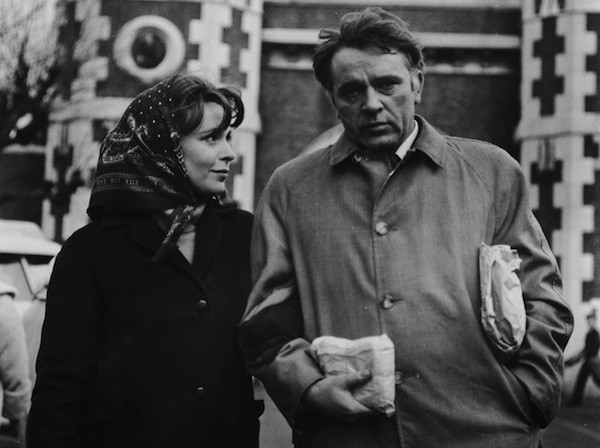
So says disillusioned British secret agent Alec Leamas (Richard Burton) in perhaps the best effort to adapt a John le Carré novel to the big screen: 1965’s The Spy Who Came in From the Cold. The serpentine plot concerns a burnt-out spook who enters a downward spiral of booze, self-hatred and lost faith after a disastrous mission in Berlin. But then it turns out that Leamas’ decline and despair is a ruse (?) play-acted at the behest of his superiors. As planned, he is recruited by the other side and ends up trying to discredit East German intelligence head Hans-Dieter Mundt (A cold, effective Peter van Eyck). Leamas undermines the ex-Nazi by feeding false (??) information to Mundt’s ambitious, Jewish deputy Fiedler (Oskar Werner, very strong here). It’s a difficult, high-risk mission, but Leamas knows that his boss back home is 100% behind him (???).
This may be the most magnificent performance in Richard Burton’s career, and will definitely please all fans of rotting charm. Drinking heavily in real life at the time, he was willing to expose his own capacity for ugliness and decay in a way that many glamorous stars of his era would not have dared to do. He exudes bone crunching hopelessness and isolation in shot after shot: Leamas alone on a park bench, alone in a bar, alone in his bed, alone chained in a cell. He’s devastated and devastating.
A 15 minute sequence of scenes in Britain is a masterclass in cinematic storytelling. It’s unsettling yet fascinating as Leamas repeatedly gets pissed and wanders through empty streets. Ultimately, he savagely beats an innocent man (Did the filmmakers cast for this part Bernard Lee — M from the flashy, unrealistic James Bond series — to make a point?). His copybook blotted, Leamas is judged “turnable” by the other side. After being released from jail, he is recruited by the Soviets in a sleazy men’s club by an unctuous businessman and a pathetic, gay procurer (Robert Hardy and Michael Hordern, respectively, terrific actors who clearly understood that there are no small roles).
The romantic aspects of the story also work well and become more important as le Carré’s ingenious plot unfolds. Claire Bloom is credible and sympathetic as the British would-be communist, who as Leamas puts it believes “in free love, the only kind I could afford at the time”. Leamas’ lacerating disdain for her naiveté reveals the depths of his own self-contempt: She may be immature in her politics but who after all is the one risking his life and doing horrible things in a struggle over the very same politics?
Rarely has the look of a movie more perfectly captured its mood, and that’s a credit to Oswald Morris. Without any conscious intention, I think I have recommended more films shot by Morris than any other cinematographer. He was a remarkably unpretentious professional who maintained an astonishingly consistent quality in his work for 6 decades (He lived to age 98). It was a bold and brilliant choice to make this movie in black and white, which let Oswald create a washed out look that matches the bleak tone of the story. As much as the excellent acting, what stays with the viewer are Oswald’s shots of complete desolation both during Leamas’ alcoholic, putatively free, British wanderings and his time in East German captivity.
The other delight of this film is that it never condescends to the audience by over-explaining. With each double and triple cross, rather than clumsy exposition, director Martin Ritt simply gives us Burton’s face, as the mind behind it struggles frantically to make sense of the latest shift in the icy wind. A small example of the film’s understated, even at times cryptic, storytelling style is the scene where Fiedler asks for some paperwork from his underling Peters (Sam Wanamaker, memorably creepy). The seated, lame, Wanamaker extends his hand but not far enough. Rather than step forward, Fiedler waits until Peters struggles to his feet and hands it to him. Leamas chuckles derisively. The subtext which the film expects you to understand: Fiedler is the boss but as a Jew, he will never be fully respected by his German underlings. A small moment, a sly moment, a powerful moment, brought across with no comment other than Leamas’ mad laughter at Peters’ expense.
Touches like that are a key reason why The Spy who Came in from the Cold is completely engrossing. Fans of espionage films simply cannot miss this landmark movie.
p.s. If you like this movie, you might enjoy two of my other recommendations. Though not as good as this film The Deadly Affair is a solid effort to adapt le Carré’s first novel to the big screen. And the astoundingly brilliant Tinker, Tailor, Soldier, Spy is the best effort to adapt le Carré to television.
Anthony Mann is justly revered by film buffs for his noir westerns with Jimmy Stewart, but he alo essayed more traditional urban noirs. One of the best is his 1947 low-budget triumph, Railroaded!.
The film opens with a high-voltage portrayal of a blown stickup, as some luckless bad guys fail to get away clean while robbing a gambling joint, despite having inside help. But the heart of the story comes after the opening fireworks, as the lead gunman (John Ireland) and his boozy floozy (Jane Randolph, who excelled in these kinds of roles) frame an innocent man (a sympathetic Ed Kelly) for the crime. A police detective (a pre-Leave it to Beaver Hugh Beaumont) at first isn’t convinced that the guy in the frame is innocent, but is persuaded to investigate by the attractive, goodly sister of the accused (Sheila Ryan). Action, suspense and romance ensue.
This film was made on Poverty Row, which churned out low-budget B-movies until its business underpinnings were destroyed by the Paramount Supreme Court Case, which I have written about before. The budgets of Poverty Row studios were too small and the films were shot too quickly to consistently achieve quality, but these studios were also a playground for talented people who went on to better opportunities later, including Anthony Mann. The Poverty Row studios were also more comfortable pushing the envelope with the censors, an example in Railroaded! is that when the slatternly Randolph and the saintly Ryan meet in this movie, they get into an extended brawl! (Nice touch by the way: They were dressed in inverted colors for the fight, Ryan all in sinful black, Randolph in angelic white).
Railroaded!, in addition to being an exciting story on its own terms, shows how creative filmmakers can overcome low budgets. They were smart enough to cast the tough and credible up-and-comer John Ireland when he was still a cheap date, just before his star was about to shine in Red River and All The King’s Men. The noir lighting and plenty of closeups keep the viewers from contemplating the cheap props and sets. And Mann’s brisk pace (the film is not much more than an hour long) stops anyone from thinking too hard about some of the less plausible aspects of a script, which would have benefited from one more rewrite to iron out some plot contrivances.
By the way, Hugh Beaumont isn’t the only person in this tough, dark crime movie who went on to inordinately wholesome TV stardom. Ellen Corby, who later became Grandma Walton, appears uncredited as Mrs. Wills.
In summary, this is a remarkably solid and entertaining movie given that its budget was probably around two bits. I believe the poverty row studio movies are in the public domain at this point, so I am posting Railroaded! right here for you to enjoy.








 All Good Movies