Categories
Drama Romance

Carnal Knowledge

The period between the war and the sexual revolution was disorienting for many American men and women, as prior standards of sexual behavior lost their hold without a clear sense emerging of what would become the norms of the future. In this terrain, Jules Feiffer scripted an unproduced play about the sexual development and relationships of two male college friends. Director Mike Nichols saw potential in the project to become a movie, and the result was 1971’s Carnal Knowledge.

Though sometimes billed as a comedy, the film is actually a melancholy drama and exploration of an era. The central characters are Jonathan (Jack Nicholson), who sees women as sexual objects and pursues them aggressively, and his diffident best friend Sandy (Art Garfunkel) who puts women on a pedestal from which they cannot escape. The film charts their sexual course in three acts running through the 1950s to the early 1970s (kudos to the makeup artists for aging the cast convincingly). The plot centers on the relationships they both have with a college student (Candice Bergen) and Jonathan’s subsequent romance with a gorgeous model who longs for a conventional marriage and home life (Ann-Margret).

The story’s origin as a play is well-exploited by Nichols, who keeps the cast small and the emotional tension high. There is an unreality in much of the staging and shots (such as the above) with only a few characters appearing in camera view at a time. The film also plays with the fourth wall, with characters seemingly giving speeches to the audience until it is subsequently revealed that they are talking to each other. Such theatricality can backfire in film, but in Nichol’s hands, it’s golden.

Nichols’ talent as a director is also evident in his getting first-rate performances from Art Garfunkel, Ann-Margret and Candice Bergen, none of whom is a first-rate actor. If I were king, I would love to see this precise story told again from the women characters’ point of view. The two female leads leave the audience wanting more and guessing so much about their motives as they — like many women of the era –try to navigate a sexually changing world where they are ostensibly freer yet somehow end up even more trapped by convention and male chauvinism than ever before.

Nichols has a penchant for making movies in which none of the main characters are likable. In Closer and the wildly overrated Who’s Afraid of Virginia Woolf? this made for excruciating cinema. But in Carnal Knowledge, Jonathan and Sandy — and even moreso the times that make them — are consistently intriguing despite never being entirely pleasant.

p.s. Look sharp for Rita Moreno making the most of her one scene in this movie.

Categories
Action/Adventure Romance

The Count of Monte Cristo

In the 1930s, film studios made a run of lavish historical costume dramas based on best-selling books (Some of them literary classics, others meretricious tripe). The majority were set in Europe and a few were even made there (including my recommendation The Scarlet Pimpernel). But most were produced on Hollywood back lots, such as MGM’s Tale of Two Cities, Warner Brothers’ Anthony Adverse, RKO’s The Hunchback of Notre Dame, and Selznick/United Artists’ Prisoner of Zenda (my recommendation here). Another classic of the form was made in 1934 by RKO: The Count of Monte Cristo.

Dumas’ thrilling tale of romance, revenge and redemption is catnip for filmmakers. It had been adapted to the silver screen several times before and has been filmed many times since (and referenced in other films as well). But the 1934 version is arguably the best of the bunch and certainly holds up very well today.

The key presence is British actor Robert Donat, who made his only trip to Hollywood to make this movie (he did not care for it, returning soon after to spend the rest of his life in England). As the Count (nee Edmund Dantes), he’s dashing, eloquent, passionate and also manages to make the credibility-stretching aspects of the plot believable. His lady love is played winningly by Elissa Landi, who like Donat is so agreeable to the eyes that it’s easy to miss her acting talent. The two performers bring across their aching romance as much through non-verbal gestures and anguished looks as with dialogue, reminding us that this was the era in which most actors were used to working without sound (The previous adaptations of this story in fact were all silent movies). Watching Donat and Landi today exerts an extra tug on the heart because modern viewers will know that both of them died young, given them a tragic air that makes them even more romantic as couple.

As was the norm for these affairs, the studio spared no expense on set designs, costumes and props, producing a spectacle that must have given Depression Era audiences some wonderful moments of escape. The sumptuous scene in which the Count throws a ball as part of his plan to avenge himself on those who betrayed him is a particularly memorable “film in a film” sequence. The cast at the ball gawps as elaborate tableau after tableau is revealed on a grand stage, and the movie audience gawps at them gawping. It’s a visual feast.

Director Rowland Lee had a touch for this sort of material and brought out the best in the talented cast. There isn’t a bad performance in the movie, and there are several powerful ones. The result is pure escapist entertainment of the first order.

p.s. If you like Robert Donat in this movie, you will probably also enjoy his performance in another of my recommendations, The 39 Steps.

Categories
Comedy Drama

Everything Must Go

Raymond Carver penned a bleak, oblique, short story about an alcoholic husband whose possessions are scattered all over his front lawn, which leads passersby to assume mistakenly that he is conducting a yard sale. First time writer/director Dan Rush spun this unusual premise into a more extended story and turned it into a fine independent movie that too few people noticed: Everything Must Go.

The plot: The life of salesman Nick Halsey (Will Ferrell) is collapsing around him. His drunken misbehavior on a business trip leads to him being sued and fired. Returning home, he finds that his long-suffering wife has left him, locking him out of the house and having all his possessions dumped onto the front lawn on her way out. With his credit cards cancelled and his bank account locked, Nick only has the cash in his pocket, which he spends on cases of beer. He settles into his recliner and begins living amidst the wreckage on his front lawn, gulping Pabst Blue Ribbon, watching his neighbors, and interacting with a series of visitors to his new home.

Among the best moments in this film is one that could have been a disaster. A bike-riding teenage African-American boy (Christopher C.J. Wallace) engages with Nick beginning about 15 minutes in. When this scene started, I cringed thinking “Oh no, not another soulful, wise, Black character who helps a lost Caucasian protagonist find meaning again”. But Rush is too talented a writer to fall into that cliché. Instead we get a well-rounded, well-acted Black character named Kenny Loftus, a mass of undirected talent and low self-confidence whose weaknesses and strengths interlock perfectly with Nick’s.

Nick’s relationship with Kenny and with a pregnant, perhaps abandoned woman who is moving in across the street (Rebecca Hall) are the emotional heart of the movie, supplemented by Nick’s interactions with his AA sponsor (Michael Peña) and encounter with a woman he knew in high school (Laura Dern). With so much focus on the central character’s relationships and not much action in the story, this film lives or dies with Ferrell, and he rings true every time. Of course he is funny at the funny moments, but his vulnerability in the story’s painful moments is also achingly well-done. He turns Nick into a character that the audience roots for not because he will ever be a superhero, but because we just don’t want such a good-hearted but flawed human being to go on destroying himself.

The film’s second half has some structural flaws. A number of movies employ plot symmetry in which a character’s evolution is illustrated by having a series of encounters from the first half of the movie replayed in altered form in the second half. Sometimes this works (e.g., A Clockwork Orange), but here it feels forced, particularly Nick’s encounter near the end of the film with the boss who fired him in the first scene. Rush also gives in a bit too much to sentimentality in how he wraps up some of the relationships in the movie.

But the originality of the premise, the honest moments and the strong performances make Everything Must Go a promising debut for writer/director Dan Rush. I hope we see more from him.

I also hope we will see more dramatic performances from Will Ferrell. One of the foundational injustices of how people judge movies is the widespread lack of appreciation that giving a good comic performance is as hard or harder as giving a good dramatic performance. When a comedic actor crosses over to a dramatic role and does well at it, most people say “I didn’t realize s/he could act” when they should say “Maybe being a comic actor takes more acting ability than I realize”. Will Ferrell, like Robin Williams, Carol Burnett, Eddie Murphy, Bill Murray et al. have been good actors all along, we just don’t seem to notice it when we are laughing so hard.

Categories
Action/Adventure Drama

Thief

The decade of the 1970s in American film witnessed the continuation of the auteur-driven creative revival that began in the late 1960s (see my recommendations The Kid Stays in the Picture and Bonnie and Clyde for details) as well as the beginning of the blockbuster era led by Jaws, Star Wars et al. But with the dawn of the 1980s, a new genre of slick, cool, cinematic products emerged in the theaters and on television. I regard Michael Mann’s gripping 1981 crime drama Thief as the first movie of this new era.

The plot focuses on an emotionally-walled off master thief named Frank (none of the characters in the film have last names). After 11 years in prison, Frank returns to his craft and starts to hope for a real life built around an equally damaged woman he fancies (Tuesday Weld) and the forthcoming return of his mentor from the joint (Willie Nelson). But with attachments and possessions come vulnerability, and Frank’s is exploited by a ruthless mobster (Robert Prosky) and corrupt cops who wants to profit from his scores. Frank is pushed to his emotional limit even as he plans the biggest heist of his life, which he dreams will let him start anew.

Made just a few years before his as-1980s-as-it-gets hit TV show Miami Vice, Thief highlights writer-director Michael Mann’s signature style, which blends some old time film noir themes with modern flashy camerawork, pulsating music, gritty performances, and attention to realistic details (real-life criminals were hired to consult on the film). There were many slick but stupid films in the 1980s, but Mann consistently managed to to make style serve substance rather than substitute for it. Thief is Mann’s best work in my view, though some of his fans would stump for Heat, which I consider excellent but not quite as tightly constructed or compelling as Thief.

Putting aside a miscast Jim Belushi, the performers are all strong here, with Caan turning in what he correctly called the best work of his career. His extended scene with Weld in which he explains how prison affected him is flawless in its writing and acting, and draws the viewer into Frank’s emotional world rather than keeping us at a distance as did too many films of this era.

This is also a terrific Chicago film. It’s not just the iconic and prosaic Chicago locations employed, but also the way the actors deliver their lines in Windy City-ese. Last but certainly not least, Tangerine Dream’s score is quite memorable, and is well supplemented by Craig Safan’s closing music that riffs on Pink Floyd’s Comfortably Numb, which not incidentally is the state this film ultimately leaves its heroes.

p.s. Look fast for Dennis Farina as one of Prosky’s gunmen.

Categories
Action/Adventure British Mystery/Noir

The Adventures of Sherlock Holmes

Beginning with a Mutoscope adaptation made in 1900, Sherlock Holmes has been one of the most oft-portrayed roles in world cinema. Among the most handsome of the countless movie productions featuring the world’s greatest consulting detective were made by 20th Century Fox in 1939. The first of these was the excellent Hound of the Baskervilles and the second is the even better The Adventures of Sherlock Holmes.

The plot of the film owes little to any of Arthur Conan Doyle’s classic stories, and indeed is one that had been used many times before and still gets a workout in movies today: A brilliant champion of justice matches wits with an equally gifted master criminal who has announced that he will soon commit “the crime of century”. But when the hero is Sherlock Holmes played by Basil Rathbone in his signature role and the villain is Professor Moriarty played with comparable verve by George Zucco, everything old is first-rate entertainment again.

As Zucco and Rathbone circle each other in their battle of wits, two supporting players bring added energy to the proceedings. Many Holmes fans do not care for Nigel Bruce’s comic take on Dr. Watson, as it goes against his portrayal in the canon. But I am with those who find it endearing, in part because it adds some sweetness to the films that sets off Rathbone’s appropriately rationalistic and at times even cold Sherlock. As the woman around whom much of the mystery centers, a then unknown Ida Lupino also strengthens the film by giving the audience vulnerability leavened with strength and intelligence (Lupino would go on to become a pivotal figure in women’s advance in Hollywood, as I describe here).

Fox rolled out the budget for its Holmes films, which shows in the excellent production values throughout. These are enhanced by the legendary Leon Shamroy’s cinematography, which has effective film noir/horror overtones. Last but not least, this is the one and only film in which I can honestly compliment Alfred Werker’s direction (I recommended He Walked by Night previously, but recall that despite the credit going to Werker, that film was mostly directed by a true master, Anthony Mann). If every journeyman director has one great film in him, this well-paced, exciting and suspenseful treat is Alfred Werker’s.

p.s. Even though both of Fox’s 1939 Sherlock Holmes films were excellent, they were not critically well-received at the time and also led to some grousing from Doyle’s descendants, who controlled the rights to his stories. After promising to make this a long-running series, Fox abandoned the enterprise after the Adventures of Sherlock Holmes. However, a new series of lower-budget Rathbone-Bruce Holmes movies set in the modern era was launched at Universal immediately thereafter. That turned out to be one of Hollywood’s very best film series. If you want to explore those films, I recommend my favorite of them, The Scarlet Claw.

Categories
Horror/Suspense Mystery/Noir

The Little Girl Who Lives Down the Lane

Hollywood superstar Jodie Foster had a remarkable 1976, with five movies hitting the theaters. They showcased her talent and poise — both startling for an actress who has just become a teenager — and also the tendency of 1970s cinema to lionize teenage liberation while at the same time exploiting it through sexualization. Foster’s Oscar-nominated turn as a child prostitute in Taxi Driver is the best known example, and the same themes are present in an effective low-budget shocker that was released the same year: The Little Girl Who Lives Down the Lane.

Appropriate to its mood, the movie opens with its central character, Rynn Jacobs (Foster) walking on a deserted beach. As the film progresses, we learn that Rynn’s independence and isolation are in some mysterious way connected to her poet father, who purchased them a house together in a small town but has never been seen by the locals. Rynn manages the finances, cooks her own food, sets her own schedule and makes her own way in the world.

What could possibly impinge on her freedom? Horrible adults of course. Most particularly the vile local family of influence, led by a frosty, bigoted WASP named Mrs. Hallet who has the town and her pedophile son Frank under her thumb (Alexis Smith and Martin Sheen, both credibly menacing). The only kindness available to Rynn comes from the Italian immigrants that the Hallets despise, specifically a creative, polio-stricken, local lad who falls in love with her (Scott Jacoby) and a friendly police officer who tries to shield her from harm (well-played by famous songwriter Mort Shuman!).

This movie works well on two levels. First, it’s a character study exploring the tension between children’s desire to be independent and adults’ desire to control and/or protect them. Foster’s emerging greatness is a major asset here, particularly as she holds her own in her scenes with seasoned adult actors. Second, this is a suspenseful tale in the mystery/horror vein, both because of Sheen’s unnerving performance and the enticing nature of the film’s central riddle: Where is Rynn’s father, and for that matter her mother? The resolution to Laird Koenig’s macabre story is easy to guess wrong, which only makes the film more engrossing.

The small budget of this Canadian film shows, both in the limited number of sets (which makes one think incorrectly that it is an adaptation of a play rather than a novel), the by-the-numbers production and camerawork, and the cheap wig on Foster’s head. But that doesn’t stop the Little Girl Who Lives Down The Lane from holding viewers’ interest and the edge of their seat as well.

p.s. There was some controversy about young Foster allegedly appearing nude in this movie, and that brief scene was cut by censors in some countries. However, as in her character’s sexual scenes in Taxi Driver, Foster’s older sister body doubled her for the shot.

Categories
Comedy Romance

The Mating Season

If I told you I was going to recommend a funny 1951 movie about class differences, you would naturally expect something British. But The Mating Season shows that post-war Americans too could also mine the comic possibilities of people from different economic strata rubbing shoulders.

The plot of this mistitled little gem: Ellen McNulty (Thelma Ritter) is a widow whose hamburger stand has gone bankrupt. She embarks on a long journey to visit her son Val, whom she and her hardworking husband were able to put through college. Val is a low level white collar manager (John Lund) trying to impress the big boss so that he can get ahead. After Val meets cute with the ravishing Maggie Carleton (Gene Tierney), daughter of a wealthy ambassador, the two fall in love and a wedding is quickly arranged, coincidentally on the day that Ellen is to arrive. Before you can say “screwball comedy” the young bride mistakes her dowdy, working class new mother-in-law for a maid, and the mother decides to play along, moving in to the new couple’s apartment!

This is a film about how working class people can be both proud of their origins yet ashamed of them at the same time, particularly as conveyed through Lund’s character. Val both loves his mother and is embarrassed of her (His chemistry with Ritter is so natural it’s hard to believe they weren’t actually mother and son). Similarly, he both despises his rich, crummy boss yet also can’t resist the impulse to tug his forelock in front of him.

The movie is also wise about how wealth makes some people generous and turns others into snobs. I don’t know if it was in the filmmaker’s minds or not, but it’s also intriguing to watch in terms of gender roles: Even though Val has little money and Maggie is rich, they both assume he will be the sole provider and the couple end up in debt as a result.

But despite all that, this isn’t A Place in the Sun; the film’s accent is on laughs rather than dark drama and The Mating Season is delightful on those terms. Miriam Hopkins is hilariously over-dramatic as Tierney’s pampered and entitled mother, and Ritter, as she showed in so many other films (including my recommendation Pickup on South Street), can deliver a wisecrack out of the side of her mouth with the best of them. She was so good at being a character actor that Hollywood didn’t seem able to see her in any other light: Despite being the star here, she was nominated for a Best Supporting Actress Oscar.

Roger Ebert used to point out how few Hollywood films take work and household budgets seriously. In the movies, single mom cocktail waitresses have huge apartments in Manhattan, architects are obligated only to look at a drafting board in their den in the evening rather than go into an office, and no one is ever shown paying their electric bill or doing their taxes. The Mating Season is a welcome exception to this rule, as Ellen works out how to deal with her failing hamburger stand, hitchhikes to save on travel expenses, scrambles for the money to pay her bills (including having to work for two days as an office temp for “Mr. Pinchbottom”), finds affordable-but-tatty lodgings and otherwise scrimps and saves. Throughout Ellen’s struggles, the film appropriately portrays as noble her and her husband’s ability to have afforded college for their son despite their modest means, rather than being condescending toward the aspirations that millions of post-war working class Americans shared.

Director Mitchell Leisen was not a consistently strong artist, but he was good enough when, as here, he had a strong script from which to work. The Mating Season’s is by Walter Reisch, Richard Breen and Charles Brackett (Billy Wilder’s frequent collaborator). In addition to some memorable zingers, the trio’s script also has some funny 1950s style sexual innuendo. This team went on to win an Academy Award for screenwriting together two years later for Titanic, but they could just as deservedly won for The Mating Season.

The Mating Season is American in style, but stands shoulder to shoulder with all the Ealing Studio comedies that alternated between having the audience laugh about class differences and nod their heads in recognition of the truths we so often don’t openly discuss.

Categories
Action/Adventure

Purgatory **With Star Interview **

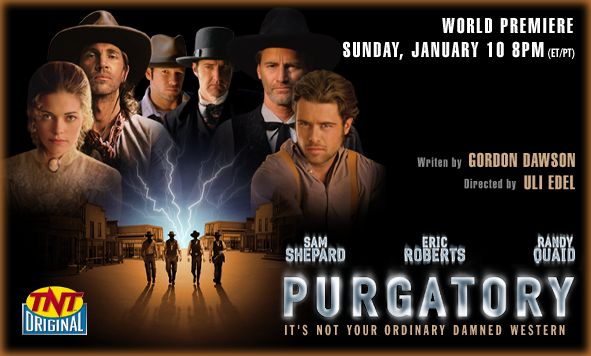
1 purgatoryOne of the happy outcomes of the cable television revolution was that more stations were competing to brand themselves with audiences, and one method some of them chose was to start making their own films. The budgets were not as large as what Hollywood might provide, but the results were often more original. Such is the case with Uli Edel’s unconventional western Purgatory, which debuted in 1999 on Turner Network Television and has attracted a growing base of fans ever since.

Purgatory opens as a classic oater, with glorious vistas, exciting gunfights, noble sheriffs and vicious outlaws. But then the film takes an entirely novel, Twilight Zone-eque turn as a group of bank robbers gets lost in a sandstorm and arrives in the strangely peaceful town of Refuge, where a sheriff who doesn’t even carry a gun (Sam Shepard) unhesitatingly welcomes them to stay. The town has a saloon that no one enters, a church that every single resident attends every day, and some strangely familiar-looking locals, all of whom are watched over by a wizened Native American medicine man. I am not going to tell you more than that for two reasons. First, I don’t want to spoil this fine film for you and second, I need the space for a special treat: An interview with the star.

BradBrad Rowe is the emotional center of the film as “Sonny” the one member of the pack of snarling bad guys who is a decent, vulnerable human being to whom the audience can relate. Brad has since gone on to become an expert in drug and crime policy, working with Mark Kleiman’s BOTEC consulting firm. I am grateful for him for taking the time to talk about Purgatory.

Brad, you’ve been in many movies and television shows, but say that this film was probably the most fun you ever had as an actor. What was so enjoyable about it?

First of all I was a very young actor and had hardly been around the block. Uli Edel was kind enough to have me come in to read for one of the lead roles in a project that already had Sam Shepard, Eric Roberts and Randy Quaid attached. After getting the role, when I arrived for the cast read through, my eyes were as big as saucers. These guys were legends to me and it was really endearing that they all took me under their collective wing. And then we got to the work of training, which included riding professional stunt horses, learning how to quick draw guns, staging screen fist fights and perfecting our cowboy swagger in period clothes. Lots of down time too where the other actors and crew would share fun stories about the countless projects and people they had experienced over the decades. I was in heaven. There was something magical to the story telling as well. Gordon Dawson had written a solid screenplay and TNT was really invested in making that story come to life. I think we all knew we were working on something special. As it turned out the project was well produced and promoted, so it found an audience. It wasn’t until I had been around for a while that I truly appreciated how many wonderful professionals had come together for a few months to make some movie magic. And of course the genre of the Western has become more of a scarcity recently so that time holds a bit of additional nostalgia for me.

I could imagine an actor first reading Dawson’s script and thinking This strange plot may just not work for an audience expecting a traditional western”. Did you have that worry or did the story hook you right away?

I personally didn’t have any reservations. It felt like the super-western with a cast of characters that spanned the storied history of the wild west. The supernatural twist was an essential tool for exposing everyone in the story’s true character — warts and all in some cases. What resonated for me was how close that character was to me at that point in my life. I was new to Hollywood and eager to learn and in many cases found myself swimming with sharks. Sonny was doing his best throughout the story to stay true to his values but finding mentors who shared the same compass was nearly impossible.

Do you think of Purgatory as a religious film?

I do. There are both themes of spiritual redemption and rigid religious observance. Churchgoing is a central to community life in Refuge and it is the place where individuals who have lived characteristically sinful lives get a shot at redemption through faithful observance of a very strict protocol. It is the adherence to that difficult path that causes the biggest challenge for several of the main characters. Forgiveness, selflessness, and sacrifice all play heavy in the story as well. I don’t want to make the movie seem overtly fire and brimstone but it hits the audience pretty squarely. Thankfully Purgatory is the uplifting kind of spiritual journey though.

ShepardLarger than life” is an overused phrase, but it applies to the playwright-actor-director Sam Shepard. What is he like in person?

Categories
Horror/Suspense

Trilogy of Terror – Amelia

“Doll horror” is almost its own cinematic sub-genre. Villains like the murderous clown doll in Poltergeist, the knife-wielding Chucky, and the ventriloquist’s dummy in Dead of Night, all scared the pants off of audiences. Let me recommend another triumph of the subgenre: The Amelia segment of the 1975 movie Trilogy of Terror.

Trilogy of Terror was an entry in a high-quality ABC Movie of the Week series. The series was a playground for rising directors and future stars as well as a chance for some old pros to enjoy a last hurrah. I have recommended multiple films from this series of made for television films: Seven in Darkness, Night Slaves, and The Screaming Woman. But Trilogy of Terror is better remembered than any of those films, probably because of the nightmares a generation of Americans experienced about “that doll”.

The movie comprises three distinct stories, all starring Karen Black. The first two are about as good as any average-quality episode of Night Gallery, Twilight Zone or Outer Limits, i.e., serviceable but unremarkable entertainment. But the third, titled Amelia, is a grab-you-by-the-throat masterpiece. The plot is simple: A young woman has purchased a Zuni hunting fetish which is alleged to contain the spirit of a savage warrior who will be contained as long as the gold chain around the doll is never removed. Guess what happens!

Karen Black’s acting gifts are essential to making this segment of the trilogy work. In a single phone call to her mother, she reveals Amelia to be a woman who has trouble asserting herself, is easily bullied and wants to avoid confrontations. Black’s establishment of her character makes what happens next more emotionally intense. Black also does an excellent job selling the physical confrontations with her foe, which very easily could have been too campy to be scary.

The segment was made by horror masters Dan Curtis and Richard Matheson, many of whose works I have recommended (e.g., Dracula). As a director-writer team they were consistently creative yet simple in their artistic goals: They aspired only to scare and entertain people, and they were very good at it. Amelia also benefits enormously from creative camerawork by Paul Lohmann and terrific editing by Les Green, which never lets the audience catch its breath.

Amelia is 16 minutes of tension and a bloody scary good time. I embed this minor classic of the horror genre below for you to enjoy.

Categories
British Horror/Suspense

Night of the Eagle

Fritz Leiber Jr. was a talented fantasy, science fiction and horror writer who is mainly remembered for the Fafhrd and the Gray Mouser books, which surprisingly have never been adapted for the cinema. In contrast, Leiber’s Conjure Wife has served as the basis of multiple movies, including the fine 1962 film Night of the Eagle (later re-titled Burn Witch Burn).

Peter Wyngarde stars as a hard-headed college professor who thinks that the supernatural is bunk. Imagine his surprise when he discovers that his wife (Janet Blair) has been a practicing witch for years, and claims that her magic has been advancing his career and protecting the couple’s well-being! He makes her promise to abandon her childish hobby, and almost immediately regrets it when a series of horrifying happenings befall the two of them. Could witchcraft be real, and is another witch in the college community out to get them?

The script is by two masters of economical, intelligent, unpretentious horror: Richard Matheson (who also wrote my recommended film Amelia) and Charles Beaumont (who also penned my recommendations The Intruder and Masque of the Red Death). They pace the plot and the scares professionally, and slyly weave a feminist subtext into the proceedings.

I have to admit that I can’t name another movie of director Sidney Hayers, but his low profile wasn’t due to lack of talent. He keeps things suspenseful and crisp, gets solid performances from all the actors and brings in the good-for-the-time special effects at just the right moments. The pleasing result recalls Roger Corman’s many solid low budget horror films, such as those he adapted from Edgar Allen Poe stories (including my recommended film Tales of Terror). Not surprisingly, Night of the Eagle was released by Anglo-Amalgamated, the British partner of Corman’s company AIP.

This suspenseful sleeper is available to watch for free at the Internet Archive, just click here. As a taster, I embed the trailer below.

p.s. This film would make a fine double feature with an ever better film based on the same themes: Curse of the Demon. My recommendation of that film is here.