Categories
Drama Foreign Language Horror/Suspense

Onibaba


When movie aficionados think of Japan, their minds typically turn to Akira Kurosawa. That’s understandable, as one could make a plausible case for him being the best director in the history of cinema. But Kurosawa is far from the only brilliant filmmaker to hail from the Land of the Rising Sun. Another is writer-director Kaneto Shindô, the creative force behind Onibaba.

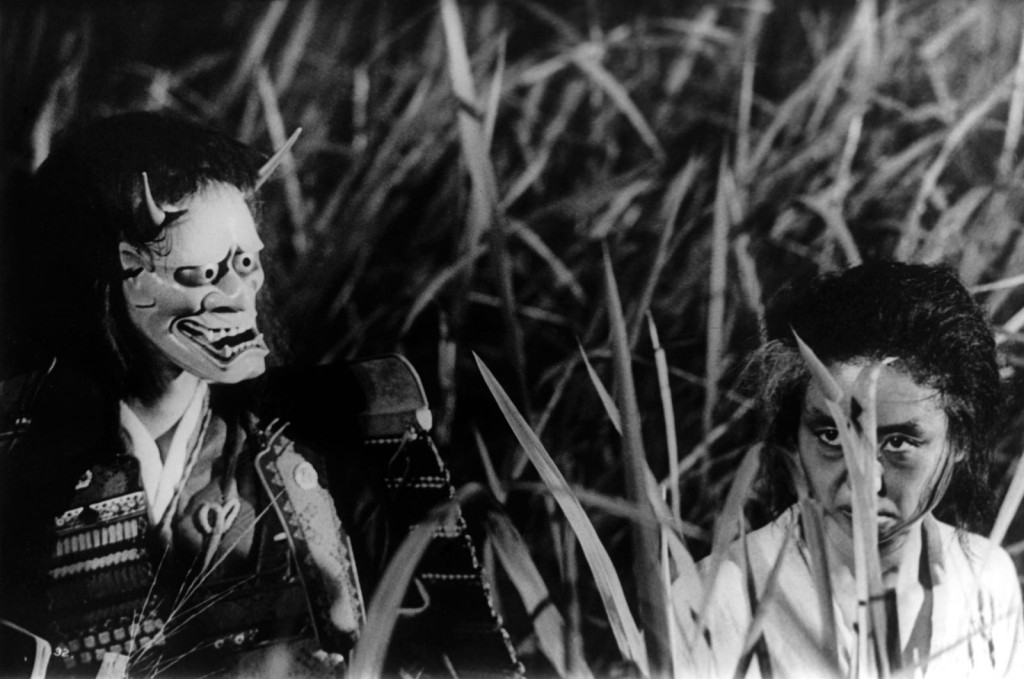
Shot in lustrous black and white under demanding conditions in 1964, Onibaba is a primal, sensual and eerie story of human beings struggling to survive. Emphasizing the mythological nature of the tale and its universal themes, the two central characters do not even have names. The older woman and her young daughter-in-law eke out a living in a swamp by murdering unfortunate soldiers who are lost or are fleeing the battles that rage across 14th century Japan. Strong, complex women characters were one of Shindô’s hallmarks, and he chose brilliant actors here to essay the roles: Nobuko Otowa (his real-life wife) and Jitsuko Yoshimura.

Onibaba (1964) | The Criterion CollectionInto this small, brutal world eventually comes a disruptive force, an ex-soldier played by Kei Satô who informs the women that the link between them is gone: the older woman’s son is dead and the younger woman is therefore now a widow. The ex-soldier moves into the swamp, while keeping a lustful eye on the young woman, whose own uncontrollable sexual yearnings are memorably dramatized by her racing through the tall, undulating susuki grass (truly, the grass forest is the film’s fourth character). The older woman is consumed both by her own sexual frustration and her fear that the young woman will leave her, ending the bloody partnership that allows her to survive. So she concocts an unusual scheme to disrupt the relationship, which backfires as the movie takes a supernatural turn that will resonate with those viewers who are familiar with Buddhist folklore.

myReviewer.com - Review for Onibaba (Masters of Cinema)This is a raw film about how human beings’ animal nature emerges under harsh conditions. On display are unbridled lust, jealousy, greed and violence. Even the way the characters eat suggests animality. Hikaru Hayashi’s one-in-a-million score, a mix of Taiko, jazz and ghostly notes from wind instruments, is the perfect marriage of music with celluloid. Kudos are also in order for cinematographer Kiyomi Kuroda for achieving technical brilliance on a hot, rainy and swampy set (It was so brutal that Shindô allegedly refused to pay the rebellious crew unless they finished the shoot). Like Saed Nikzat, Kuroda has the confidence to hold a still long shot and let the audience experience the environment and characters rather than forcibly directing our attention by moving from one quick cut to another. This is especially effective in his hypnotic, sensual images of the ever-swaying susuki grass forest.

Although the film is perhaps 10 minutes too long, Onibaba is completely original and fascinating. It’s also rather unsettling in the best artistic sense of that word. To fully enjoy this classic of Japanese cinema, try to get your hands on the gorgeous Criterion Collection re-issue.
Categories
Drama Foreign Language

A Time for Drunken Horses

A Time For Drunken Horses review | GamesRadar+

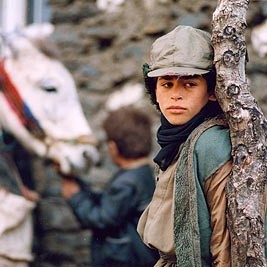
I remember the Kurdish area on the Iran/Iraq border as a land of stunning beauty and inordinate risk. No movie captures both realities better than A Time for Drunken Horses. Made by then-unknown Iranian director Bahman Ghobadi in 2000, it’s the first widely-released film in the Kurdish language, one of many virtues that help it bring alive this part of the world in an authentic way.

The Kurdish villagers (most of whom Ghobadi had play themselves on screen) eke out an existence by smuggling goods back and forth across the snowy, mountainous border. In addition to avoiding border guards who mete out lethal summary punishments, the smugglers must also scramble to evade armed bandits who raid their caravans. Crushing poverty is the lot even of those smugglers who succeed, but they are too economically desperate to abandon their dangerous business. The film’s plot centers on an orphaned family led by a heroic 12-year old boy named Ayoub. He provides for his siblings by smuggling, but his profits are too small to save his deformed, pained, and ill brother Medi. Though an operation will only extend rather than save Medi’s life, Ayoub takes on increasingly dangerous work out of love for his sickly brother.

This is an achingly sad film that tells a painful story in an unsparing fashion (Analogies to Vittorio De Sica’s Bicycle Thieves are inevitable and accurate). But it’s watchable because of the astonishing performances of the young actors and the inspirational courage and love of the family upon whom the story centers. As a director, Ghobadi is wise enough to never descend into mawkishness or to idealize the moral character of the poor, some of whom are portrayed here as greedy and conniving. Nor does he make the mistake of some films of this sort by lecturing the audience (e.g., by having some character deliver an earnest speech about the callousness of wealthy Westerners). Rather, he lets the audience feel their own emotions and draw their own conclusions about the characters’ bleak lives.

The Film Sufi: "A Time for Drunken Horses" - Bahman Ghobadi (2000)

Saed Nikzat’s cinematography captures the harsh gorgeousness of the region. Nitzat also, wonderfully, lets the camera linger in extended shots so that viewers can immerse themselves in the events portrayed rather than have their attention jerked around by constant jump cuts and close ups. The camerawork makes watching this film at times feels like a melancholy form of meditation.

A Time for Drunken Horses is a powerful piece of cinematic art that deservedly raised the profile of Iranian film worldwide. It will not make you happy, but it will stay with you in a way that is precious beyond words.

Categories
Drama

The Intruder

It is pretty hard to imagine a Hollywood Producer sitting in a meeting in 1962 and saying “I want a daring and powerful film about racism in the civil rights era…get Roger Corman and Bill Shatner on the phone pronto!”. Yet the B-Movie king and television’s most beloved overactor did indeed make such a movie, and The Intruder still packs a punch today. .

The story opens with an angelic-looking charmer (Shatner) named Adam Cramer arriving at a small Southern town for the purpose of “social work”. He is boyish and innocent-seeming at first, but it quickly becomes apparent that he is a member of a John Birch-type society and intends to stir up racial animosity concurrent with the arrival of school integration. He preys on weakness in all its forms and foments hatred and violence which spins out of control. Disgusted by Cramer, a fence-sitting newspaper editor (Frank Maxwell) has an attack of conscience and moves to side decisively with integration, at horrible cost to himself and his family.

Maybe because it was his first movie leading role or because Corman kept him under control, Shatner is unusually restrained here and it really works well for him. Then young and handsome, he is particularly effective at portraying seductive yet smarmy sexuality. Most of the extras and small roles were people of the town in which the crew filmed and were eventually chased out of because of the dirty laundry the movie was airing. Charles Barnes as the high school senior leading the first Black students into the previously segregated school movingly conveys strength, dignity and sadness all at once. This was a role from the heart for him as the prior year he had actually done the same thing in real life.

Although The Intruder can be experienced as a film about racism, it can be even better appreciated as a mesmerizing character study. Adam Cramer is a blend of the calm salesman and someone desperate to obtain, a bully and a weakling, an Adonis who is deeply ugly. The development of this strange yet realistic character is the best thing about Charles Beaumont’s script. For someone with a tragically short life, Beaumont had significant artistic impact, including co-creating The Twilight Zone with Rod Serling and going on with Corman and much of the cast here to make the first adaptation of H.P. Lovecraft’s work for the big screen (The above-average horror film, The Haunted Palace).

Corman was known for making cheap, unpretentious grindhouse films about motorcycles, monsters and mayhem (Including Edgar Allen Poe adaptations I recommend here and here). He also, famously, never lost money on a movie. Until The Intruder that is, which was denied bookings in much of The South and in other parts of the country where the film was considered too controversial. It was re-titled multiple times to try to get it into theaters (as “Shame” and later with the cringe worthy exploitation title “I Hate Your Guts!”), but with minimal success. As the film’s reputation grew and it was the subject of some documentaries and festivals, it finally broke even four decades after its release.

The only thing I didn’t love about The Intruder was the climax, which though still downbeat comes out a bit happier than I expect it would have in real life. But if Corman had gone for complete realism his film would never have been released at all. This was daring stuff for its time, and both for its themes and character development The Intruder remains an impressive piece of cinema over 50 years later.

The Intruder is in the public domain and you will be able to find it online pretty easily. It took only the first six minutes for me to be completely hooked.  After you have watched it, you might enjoy this short film about the making of the movie (spoilers).

Categories
Action/Adventure Comedy Mystery/Noir

And Then There Were None


Agatha’s Christie’s tale of 10 strangers on a remote island who are mysteriously killed off one by one has been adapted countless times on stage, on television and on the big screen. But it will be hard to ever top the 1945 version that was the highlight of the otherwise forgettable English-language phase of French film director Rene Clair’s career: And Then There Were None.

The story opens with a wonderful extended non-verbal sequence in which a group of disparate people eye each other curiously on a rowboat that is making its way to a lonely island. They soon discover that they have been invited for a weekend trip from which they are not expected to return. The owner of the mansion in which they are staying had pledged to kill them all as vengeance for their past misdeeds. Who is the killer, and is he — or she — actually one of the guests?

Christie’s story is contrived beyond belief but is so much fun twist by twist that audiences have never cared. The mordant wit is a particular plus throughout, and keeps the audience smiling even as the bodies pile up. The film version uses the more upbeat ending from the stage version rather than the tenebrous wrap up from the book, which was probably a good decision given the wartime audience.

Clair turns in near-Hitchcock level direction in the comedy-romance-suspense vein, and the cast is roses. Barry Fitzgerald and Walter Huston sparkle as the leads, Judith Anderson is brilliant as always as one of the guest/victim/suspects, C. Aubrey Smith offers an agreeably demented take on his Commander McBragg routine, and Roland Young (who was hilarious in my friend Jean O’Reilly’s recommendation of Ruggles of Red Gap) is a hoot as a private detective whose brain works at half speed.

Last but not least among its virtues, this film appeals to a broad age range of audience. I know myself because I watched it twice with a gap of 30 years in between and loved it both times.

And Then There Were None is in the public domain so I embed it here for your viewing pleasure.

Categories
Documentaries and Books

Hollywood Enigma: Dana Andrews

I take a break from recommending movies in favor of recommending the next best thing: A book about the movies! I have always found Dana Andrews intriguing because he was such a towering star in the 1940s, anchoring films of superlative quality that were also wildly popular with audiences, including A Walk in the Sun, Laura and of course The Best Years of Our Lives. But beginning in the 1950s his career dissipated very rapidly and few people today even remember his name. What happened to this talented and toothsome actor, who seemed poised to dominate the screen for decades as did similar performers such as Henry Fonda and Gregory Peck?

That’s one of the central questions addressed by Carl Rollyson’s fine recent biography Hollywood Enigma: Dana Andrews. Nothing else written about Andrews over the years pulls together so many sources of information so skillfully, making this likely the definitive biography of the man for all time. Crucially, Rollyson obtained the support of Andrews’ family and with it access to home movies, letters and anecdotes that get beneath the glossy images that the Hollywood publicity machine creates for its stars.

Rollyson makes clear that Andrews’ path to Hollywood was neither certain nor easy. Dana’s domineering, colorful father was a Baptist preacher in Texas and money was at times tight in the large Andrews clan. Dana and his siblings worked at odd jobs to keep the family afloat, and even as he was later getting a foothold in Southern California theater, he was still driving trucks to make ends meet during The Great Depression. His humble origins may have accounted for why, throughout his life, he remained an unpretentious regular guy more comfortable with the average person on the street than the glitzy Hollywood types who came to surround him when he became a star. It also helped account for him later becoming an avid New Dealer who loathed the political rise of Ronald Reagan (Both Reagan and Andrews would serve as President of the Screen Actors Guild).

Through extracts from love letters Rollyson movingly conveys the central conflict of Andrews’ young adult life. He had moved to California and was excited by what he might achieve there. But he was still strongly attached to his long-time girlfriend back in Texas. A painful choice had to be made and he ultimately broke off the engagement with the girl-next-door and married a woman he had met in his new life. Yet he stayed lifelong friends with his first girlfriend, whom he probably recognized understood him and loved him in a way that the many women who later swooned over the famous star never would.

After success in theater, Andrews began to land movie parts of growing significance. He was the epitome of a certain kind of masculinity that was cherished in that era. Outwardly strong, noble and fearless on screen, he simultaneously conveyed, in a minimalistic and naturalistic way, churning emotion underneath. Clearly, he had a handsome face, but it was what was going on underneath that transfixed most movie-goers. Rollyson dissects Andrews’ most critical roles well, helping the reader understand both Andrews’ talents and how some directors (but not others) knew how to maximize them.

In the mid-to-late 1940s, Andrews was one of the most beloved, most highly-paid movie actors in the world. But how many people remember him today compared to Bogart, Peck and Fonda, or even Fred MacMurray, who attained similar heights in that era? Andrews’ steep decline fascinates Rollyson and he goes a long way towards sorting out why it happened.

Categories
Action/Adventure Mystery/Noir

Where the Sidewalk Ends

In 1944, Andrews and his frequent co-star Gene Tierney, Director/Producer Otto Preminger and Cinematographer Joseph LaShelle made Laura, a classic film of high society longing, love and murder. Take that same foursome, move the story setting down significantly in economic strata and add a dose of brutality and you have 1950’s Where the Sidewalk Ends.

The story, as conveyed through one of Ben Hecht’s many outstanding scripts, centers on Police Detective Mark Dixon (Andrews). Dixon’s hatred of gangsters is legendary, and leads him to relentlessly un-Miranda-type behavior toward thugs. He has a particular grudge against mob boss Tommy Scalise (an oleaginous Gary Merrill), for reasons that are revealed during the film. While investigating a murder in which Scalise is involved, Dixon loses his temper one time too many, resulting in a tragic death which he tries to cover up. He hopes to frame Scalise, but suspicion instead falls on an innocent man (sweetly played by Tom Tully) whose dishy daughter (Tierney) turns Dixon’s head. The dark story twists like a knife from there, up to and including the very last scene.

The film has some superb noir cinematography, with the standout shot being a long, fixed point take of a car with Dixon and some mobsters in it approaching and entering a car elevator (in which LaShelle cannily placed the camera) and then rising up off the screen as the men in the car eye each other suspiciously. There are also a number of arresting shots that draw the viewers’ attention to two distinct points on the screen. My favorite is when Andrews is about to tell Tierney the truth but then turns toward the viewer, his face partly shaded. She then talks over his shoulder at the camera, as his face is transfixed with shame and doubt. Preminger set up many scenes this way in his career, challenging the viewer to track both external action and internal reactions in the same shots.

Who gets the credit for these effective framings and the movie’s overall cool look? I have written about how some directors are more controlling than others of the camerawork. Preminger was a legendary martinet on the set, so one can presume at least some of the photography set ups were his idea. On the other hand, LaShelle was an excellent cinematographer not just in the half dozen films he made with Preminger but also without him: He was nominated for an Oscar nine times! So credit both of them for an effective collaboration, especially LaShelle because Preminger could be such a domineering artist.

Categories
Action/Adventure Drama Romance

Canyon Passage

Image result for canyon passage 1946

Between making bettered remembered films, Dana Andrews starred in an underappreciated 1946 frontier yarn made in glorious Technicolor by an extraordinarily unlikely director: Black and white film noir master Jacques Tourneur! The result is an entertaining, highly original (if blandly titled) Western: Canyon Passage.

The plot, set in mid-19th century Oregon, is not easy to summarize, which turns out to be one of the film’s virtues. Throughout there is a movie-length story thread concerning whether brave, restless entrepreneur Logan Stuart (Andrews) will marry a sweet, stay-at-home woman (Patricia Roc) or end up with the sassy, adventurous flame-haired beauty the audience knows is made for him (Susan Hayward) if only she were not engaged to his friend (Brian Donlevy). But there is much more to the film than that. It’s a slice of frontier life, told through different lenses. Indeed, the film’s highlight is an extended sequence of slight relevance to the love triangle storyline in which the pioneers raise a cabin for a newly married couple. The panoramic tale also includes subplots about the cruelty of “justice” in towns where no police or courts exist, the workings and risks of gold mining-based economic systems and how boredom leads small town dwellers to seek out destructive entertainments (e.g., egging on fistfights, engaging in compulsive gambling). Some critics found Canyon Passage too “plotty” but if you step back from the details and see it more as the story of a entire frontier community, it’s unified and not a bit overstuffed.

That style of storytelling is one sign that Tourneur clearly didn’t want to make a typical Western. Another is that the first closeup doesn’t occur until 15 minutes into the movie! Throughout the film, Tourneur keeps the camera at a distance from his stars (thereby driving producer Walter Wanger batty), which makes the audience think about the many characters in the town as a whole rather than just seeing them as background for the leads.

What makes Andrews’ commanding performance so enjoyable is the way he plays off three other talented actors. His flirty, forbidden jousting with Hayward has palpable electricity, his dedication to his flawed friend Donlevy is both inspiring and sad, and his conflict with a vicious local bully (Ward Bond) is gripping. Bond was a physical powerhouse, and his brutal character here is what Jud Fry would have been in Oklahoma! if he had regularly consumed steroids. The physical confrontation between Andrews and Bond, one of the film’s highlights, left both men bruised and in need of stitches (that’s an juicy detail in the engaging Carl Rollyson biography about Andrews that I recommended here). Other fine performances in the film are turned in by Andy Devine, Halliwell Hobbes and a then-unknown Lloyd Bridges. When such a large cast is uniformly good, you should credit the director, so hats off to Tourneur for his skill.

Whether you find this film to be outstanding or just pretty good may well turn on whether you are a fan of Hoagy Carmichael, who had an enormously successful and unique multi-decade career in Hollywood. He is primarily remembered for his music, but also acted in some movies in the 1940s and early 1950s including in the Andrews-anchored classic The Best Years of Our Lives (my favorite Carmichael role in is one of my recommendations, To Have and Have Not). Here he plays (what else?) a musically inclined shopkeeper and performs several original songs which he wrote for the movie, including Ole Buttermilk Sky and Silver Saddle. I think his music is pleasing in any event and also fits the movie particularly well, but see what you think.

Categories
Drama Mystery/Noir

Boomerang!

The duty of the prosecutor is to seek justice, not merely to convict.

1947’s Boomerang!, based on a real-life murder case that was never solved, stands out among Hollywood’s many courtroom dramas due to its excellent acting, unusual plot structure and creative storytelling style.

The crime that provides the basis for the movie occurred in Bridgeport, Connecticut in 1924, but because the town refused to allow Boomerang! to be filmed there, nearby Stamford was used instead. The basic facts of the original case are all present in the film. A priest is publicly executed by a gunshot to the head and the killer escapes before shocked witnesses can react. A manhunt and tremendous pressure on the police and local politicians ensue. Eventually the police arrest a drifter, a war veteran familiar with firearms and in possession of a .32 caliber handgun such as was used in the murder. He initially asserts his innocence but confesses to the crime after an extended pre-Miranda Era grilling by police detectives. The pressure is on for a quick conviction and sentencing, but the state’s attorney (in real life, future Attorney General of the United States Homer Cummings) begins to doubt the guilt of the accused.

The film is an early effort of Elia Kazan, and shows the flowering inventiveness of a young filmmaker on his way to a glittering career. Montage sequences are skillfully employed both to move the story along and also to provide local color. We don’t just see the usual newspaper headlines “Murder Suspect Arrested!” racing across the screen. Instead the montages also cut between little moments: Woman gossiping about the crime on the back stoop, men who vaguely match the description of the killer being arrested by police, ordinary people eyeing each other suspiciously on the street. Combined with shooting on location, these sequences do much to deepen the film’s realistic style.

Richard Murphy’s script, based on Fulton Oursler’s Reader’s Digest article about the real case, adds some elements that are uniquely suspenseful. Through an early scene with the priest followed by some meaningful closeups later, viewers are signaled about the true identity of the murderer. Thus, unlike in films where the audience is on the edge of their seats wondering if someone is guilty, the tension is focused instead on whether mob pressure will result in the conviction of an innocent man. Further, by inventing context about local machine politics, including giving the defendant an attorney who wants him to be convicted, the script shifts attention away from what will happen when the case is tried and centers its conflict on the morality of one character: When absolutely everyone is rooting for a conviction and the consequences of not securing it could be personally disastrous, what should a state’s attorney do when he thinks the police have the wrong man?

Dana Andrews was born to play characters like the state’s attorney, and this is one of his best roles. When he meets the accused (Arthur Kennedy, very good as usual) in jail, he expects a perfunctory post-confession meeting. But when he begins to learn the other side of his story, the doubt and sympathy subtly and irresistibly grow on Andrews’ face. He was so good at calibrating his reactions that you could imagine everyone in the audience thinking they were the one person who noticed that something was roiling beneath the surface polish. Kazan was of the method school and wanted more histrionics from the naturalistic Andrews, which goes to show that even A-list directors are wrong some of the time.

An actor more to Kazan’s liking, Lee J. Cobb, makes a big impression here as a gruff, tough yet ethical police detective. There are a few scenes when Kazan lets the camera linger on him for a few moments after the dialogue has ended, and each time Cobb gives some look or non-verbal gesture that nicely conveys his thoughts and feelings. Jane Wyatt, as Andrews’ wife, has the right touch in the domestic scenes: They are absolutely credible as a loving, long-married couple. Ed Begley is also compelling as a slimy local businessman with a selfish interest in a quick conviction, and Karl Malden makes a good cop, just as he would again with Andrews in Where the Sidewalk Ends (Recommendation here).

The last act of the film, which takes place in a packed courtroom, shows how a superstar can dominate the screen (if you want a similar, more recent example, check out Paul Newman’s courtroom closing argument in The Verdict). Standing center stage and looking devastating in a natty dark suit (WHY WHY WHY did American men ever stop dressing this way?), Andrews has 95% of the dialogue, with the other actors mainly being window dressing. It could have been stagy, but Andrews sells it with invincible credibility, giving the audience an exciting and satisfying wrap-up of every loose end in the story.

Categories
British Drama

House of Cards

Francis Urquhart - Wikipedia

After a gold-plated bollocking by Margaret Thatcher, political advisor Michael Dobbs had more than a few drinks and scribbled down two letters: F.U.. That experience planted the seeds of what became his acclaimed political novel about vile British politician Francis Urquhart, which was later adapted by BBC television: 1990’s House of Cards.

Andrew Davies’ scintillating script makes many changes to Dobb’s novel, but the structure of the plot is similar: Thatcher is gone and the resulting leadership fight is won by the well-meaning but ineffectual Henry Collingridge (David Lyon). Our guide to these events is Chief Whip Francis Urquhart (Ian Richardson, who frequently speaks directly to the audience with seductive effect). Promised a cabinet post, F.U. is enraged when he is not promoted. He decides to destroy Collingridge by any means necessary, and “puts a bit of stick about” with a vengeance. His devious plan pays off, spurring a new leadership fight, but this time around, with the encouragement of his ambitious and equally ruthless wife, he realizes that the top job is within his own grasp.

BBC hit it for six on this series, with inspired casting, acting, direction and production. Despite a 3 1/2 hour running time it’s easy to gobble up House of Cards in one or two sittings.

Bina007 Movie Reviews: HOUSE OF CARDS (UK) - part three

Dobbs worked for Thatcher, and therefore clearly didn’t have a problem with strong women. That is reflected in multiple complex, powerful female characters in the story. Susannah Harker is very good as Mattie Storin, an ambitious journalist on a Telegraph-like newspaper (which is owned by a Murdoch parody well-played by Kenny Ireland). Storin is manipulated by Urquhart and manipulates him back, struggling with one hell of a father complex along the way. Diane Fletcher is even better as Urquhart’s wife Elizabeth, played less so as a Lady MacBeth than as an equal partner in crime. I also liked Alphonsia Emmanuel (known to American audiences mainly for another of my recommendations, Peter’s Friends) as the clever-in-work-but-foolish-in-love assistant to the cocaine-addicted ex-footballer who runs the political party’s publicity operation (Miles Anderson, in a believable and sympathetic performance).

But the heart of this movie is Ian Richardson, whose work I have praised many times (see for example here, here, here and here). You could almost call House of Cards “Dracula goes to Westminster” for he gives a vampiric performance mixing surface charm and urbanity with a bloodthirsty, remorseless drive for dominance. Many people who watched this mini-series on BBC wondered how they ended up rooting at times for such an awful person; that is the genius of Richardson at work.

Categories
Mystery/Noir

Black Angel

duryea

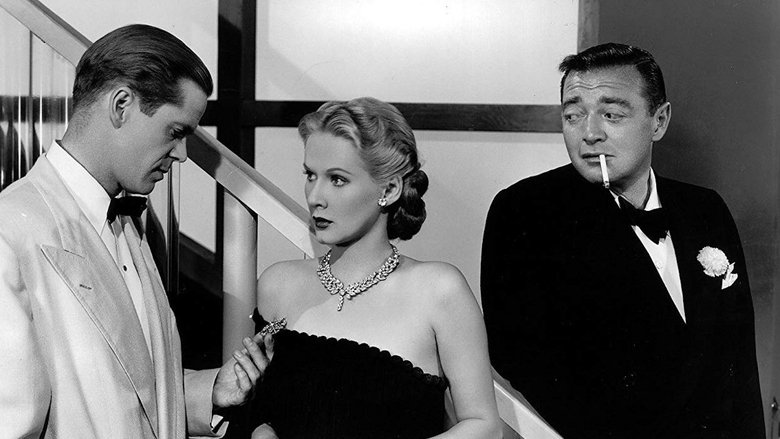
Dan Duryea, sometimes called “the heel with sex appeal” was usually cast as a second lead or a one-dimensional villain (For example in the outstanding noir Too Late for Tears, recommended here). But in 1946, he landed a leading part that let him show that he could portray complex characters with competing motives: Black Angel.

Duryea plays Martin Blair, an alcoholic once-successful tunesmith/piano player who has been on the decline since he was dumped by his beautiful but thoroughly self-absorbed and evil wife Mavis (Constance Dowling). Still carrying a torch for his ex, Martin tries to visit her at her apartment on their wedding anniversary but is ejected by the doorman. Before walking away, he notices a suspicious looking character (Peter Lorre) being admitted to Mavis’ apartment. Later in the evening, yet another man, Kirk Bennett (John Phillips) enters Mavis’ apartment, also apparently looking for love. He finds her strangled body, leading the police, in the form of no nonsense Captain Flood (Broderick Crawford), to slap the cuffs on him. Bennett is sentenced to die, but his heroic and devoted wife Catherine (June Vincent) believes he is innocent (of murder, anyway). She rouses Blair from his latest bender and the two set off to find the real killer. Suspense, romance and some fantastic plot twists ensue.

As you might have guessed, this film is a bit overplotted, but every scene engages due to the quality of the acting and the fine work of Director/Producer Roy William Neill, who is best known for his masterful adaptations of Sherlock Holmes (I recommended one of them here). I consider Black Angel Duryea’s finest hour, because he has so much to do and does it all well. After his early scenes of drunken desperation he sobers up and does a tremendous job conveying his growing but frustrated love for Catherine even while he knows they are both working to save her husband.

Black Angel (1946) — The Movie Database (TMDb)

As for Peter Lorre, there’s something about him as an actor that whenever he walks into a movie with a long cigarette just barely hanging out of his mouth, the audience knows they are going to be entertained. If there exists a film that doesn’t benefit from his presence, I don’t know what it is. Last but not least, June Vincent is moving as the wife who will do anything to save her wayward husband, most memorably in her wordless, teary recognition that she is going to have to get between the sheets with Lorre’s character if she is ever to learn the truth.

Paul Ivano’s photography is generally workmanlike, with two notable exceptions. Both the opening tracking shot/dissolve from Duryea on the street to Mavis’ apartment building and the closing alcoholic memory sequence are creative and arresting. On a different note (pun intended), the well-executed musical sequences are smoothly integrated into the story and enhance the movie’s mood. It all adds up a highly satisfying night at the movies for noir films as well as for cinema goers more generally.

p.s. If you like this excellent film noir you might also enjoy another of my recommendations, The Chase, which like Black Angel is a loose 1946 adaptation of a Cornell Woolrich novel that features fine supporting work by Lorre, again with one of those cigarettes hanging on to his upper lip for dear life.