The White Knight Stratagem was the final episode of a handsomely produced 2000-2001 British television series that re-imagined the Sherlock Holmes stories. The protagonist of the Murder Rooms: The Dark Beginnings of Sherlock Holmes series was Arthur Conan Doyle (center of photo above) who learns the methods of Professor Joseph Bell (far right) as they solve monstrous crimes. Baker Street Irregulars will enjoy how many of the cases contain elements that ultimately appear in the Holmes canon. The White Knight Stratagem is to my mind the best of the series, which is truly saying something.
The plot centers on an unsolved murder in Edinburgh, upon which Bell and Doyle are called upon to consult. It is soon revealed that the case was preceded by another unsolved murder in which Bell clashed with Lt. Daniel Blaney, a once great police detective now on the skids. Blaney, still on the force, resents Bell’s involvement, and Doyle must try to negotiate the rivalry between these two powerful personalities while simultaneously solving a progressively more complex case.
If The Long Arm had been one of the films pitched to producers in Robert Altman’s superb film The Player, the pitcher would have said “It’s ‘Father Knows Best’ meets ‘Dragnet’! In London! And we’ll get that British guy to star, you know, uh, what’s-his-name!”.
That ‘British guy’ in this case, would be Jack Hawkins, who embodied for a generation of British men the ideals of decency, strength, courage, and dutifulness leavened with compassion (see here for a warm tribute to him by Simon Heffer). His life was cut short by his addiction to tobacco and he took time off from acting to serve his country during the war, leaving him fewer years than he needed to become an international superstar. But he is fondly remembered in his home country, and has many fans in America as well. To all of them I say that if you like Jack Hawkins, you will like The Long Arm, because he is in virtually every scene and carries the movie end to end.
The plot of this 1956 film juxtaposes the very traditional 1950s family life of a Scotland Yard Detective Superintendent with his dogged pursuit of a master safecracker. The family elements are almost comically dated to modern viewers and are best appreciated as sociological rather than dramatic. The family scenes show how a number of people lived — or at least wanted to imagine that they lived — after the turmoil of the war. Money was not plentiful but Dad was wise and had a job, Mom created a loving home, and Junior was precocious yet respectful.
Meanwhile, in the best traditions of the police procedural, Scotland Yard slowly gathers evidence on the bold thief who has been breaking into safes all over the country. How does he get the inside information to prepare his heists? And how does he open such sturdy safes? As the police begin to answer these questions, it becomes clear that their prey is not only extraordinarily clever, but also capable of cold-hearted violence.
This double feature recommendation comes with a strong suggestion for viewing order. You absolutely should watch Zero Hour! first, because once you’ve seen Airplane!, you will have a hard time taking the former film seriously again. And that would be too bad, because it’s a perfectly solid drama/thriller.
Written by Arthur Hailey of Airport fame, 1957’s Zero Hour! stars Dana Andrews as former squadron leader Ted Stryker. I’ve written before about this period in Andrews’ career, during which he labored in B-movies as he struggled with alcoholism (not incidentally, his co-star here, Linda Darnell was in the same boat). Yet he managed to class up these productions with good performances, a strong jaw and leading man looks (albeit a bit drink-ravaged). Perhaps because he himself was a man whose career and life were on a downslope, he is particularly good in Zero Hour! at making the audience sympathetic with Ted Stryker. Following one terrible misjudgment during the war, Ted has been haunted by self-doubt. He has lost the respect of his wife (Linda Darnell) but is consoled by the fact that his son still looks up to him (Raymond Ferrell).
And then, before you can say “contrived plot development”, the Stryker family ends up on an airplane on which many passengers are sickened by bad food. The plane’s captain also falls ill and can no longer fly (The captain is played by Crazylegs Hirsch…a famous athlete playing an airline pilot..I wonder if someone could ever find a way to make fun of that?). A serious, silver haired physician (Geoffrey Toone) who happens to be on board intones somberly that if the passengers are not hospitalized soon, they will die. Meanwhile, the weather is worsening, becoming reminiscent of the horrible conditions during Ted’s failed World War mission. Can Ted shake off his fears, land the plane, and at the same time save his son, who is among the ill? He will have at least some help: on the ground, the hard-headed, no nonsense Capt. Martin Treleaven (Sterling Hayden, as alcohol-soaked at this point in his career as Andrews) has taken command at the airport and is prepared to bring the plane in safely.
OK, it’s a bit of a potboiler, but the acting is fine, the effects are good for the period, and the story is genuinely exciting. And this film is probably the high point of Hall Bartlett’s uneven career as a director; he gets everyone to play things super straight, which you could pull off with a 1950s audience in a way you never could with a modern one.
Which brings me to the 1980 film Airplane! Three very, very funny guys (David Zucker, Jim Abrahams and Jerry Zucker) saw Zero Hour! late at night and apparently laughed all the way through. They then created a movie that is hilarious in its own right and also deserves admiration for being one of the best parodies of a prior movie ever made. If you have just watched Zero Hour!, Airplane! is even MORE funny, if that’s possible. Indeed, some of the most laugh-inducing lines in Airplane! appear as dead serious lines in Zero Hour! (“Looks like I picked the wrong week to quit smoking…”).
Great dialogue has been in decline in Hollywood for a long time, even though a few masters (Sorkin, the Coen brothers) keep the flame of Preston Sturges alive. As the movie-going audience came to comprise a larger share of teenagers and the international market (much of it not fluent in English) became more important, the demand for complex, smart, language usage in film declined.
However, as the Silent Era directors knew well, you don’t need dialogue to create emotionally powerful scenes. I have written here previously about Madeleine Carroll’s fine, extended and wordless scene in The 39 Steps.
More recently, Pixar hit it out of the park with Up’s achingly sweet montage about a marriage. Curl up with your mate and have a good cry.
All the world will be your enemy, Prince of a Thousand enemies. And when they catch you, they will kill you. But first they must catch you; digger, listener, runner, Prince with the swift warning. Be cunning, and full of tricks, and your people will never be destroyed.
These words are uttered by an unseen narrator (well-voiced by Sir Michael Hordern) in the magical opening sequence of writer/director Martin Rosen’s Watership Down. The opening presents a creation myth centered on a god called Frith and a prince of rabbits named El-ahrairah. The movie then turns to the story of some of the descendants of the Rabbit Prince, who live in modern day Sandleford and are about to embark on a perilous journey to find a new home.
A cartoon movie about bunny rabbits doesn’t sound like the sort of thing that would hold the interest of a thoughtful adult. But give this 1978 movie a chance. Like the Richard Adams book upon which it is based, the film is dark, dramatic, and in parts, engagingly philosophical. Although older children will probably like it, Watership Down is really an animated movie for grown-ups.
The story centers on a warren in which all the rabbits seem happy and safe. Yet a rabbit named Fiver has a prophetic vision of blood and destruction. He and his older brother Hazel cannot get the local rabbit chief to believe them about the danger; indeed the warren’s police (the Owsla) try to suppress their dissent. With a group of fellow rebels, including a powerful former Owsla member named Bigwig, Fiver and Hazel fight their way out of their warren to seek a new home.
Their journey is filled with hazards and some of the rabbits come to bloody ends. They encounter different warrens with different sociologies and politics, eventually establishing their own independent warren at Watership Down, which Fiver had seen in a vision. But they soon come into conflict with another, imperialistic warren run by the menacing General Woundwart (as scary a villain as one could ask for in a movie about rabbits).
I consider Watership Down the best animated film ever produced in the UK. The rabbits’ faces are expressive and their movements realistic. The story is exciting and contains moments of serious drama. As for music, Art Garfunkel fans will appreciate “Bright Eyes”, which is accompanied here by an appealing animated sequence. And the voice actors, especially John Hurt, are outstanding. My only complaint is the presence of a comic relief bird character voiced by Zero Mostel (it was his final film performance). I suppose that was put in to make the film more kid-friendly…I think it would have better to just go for it and target the film at adults, but YMMV. Even if you don’t like the bird, it’s a small annoyance in what is overall a very good movie.
The trailer is a bit long, but gives a flavor of the film.
p.s. Rosen (and Hurt) went back to the Adams well a few years later to make The Plague Dogs. It drew nowhere near the same audience, probably because it’s significantly grimmer than Watership Down. But it too is an accomplished work.
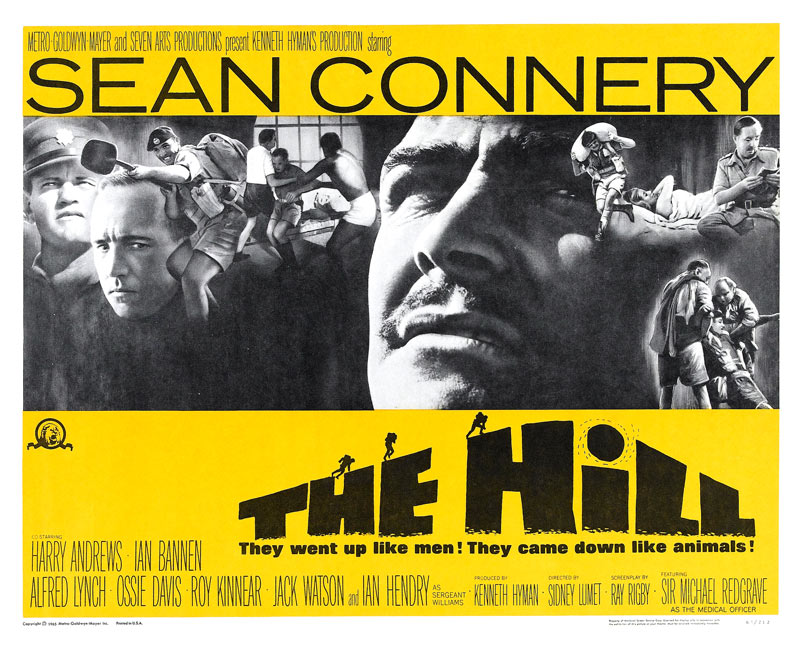
Sidney Lumet’s brutal, gripping 1965 movie The Hill opens with a solitary figure laboring up the man-made torture device that gives the film its title. In one of Oswald Morris’ many mesmerizing crane shots, the man collapses in the North African heat and then the camera begins to move slowly away, off into the distance, abandoning the man and the compound in which he is forced to live. As in the rest of the film, no music is heard, which lets the hopelessness and isolation of the people we are watching sink in.
The story begins with five British soldiers arriving at a military prison. Four of them are privates who have committed various crimes (including Ossie Davis as a West Indian soldier and Roy Kinnear as a fat spiv), but the fifth is something different. Joe Roberts (Sean Connery) was a heroic sergeant major who has been busted down for beating up his commanding officer. Connery, given his first chance as a star to do something different from James Bond, plays the part well, showing how Roberts can be callous in some respects yet gentle in others. He is in emotional agony, for reasons that become clear as the film progresses.
The most complex performance is given by Harry Andrews, as RSM Wilson, who runs the daily operations of the prison. It would have been easy to write and play the character of RSM Wilson as a heartless martinet. But Ray Rigby’s script and Andrews’ acting are much more sophisticated than that. Yes, the RSM can be tough, but he also shows compassion because he is committed to rebuilding the prisoners rather than simply destroying them. He’s a three dimensional person, unlike the newly arrived Sergeant Major Williams (Ian Hendry), who is uncomplicatedly nasty. Ian Hendry, who was by all accounts a piece of work in real life (sadly, he drank himself to death in his early 50s) is convincingly vicious as Williams. As Connery’s character says “Wilson wants to build toy soldiers and Williams wants to break them”.
The prisoners struggle against the harsh prison regime, and also among themselves. But as Williams gets more brutal, causing a tragic incident, they begin to unify in opposition to the screws. They are aided by a diffident medical officer (a solid as ever Michael Redgrave) and a staff sergeant whose motives are interesting to speculate about (Ian Bannen).
Two complaints. The film would have benefited from some tightening in length and from dropping the final stages of evolution of Ossie Davis’ character. His behavior at the end seems a theatrical flourish to please a 1965 audience and not, like the rest of the film, a realistic take on WWII prison life. His performance though, like that of everyone else in the all-male cast, remains top-notch.
It would be an injustice to close on such cavils, however. Sidney Lumet’s “movie as play” style works perfectly in the claustrophobic setting of a prison. Cinematographer Oswald Morris and editor Thelma Connell do brilliant work throughout, particular during the scenes in which the prisoners are forced to climb the hill (In one case, while wearing a gas mask — horrifying). Given its subject matter and tone, this isn’t a date movie…but it’s a great movie.
A closing note on Connery’s evolution: As this critically-acclaimed movie bombed at the box office he saw audiences line up world wide to munch popcorn and watch Thunderball, which began to disgust him with the James Bond franchise and the state of his career. But while he didn’t know it at the time, he had already made the wisest move possible, which was to link up with a great director who saw more to him as an actor than the Bond films revealed (For more on this, see my recommendation of The Offence).
An incisive take on the life of corporate suits and their sexy secretaries in 1960s Manhattan, with Robert Morse as the star. No, it’s not Mad Men, but 1967’s toe-tapping, uplifting and funny “How to Succeed in Business (Without Really Trying)”.
Based on the smash Broadway hit, the heart of the film is of course the music. The songwriter is the great Frank Loesser, and some of his most enjoyable pieces are rendered with energy and talent by the cast (“Brotherhood of Man”, “The Company Way”, “I Believe in You”). Bob Fosse’s choreography is consistently creative and the colourful costumes by Micheline enliven every scene.
The agreeably silly script tells the story of an ambitious window washer named J. Pierpont Finch (Robert Morse, whose bravura performance deserved an Oscar nomination) who climbs the corporate ladder with shocking speed, aided by the titular self-help book. He is pursued by Rosemary Pilkington (Cutely played by Michelle Lee), who is every bit as ambitious in love as he is in work. Many veterans of the stage production (including Rudy Vallee) contribute their comic and musical gifts.
David Swift, famous as a Disney animator and TV writer/director, seems an unlikely writer/producer/director for this film. In some ways, one could say it was an easy job because the choreography and cast had mostly been worked out already on Broadway. But on the other hand, adapting a beloved Broadway show to the screen is a big risk for a director because fans of the stage version can get upset at the inevitable changes in the film version. Here they were apparently delighted along with the rest of the movie-going population, so kudos to Swift for a smooth translation of play to screen, and congratulations on what was the high mark of his career as a film maker.
I am embedding one of my favorite numbers from the movie because it always picked me up when I was a lowly graduate student feeling stomped on and disrespected in a really demanding doctoral program. Enjoy.
Footnote: There are two continuity goofs in the opening minutes of the film. Finch pays for his newspaper but grabs the self-help book impulsively without paying for it and the guy running the booth doesn’t react. A few moments later, when he starts from the roof down on the window washing platform, there is another window washer working the other side. But that guy is played by a different actor by the time Finch has descended to the window. Yes…noticing these things means I have seen this movie perhaps too many times. But. Can’t. Stop. Re-Watching. So. So. Entertaining.
If Lt. Columbo had been Scottish, he would have born a strong resemblance to Inspector Cockrill, as wonderfully played by Alastair Sim in 1946’s Green for Danger. In the film role that helped make him a huge star, Sim perfectly essays the role of the dowdy looking, socially clumsy police detective who has a razor sharp mind and a relentless desire to snag his prey.
The setting is a wartime British hospital, where doctors and nurses treat the victims of the German doodlebugs that are wreaking havoc throughout the countryside. When an injured local postman mysteriously dies on the operating table, everyone looks like a plausible suspect. Which member of the surgical team did it? Is the killer Mr. Eden (Leo Genn), the lothario head surgeon? Sister Bates (Judy Campbell), the woman he most recently discarded? Or perhaps it’s Dr. Barnes (Trevor Howard), the doctor with a stain on his medical record?
Particularly if you have the Criterion Collection version, this film is not just entertaining but very easy on the eyes. Much of it was shot indoors, but Cinematographer Wilkie Cooper makes the most of the exterior scenes to give us eye-catching and haunted-looking backdrops that maximize the tension of the story (He had Oswald Morris and Thelma Connell on the team, whose also collaborated on another of my recommendations). With all the wind, trees and shadows, the mood created is reminiscent of horror films in which a small group of desperate people are locked inside a remote and spooky mansion where violent events unfold.
Despite being a murder mystery, the film has many funny moments (especially Sim’s wry dialogue and voiceovers). Sidney Gilliat had already shown his gift for comic thrillers by co-scripting Hitchcock’s The Lady Vanishes. Here he also takes the director’s chair, from which he skillfully keeps the tone right as the story moves from hospital soap opera to murder investigation to amusingly Columbo-esque moments between Cockrill and the suspects. Gilliat gets solid performances from every member of his cast, who do a nice job humanizing characters that might otherwise lapse into stereotype. Gilliat’s script (co-written by Claude Guerney based on Christianna Brand’s novel) invokes a number of coincidences to make everyone look like a suspect and offers a somewhat rococo ultimate explanation for the crimes. But these are time-honored and enjoyable elements of the locked room mystery genre, right down to the climactic re-staging of the crime by Inspector Cockrill.
To compliment my recommendation of The Long Arm, let me endorse an even better film featuring the wonderful Jack Hawkins. In the high point of his career as a star (although he would go on to have a career as a character actor in upmarket blockbusters such as Lawrence of Arabia, Zulu, and Ben-Hur), Hawkins turns in a powerful, weighty performance as Captain Ericson in 1953’s The Cruel Sea. Scripted by Eric Ambler and based on the well-regarded Nicholas Monsarrat novel of the same name, this is a realistic, exciting and emotionally affecting portrayal of the British Royal Navy’s efforts to protect convoys from the predations of German U-Boats.
As the story begins in 1939, Ericson is called from the merchant marine to captain a corvette with a crewful of amateurs. His second lieutenant, Bennett, is a martinet of questionable ability (Stanley Baker, who really registers here in an early role for which he campaigned after being impressed with the character’s possibilities in the novel), and the junior officers below him were only recently working as barristers, journalists and in other professions that are of no value in naval combat. Ericson must train and lead them while making the terrible life or death decisions that wartime demands (If you want a short, powerful take on the nature and challenges of leadership, the events about 40 minutes into this movie are hard to beat). He is at least encouraged that when Bennett suddenly departs the ship, one of his young officers, Lockhart (Donald Sinden), starts to grow into the kind of officer he can count on.
Meanwhile, the crew have to protect convoys from U-boats, which increasingly gain the upper hand as the war wears on. In these scenes, documentary footage is smoothly blended with shots of the actors to give us the feel of being at sea as storms rage and the terrible possibility of torpedoes is ever-present. There are moments that will have you gripping the armrests and hoping along with the men that they will survive each crisis in which they find themselves.
A remarkable number of films absolutely botch their opening moments by introducing way too much information/needless detail or by providing essential information in a clumsy fashion. The worst ever example in the movies was David Lynch’s Dune, which had such an incoherent opening narration that when it played in the cinema, audience members were given an explanatory handout sheet with their tickets (And it didn’t help. Very disappointing given the greatness of Frank Herbert’s book).
At the other end of the spectrum, In a Lonely Place (recommended here) takes less than 5 minutes to show who Bogart’s character is and what drives him, and you can’t help being pulled into the story by both lapels (for a more recent example, check out the first scene of the 2014 film Whiplash).
A television series that opens its story as well as any is Patrick McGoohan’s brilliant (if uneven and occasionally maddening), The Prisoner. I re-watched a number of these recently and greatly admire the creators for trusting the audience by using a 90 second opening with no dialogue. The images make clear what the series is about economically and cleverly. The next 90 seconds of the opening were substantially the same each week, but included some tailoring for the episode at hand. It’s an arresting and innovative way to begin telling a story and it has great background music as well.







 All Good Movies