One of the most memorable adaptations of A Christmas Carol is a short, animated film of the same name. Made in 1971 by animation icons Richard Williams, Ken Harris and Chuck Jones, this is by far the most eerie and dark version of the much-filmed Dickens classic.
Despite being condensed to 25 minutes, this Oscar-winning film’s storytelling will be comprehensible even to people unfamiliar with the original. Adding immeasurably to the production are the voice talents of two actors from the best live action version of the old chestnut (Alastair Sim and Michael Hordern, who reprise their 1951 roles as Scrooge and Marley, respectively).
But the real star here is the animation, which was inspired by illustrations in early editions of the book (especially the Victorian era drawings of John Leech). The images are lugubrious and scary yet hard to look away from, not unlike Goya’s Pinturas Negras. I first saw this film as a child and the visual of “ignorance and want” haunted my imagination for years. The film makers accentuate the power of the animation by employing arresting pan and zoom shots that are extremely effective both as storytelling devices and as setters of mood.
The threnodic tone of the film does not stop the essentially positive message of the story from emerging brightly in the end. Ebenezer Scrooge’s transformation to a life of charity and decency remains uplifting, perhaps even moreso for the considerable terrors of the night before.
Having recommended the movie that gave Stanley Baker his first break (The Cruel Sea) and one he produced and starred in once established (Robbery), let me fill in the middle by recommending the thrilling film that made him a star in 1957: Hell Drivers.
The plot is agreeably simple. Baker plays Tom Yately, a tough but moral ex-con trying to go straight. He takes a job at a trucking firm managed by a ruthless boss (William Hartnell, who effectively plays the villain here, albeit of a different type than in Brighton Rock). The business would give OSHA a coronary. The truckers are assigned to ship gravel from a mine to a worksite many times a day, getting paid more money the more trips they make. They respond by driving like maniacs, at significant risk to themselves and others. And they all compete to topple the domineering, violent and reckless “Red” (Patrick McGoohan) as the top driver of the crew. Meanwhile, Tom befriends a kindly, devout Italian driver named Gino (a spot on Herbert Lom) whose girlfriend (Peggy Cummins) begins to put the moves on him.
The driving scenes in this movie are thrillingly shot by the justly revered Geoffrey Unsworth (I’ve praised his work in A Night to Remember, Superman and Unman, Wittering and Zigo). This includes the ultimate driving test from hell for Tom Yatley, in which he is accompanied by a perfectly droll Wilfrid Lawson as the firm’s mechanic. The final confrontation of the film, as Red and Tom have a trucking duel in an abandoned quarry, is particularly well-done and highly satisfying.
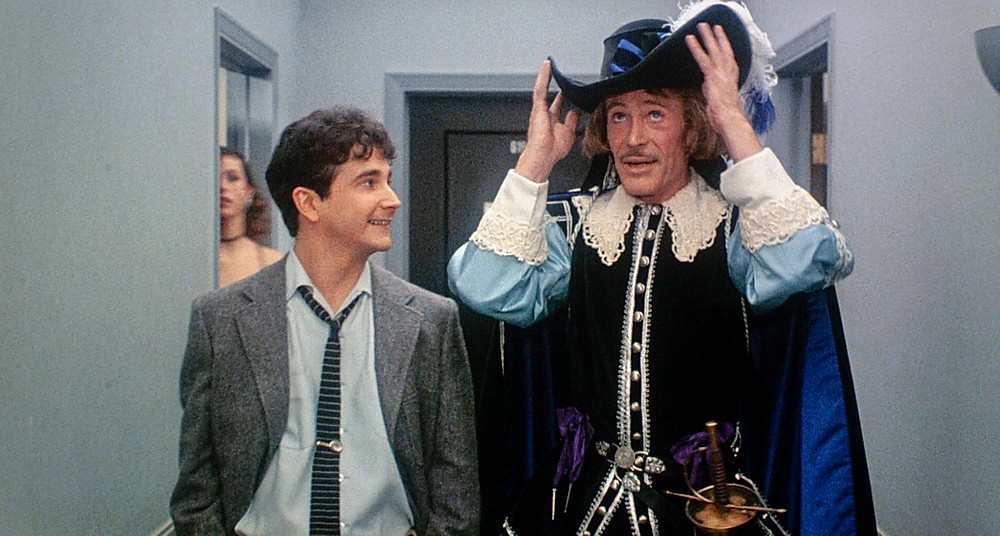
This 1982 star vehicle for Peter O’Toole (playing a drunken, rakish, movie star oddly reminiscent of Peter O’Toole) delivers big laughs as well as some acute observations on the nature of fame. The movie also opens a window into the world of 1950s live television comedy and the people who made it happen.
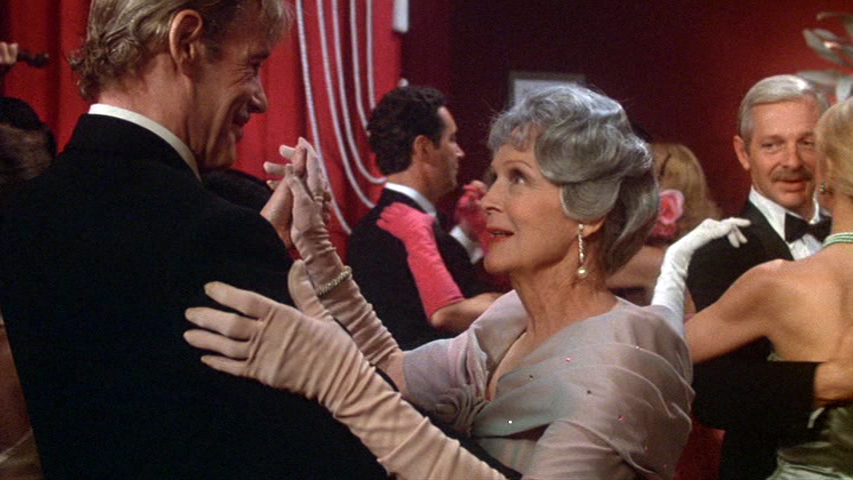
The supporting cast is filled with wily veterans who know how to get the most laughs out of the material. Bill Macy is perfect as the beleaguered head writer, and Joseph Bologna is almost as good as a Sid Caesaresque television star. Another treat: In the sweet scene in which O’Toole dances with an older woman on her wedding anniversary, the role is played by 1930s film star Gloria Stuart (two of her best are Prisoner of Shark Island and The Old Dark House).
This was Richard Benjamin’s first time out as a director, and it shows a bit. The tone and style of the film are not as consistent as what he would achieve in his films as he became more experienced. Norman Steinberg and Dennis Palumbo’s script, while funny most of the time, also includes some weak gags and slow spots. Can one extremely charming star leap over such weaknesses in a single bound and keep the audience laughing and cheering? In O’Toole’s case, the answer is clearly yes.
p.s. There is an oft-repeated story that this film was inspired by Executive Producer Mel Brooks’ recollections of Errol Flynn doing a guest spot on Your Show of Shows when Brooks was a writer. But as many of the tapes of that show are lost to us, no one to my knowledge has ever confirmed that such an event actually transpired.
Filmmakers Steve James and Peter Gilbert started with the idea of making a 30 minute TV show about kids playing basketball at an urban playground. Instead they got pulled into the lives of two remarkable families and you will be too by the astounding 1994 documentary Hoop Dreams.
The film follows two African-American basketball players for five years as they grow from boys to men in Chicago. Both have been scooped up as potential basketball stars by an ambitious coach at a white suburban high school (Is this an opportunity or just exploitation? The film doesn’t flinch from this question.). When one of them, Arthur Agee, doesn’t do well academically (or is it just that his white coach thought he wasn’t a good enough player?) he is sent back to his local high school where his sports career prospers in new ways. The other, William Gates, fares better in the burbs at first but then his life takes some turns that I will not ruin for you by telegraphing them.
Among the things that amaze about Hoop Dreams is the access everyone gave to the filmmakers. The boys themselves, the coaches and their friends are all remarkably candid in the interviews. And the Agee and Gates families open up their personal lives to an almost unbelievable extent. The amount of intimacy they let the viewer have at some of the most critical moments of their lives is a true gift.
The other impressive thing about Hoop Dreams is that despite an almost three hour running time (edited down from a reported more than 250 hours of footage!) it holds your interest at every moment. Personally, I tend to be pretty hard on movies that run more than two hours without an exceptional reason. Here, I was riveted throughout and indeed would have loved more.
Hoop Dreams is sometimes referred to as a great film about inner-city existence or low-income Black Americans. Yes, it is those wonderful things but it’s also more than that, it’s a film about life, family and growing up with which anyone with a heart and a mind can connect emotionally. That’s why it’s not just one of best documentaries of my lifetime; it’s a great work of art.
Finally, just as a comment on inner city life, which this film so well captures, it is quite sad that a number of people in this film have been murdered since the film’s release, including William’s older brother and Arthur’s father-in-law.
p.s. Even some fans of this film sometimes underestimate its worth. They are angry that it wasn’t nominated for a best documentary Oscar. That was indeed an outrage, but in a year when Forrest Gump won Best Picture, the nominators in that category should have hung their heads too. Props to Siskel and Ebert for using their platform to boost this movie and to blast the Academy for their disgraceful decision.
Following the success of his low-budget films That Sinking Feeling and Gregory’s Girl, Scottish film maker Bill Forsyth had the adjective “quirky” hung on him by critics, and it stuck. But there’s a nicer way to describe this talented writer-director’s output: Sweet, original and offbeat. For me, no film in Forsyth’s career better illustrates those qualities than 1983’s Local Hero.
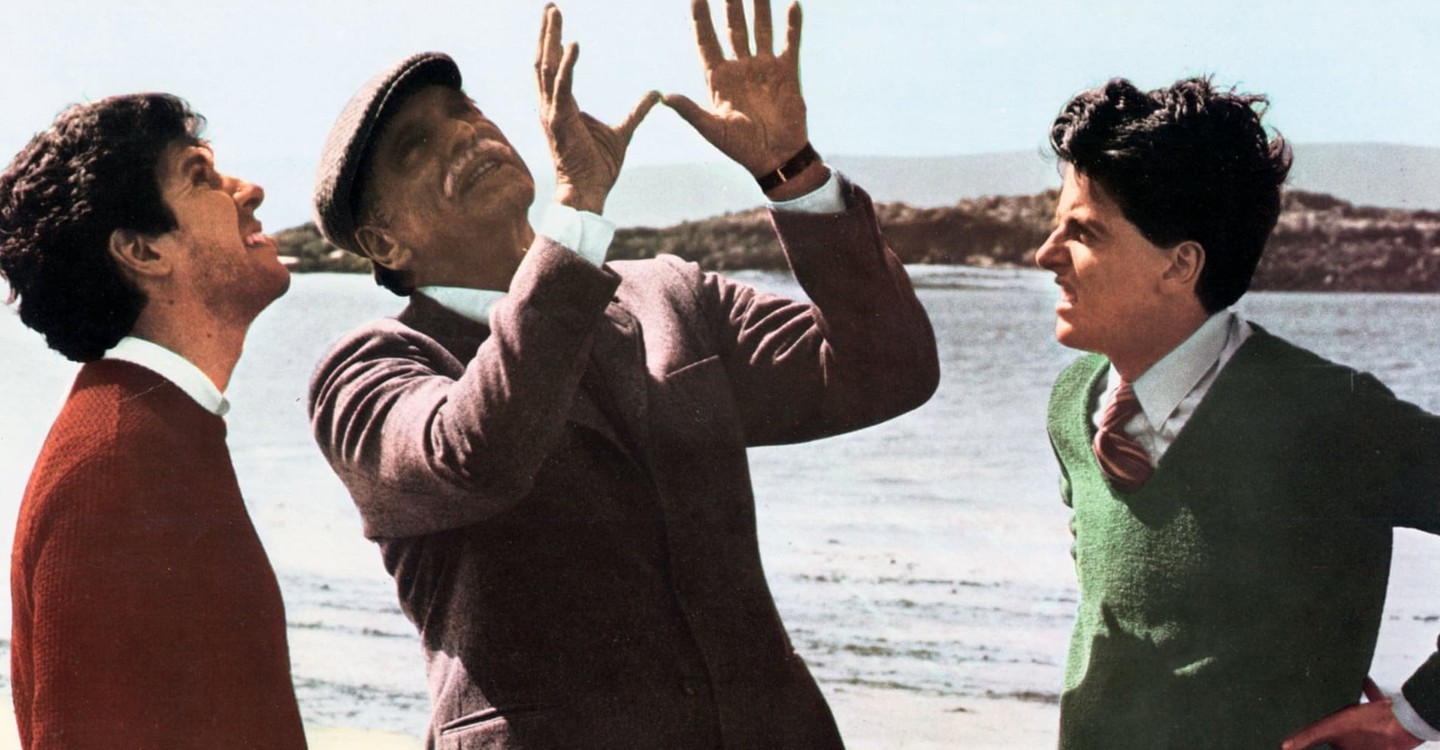
On its face, the plot is simple. Knox Petroleum needs to buy an entire Scottish seaside town in order to further its oil empire, so its all powerful and extremely eccentric President Felix Happer (Burt Lancaster) dispatches a guy named MacIntyre (Peter Riegert) to close the sale, because, well, with a name like that he must understands Scottish people. In a more clichéd film, the quietly noble and down-to-earth townspeople would resist the heartless tyrants of capitalism. I will not spoil the film for you but rest assured that Forsyth is far too creative to follow that tired line of plot, either for MacIntyre and Happer or for the people of the village.
Under Forsyth’s direction, the cast sparkles throughout. Burt Lancaster, like Sean Connery and Clint Eastwood, was wise enough in late life to transition from swashbuckling roles to more age-appropriate fare. His turn as an isolated, slightly daft, stargazing corporate titan is hilarious, particularly his scenes with one of the most abusive psychotherapists in film history.
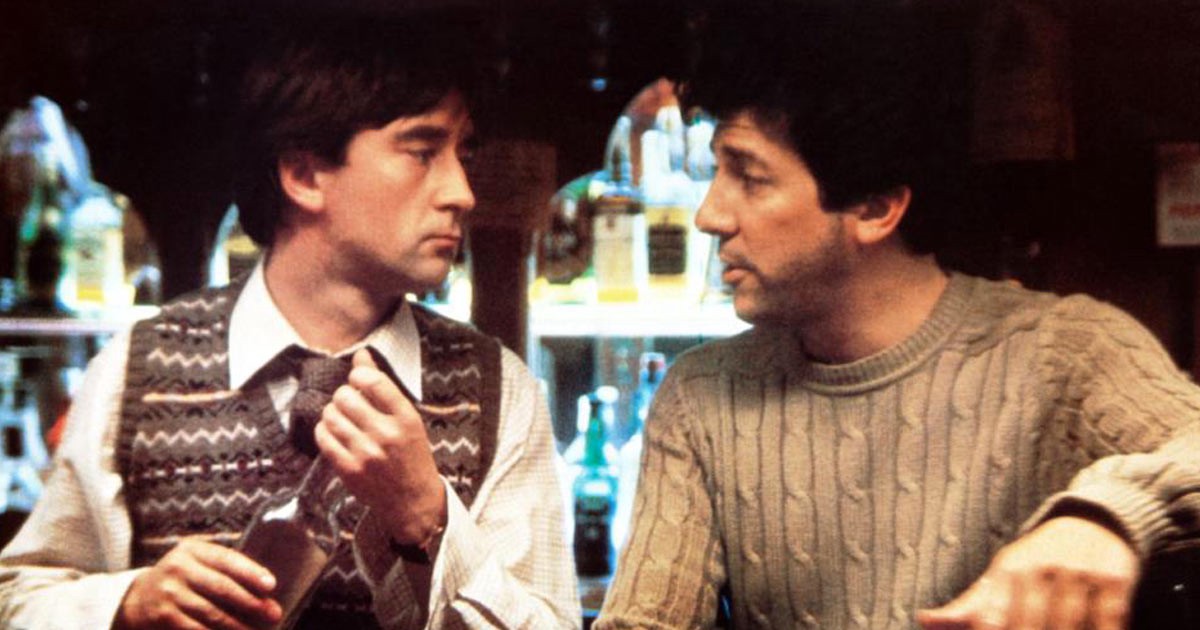
Peter Riegert is very good at playing people who are present in some respects but completely absent in others. Outwardly, his MacIntyre is a financially successful oil acquisitions man. On the inside, he is a lonely person with a bitter break-up behind him and, the film hints, more romantic disappointments to come. His last name is Scottish but even that isn’t real; he no more belongs in Scotland than he does anywhere else. What pulls on his emotions the most about the Scottish town is the wildly satisfying (in every respect) marriage of his hosts at the local B&B. It’s the life he longs for but simply doesn’t know how to create.
The charming Jenny Seagrove, whose success in UK film and television unfortunately never translated across the pond, hits the right notes as a scientist with whom Peter Capaldi’s character falls in love (Capaldi, later so good as a thoroughgoing bastard on The Thick of It and In the Loop, is completely different here in the film that first brought him notice). Kudos also to the set designers for Felix Happer’s bizarre and palatial office suite, and to Mark Knopfler of Dire Straits fame for an understated and memorable score.
Like most of Forsyth’s films, there are a few big laughs and many more small ones. Wistful in some ways, joyful in others, this quiet gem of a movie will bring a smile to your face.
Adolescence includes aches (loneliness, alienation from adults, sexual longing) and joys (first love, treasured friendship and music). Few films have portrayed both classes of teenage experience as warmly and intelligently as the 1991’s Flirting.
Due to an execrable U.S. advertising campaign, which misrepresented the film as a sniggering teen sex comedy from “those crazy blokes down under” (I cannot bring myself to post the trailer) this Australian gem barely opened in the U.S. and when it did mostly the wrong people saw it. But a precious handful of people outside of Oz have found this excellent film and continue quite properly to point others to it. Having been so blessed by a friend some years ago, I wish to pay it forward here with the strongest possible recommendation that you give this excellent movie a look.
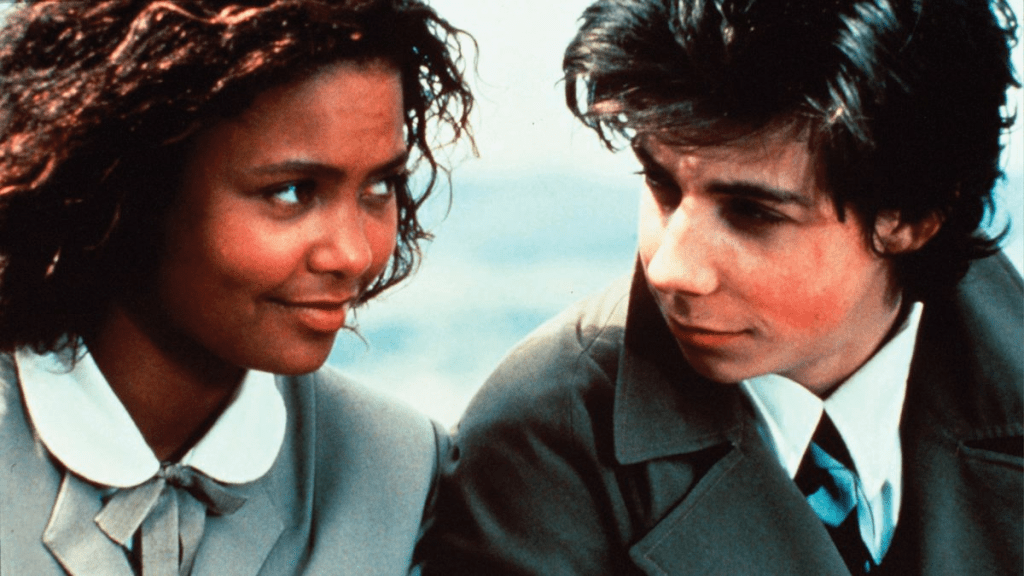
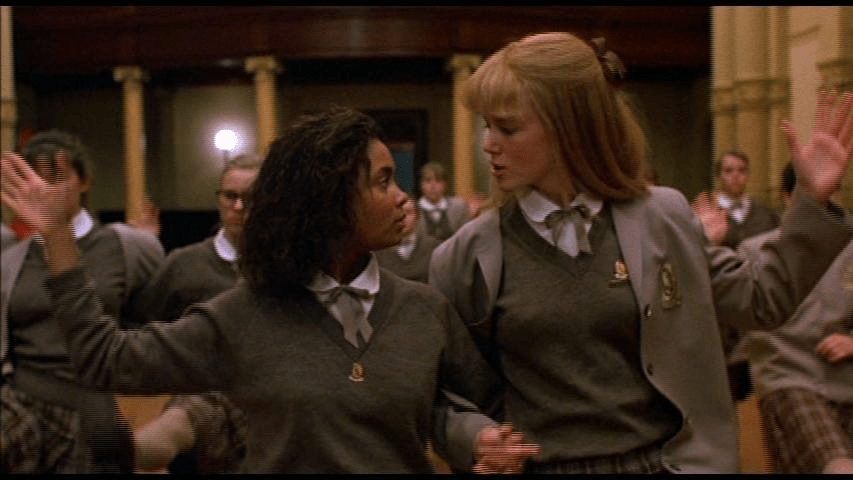
Writer-Director John Duigan sets his story in two boarding schools that stare at each other (like their residents) across a lovely lake. In the boys’ school, anxious, stammering Danny Embling (sweetly played by Noah Taylor) is being ground down by sadistic masters and bullying classmates. Meanwhile, a student from Uganda, Thandiwe Adjewa (the luminous star-to-be Thandie Newton), is getting a cold welcome at the girls’ school. Yet as is so often the case, the underdogs attract a stout friend or two, and are also drawn irresistibly to each other. Taylor and Newton have great chemistry on screen, and you will be rooting for their budding romance from the very first.
The other central character is the alpha girl of Thandiwe’s school, played to perfection by a pre-fame Nicole Kidman. Initially imperious and frosty, she eventually reveals more accessible layers beneath, particularly in the superb scene after she catches Thandiwe sneaking back into the school after a rendezvous with Danny.
Many of the plot elements and themes here are familiar (Rebel Without a Cause is one a zillion films to tread similar ground). But it wasn’t fresh plots that made Shakespeare the Immortal Bard, it was what he did with them. With its wisdom, sensitivity and wit, Flirting turns the usual coming-of-age story into an fresh and inspiring experience that is not to be missed.
I have recommended the film Flirting, in which sadistic masters torment the new students in a boys’ school. I now turn the tables by recommending a film in which a new teacher John Ebony (David Hemmings) and his wife Silvia (Carolyn Seymour) are terrorized by the fifth form from hell. The last three students on the class roll are Unman, Wittering and Zigo, but Zigo is always absent, even going back to the time when the teacher that Ebony is replacing, Mr. Pelham, fell to his death (by accident?).
Director John Mackenzie of Long, Good, Friday fame made this creepy, nasty, thriller in 1971. He was aided immeasurably by master cinematographer Geoffrey Unsworth, who contributed some dazzling and disturbing point of view shots in the opening sequence as well as during the most horrifying scene in the film (which I will not spoil by describing other than to say, don’t bring the kids to this one).
The nefarious school boys (who include some actors who went on to distinguished careers including Michael Kitchen and Michael Cashman) are hard for the viewer to keep straight but that actually works, along with skillful editing, to make them seem less a group of individuals than a multi-headed hydra snapping relentlessly at Mr. Ebony. Hemmings, who also produced, is good as the pitiable Ebony, including in those scenes where he starts destroying himself with alcohol (perfect casting there, sadly enough. Hemmings left us too soon).
While struggling with the boys ostensibly below him in the hierarchy, Ebony must also cope with the headmaster, played by Douglas Wilmer with just the right amount of Old Brit unctuousness overlaying snobbery and cold-heartedness. Although the scenes with the boys are chilling, the pre-dinner drinks scene with the Ebonys, another master and his wife and the headmaster, make one’s skin crawl in an entirely different way.
The final third of the movie is not entirely satisfying in terms of logical plotting, but the film still delivers a consistent air of menace that gets under your skin. Certain ambiguities in the story invite debates about the interpretation of this film; to avoid spoiling the movie for those who haven’t seen it, I have placed my own nagging questions about this movie after the jump (i.e., Don’t read the rest of this unless you have seen the film, it will ruin it for you).
One of my favorite Christmas movies is Kenneth Branagh’s Peter’s Friends. Sometimes glibly dismissed as a “British knockoff of The Big Chill” this 1992 movie is in fact superior in most respects to that film (which not incidentally was itself based on a better, little seen movie, The Return of the Seacaucus Seven).
The plot: Peter (Stephen Fry) has inherited a large estate and house from his recently deceased and very formidable father, whom he hated but now misses. He is also grappling with a serious personal problem — the nature of which is not revealed to the audience until late in the movie — that is causing him great strain. Unable to decide what else to do, he throws a weekend Christmas party for his dear friends from Oxbridge days. Once a young and happy troupe reminiscent of the Footlights (of which many of the actors in the film are alums), Peter’s friends have since run into their own painful challenges in life.
Rita Rudner, who is hilarious as a shallow and unhappy American TV star, wrote the witty script with her husband Martin Bergman. The script also includes some strong dramatic moments, even though it doesn’t quite seem to know how to wrap things up at the very end. Without spoiling the plot, Peter’s Friends also deserves praise as being one of the first major British movies to deal with a particular topic that had been too long avoided.
Director Kenneth Branagh gets the best out of the talented ensemble cast, even though he himself gives only a so-so performance (for whatever reason, with the exception of the Wallander series, Branagh often seems a bit too mannered and self-conscious when he plays modern parts). You are blessed with more than a bit of Fry and Laurie here, as well as good work by Imelda Staunton, Tony Slattery, and Alphonsia Emmanuel. But the best performances of all come from the mother-daughter team of Phyllida Law as the housekeeper-quasi-parent of Peter, and Emma Thompson as a bookish turbo-neurotic who is secretly in love with him. I have never met anyone whose former boyfriend wrote self-help books right up to the moment he committed suicide, but if I did, I would expect her to be exactly like Thompson’s pathetic, nerdy but still very appealing Maggie Chester.
The film’s music is also enjoyable, including hits of the period (by Bruce Springsteen, The Pretenders, and Tears for Fears) as well as a lovely version of Jerome Kern’s “The way you look tonight” sung by the entire cast (Imelda Staunton can really hit a note!). The then-popular music and focus on a particular British generation’s experience could have turned this into a period piece which would age badly, but the many laughs and the moving moments gives Peter’s Friends appeal that extends to the present day.
Director Jacques Tourneur didn’t make many movies and is largely forgotten today, but he has a cult following of which I am a part. He made horror films such as I Walked with a Zombie, film noirs such as Out of the Past, and films that exist somewhere in between, such as 1957’s suspenseful and scary Curse of the Demon.
The plot of the film pits hard-headed American psychologist Dr. John Holden (Dana Andrews) against sinister British cult leader Dr. Julian Karswell (a deliciously malevolent yet courtly Niall McGinnis), who claims to have magical powers. Holden is investigating the mysterious death of a colleague who, like himself, was trying to debunk Karswell’s claims. Karswell tells him calmly that his colleague was destroyed by the curse of the demon, and that a similar curse has been placed on Holden and will end his life in just a few days. Holden at first laughs this threat off, but then begins to experience a series of unnerving events that cause him (and the audience) to becoming increasingly scared that the curse of the demon is real.
As detailed in Carl Rollyson’s first-rate biography of Dana Andrews (recommended here), this handsome, broad shouldered actor looked like he had decades of stardom ahead of him in the 1940s, but he developed a serious alcohol problem that drove his career southward before he finally got into stable recovery around 1970. In some of his scenes here, he looks a little shaky and pale and one wonders if that is acting or not, but in either case, it works perfectly as Dr. Holden begins to unravel psychologically. Peggy Cummins, who commanded the screen in another of my recommendations (Hell Drivers), is surprisingly bland here as Holden’s fellow investigator and love interest. Instead, the sparks come in the scenes between Andrews and McGinnis. Their debates about science versus superstition are among the highlights of this film (The photo above is from my favorite such scene, which Tourneur brilliantly set at a children’s party in which Karswell is wearing a clownish magician’s costume).
As you would expect for Tourneur, there are lots of noirish visual touches, including abundant shadows and deep focus shots of people walking alone down empty corridors and streets. It all works perfectly to maximize emotional tension in this classic chiller.
This film is sometimes entitled “Night of the Demon” and sometimes “Curse of the Demon” depending on whether you’ve got hold of a US or UK print. In any event, the thing to ensure is that you have the full 95 minute version and not one of the chopped up shorter prints that are around.
N.B. Spoiler Alert, stop reading here you haven’t seen the film. Tourneur was unhappy with how unambiguously the final version of the film makes clear that the demon was real. He wanted to show the demon either not at all or so quickly that the movie would not take a clear position on whether there was such a creature or whether it only existed in the minds of its victims (A conclusion echoed in Andrews’ final line in the film about how it’s better not to know whether there was such a creature). But Tourneur was overruled by the producers, who took control of the two demon scenes on the film. In the final scene, Tourneur had clearly set up the smoky, clacking train to be the cue that convinced Karswell that the demon was after him, and the (not bad for the time) demon effects are now superimposed on that. Note also in the first appearance of the demon, the demon is not necessary to the death that occurs, so again Tourneur had set up everything to keep the demon’s existence ambiguous. Whether it would have worked better Tourneur’s way is a matter for debate. I suspect it would have been a very good, hair-raising film either way.
Let’s get meta: That’s Sir Michael Gambon sitting in the very chair where I wrote this recommendation of the film in which he and it appear: Matthew Vaughn’s stylish and hard-edged Layer Cake. Gambon plays wily drug kingpin Eddie Temple in one of the great British gangster films (which is saying something, they have been making outstanding movies about guns and geezers over here for three quarters of a century).
The film centers on cocaine middleman “Mr. X”, played convincingly by a pre-James Bond Daniel Craig. One of the many things the film gets right about the illegal drug trade is that it includes people like Mr. X who think they can make big money while remaining untouched by the damage that drugs do downstream and the violence and immorality of the kingpins who call the shots upstream. Mr. X tells himself he is just a businessman whose commodity happens to be illegal, and that he will simply leave the drug trade behind him when he is financially secure. But when drug honcho Jimmy Price (Kenneth Cranham) gives him an unusual assignment, his assumptions are shattered and he quickly gets in way, way over his head. Meanwhile, he develops a serious case of the hots for a low-level gangster wannabe’s girlfriend (played by Siena Miller…rumor has it that she and Craig prepared for their sex scenes together Lee Strasberg-style).
The supporting cast is uniformly strong, with a standout performance by Colm Meaney as a long-time gangster. There are some over-the-top camera shots by Vaughn which some people found self-conscious and annoying, but they work well given the kinetic story line. And Gambon’s soliloquy on “the facts of life” is as quotable and as well-delivered as anyone could ask.
p.s. This film is rated R with an exclamation point, so by all means don’t bring the kids. p.p.s. Vaughn shot three different endings for this movie, all of which I’ve watched and he definitely picked the right one.







 While struggling with the boys ostensibly below him in the hierarchy, Ebony must also cope with the headmaster, played by Douglas Wilmer with just the right amount of Old Brit unctuousness overlaying snobbery and cold-heartedness. Although the scenes with the boys are chilling, the pre-dinner drinks scene with the Ebonys, another master and his wife and the headmaster, make one’s skin crawl in an entirely different way.


 All Good Movies