Categories
British Drama Horror/Suspense

Unman, Wittering and Zigo

I have recommended the film Flirting, in which sadistic masters torment the new students in a boys’ school. I now turn the tables by recommending a film in which a new teacher John Ebony (David Hemmings) and his wife Silvia (Carolyn Seymour) are terrorized by the fifth form from hell. The last three students on the class roll are Unman, Wittering and Zigo, but Zigo is always absent, even going back to the time when the teacher that Ebony is replacing, Mr. Pelham, fell to his death (by accident?).

Director John Mackenzie of Long, Good, Friday fame made this creepy, nasty, thriller in 1971. He was aided immeasurably by master cinematographer Geoffrey Unsworth, who contributed some dazzling and disturbing point of view shots in the opening sequence as well as during the most horrifying scene in the film (which I will not spoil by describing other than to say, don’t bring the kids to this one).

The nefarious school boys (who include some actors who went on to distinguished careers including Michael Kitchen and Michael Cashman) are hard for the viewer to keep straight but that actually works, along with skillful editing, to make them seem less a group of individuals than a multi-headed hydra snapping relentlessly at Mr. Ebony. Hemmings, who also produced, is good as the pitiable Ebony, including in those scenes where he starts destroying himself with alcohol (perfect casting there, sadly enough. Hemmings left us too soon).

Unman, Wittering and Zigo (1971) | Nostalgia CentralWhile struggling with the boys ostensibly below him in the hierarchy, Ebony must also cope with the headmaster, played by Douglas Wilmer with just the right amount of Old Brit unctuousness overlaying snobbery and cold-heartedness. Although the scenes with the boys are chilling, the pre-dinner drinks scene with the Ebonys, another master and his wife and the headmaster, make one’s skin crawl in an entirely different way.

The final third of the movie is not entirely satisfying in terms of logical plotting, but the film still delivers a consistent air of menace that gets under your skin. Certain ambiguities in the story invite debates about the interpretation of this film; to avoid spoiling the movie for those who haven’t seen it, I have placed my own nagging questions about this movie after the jump (i.e., Don’t read the rest of this unless you have seen the film, it will ruin it for you).

Categories
British Comedy Drama

Peter’s Friends

One of my favorite Christmas movies is Kenneth Branagh’s Peter’s Friends. Sometimes glibly dismissed as a “British knockoff of The Big Chill” this 1992 movie is in fact superior in most respects to that film (which not incidentally was itself based on a better, little seen movie, The Return of the Seacaucus Seven).

The plot: Peter (Stephen Fry) has inherited a large estate and house from his recently deceased and very formidable father, whom he hated but now misses. He is also grappling with a serious personal problem — the nature of which is not revealed to the audience until late in the movie — that is causing him great strain. Unable to decide what else to do, he throws a weekend Christmas party for his dear friends from Oxbridge days. Once a young and happy troupe reminiscent of the Footlights (of which many of the actors in the film are alums), Peter’s friends have since run into their own painful challenges in life.

Rita Rudner, who is hilarious as a shallow and unhappy American TV star, wrote the witty script with her husband Martin Bergman. The script also includes some strong dramatic moments, even though it doesn’t quite seem to know how to wrap things up at the very end. Without spoiling the plot, Peter’s Friends also deserves praise as being one of the first major British movies to deal with a particular topic that had been too long avoided.

Director Kenneth Branagh gets the best out of the talented ensemble cast, even though he himself gives only a so-so performance (for whatever reason, with the exception of the Wallander series, Branagh often seems a bit too mannered and self-conscious when he plays modern parts). You are blessed with more than a bit of Fry and Laurie here, as well as good work by Imelda Staunton, Tony Slattery, and Alphonsia Emmanuel. But the best performances of all come from the mother-daughter team of Phyllida Law as the housekeeper-quasi-parent of Peter, and Emma Thompson as a bookish turbo-neurotic who is secretly in love with him. I have never met anyone whose former boyfriend wrote self-help books right up to the moment he committed suicide, but if I did, I would expect her to be exactly like Thompson’s pathetic, nerdy but still very appealing Maggie Chester.

The film’s music is also enjoyable, including hits of the period (by Bruce Springsteen, The Pretenders, and Tears for Fears) as well as a lovely version of Jerome Kern’s “The way you look tonight” sung by the entire cast (Imelda Staunton can really hit a note!). The then-popular music and focus on a particular British generation’s experience could have turned this into a period piece which would age badly, but the many laughs and the moving moments gives Peter’s Friends appeal that extends to the present day.

Categories
British Horror/Suspense

Curse of the Demon

Director Jacques Tourneur didn’t make many movies and is largely forgotten today, but he has a cult following of which I am a part. He made horror films such as I Walked with a Zombie, film noirs such as Out of the Past, and films that exist somewhere in between, such as 1957’s suspenseful and scary Curse of the Demon.

The plot of the film pits hard-headed American psychologist Dr. John Holden (Dana Andrews) against sinister British cult leader Dr. Julian Karswell (a deliciously malevolent yet courtly Niall McGinnis), who claims to have magical powers. Holden is investigating the mysterious death of a colleague who, like himself, was trying to debunk Karswell’s claims. Karswell tells him calmly that his colleague was destroyed by the curse of the demon, and that a similar curse has been placed on Holden and will end his life in just a few days. Holden at first laughs this threat off, but then begins to experience a series of unnerving events that cause him (and the audience) to becoming increasingly scared that the curse of the demon is real.

Night of the Demon ****½ | Wonders in the Dark

As detailed in Carl Rollyson’s first-rate biography of Dana Andrews (recommended here), this handsome, broad shouldered actor looked like he had decades of stardom ahead of him in the 1940s, but he developed a serious alcohol problem that drove his career southward before he finally got into stable recovery around 1970. In some of his scenes here, he looks a little shaky and pale and one wonders if that is acting or not, but in either case, it works perfectly as Dr. Holden begins to unravel psychologically. Peggy Cummins, who commanded the screen in another of my recommendations (Hell Drivers), is surprisingly bland here as Holden’s fellow investigator and love interest. Instead, the sparks come in the scenes between Andrews and McGinnis. Their debates about science versus superstition are among the highlights of this film (The photo above is from my favorite such scene, which Tourneur brilliantly set at a children’s party in which Karswell is wearing a clownish magician’s costume).

As you would expect for Tourneur, there are lots of noirish visual touches, including abundant shadows and deep focus shots of people walking alone down empty corridors and streets. It all works perfectly to maximize emotional tension in this classic chiller.

This film is sometimes entitled “Night of the Demon” and sometimes “Curse of the Demon” depending on whether you’ve got hold of a US or UK print. In any event, the thing to ensure is that you have the full 95 minute version and not one of the chopped up shorter prints that are around.

N.B. Spoiler Alert, stop reading here you haven’t seen the film. Tourneur was unhappy with how unambiguously the final version of the film makes clear that the demon was real. He wanted to show the demon either not at all or so quickly that the movie would not take a clear position on whether there was such a creature or whether it only existed in the minds of its victims (A conclusion echoed in Andrews’ final line in the film about how it’s better not to know whether there was such a creature). But Tourneur was overruled by the producers, who took control of the two demon scenes on the film. In the final scene, Tourneur had clearly set up the smoky, clacking train to be the cue that convinced Karswell that the demon was after him, and the (not bad for the time) demon effects are now superimposed on that. Note also in the first appearance of the demon, the demon is not necessary to the death that occurs, so again Tourneur had set up everything to keep the demon’s existence ambiguous. Whether it would have worked better Tourneur’s way is a matter for debate. I suspect it would have been a very good, hair-raising film either way.

Categories
Action/Adventure British Drama

Layer Cake

Layer Cake (2004) where the old criminal boss has a nice library.

Let’s get meta: That’s Sir Michael Gambon sitting in the very chair where I wrote this recommendation of the film in which he and it appear: Matthew Vaughn’s stylish and hard-edged Layer Cake. Gambon plays wily drug kingpin Eddie Temple in one of the great British gangster films (which is saying something, they have been making outstanding movies about guns and geezers over here for three quarters of a century).

The film centers on cocaine middleman “Mr. X”, played convincingly by a pre-James Bond Daniel Craig. One of the many things the film gets right about the illegal drug trade is that it includes people like Mr. X who think they can make big money while remaining untouched by the damage that drugs do downstream and the violence and immorality of the kingpins who call the shots upstream. Mr. X tells himself he is just a businessman whose commodity happens to be illegal, and that he will simply leave the drug trade behind him when he is financially secure. But when drug honcho Jimmy Price (Kenneth Cranham) gives him an unusual assignment, his assumptions are shattered and he quickly gets in way, way over his head. Meanwhile, he develops a serious case of the hots for a low-level gangster wannabe’s girlfriend (played by Siena Miller…rumor has it that she and Craig prepared for their sex scenes together Lee Strasberg-style).

The supporting cast is uniformly strong, with a standout performance by Colm Meaney as a long-time gangster. There are some over-the-top camera shots by Vaughn which some people found self-conscious and annoying, but they work well given the kinetic story line. And Gambon’s soliloquy on “the facts of life” is as quotable and as well-delivered as anyone could ask.

p.s. This film is rated R with an exclamation point, so by all means don’t bring the kids.
p.p.s. Vaughn shot three different endings for this movie, all of which I’ve watched and he definitely picked the right one.

Categories
Action/Adventure British Comedy Horror/Suspense Romance

The 39 Steps

The 39 Steps (1935)

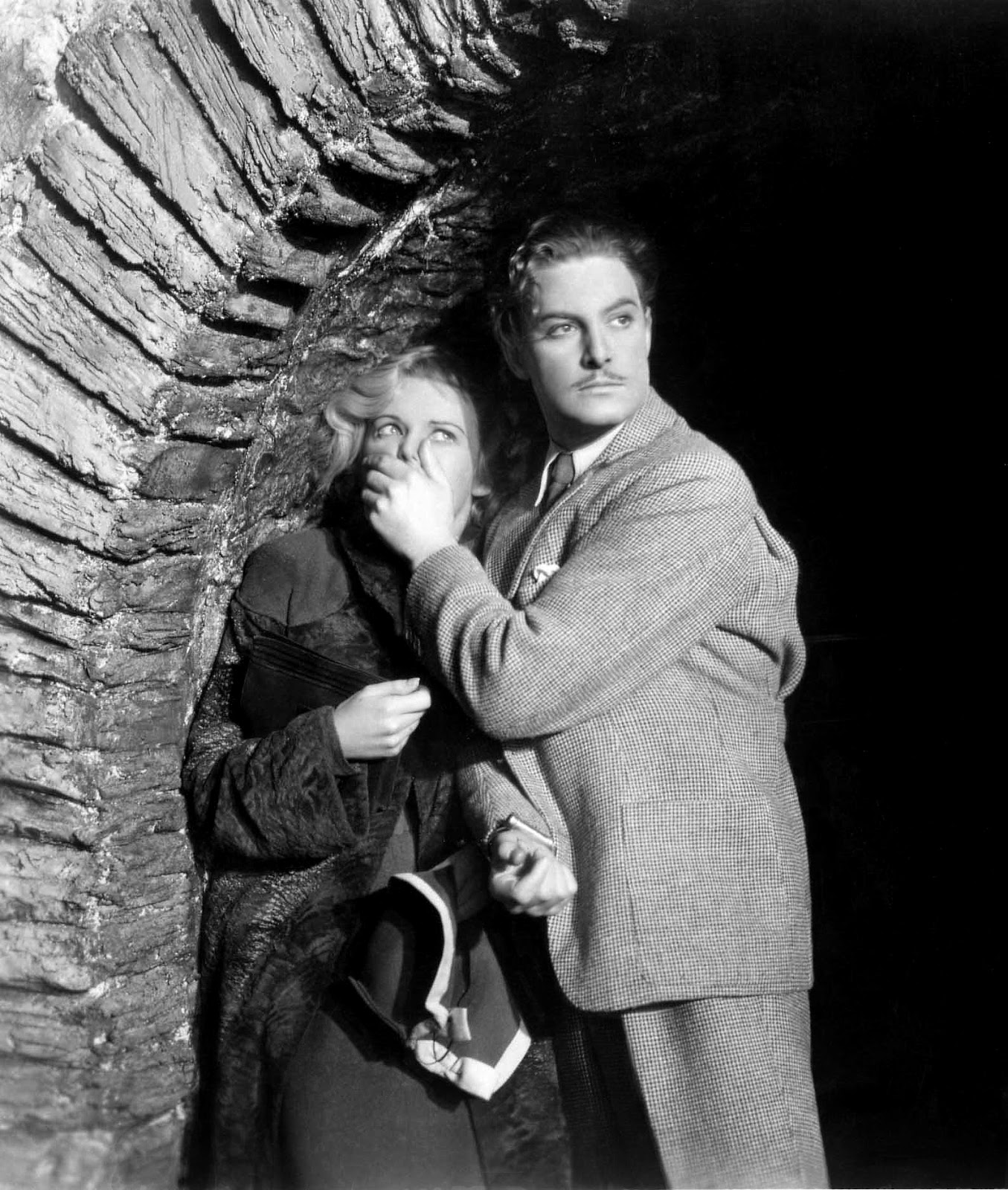
Alfred Hitchcock had a successful directing career in Britain that preceded his American super-stardom. Hitchcock fans rightfully consider the 1935 comedy-romance-thriller The 39 Steps among the very best works of the Master’s “British period”.

Robert Donat cuts a dash as Mr. Hannay, the hero of the film, who tries to save England from the threat of nefarious and crafty foreign agents. As in other Hitchcock films (e.g., North by Northwest, The Wrong Man, The Man Who Knew Too Much,), the central character is an innocent who is pulled into a web of intrigue and danger which he doesn’t understand. But unlike in those darker films, it doesn’t seem to bother him a jot.

“Did this beautiful woman just fire a gun in a crowded theater to evade her pursuers and then tell me that she is an international spy for hire? Well then, let’s go back to my flat for a large whiskey and soda and I’ll cook her up some haddock while she tells me all about it.”

“I seem to have walked into a political rally focused on I know not what and I have been mistaken for the distinguished guest speaker. Well then, jolly good, I’ll give it a go.”

“Am I really handcuffed to yet another beautiful woman as I run through the Scottish Highlands with people trying to shoot me? Well then, I wonder if she’s married or at least broad-minded.”

Categories
Documentaries and Books

American Movie

Chris Smith was an unknown would-be director attending film school in Milwaukee when he met a fellow would-be filmmaker named Mark Borchardt, whose career could not have looked very promising. Smith wisely made the decision to make Borchardt the subject of a documentary, and the result is a movie that succeeded artistically and financially more than either of them could have imagined: 1999’s American Movie (sometimes listed as “American Movie: The Making of Northwestern”).

The documentary follows Borchardt’s painfully unsuccessful effort to make “Northwestern”, which he envisions as a cinematic masterpiece. As the shoestring production collapses around him, Borchardt decides instead to resurrect his half-finished horror film “Coven”, the proceeds of which he hopes will finance his dream project. With money from his dotty Uncle, and, volunteer acting and production by his family and aspiring local actors, Coven fitfully begins to turn into something of which Borchardt hopes he can be proud. Meanwhile, the rest of his life is a mess. He is unemployed, lives at home with his parents, drinks too much, and is estranged from his children. The emotional anchor of his life is less so his family than his best friend Mike Schank, a recovering alcoholic with a taste for gambling and a peaceful stoner/Buddhist-esque demeanor.

Never mocking or exploitative, the movie takes its subjects seriously just as they take themselves and their art seriously. As with Hoop Dreams, the families involved gave a remarkable level of access to the documentary makers. The affecting result is a true slice of American life, as lived by white lower middle class people in Milwaukee.

And remember, “Coven” does not rhyme with oven. Should’ve kept the umlaut….

Categories
British Drama Mystery/Noir

Brighton Rock

The 2010 remake of Brighton Rock got mixed reviews, so I recommend discovering instead the 1947 original, which is both a fine character study and a solid piece of British film noir. Made just after the war by the Boulton Brothers, this story of razor-wielding gangsters was considered shocking in its day. Though a bit dated, it remains worth watching for its strong acting, emotional impact and truly memorable visuals (particularly during some jolting violence).

Scripted by two lions of British cinema, Graham Greene and Terence Rattigan, the plot centers on a small criminal gang led by the cold hearted Pinkie Brown (A genuinely chilling Richard Attenborough). The former boss of the gang has just been murdered and Pinkie is struggling to revenge the loss while fending off internal and external threats to his control. A saintly, pretty young girl named Rose (a pitch perfect Carol Marsh in her film debut) has evidence that can put Pinkie away for a killing, but also, strangely enough, seems to be falling in love with him. Meanwhile he grapples with Catholic guilt at the life he is leading.

Richard Attenborough in "Brighton Rock" (1947) | Brighton rock ...

As in many British dramas of the era, highly experienced actors take every advantage of the smaller roles in this movie. A pre-Dr. Who William Hartnell plays a complicated criminal who is heartless when committing violence yet develops a paternal protectiveness towards Rose. Veteran stage actor Harcourt Williams steals scene after scene as a Shakespeare quoting shyster.

Only quibble: In trying to contrast “carefree tourist Brighton” with the seedy underbelly, the film makers go overboard early in the film with annoyingly upbeat music that detracts from the mood of menace. But that trope fades out after the first 20 minutes or so, leaving the viewer plenty of time to be both fascinated and repulsed by Pinkie Brown and the criminal world which he inhabits.

Categories
Documentaries and Books

A Perfect Candidate

Every election season, I revisit R.J. Cutler and David Van Taylor’s revealing 1996 documentary A Perfect Candidate. The setting is the 1994 Virginia Senate race between incumbent Chuck Robb and challenger Oliver North, which one voter likens to a choice between “the flu and the mumps”. The principal players in the movie are Washington Post report Don Baker and North’s campaign manager Mark Goodin (a Lee Atwater mentee). Their candor and insight are nothing less than disturbing, as this set of clips with Goodin shows.

As the movie unfolds, both campaigns lurch from the trivial to the ugly, and no one comes out looking very good at the end. The fact that the outcome of the election is known in advance by the audience does nothing to limit the fascination this movie generates as it documents how campaigns operate. There is nothing inspiring here about the electoral process, unless it is to inspire us to change it. But that’s why A Perfect Candidate is an outstanding documentary: It shows life unvarnished and in an emotionally compelling way. It’s a raw, remarkable must-see film for political junkies and for anyone who wonders why we get the candidates we do in our elections.

Categories
Comedy

Murder by Death and The Cheap Detective **Double Feature**

There is an above average Jimmy Stewart movie called No Time for Comedy, in which he is cast as Gaylord Esterbrook. Gaylord writes hilariously funny plays yet feels he should write dramatic productions of greater weight in order to be a “serious writer”…but his effort to do so is disastrous. The movie always makes me think of Neil Simon. When he tries to be dramatic he is often manipulative, soppy, boring or pretentious. Films like “California Suite” make me ape Homer Simpson’s reaction to watching Garrison Keillor (Homer beats the idiot box yelling “Stupid TV! BE MORE FUNNY!”).

But when Simon gets over himself and just tries to be funny, he can be absolutely, rib-ticklingly, delightfully enjoyable. This double feature recommendation highlights Simon at his gutbusting best in two loosely linked comedies directed by Robert Moore: Murder by Death (1976) and The Cheap Detective (1978).

Both films are affectionate parodies of fictional detectives from the movies. Nick and Nora Charles, Charlie Chan, Sam Spade, Miss Marple and Hercule Poirot are sent up in Murder by Death. The Cheap Detective focuses only on Sam Spade (renamed Lou Peckinpaugh) as he works his way through the plots of many Humphrey Bogart classics, including the Maltese Falcon, the Big Sleep and Casablanca. There is murder and intrigue in both films and a plot as well, but who cares?: The purpose is laughter and laugh you will if you have a funny bone in your body.

The cast is gold, a simply stunning array of talent (some of whom appear in both movies): Peter Falk, Eileen Brennan, James Coco, David Niven, Maggie Smith, Alec Guiness, Louise Fletcher, Peter Sellers, Marsha Mason, James Cromwell, Nancy Walker, Elsa Lanchester, Sid Caesar and many more. Everyone knows what they are doing and gets every conceivable laugh out of Simon’s scripts.

My favorite bits are hard to choose from such an embarrassment of comedy riches, but I will try. In Murder by Death: The best ever update of “Who’s on First”, featuring a butler named JamesSir Bensonmum and his father Howodd Bensonmum. In the Cheap Detective: Betty DeBoop’s stage number and first encounter with Lou Peckinpaugh (“You made me swallow my gum”).

Categories
Action/Adventure Drama

Robbery

If you are one of the many admirers of the 1968 American classic Bullitt starring Steve McQueen (my recommendation here), you will almost certainly enjoy the British film Robbery. Released the year before Bullitt, it’s a partly fictionalized account of the astonishing 1963 heist of a British mail train by a gang of bold and crafty thieves.

Like many heist films, this one begins with a smaller job that introduces us to the characters and sets up the big score to come. The gang upon which the movie centers is led by criminal mastermind Paul Clifton (Stanley Baker, who also produced). Baker was one of a number of rough-hewn leading men who captivated British audiences in the 1960s. One wonders if we would have ever heard of a similar actor — Sean Connery — had Baker not turned down the offer to play a secret agent named James Bond (Side note: It is nothing less than eerie to see how much an older Baker looks like an older Connery in later projects such as the ITV mystery special Who killed Lamb?). In all his roles, Baker radiates power, even as in this case when his character is intellectual and non-violent. Credit him here also with first-rate production values on a film was no doubt good practice for the studio that would go on to make The Italian Job.

The gang escape their first job after a harrowing, thrilling car chase through London, but they don’t spend the money. They need the swag to fund something much bigger that Clifton is planning. The actors playing Clifton’s crew all turn in good performances, as does James Booth as the Police Inspector who doggedly pursues them. We don’t get detailed back stories on any of the characters, but it doesn’t matter because the actors are talented enough to bring them to life and make them distinct.

It was the amazing car chase, much of it shot with handheld cameras by the great Douglas Slocombe, that made Steve McQueen chose Peter Yates as the Director for Bullitt. But that isn’t the only parallel between the two films. Unusually for a director gifted at action films, Yates is comfortable with long silences and seems to encourage his actors to underplay their parts. It creates a distinctive mood that is somewhat melancholy, which fits the many of Yates’ characters who are driven to do things that seem very unlikely to satisfy them in the end.

The bulk of the film is devoted to the painstaking preparations of the gang to pull off the crime of the century, and then the heist itself. As in the actual great train robbery, a number of things go wrong, giving the police a chance to track down the gang and its crafty leader. The resolution of the film is perhaps a bit sudden, and there are a few draggy spots, but overall it’s a solid caper film that will please fans of the genre.