Categories
Action/Adventure British Drama

In Which We Serve

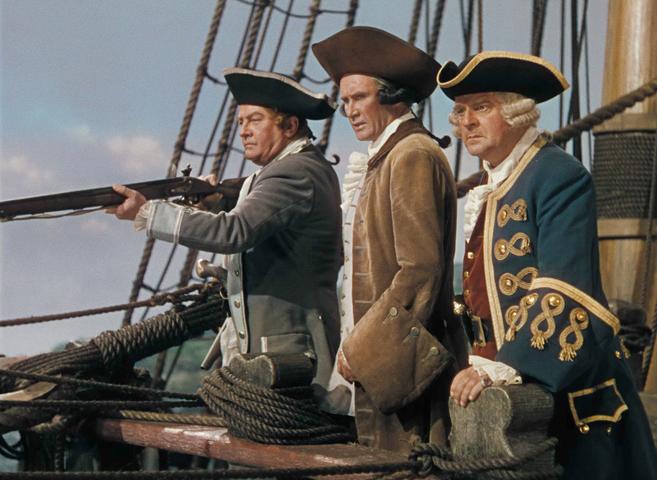
Pour yourself a small gin or a nice cup a tea, stiffen your upper lip, turn off the wireless (radio, that is) and watch one of the best films ever released in a time of war: 1942’s In Which We Serve. Made almost single-handed by Noël Coward (with some directorial assistance from the legendary David Lean), this is an unabashedly patriotic tribute to the Royal Navy, told as “the story of a ship”, the HMS Torrin. The primary purpose of the film is to encourage a nation facing annihilation, and it clearly succeeds in that respect. But it’s also — even today — moving, exciting and worthy of admiration as a piece of cinema.

The story telling style is reminiscent of Coward’s magnificent Cavalcade. Rather than following a strictly linear narrative, the film instead presents a series of recollections by different characters, all of whom are literally clinging to life after their ship has been torpedoed. In flashback scenes, they recall their families, their friends, and most of all their experiences on the H.M.S. Torrin. It’s stirring stuff. The Dunkirk rescue operation and the battles near Crete are brought vividly to life, using a well-edited mix of documentary footage and scenes shot for the film.

Noël Coward’s Mountbatten-esque performance (the two remarkable men were good friends) as Captain Kinross is probably a bit too mannered to be completely accessible to most viewers. The heart of the film is much more Bernard Miles as CPO Hardy and John Mills as his nephew by marriage, ordinary seaman Blake (Following this movie, Mills became a David Lean favorite, and won a best supporting actor Oscar under Lean’s Direction almost 30 years later). They and the other perfomers playing junior officers, ordinary seaman and family members back home are more vulnerable and therefore particularly sympathetic for the audience. We admire the formidable Kinross from an emotional distance but the “average” fighting men and their loved ones on the home front have more common humanity, particularly as we witness their courage, their fears and their loves.

In Which We Serve (1942) | From The Dam Busters to Dunkirk: the 31 ...

The film does not skimp on the horrors of war, including the terror of combat and the grief at losing loved ones. If you can’t shed a tear during the scene in which Blake tells CPO Hardy the latest news from home, call a cardiologist immediately because you are missing a vital organ from your chest.

The Brits and indeed the world were up against it when this film was made, so don’t expect cynicism, unhappy families or emotional breakdown by the characters (Even Richard Attenborough, as a coward, mans up in the end). A more realistic take on the war was possible after it was all over and people had the security to look back with a more gelid eye (see for example my recommendation of 1953’s The Cruel Sea). But none of that takes away from the power of this straight-faced tonic for the people of Britain at a time of unimaginable peril. It’s a triumph for Coward and the whole cast, who received a special and much deserved Academy Award for their efforts.

In Which We Serve is in the public domain and you can watch a high-quality copy for free by clicking here.
Categories
Blogs on Film Uncategorized

Money is Small and Light in the Movies

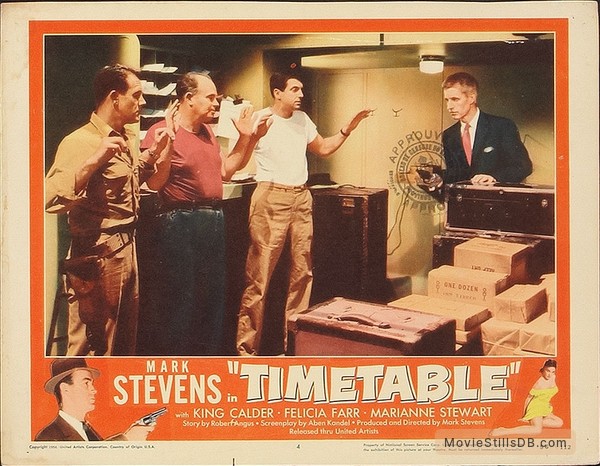
Time Table - Lobby card

I recommend Mark Stevens’ excellent 1956 film noir Timetable. There’s a funny movie trope during the robbery scene portrayed above. After the robber blows the safe, he steals “$500,000 in small bills”. The money is contained in two small satchels each about the size of a woman’s purse, which he almost daintily lifts and then tosses into his suitcase.

In real life, a piece of US currency is .0043 inches thick and weighs about a gram. If we assume the average “small bill” in 1956 is a $10 note and that the bills are all perfectly pressed flat with no wrinkles, the stack of bills should have been 17.92 FEET high and would have weighed just over 110 pounds!

But in the movies, money is small and light. Countless caper films (e.g., Heat) feature people nimbly running around with zillions of dollars in their small, lightweight satchels.

Someday I hope to see a film that undoes this trope, for example by having a kidnapper not be strong enough to lift the suitcase with the ransom in it, or having a car axle bend under the weight of the multi-billion dollar haul in the back seat.

Categories
Blogs on Film

John Leach Helped Make Spy Movies Cool

John Leach has passed away. He was a multi-talented composer and musician with many artistic achievements to his credit. He also made a small but important contribution to the ambience of the spate of espionage films that emerged from Britain in the 1960s and eventually became a world wide phenomenon.

The theme music of many of these movies featured sonorous notes — at times evocatively asynchronous — that came from a cimbalom, a hammer dulcimer from Hungary that Leach mastered. The musical touchstone is the theme to The Ipcress File (Michael Caine’s superb first outing as Harry Palmer). The music was written by the legendary John Barry with Leach adding his own magic, and the resulting style was widely copied in later films using either a cimbalon or other instruments that could generate a similar effect (e.g., the plucked strings of a piano or a properly tuned electric bass guitar).

When I hear those intoxicating notes, I see in my mind a hundred ultra-cool, glumly professional spooks in overcoats, walking down dark streets and battling it out with their opposite numbers in The East. Music really can help define and enrich a film genre. Well done Mr. Leach. R.I.P.

Categories
Blogs on Film

Overused Movie Trope #267: No-o-o-o-o-o-o-o-o-o-o-o-o-o-o-o!!!

Suffering through The Hobbit: An Unexpected Journey on an airplane some years ago, I noticed a movie trope that is even more overused (and is much more annoying) than “over and out” the tell-tale cough of death and bullets that throw people across rooms upon impact.

The scene: Thorin sees his father slain in combat and the camera zooms in on his face and then we go to slo-mo as he yells “No-o-o-o-o-o-o-o-o-o-o-o-o-o!!!!!!”.

How many zillion times have I seen that in a movie? I thought, and has it ever really worked?

And how long before I have to watch this stale bit of film making again?

Answer, in the closing scenes of The Hobbit, a scant 8 hours later (I’m estimating by how it felt), Thorin is about to be killed by a big orc and so the camera zooms in on Bilbo’s face, and we go to slo-mo as he yells “No-o-o-o-o-o-o-o-o-o-o-o-o-o!!!!!!”.

I wish every time a screenwriter and director agreed they were going to re-use this trope, someone sitting in on the script meeting would do what all the people in this youtube clip do.

Categories
Blogs on Film

Making a No Budget Movie

The movie adaptation of some of my wife’s poetic short stories has just been entered into the very intense competition to appear at Cannes. They have categories for big budget, mid budget and low budget. And then below that are films like ours, in which a large cast and crew donated their time because they wanted to be a part of an artistic project that excited and fulfilled them.

Huge congratulations to Director Jeff Wedding, who laboured for six years to make A Measure of the Sin a 16mm reality. As the trailer below demonstrates, technology has democratized film making: You don’t need millions of dollars to create cinematic art.

Categories
Blogs on Film Uncategorized

Impress Audiences Quickly, Or Else

Watching a movie once required a significant investment of time. You had to page through the newspapers to find the ads, decide what you wanted to see, look at showtimes until you found one that worked with your schedule, travel to the theater, buy a ticket and travel home afterwards. Today, just sitting here in my living room I can watch thousands of films with the click of a button over the Internet, or for that matter can reach out and grab any of the hundreds of DVDs on my bookshelf.

It’s therefore incredibly easy to switch away from one movie you are not enjoying to a different choice. This simply wasn’t possible in the old days. If you didn’t like how a movie was going you would probably sit through it anyway because of sunk costs (travel time, ticket purchase) and because the alternative film might be a week away. Even if you were watching the movie on television, there were not that many channels then and there probably wasn’t much else to switch to.

In the days when you were more or less stuck with one movie to watch, it was easier for movies to overcome really bad openings. Poseidon Adventure was a smash hit at the box office, but its opening 20 minutes are almost comically dreadful. The film opens on a doomed ship, with each key character getting serial ham-handed introductions of their stereotypical back story. The Simpsons parodied the opening moments of the film thus:

Marge: What a fascinating cross-section of humanity. You got the lonely, but lovable loser…

Jeff (sitting with dolls of Charlie’s Angels): Hello, Angels. Your mission today involves going undercover at a wet t-shirt contest. (pours his water over the dolls) Just get you wet… (grins)

Marge: Maybe not so lovable.

Lisa: And you got the elderly Jewish couple making their first trip to Israel.

Wife of Old Jewish Man: Our son Shlomo is working on a kibbutz in Haifa. We’re schleppin’ him some kreplach.

Old Jewish Man: We’re Jewish all right.

This dreadful narrative “technique” is accompanied by painfully wooden acting. In particularly, Leslie Nielsen, as the Serious, Strong-Jawed Ocean Liner Captain with Integrity, seems to be parodying himself as he later would do so well in The Naked Gun…but his part here is putatively dramatic rather than comic.

And yet, about 20 minutes into this torment, the boat flips over and the movie becomes one heck of a good time as the survivors try to travel its length and escape. There are good special effects, exciting action scenes, some suspense, some existential weight, and some hard to forget visuals of upside down kitchens, bathrooms etc.

It would be hard to persuade a modern viewer to sit through those first 20 minutes when there are a thousand other film choices a touch of the button away. Now, of course there is nothing wrong with film makers not making a bad opening 20 minutes, but what about films that take some time to develop but are more rewarding as a result, such as Vertigo? Would a film maker be as likely today to risk telling a story that was initially confusing (e.g., The Long Good Friday), or challenging, or leisurely in pace?

Directors and producers want their films to be watched and watched in their entirety for artistic and commercial reasons. In an age of so much choice they must feel more pressure to put more action/sex/plot twists in early so that people don’t flip around to another cable channel or Internet streaming site. They must also feel some pressure to be ingratiating rather than challenging to their audience.

I’d be curious to hear the perceptions of people who have been watching movies for a long time whether they perceive any trend toward “front-loaded” narrative structure in movies as film makers compete ever more intensely for viewers with countless other easily accessed options.

Categories
Blogs on Film

Artistic and Economic Legacies of a Landmark Antitrust Case

The marked decline in Hollywood’s fortunes in the 1950s and early 1960s (before Scorsese, Coppola, Evans et al saved the day) is usually attributed to the increasing availability of televisions in American homes. This was no doubt a factor, but equally important was a 1948 Supreme Court: United States v. Paramount Pictures. The impact of this antitrust ruling was enormous both for the artistic content of studio movies and for the economic shape of the film industry.

Understanding the case requires an appreciation of the vertical integration of Hollywood’s business prior to the war. You may have noticed that many cities and towns have cinemas with names like “The Paramount”, “The Detroit Fox Theater” and “Warner” (including the hometown theater where I happily misspent a non-negligible portion of my West Virginia childhood). Those theater names are a legacy of the era in which the five major film studios owned the bulk of movie houses in the U.S.

Owning the theaters in which their movies played gave the big studios an extraordinary financial advantage in distribution, which they leveraged further by forcing independently-owned theaters to “block book” their products. If you wanted to show the hot new Bogart picture Casablanca in your independently-owned theater, you were strong-armed into also showing some Warner Brothers-made newsreels, short subjects and probably a low-budget second feature as well. And if you were an independent film producer looking for an audience, you pretty much had to go on your knees before the major studios to gain access to their theaters. The SCOTUS Justices knew an antitrust violation when they saw it, and their 1948 decision in the Paramount Pictures case forced the studios to give up ownership of theaters.

The artistic impact of the high court’s decision is not fully appreciated, even by film buffs. In the old business model, studios had regionalized audiences, which influenced their film production choices. In trying to explain why Broadway style musicals and cosmopolitan comedies were staples at MGM/Loews studio but not at 20th Century Fox for example, you need look no further than where their respective theaters were located: The former were concentrated in New York City and other parts of the Northeast, the latter were mostly further west, often in more rural areas.

Shorn of regionalized audiences, all the studios began playing a national game of pursuing audiences and lost their distinctive artistic approaches. Their products became more homogenized as a consequence.

Economically, the Paramount Pictures decision helped create what my pals Robert Frank and Phil Cook term a “Winner-Take-All-Market” in the movie industry. In the old system, all the studios could ensure at least some ticket sales by putting their own films into their own theaters. As theaters became free entities, competition was nationalized with no floor under what amount any studio might make and not much of a ceiling on what they might realize either.

Funnily enough, it was Paramount that first grasped the implications of the new market when it released The Godfather in a then shocking 400 screens nationwide. Soon afterward, Jaws tripled the size of that release. Both films made money hand over fist, and the blockbuster film era had truly arrived. From then on, a small number of films would make extraordinary profits, whereas the great bulk of films would make little or no money at all.

Categories
Mystery/Noir

Too Late for Tears

I’ve recommended I Walk Alone, a 1948 gangster melodrama directed by Byron Haskin with Lizabeth Scott and Kristen Miller in supporting parts and Burt Lancaster and Kirk Douglas in the leads. The following year, the first three of those talented people re-teamed to make Too Late for Tears. This time around, men move to the back of the room to make space for the women characters, the noir elements are much more pronounced, and the script offers a more tightly constructed and cleverly plotted story. The result is an even better movie, indeed a treasure of the film noir canon.

The plot has so many surprises that it’s hard to summarize without spoliers, so I will confine myself to the set up. The Palmers are driving down a lonely, winding canyon road. Alan Palmer is a straightforward, true blue type who loves and trusts his wife (or so it seems…). Jane Palmer has been married before to a man who committed suicide (apparently…) and complains that she is tired of not having enough money. But she is so happy to have Arthur as her husband that she doesn’t mind that he isn’t rich (or so she says…). And then, a miracle. Another car throws a suitcase full of kale into their back seat and then drives away without explanation. Clearly some mistake has been made and they ought to go to the police, but it’s so so tempting to keep so so much money. And then they see another car pursuing them: Is it driven by the person who was supposed to receive the payoff that has landed in their lap?

To reveal more would be an injustice. Roy Huggins, who later went on to TV Hall of Famedom for The Rockford Files and The Fugitive, deserves roses for his ingeniously plotted script. It keeps the viewer guessing (usually, wrong) and ties up all the loose ends in a satisfying conclusion.

Kristine Miller, as the sister-in-law who has never really trusted Jane Palmer, has some wonderful scenes with Scott where they are pleasant on the surface but clearly jousting underneath. I find it strange that the alluring and talented Miller never became a star, but she said in late life that in the end Producer Hal Wallis “didn’t know what to do with her”. That’s a shame, because with the right vehicle she could have captured the public’s imagination in way she ultimately did not in the 1940s and 1950s.

The male supporting players, Arthur Kennedy as Alan Palmer, Dan Duryea as a slimy grifter and Don DeFore as a man with mysterious motives, turn in solid performances. And Haskins, in contrast to I Walk Alone, seems in full command from the director’s chair, partly no doubt due to experience and partly because he has a stronger storyline this around.

But this movie is first and foremost dominated by Lizabeth Scott, in a knockout performance. She had an unusual life in film. She looks and sounds like a cross between Veronica Lake and Lauren Bacall, and indeed was packaged as a Bacall-type by Hal Wallis. She spent almost her entire career making crime melodramas and film noirs in the 1940s (the fine picture Dead Reckoning with Humphrey Bogart being the mostly widely remembered). And then in the 1950s her career swooned, perhaps because the tabloid press reported that she was a lesbian (Ms. Scott, who lived until 2015, shunned publicity for over a half-century, so her view of what happened remains unknown).

I criticized her somewhat stilted performance in I Walk Alone, but I can do nothing but praise her tour-de-force in Too Late for Tears. She owns the screen, in one of a handful of movies made right after the war that was willing to put a tough woman at the center of the story (for another, see my review of Strange Impersonation). In her words, expressions and physical movements, Scott brings alive a femme fatale of hidden motives, craftiness and tough-as-nails pursuit of money. She’s a nasty, manipulative piece of work such that when a tough male actor like Dan Duryea is clearly shocked and repulsed about how much more brutal she is than he ever could be, the audience nods along, mouth agape.

Comparing this film to I Walk Alone is a good way to learn about the nature of film noir. Although I Walk Alone is often mentioned in books about the genre and Too Late for Tears is not, the latter is a much more fully realized example of the style. Look for example at the washed out set design in the Palmers’ apartment and the lighting and camerawork in Scott’s scenes with Duryea. The bleak view of human nature and the number of characters trapped by irresistible, bad impulses are also defining features of what is probably the most completely developed style of American film (Even though, of course, its precursors are European). Why Too Late for Tears isn’t mentioned in the same breath with other noir classics is a mystery to me, because it ranks with the very best of the genre.

Categories
Drama Mystery/Noir

I Walk Alone

4 Movies Starring Burt Lancaster and Kirk Douglas

Burt Lancaster and Kirk Douglas had remarkably parallel careers. They both made their first film in 1946, quickly became huge international stars, and maintained their cinematic dominance for decades. Both were handsome, athletic men who were also intelligent enough to play parts with nuance and depth. Both ultimately broke away from the studio system to become independent producers. And last but not least, they made seven films together, the first of which is the 1948 crime melodrama I Walk Alone.

The story commences with Frankie Madison (Lancaster) getting out of the joint after a 14 year stretch. He was arrested for bootlegging with Noll “Dink” Taylor (Douglas), but Taylor eluded the cops, never did any hard time and indeed never even bothered to visit Frankie in prison. Frankie’s old friend Dave (Wendell Corey, in a quietly effective performance), who has stayed true to him, is under Dink’s thumb as the bookkeeper of his swanky nightclub. Frankie feels entitled to half of the club, but Dink isn’t feeling generous. Dink sends his moll, a singer in the club (Lizabeth Scott) to sweet-talk Frankie; he’s lost interest in her anyway because he wants to marry a blue blood (a sultry and perfectly bitchy Kristine Miller) who will secure his place among the posh people.

The emotional power of the film comes from the conflict between Frankie and Dink. Lancaster’s Frankie is a pacing, rough cut ex-con who would like nothing better than to slug it out. Douglas’ Dink is all suaveness and reassurance, an oleaginous modern businessman who claims to have left the world of guns and fists. This contrast produces the best scene in the movie, in which Lancaster shows up with some thugs to take over the club by force, and Douglas humiliates him by explaining that because of multiple holding companies and escrow agreements, there is nothing to take over (without a vote of the board and amendment of the by laws of course). As Dink himself says, Frankie is a dinosaur, unable to cope with the realities of the modern world. But Dink still fears him enough to commit a terrible crime and frame his former pal as the culprit.

There are some flaws in this film. It was Byron Haskin’s first directorial outing, and he doesn’t seem in full control of the material. He got much better later, for example in another of my recommendations, Treasure Island. This isn’t Lizabeth Scott’s best work either. She seems one-note off in I Walk Alone, for a reason I cannot guess (Bad direction from Haskin, maybe). Charles Schnee was a great script writer (The Bad and the Beautiful, starring Kirk Douglas, being one of his gems). His script here includes some pungent dialogue but the story drags at times, particularly in the second half. But no matter what slow spots intrude on the viewer’s enjoyment, the film always roars back to life as soon as the two lions of post-war cinema are tussling on the screen again.

As a note on the actors, this was the fourth film for both men and they apparently spent little time with each other off-screen. Their friendship/rivalry was to blossom much later during the making of Gunfight at the O.K. Corral. About 10 years ago, I had the good fortune to hear from Douglas’ own lips that the rivalry was largely a studio and trade press invention, when in reality they had always been good friends. But who knows or cares? Whatever their personal relationship was like off screen, they were a terrific duo onscreen.

Categories
Action/Adventure British

Treasure Island

Yarrrrrrrrrr! Movie pirates didn’t have heavy West Country accents before Robert Newton’s famous turn as Long John Silver in the 1950 version of Treasure Island. Disney’s first-ever live action film is aimed squarely at school age boys, but is also pleasant for grown-ups to revisit on a rainy Sunday afternoon. The film’s production values hold up well even 60 odd years on, and, while even older, R. L. Stevenson’s 1883 story (with some amendments) retains its charm and excitement even for modern audiences.

The story opens with young Jim Hawkins tending the bar in his mother’s inn (She herself nor any other significant female character appears in the film, so we are truly in boyland here). In comes Black Dog, a menacing Pirate in search of Captain Billy Bones, who is hiding out at the inn. After Black Dog leaves, Billy Bones gives young Jim a treasure map and tells him to flee before the pirates return. Jim confides in two honorable adults, Squire Trelawny and Dr. Livesy. Our heroes set sail in search of pirate treasure, not realizing that the old sea dog they have hired as the cook is the dread Long John Silver, and most of the crew are his own bloodthirsty band of brigands! Thems that die’ll be the lucky ones, arrrrhh!!! Adventure, thrills and some welcome moments of humor and humanity ensue.

Treasure Island - Is Treasure Island on Netflix - FlixList

The emotional heart of the film are Long John Silver (Robert Newton) and Jim Hawkins (Bobby Driscoll). The good adults led by Squire Trelawny are uniformly noble and brave, the pirates (other than Long John) are uniformly nasty and craven. With that as a flat background, Silver and Hawkins really come to life. Long John is the only adult of complex character in the story, being in some ways cunning and greedy but in other respects moral and kind. And because Jim is the only character who travels between the worlds of the oh-so-good-heroes and the oh-so-evil pirates, he becomes a finely shaded character too, particularly as he learns to appreciate that his sometimes-friend Silver is neither a thoroughgoing villain nor a worthy role model.

Newton’s flavourful acting makes this film hum and is worthy of admiration. A less professional actor would have condescended to only a half-hearted or one-dimensional performance, seeing a “children’s film” as beneath him. But Newton goes all in, bless his cotton socks. He will likely always be cinema’s iconic Long John Silver and Silver will certainly always be his most famous role even though he turned in many strong performances in his career (e.g., as Bill Sykes in David Lean’s fine adaptation of Oliver Twist). Newton never makes Silver so evil that the audience can just hate him outright (as hammier actors have in other adaptations of Stevenson’s novel), but neither does he minimize the cruel aspects of the character that make him scary and thereby provide much of the tension of the story.