In the late 1960s and early 1970s, African-American actors had a boomlet of Academy Award acting nominations. Many predicted at the time that the civil rights era had finally come to Hollywood, and that Black nominees and winners would become a fixture at the Oscar ceremony.
It was a false dawn. Nomination droughts set in for Best Actor (1972 to 1986), Best Actress (1974 to 1985), Best Supporting Actor (1969 to 1981) and Best Supporting Actress (1967 to 1983). Black actors were rarely given good opportunities to showcase their talents, and when they did, the Academy ignored them.
In 2001, Halle Berry won the Oscar for Best Actress and Denzel Washington won for Best Actor. Again, many predicted that Hollywood had changed forever. Enough time has gone by to evaluate whether 2001 was a turning point or a blip on the radar.
The second time was the charm. Since the Academy’s creation in 1929, African-Americans have been nominated for acting awards a total of 88 times. Most (59%) of those nominations occurred from 2001 onward. The change is even more impressive if the analysis is restricted to winners: 16 Oscars in the 21st century, versus only 6 over the preceding 72 years.
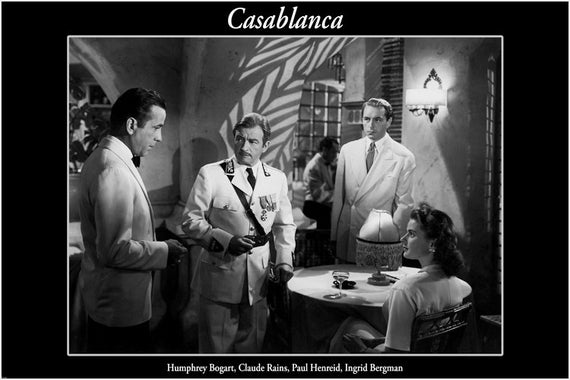
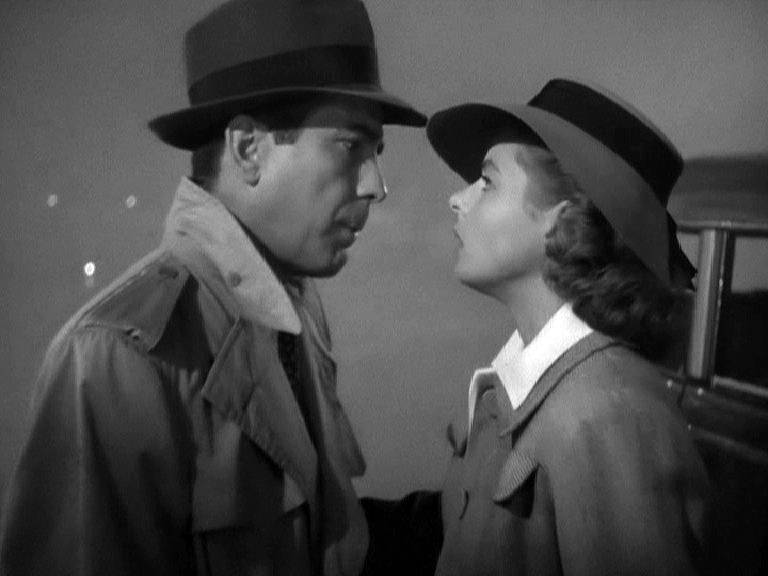
Everyone has their favorite quote from Casablanca – so many to choose from: “Round up the usual suspects!”, “I’m shocked, shocked, that gambling is going on in this establishment”, “Are my eyes really brown?” etc. After about 10 or 15 viewings, my favorite switched to a lesser known line. I love it because of how it’s said, how it’s the key to the love story, and most of all how it’s untrue.
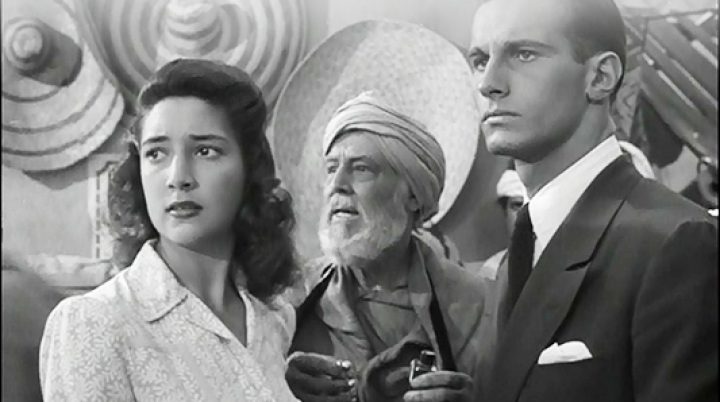
As in a Shakespearean romance, there’s a young couple who are a foil to the central romance (between Rick and Ilsa). Jan and Annina Brandel are just-married Bulgarian refugees, desperate to get to America. Annina Brandel (Joy Page) comes to Rick for advice.
She is considering prostituting herself for exit visas but worries about her husband’s reaction. She asks Rick “If someone loved you very much and your happiness was the only thing she wanted in the world and she did a bad thing to make certain of it, could you forgive her?”.
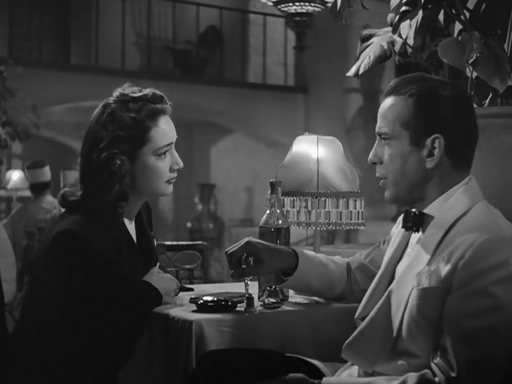
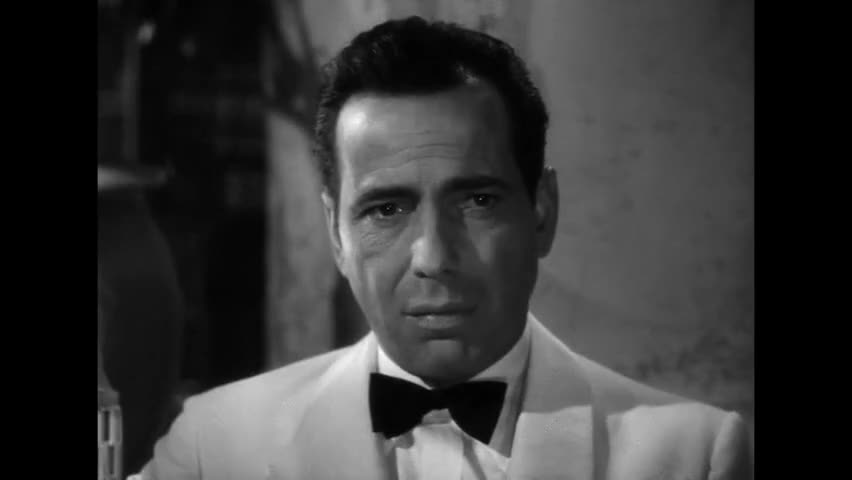
Whence comes my favorite line. Rick says “Nobody ever loved me that much”. Bogart delivers it with a perfect mixture of hurt, bitterness, and vulnerability. Underneath his cynical shell, Rick’s still standing at that train station with a comical look on his face because his insides have just been kicked out, thinking that Ilsa never really loved him.
And of course he’s wrong! Casablanca’s love story is fundamentally about Rick realizing that Ilsa did indeed “love him that much”, so that they both “get Paris back”. Casablanca in many stories at once, but at least for the love story, this is the line upon which it turns.
p.s. This as you might have guessed was originally a Twitter thread, and one of the nice things about putting it there is that I got a kind comment from Monika Henreid, daughter of Paul, who played Victor Laszlo.
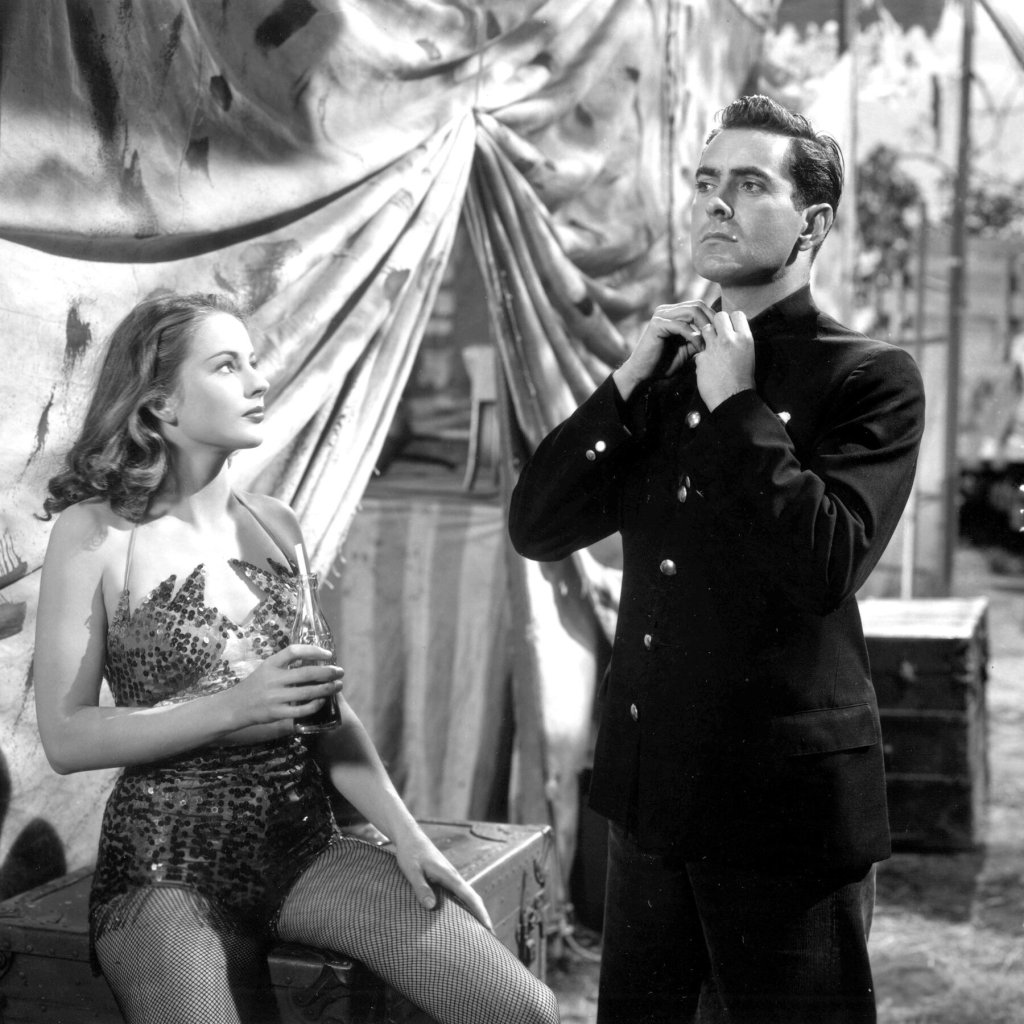
Tyrone Power was one of most dashing leading men in Hollywood history and became a massive box office draw beginning in the mid-1930s. However, after many swashbuckling Saturday matinees, musicals, and romantic dramas, he longed to do something more weighty. He used his star power to convince a skeptical Daryl Zanuck to produce a film based on a dark, disturbing, debut novel by a dark, disturbing guy named William Lindsay Gresham. The resulting film was a most atypical one both from the point of view of Power’s career and the film noir genre: 1947’s Nightmare Alley.
The plot is long and twisty, but Jules Furthman of The Big Sleep and To Have and Have Not fame knew as well as any screenwriter how to keep an audience from becoming lost. Stanton Carlisle (Power) works at a carnival, assisting a couple with their low rent mind-reading act. Zeena (Joan Blondell, whose performance stands out even in this strong cast) has become the brains of the outfit due to her husband Pete’s decline into alcoholism (A sympathetic Ian Keith). Once Zeena and Peter were the toast of high society, due to a sophisticated code they developed to create the illusion of extra-sensory perception. Stanton turns his magnetic charm towards getting Zeena to teach him the code and simultaneously seducing a young beauty named Molly who also works at the carnival (Coleen Gray). He gets what he wants from both women, and he and Molly flee to the big city. They revive Zeena and Pete’s old act with tremendous success. But soon an alluring and devious psychiatrist (a delicious part deliciously played by Helen Walker) tempts Stanton into an even bigger con, which leads him to places many a film noir protagonist knows far too well.
Nightmare Alley is a punchy exploration of how ambition and greed translate into cruelty and deceit. Although not generally known as a noir director, Edmund Goulding has firm grasp of the material, and deserves credit for the uniformly strong acting. He and Power had just collaborated on the excellent The Razor’s Edge and they continue to thrive together here, making Stanton appealing and vulnerable enough that we keep caring about him even as his morality corrodes. The film also offers an unusually large array of complex, strong, women characters, all of which are well-played.
Nightmare Alley is unlike most noirs of the period, for two reasons. First, Power doesn’t look the part of the noir protagonist: he’s too handsome, too smooth, and too poised. He looks out of place in the carny scenes, but at home in the swanky scenes where he wears a tuxedo in a plush hotel ballroom. And yet, it works, because this is perhaps the best performance of Power’s career, stretching his range unlike anything he’d been in before. The fall of his character is that much more devastating precisely because he starts out looking like he has success oozing out of every pore.
The other atypical aspect of the film is that it’s one of very few big budget noirs of the period (Leave Her To Heaven being a better known example) Noirs were usually cheaply made, and indeed some of their conventions (e.g., minimal lighting) emerged in part to hide their low budgets. In contrast, this is a gorgeous looking film shot by Lee Garmes and stuffed with authentic sets, varied locations, and perfect outfits for the characters.
The only thing that bothered me about the film is that the perfect, sock you in the gut final scene became the penultimate one when Zanuck saw the rushes. The film closes instead on a more hopeful (though still dark) scene that has less psychic weight. Studio-imposed, punch pulling, final scene are commercially understandable but artistically barren (I had the same complaint about 99 River Street), particularly here when “I was made for it” is an all time noir classic line that should have closed out the story. But that’s a small complaint to have about such an accomplished piece of cinema.
Nightmare Alley didn’t do good business at release because Zanuck didn’t believe in it and because it violated audience expectations for Power and for film noir. But in the years since, it has been deservedly rediscovered as a classic of the genre and a high point of the tragically short career of Tyrone Power.
To hell with happiness. More important was excitement and power and the hot stir of lust. Those made you forget.
Dorothy Hughes’ bewitching and disturbing novel In a Lonely Place was thankfully re-issued by New York Review of Books in 2017. It very much recalls some of Jim Thompson’s darkest works, though she’s arguably an even better writer than he was. Hughes’ stylish evocation of a psychopathic psychology is like one of those sweetened Russian cocktails that tastes wonderful going down even though you know it’s burning out your insides and will leave you full of the blackest regret in the morning. I can’t recommend the book strongly enough, though not for the faint-hearted.
Once you have read it, consider watching the unforgettable film adaptation, which I review below.
I was born when she kissed me. I died when she left me. I lived a few weeks while she loved me.
Amazingly, there are people who consider themselves Humphrey Bogart fans who have never seen the brooding, powerful 1950 film In a Lonely Place. In one of his greatest roles, Bogart plays bitter, hard-drinking Hollywood screenwriter Dixon Steele, whose best days seem to be behind him. After being tasked with adapting a dreadful novel for the silver screen, he asks a ditzy hat check girl who loves the book to come to his apartment and tell him the plot. The next morning, the police inform Dix that the girl has been murdered and dumped by the side of the road. As the audience, we do not know what really happened. Steele is initially alibied by sultry neighbor Laurel Gray (Gloria Grahame, all eyebrows, curves and nimbly masked emotional turmoil), who promptly yields to his romantic advances. They fall in love and Dix is able to regain his gifts as a writer. But as Laurel sees Dix continue to be volatile and aggressive, she begins to wonder, Suspicion-style, whether Dix is a murderer after all.
This movie is cynical about fame, Hollywood, and human relationships, but tantalizes us with the possibility that new love can redeem it all. The suspense emerges less from the murder mystery than from the warring internal emotions of the characters. Director Nicholas Ray knew life’s dark places and how to get actors to go there. His marriage to the volatile Grahame ended in the most sordid way imaginable while they were making this movie, and the anguish and anger on the set comes out in the electric performances of the cast. The film is also remarkable for its opening five minutes, which are a clinic in how a great director and actor can establish a character with ruthless economy (incidentally, the bar in the opening scene was modeled after Romanoff’s, Bogart’s favorite watering hole).
There are countless movies told from the man’s point of view in which a beautiful, younger woman falls in love with the protagonist (indeed, Bogart himself made a number of such films). The women in those movies are flat characters and we aren’t told why they go for the hero. He wants her, the story needs them to fall in love, so they do. What is truly remarkable about this movie’s structure is that it follows this formula about half-way through and then flips the perspective to the woman’s point of view.
The classic Dickens novels usually end with the central character finally finding a proper place in the world after years of hardship and misadventures. R.F. Delderfield’s To Serve Them All My Days takes the opposite approach of having a character with a tragic backstory find his proper place on the very first page, and spend the rest of his life realizing it. In 1980, BBC tapped Andrew Davies (later to pen another of my recommendations, House of Cards) to adapt the novel to the small screen, and the result is a fine 13 part miniseries that I recommend to you this week.
The series opens with shell-shocked, limping, wan, Welshman David Powlett-Jones (John Duttine) returning from the horrors of the trenches to apply for a teaching post at Bamfylde boarding school in Devon. The wily, gentle, headmaster Algy Herries (endearingly played by Frank Middlemass) sees potential in the traumatized young man and hires him as a teacher. Surrounded by better educated, better born, men, David initially struggles with that peculiarly Welsh working class admixture of pride and insecurity. But he slowly begins to find his footing, largely because he develops positive relationships with Algy as well as with a lonely, cynical, yet also compassionate senior housemaster (Alan MacNaughtan). He also grows to understand and be respected by the boys, despite not sharing their class background nor their politics.
David’s life is also shaped profoundly by three women he loves over the years, each of whom is emblematic of a different historical age. Beth Marwood is the perfect Victorian helpmate (indeed too perfect, she is the most flat character in the series unfortunately for Belinda Lang, who does her best). She is followed by the sexually liberated Julia, who has a flapper sensibility even though her horizons are limited by the social and occupational constraints placed on women in the 1920s. In the 1930s, Christine Forster arrives in a David’s life as a powerful person in her own right both psychologically and politically, facing down sexism while running for Parliament.
This series really grew on me episode by episode. In part that was due to Duttine’s layered performance as a lost, angry, and tentative person becoming over many years completely at home at Bamflyde, invested in life, and deservedly confident of his abilities. I also appreciated that some characters who started out as stereotypes, like Carter the failed soldier turned teacher (Neil Stacy) and the icy martinet headmaster Alcock (Charles Kay) became better-rounded over time. But the most rewarding feature of the series — as in virtually all drama — were the rich human relationships brought alive by a worthy script, directors, and cast.
The series isn’t perfect. The 12th episode features a subplot about anti-Semitism that is disappointingly carmelized and should have been dropped, one of the revelations in the final episode isn’t set up well enough in earlier episodes to have the desired impact, and throughout the series isn’t much to look at in terms of sets or camerawork. But it’s almost impossible to put 11 hours of film together and not have some weak spots.
To Serve Them All My Days is the sort of literate, solid entertainment upon which the BBC’s reputation for high quality drama rests. Make yourself a pot of tea and get watching.
London-based Hammer Films had a fertile and fiscally rewarding period in the 1950s and 1960s styling itself as the British second coming of the old Universal Studios Monster Movies. They gave Dracula, Frankenstein, and the Mummy quite a workout, relying on generally solid and scary scripts, a stable of dependable stage-trained actors, not-bad special effects, atmospheric locations (e.g., Highgate Cemetery) and an abundance of aspiring starlets with daring décolletage. Many viewers remember Hammer monster movies in their nightmares, but few recall that the studio also turned out some high-quality psychological thrillers, most of them scripted by Jimmy Sangster. This week I recommend my favorite of these films: 1961’s Taste of Fear (aka Scream of Fear).
The story centers on a frequently-invoked but still effective thriller trope: The central character who has some physical limitation that makes them unusually vulnerable. In this case, it’s Penny Appleby, who has needed a wheelchair since suffering a tragic accident. She has traveled far to visit the wealthy father whom she has not seen since her parents’ divorce over a decade ago. Her father’s new wife and a family friend named Dr. Gerrard greet her warmly, but inform her that her father is away on business. Yet as the days go by, a series of peculiar and shocking events make her start to think her father has in fact been murdered! Has she come across the world’s wickedest stepmother, or is she losing her mind? Nerve-shredding suspense and some inventive plot twists follow.
Taste of Fear is often referred to as Hitchcockian, and while I can see why, it recalls for me much more the French classic Diabolique, which Sangster almost certainly must have seen. Both films create a sense of dread and continually lead the viewer to think “Ah, that’s what’s really going on” to be immediately followed by “I was wrong again – I have no idea what’s really going on”.
Hammer made the film in partnership with Columbia Pictures, which accounts for them landing American Susan Strasberg for the role of Penny. She brings across very well a young woman who is understandably fearful but at the same time determined and smart enough to keep pressing the question. The rest of the cast are British talents of the type that Hammer more typically favored, including Dracula himself, Christopher Lee, as an effectively creepy Dr. Gerrard.
The other undeniable strength of the film is Douglas Slocombe’s pristine, gorgeous black and white cinematography. Both he and director Seth Holt have refined visual instincts regarding the balance of light and shadow that keeps the audience on the edge of their seats. They also create a stunningly horrifying shot underwater that I will not detail because it would spoil a plot point, but you’ll appreciate it when you see it. Credit former film editor Holt also for a tightly constructed movie – flabbiness is the enemy of suspense and everything in this movie is lean and tight.
Hammer devotees argue which of the studio’s films was the most creative and well-made, with Brian Clemens’ Captain Kronos, Vampire Hunter at the top of many fans’ list. That’s a fun movie, but I find Taste of Fear more tightly constructed and better acted as well. This shamefully-forgotten thriller is available on Daily Motion, which I believe has the legal right to rebroadcast old movies on line, so you can enjoy it free of guilt right here.
In my transatlantic existence, I’ve had many opportunities to observe the differences between British and American culture. One of the smaller ones: only the former have a broadly-shared tradition of telling ghost stories at Christmas. A Christmas Carol is of course the touchstone of this British pleasure, but it apparently started centuries before Dickens’ classic.
BBC responded to and nurtured this tradition for a number of years by adapting a ghost story for television each yuletide season during the 1970s, reviving the practice a little over a decade ago. Most of them have featured the stories of M.R. James, though Mr. Dickens has also had his turn (An effective adaptation of The Signalman). James was a respected British academic and medieval studies scholar who famously had a sideline in writing chilling tales of the supernatural, most of which featured a central character from James’ world (e.g., a writer, professor, bishop, museum curator) who gets in over his head when encountering malevolent forces he cannot understand.
Many people incorrectly recall the first BBC ghost story as being a Christmas special like all those that followed, but it was actually a springtime entry in the long-running series Omnibus, which more typically carried art-focused documentaries. But in 1968, legendary director Jonathan Miller gave Omnibus audiences a giant scare instead. The story centers on Professor Parkins, vividly portrayed by Michael Hordern as a near-autistic Cambridge Don who talks to himself more than the people around him. In a remote English seaside town, he checks into a bed and breakfast with a plan to do some reading and some “trudging” along the desolate beaches. His social awkwardness is extreme, positioning him apart from the other guests both figuratively and literally. But in this pivotal scene in which the hyper-rational Parkins puts a fellow guest who believes in ghosts in his place (“There are more things in philosophy than are dreamt of in heaven and earth”) we learn that it’s fundamentally smugness and not a sense of inferiority that separates Parkins from the rest of humanity. This is the classic M.R. James set up for a haughty intellectual to get his comeuppance via the world beyond.
And so it comes to pass. Professor Parkins comes across a grave that has been eroded by the sea and wind. Unwisely, he sorts through the bones to find a whistle with a Latin inscription meaning “Who is this who is coming?”. Of course the poor sod can’t resist blowing the whistle. Something awakens, glimpsed first as a distant, shrouded, figure silhouetted by the fading sun, then taking more form in pursuit during the Professor’s nightmares, and far too closer for comfort soon after that.
Like all of M.R. James’ stories, Whistle and I’ll Come to You is not a blood-spattered terror ride, but an eerie tale of foreboding, in which evil is often only glimpsed out of the corner of our eye. This is the artiest of BBC’s many adaptations of James’ stories, probably because of Miller’s presence and because the Omnibus audience would have expected nothing less (This also may account for the opening documentary-like narration by Miller, which might better have been dropped). Dick Bush does a tremendous job with single black and white camera set ups and long takes, including some effective low-angle and deep focus shots. He uses very few mid-range shots, mainly relying on distant, lonely, camera placement interspersed with a few well-chosen extreme closeups. The whole effect is admirably unnerving.
Were this constructed as a pure suspenser, the 40 minute running time would have been too long, but that’s why Hordern is such a treasure here. About half the story is a character study of an odd and indeed not particularly likable man, and Sir Michael carries that off in a compelling way until we get to the truly scary bits.
Whistle and I’ll Come to You is a worthy start to what became a beloved Christmas tradition in the UK (of the ones that followed, A View from the Hill is my favorite). Although the same story was re-adapted in 2010 by BBC with a bigger budget, the original is still I think the stronger piece of television and very much worth your attention this wintry season.
I once watched the 1941 version of The Maltese Falcon in San Francisco, and the audience started laughing when these words appeared on the screen.
Surely superfluous, they must have thought: who wouldn’t recognize San Francisco with all that stock footage of the city’s essentials? But San Francisco was a much smaller, less culturally significant city back then and many American movie goers would not even have heard of it much less been able to recognize it by sight.
I enjoy these “unnecessary explanations” in old films as historical curios. Another of my favorites is in the 1948 criminal investigation classic Call Northside 777. A suspect takes a lie detector test and a scientist explains what the machine does at what to modern audiences seems like inordinate length (after all, even in films like Deceiver that revolve entirely around a lie detector, there is little such exposition). The scientist is Leonarde Keeler, the co-inventor of the lie detector, a machine that audiences would not have heard of in 1948 and probably wouldn’t have taken as a credible plot point without all the sciency lecturing.
Similarly, another great police procedural of the same period, He Walked by Night, includes a detailed explanation of what a police composite sketch artist does because of course audiences at the time wouldn’t have already watched a million episodes of Law and Order on television.
Another notable example are “nature documentary moments” that appear in many films prior to the era of widespread television ownership, for example 1950’s King Solomon’s Mines. The characters in such films have plot-irrelevant conversations of the form:
Stay back, it’s a snake!!!
Hero or Heroine: “What on earth is that?”
Grizzled Guide Who Knows the Local Terrain: “That is a leopard”
Hero or Heroine: Wow!
Pretty boring if you’ve seen a Jacques Cousteau special or virtually any hour of what plays on the Nature channel all day long. But audiences back then couldn’t watch television nature documentaries and few of them had access to exotic zoos or international travel either, so as dull as these bits of cinema are to us today, they amazed viewers at the time, and they teach discerning viewers about the period in which the movie was made.
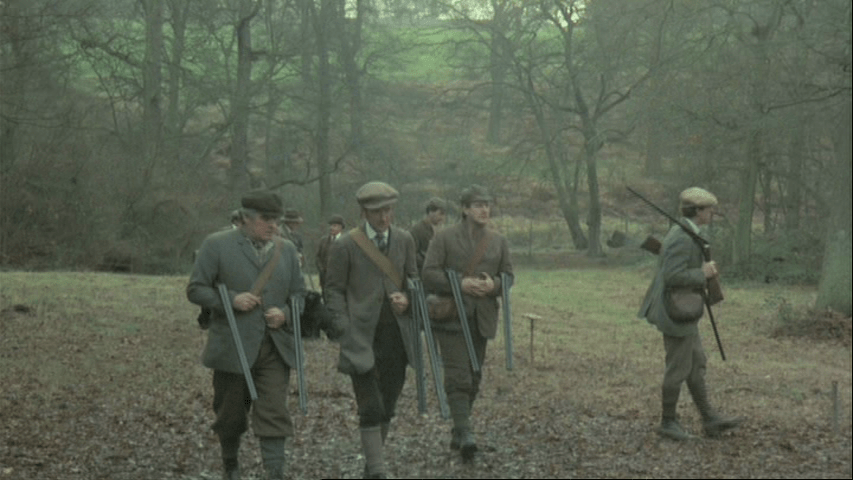
I have a weakness for British art that echoes French art, such as Anthony Powell’s Proust-esque Dance to the Music of Time. In a similar vein, allow me to recommend a British film that recalls Renoir’s Rules of the Game: 1985’s The Shooting Party.
The plot: Not long before The Great War will descend upon Europe, the kindly, idealistic, yet somewhat world-weary Sir Randolph Nettleby (James Mason, in his final cinematic performance) hosts a weekend shooting party at his arcadian estate. The guests include the competitive and cold Lord Gilbert Hartlip (Edward Fox, as watchable as ever) and his amorous and unfaithful wife Lady Aline Hartlip (Cheryl Campbell, whose performance stands out even among all this talent). Another unfulfilled but better-behaved noble couple (Lord and Lady Liburn, well-played by Robert Hardy and Judi Bowker) join them, as do a number of not-quite-that-loftily-titled but still upper class types from England and abroad. Gossip, affairs, and philosophical discussions upstairs and downstairs ensue as countless pheasants and grouse meet their end.
The main pleasure here is seeing a large number of outstanding actors work their magic under the eye of a solid director (Alan Bridges). Julian Bond’s adaptation of Isabel Colegate’s novel includes many subplots involving the marriages and friendships of the characters, the dynamics between and among servants and gentry, and observations on how children interact with and understand adults. Some of these are amusing and heartwarming. But this is no comedy: the film has an undertone of violence which the shooting scenes symbolize. By the end the viewer appreciates the violence some upper class people are willing to casually commit against lower class people and also the mix of self-regard and misplaced romanticism that will facilitate much of the aristocracy of Europe wiping each other out in World War I.
Some of the dialogue is heavy-handed, as if Bond doesn’t trust the audience enough to understand the themes of the film unless he has a character state them explicitly. But the experienced cast is skillful enough to sell these awkward moments and make even more of the (thankfully more numerous) authentic exchanges in the film. As for the look of the movie, anyone who has seen an episode of Masterpiece Theater knows that the Brits can do the country house with wood-paneled rooms and roaring fireplaces stuff as well as anyone, and they don’t disappoint here, including Fred Tammes’ autumnal cinematography.
My favorite scene in the movie is I suspect almost everyone’s favorite scene in the movie because it brings together two British acting giants to play off each other beautifully. John Gielgud is an animal rights protester who disrupts one of the shoots, bringing him into Sir Randolph’s presence for an exchange that dissolves the tension between them. I close the recommendation with a clip (which will not spoil the film’s plot at all) to highlight the stellar acting you will see if you watch this fine drama.
One of the best books I read in 2018 was the sci-fi/horror classic I am Legend by Richard Matheson. Matheson wrote it in 1954, years before he became famous as one of the creative forces behind The Twilight Zone. It’s a grim, powerful, novel about isolation and trauma, centering on Robert Neville, the last surviving human being. A global pandemic has turned the rest of humanity into vampire-like creatures who persecute Neville by night whereas he slaughters them by day. As the years go by, Neville is increasingly consumed by loneliness, sexual frustration, grief at the loss of his family, suicidal urges, and an ongoing angry dialogue in his own head, which he tries to extinguish with a river of alcohol. The book concludes with a psychically weighty twist worthy of the best Twilight Zone episodes.
Many of Matheson’s works were successfully adapted for the big and small screen. I have recommended a number of the excellent results, including Night of the Eagle, Tales of Terror, Dracula, and the Amelia segment from Trilogy of Terror. Given that track record, it’s not surprising that movie makers thought that I am Legend could be spun into cinematic gold. This week I examine three of these adaptations.
Producer Robert Lippert was the first to have a go at Matheson’s novel and managed to land the man himself to work on the screenplay. Initial plans were for Hammer Studios to make the film under the title The Last Man on Earth, with the legendary Fritz Lang being mentioned as a possible director. Unfortunately, financial problems and British censors got in the way, turning it into a low budget 1964 Italian production directed by Stanley Salkow. For Matheson and for many viewers as well, the resulting cheap production values and bad dubbing of Italian actors were enough to sink it, but I feel more kindly toward the film than that.
Vincent Price got to me as a glum Robert Neville, proceeding through a regime of staking vampires and burning bodies by day, and getting drunk and moody at night. Price often hammed it up on screen, but to the extent he does that here it fits with how Neville is portrayed in the novel. The vampires in the film (who are more reminiscent of the zombies that George Romero later made famous after being inspired by this movie) are simply not scary enough to make the suspenseful part of Neville’s dilemma sufficiently frightening, but the alienating and agonizing parts come through very well. Also, The Last Man on Earth deserves praise for being the only adaptation to keep the morally complex twist ending of the novel. Warts and all, I give thumb’s up to this version of Matheson’s book even though it’s certainly not at a level to make one stand up and cheer.
Seven years later, the book was re-adapted with a more respectable budget for Charlton Heston, who had a following among science fiction fans based on Planet of the Apes. In this version, titled The Omega Man and directed by Boris Sagal, the vampires have been replaced by an albino mutant cult who hate modern technology as personified by Army scientist Neville. Unlike in the novel, the film is packed from the first with comic book action scenes laced with explosions, stunts, and machine gun fire. Also unlike the novel, the character nuance and twist ending were removed, leaving a crusading hero versus bad guys storyline. That said, the few scenes showing Heston alone in his fortress apartment, trying to hold his sanity together as the mutants torment him each night, are really well done.
No one could mistake this for anything other than a 1970s movie, from the Manson Family-esque mutants to the painfully stereotypical African-American characters, who feel like they wandered off the set of a blaxploitation flick shooting on the next lot. Indeed, the whole thing could have lapsed into camp if not for Heston’s credible, strong-jawed performance (which at times recalls not only his role in Planet of the Apes but some of his religious movie roles as well), matched nicely by Anthony Zerbe as the leader of the mutants. It sticks less closely to the novel than does Last Man on Earth, but it’s more exciting to watch without being dumbed down.
The third adaptation of I am Legend kept the same title. This 2007 film is a mega-buck Hollywood blockbuster starring Will Smith. The film dispenses with the emotional core of the novel from the very first scene, giving Robert Neville a dog companion to give him comfort and to whom he can talk. The dog in the book shows up only halfway through and dies soon thereafter, painfully raising and then dashing Neville’s hopes of an end to his isolation. The canine companion here is used well to motivate some suspenseful encounters and also to give us one scene with real emotional power (kudos to Smith there), but its presence insulates the audience from experiencing the sense of isolation that made the book so haunting. The vampires here are bad CGI creations who act like the super zombies in World War Z, so filmgoers are protected from experiencing any complexities there as well. The filmmakers shot an ending that introduced a slight note of ambiguity about the vampires in the final scene, but when it didn’t “test well” with audiences (apparently someone reported experiencing an independent thought) the producers replaced it with an uncomplicated heroic end for Neville and a happy clappy conclusion for the audience. Naturally, this slick cop out of a movie made a mint at the box office.
So there you have it: Three films which were just not as great as the book on which they were based. Some novels are very hard to bring effectively to the big screen. Much of the power of Matheson’s book comes from Neville’s internal fulminations and struggles, and if you turned all that into first-person narration it would be an incredibly clunky film script. Because Neville is alone almost all of the novel, a screenwriter is also deprived of the usual opportunities for dramatic tension and dialogue between characters. It’s also a downbeat novel with psychic nuance, and that’s unlikely to please millions of film goers who come to the theater expecting simple up-with-people stories that they can stare at while stuffing their face with popcorn. It’s not an accident that as the adaptations got further and further away from Matheson’s book, they made more and more money at the box office.
So my strongest recommendation this week is not a film but a book: The only way to appreciate Matheson’s excellent novel is to actually read it. If I had to watch one of the three adaptations again, I would choose The Omega Man on balance. Yet I remain part of the cult following who sees significant strengths in The Last Man on Earth (which is in the public domain you can watch it here).