Categories
British Drama Mystery/Noir Romance

It Always Rains on Sunday

There’s a special joy that comes when you watch an old movie with no preconceptions because you’ve never heard of it and come away loving it. That’s the lucky experience I had some years ago with It Always Rains on Sunday. A big hit for Ealing Studios in 1947, it was forgotten in the ensuing decades. But thanks mainly to restoration and promotion by the cinematic angels at BFI, many modern viewers have had the wonderful experience I did with a film that is both enthralling and culturally significant.

The movie’s plot is two-fold. On the one hand, It Always Rains on Sunday is a romantic drama somewhat like one of my other recommendations, Brief Encounter, but for the working classes. On the other hand, the movie is like a gazillion of my other recommendations in being a film noir. These two genres come together as follows:

In a cramped, dingy house in the East End, a once carefee ex-barmaid named Rosie Sandigate (Googie Withers) is chafing under dreary post-war British domesticity. Her husband George (Edward Chapman) is older, decent, and dull, and her step-daughters get on her nerves, particularly the free spirited Vi (Susan Shaw) who is stepping out with a flashy, married man (Sydney Tafler). Rosie’s drab world is upended one Sunday morning when she goes out to her Anderson shelter and is startled to discover a handsome criminal on the run: her former lover, Tommy Swann (John McCallum)! Tommy begs Rosie to help him, and amidst a tumble of emotions, she agrees, leading to a life changing Sunday indeed.

The Dark Time: “It Always Rains on Sunday” Kitchen Sink Noir

From this description, this film may sound like a misbegotten mish-mash but the potentially competing strands are expertly woven together courtesy of screenwriters Angus MacPhail and Henry Cornelius, and, co-writer and director Robert Hamer. When people think of Hamer and Ealing Studios, the peerless black comedy Kind Hearts and Coronets and other funny films naturally springs to mind. But Ealing wasn’t yet a comedy powerhouse in 1947, and to the extent Hamer was known at all when he was signed to make It Always Rains on Sunday, it was for directing part of a classic horror film (Dead of Night). Hamer, who died tragically young from alcoholism, was no stranger to turbulent emotions and brings them out on screen here.

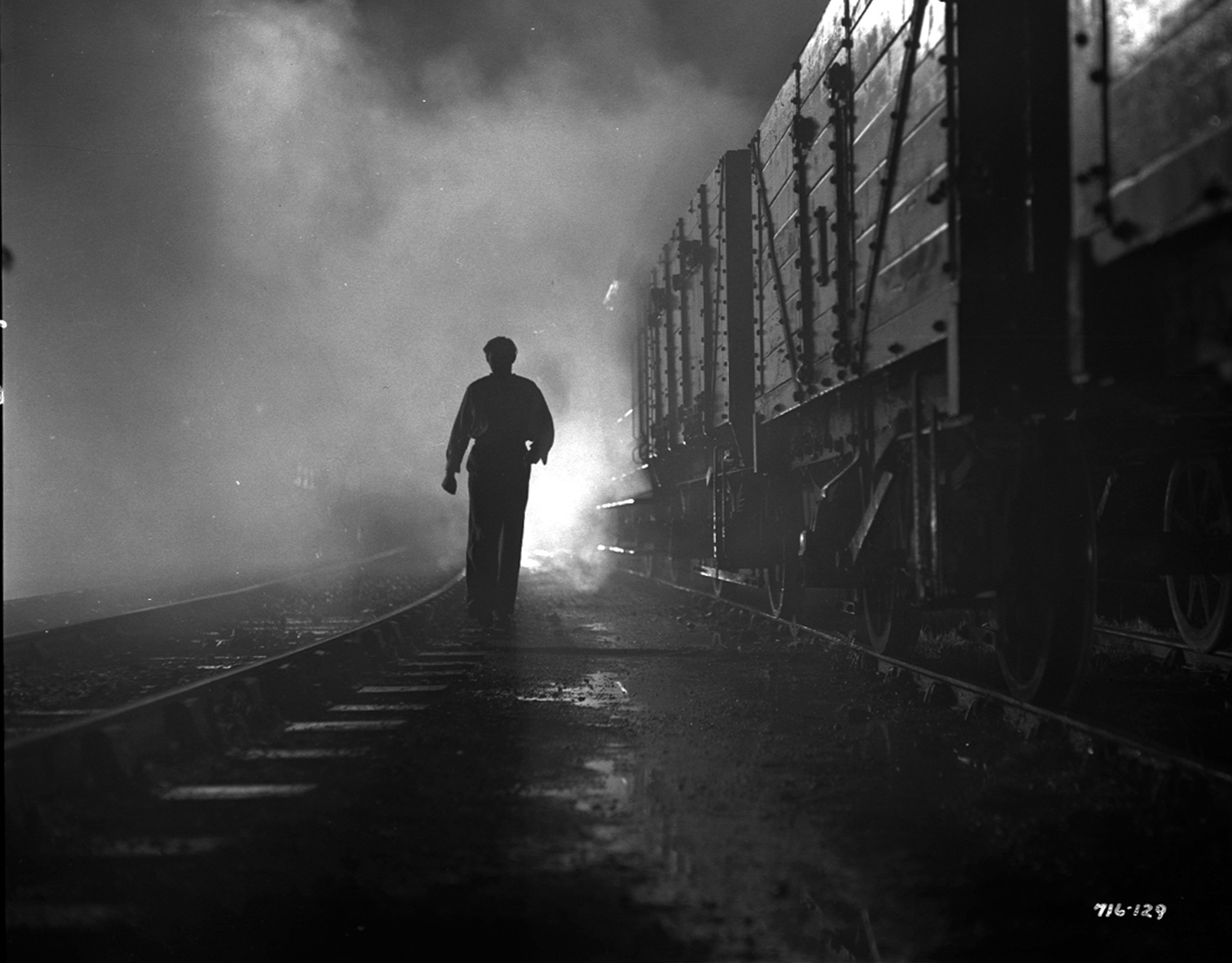
Googie Withers really makes the domestic side of this story hit home. She’s downright brilliant at portraying competing emotions: Disapproving of Vi but also envious of her youthful freedom and passion; Barely tolerating George yet also yielding to the virtues of stable commitment; and most of all, being intoxicated by, scared of, and scared for Tommy. Outside of the confines of the Sandigate home, the movie focus more on action than drama, with equally potent results. The thrilling pursuit of Tommy by the police ends with an epic train yard confrontation that was filmed with no stunt people (i.e. those are the real actors dodging and climbing on real trains).
It Always Rains on Sunday. 1947. Directed by Robert Hamer | MoMA

The look of this film is critical to its success. The Sandigate home is the apex of British drear (hat tip to Art Director Duncan Sutherland), from the faded wallpaper to the cracked plaster to the fractured windows to the piled bric-a-brac. Rosie’s frustration at how her life has turned out is accentuated by her surroundings in every cramped, overcrowded scene on that remarkable set. And for the shadowy scenes of action and intrigue, it’s always hard to beat Douglas Slocombe, whose noir camerawork I have praised many times (e.g., Taste of Fear, Robbery).

The film was influential in shaping an emerging genre (Brit Noir) but even moreso in prefiguring the kitchen sink dramas that would become popular a decade later. It Always Rains on Sunday contains the seeds of mega-hit working class soap operas like EastEnders and Coronation Street as well as darker fare like Look Back in Anger. In an era when many British films were filled with earls, viscounts, and people who dress for dinner, It Always Rains on Sunday gave working class people overdue attention.

Withers and McCallum began a 60+ year marriage shortly after making It Always Rains on Sunday. Rather than close with the movie trailer, I will instead share a charming interview with their daughter, Joanna McCallum. An an actress herself, she offers insight into both the movie and the relationship of her remarkable parents.

Categories
Drama

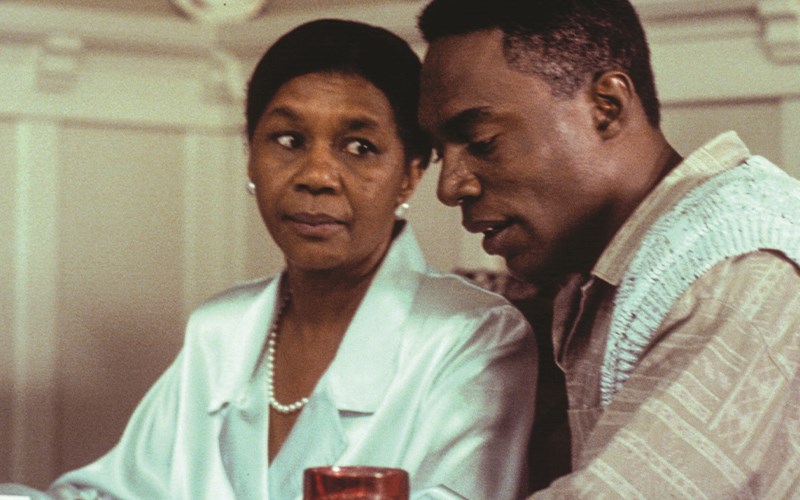
To Sleep With Anger

Many films structure their narrative around the power of visitors to disrupt overtly settled lives. Sometimes the results are comic (e.g., The Mating Season), sometimes they are dramatic and heart-warming, (e.g., The Bishop’s Wife) sometimes they are sinister (e.g., The Intruder), and sometimes they are a combination of all these things, as in the superb 1990 film To Sleep With Anger.

The plot: The heads of a multi-generational family, Gideon (Paul Butler) and Suzie (Mary Alice), left The South geographically — but not culturally — decades ago and established themselves in a middle-class Black neighborhood in Los Angeles. Their sons now have families of their own, though Junior (Carl Lumbly) is eminently responsible and “Babe Brother” (Richard Brooks) is immature and selfish. Into this fairly placid picture comes Harry (Danny Glover), a charming acquaintance from back home whom they haven’t seen in 30 years. The trusting, good-hearted Gideon and Suzie invite Harry to stay with them for as long as he wishes. Much like a vampire, once invited over the threshold Harry changes from ingratiating to calculating, undermining the family’s well-being for reasons that remain mysterious.

Writer/Director Charles Burnett put himself on the map with his cinema vérité film school thesis project Killer of Sheep. That film has been lionized by critics as one of the great movies of the 1970s, but its lack of narrative structure or character development limits its appeal outside cineaste circles. In contrast, To Sleep With Anger is a much more accessible movie. Burnett creates an array of full-blooded characters who evolve in believable ways, and a storyline that is dramatically rich. He also proves an assured director in his first film with professional actors.

Film Scene - TO SLEEP WITH ANGER

The heart of the film is Danny Glover, in a darker role than he typically assays (Indeed, other than on some episodes of Hill Street Blues, this is the only time I can recall him getting to develop a malignant character on screen). He is masterful from the very first scene at appearing straightforward, open-hearted, and uncomplicated, while subtly cueing the audience that Harry is none of these things (Burnett’s script is also a help here, giving us some supernatural tipoffs). Some film reviewers have referred to Harry as a “trickster” character but I don’t think that fits. In Black folklore, the trickster uses his wits to triumph over people with more power (e.g., Whites). Harry instead is a danger to the vulnerable and the weak.

Around the mystery of Harry’s motives and nature are more conventional subplots of family drama: The tensions between adults set in their ways and children who want something more modern, the love and rivalry between siblings, and the way marriages can be strong and frail at the same time. With a big assist from Burnett, the entire cast makes these well-worn themes come alive on screen in an authentic and touching way, with some humorous moments as well. In 2019, To Sleep With Anger was selected for inclusion in the Criterion Collection, a deserved honor for this highly original and engaging movie.

Categories
Blogs on Film

Overused Movie Trope #82: How Long Has That Villain Been Standing There?

I watched one of the usually good English-language adaptations of Wallander (The Swedish detective show), which ended with a painfully predictable stand off as the hero bursts into a room and finds the villain holding a gun to someone’s head.

Which raises the usual question: How the hell long was that guy standing there with the gun to the hostage’s head to ensure that the hero would come in while he was in that threatening pose? By the storyline it seems to have been at least an hour. Doesn’t the bad guy get tired or hungry or have his attention wander?

Another example: In Max Payne, which I watched on an airplane because I had nothing else to do, and was so bad that I was tempted to walk out of the theater, Mark Wahlberg is striding through a snowy cityscape. Suspecting some trouble up ahead, he darts down a back alley, goes around a few dark corners and waits. And then Milan Kunis tells him to freeze because she has a gun to his head.

Does she live in that back alley? Isn’t she cold, staying there day after day? Why is her make-up still perfect when she lives out of doors in winter? How did she know that our hero would ever even walk by? Are other back alleys filled with withered corpses of villains who passed away after waiting for years for different heroes to dart down their alley and then conveniently turn their backs?

But the worst ever example is the Michael Caine stinker The Black Windmill. It opens with two little boys playing with a toy airplane near their school. They wander across a field and come to an abandoned government airstrip. They decide to sneak in. They go into a hangar. And there they encounter a group of bad guys who have long planned to kidnap one of the boys. They are wearing soldiers’ uniforms to fool the other boy they somehow knew would be with the victim so that he would tell the authorities that soldiers did it.

I imagine the villains sitting there year after year, tired, alone and bored.

Lower level bad guy: Do you think the boys might come here today? — it’s been 5 years now and…
Boss bad guy: Shut up! Be a professional.
Lower level bad guy: Why don’t we actually, like, go to them instead of just waiting here in this abandoned building at an abandoned airstrip miles from where they are?
Boss bad guy: It just isn’t done. You’ll understand when you’re older.
Lower level bad guy: What if we went to the kid’s actual house and just got him. Same day service, no muss no fuss. You know, he will be old enough for college in a few years and could move away…
Boss bad guy: You just don’t get it, do you?

Categories
Blogs on Film

Overused Movie Trope #152: The Completely Ransacked Room

If you love movies as much as I do, you probably watch a lot of them. Generally that’s a joy, but some overused movie tropes can eventually to wear down even the most devoted cineaste, such as people yelling no-o-o-o-o-o-o!! in slow motion and the tell-tale cough of death. Another one that always gives me a chuckle and that you — fair warning — will not be able to “unsee” once you know about it: The completely ransacked room.

You know the set up: Our hero/heroine has hidden the black bird/legendary cumbersome diamond/exonerating evidence/incriminating photos/only copy of Great Uncle Casmir’s will in his/her room. But upon returning, s/he gasps as the camera shows us that the room has been tossed! All the drawers are open, the cushions on the couch are slashed, the floor is cluttered. The protagonist runs to the hiding spot, opens the box/drawer/envelope and says “Oh no — It’s gone!”.

What’s wrong with this picture? The room is invariably completely ransacked. But unless the bad guys have the bad luck to always look in the right place at the very end of their search, this wouldn’t happen. As soon as they found the black bird/legendary cumbersome diamond/exonerating evidence/incriminating photos/only copy of Great Uncle Casmir’s will, they would stop searching, leaving the rest of the room in a pristine state.

I imagine the exchange:

Senior bad guy: I found the treasure map!

Junior bad guy (stops stabbing the cushions): Right let’s go!

Senior bad guy: No way, keep stabbing those cushions while I toss the bedroom!

Junior bad guy: But…

Senior bad guy: You aren’t a scab are you?

Junior bad guy: No, I’m a member of the Loyal Brotherhood of Thugs, Yeggs and Second Story Men, just like you.

Senior bad guy: Then what the hell are you doing throwing away a good hour of work just ’cause we found the map? Remember, it will be 5 o’clock soon — that’s time and half for both of us!

Junior bad guy: Yippee! I don’t know what I was thinking. Can I pull up the linoleum after I finish with the cushions?

Senior bad guy: Good thinking, kid.

Categories
Action/Adventure Mystery/Noir

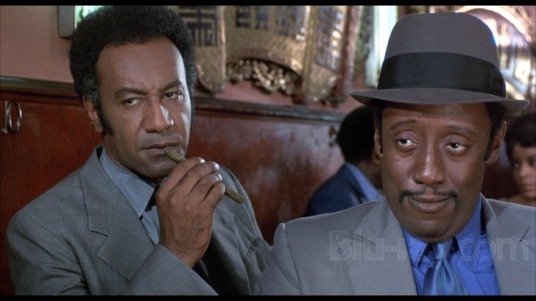
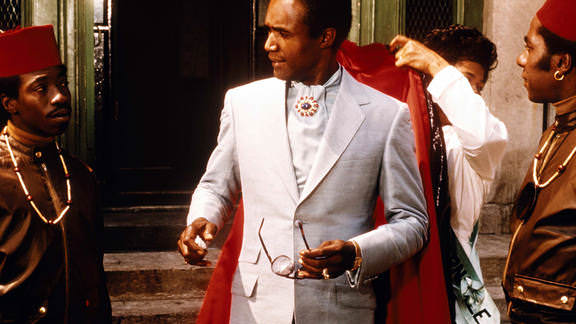
Cotton Comes to Harlem

Cotton Comes to Harlem (novel & film) – www.detnovel.com

When you steal from white people, that’s your business. But when you steal from Black people, that’s my business!

So growls badass but ethical Police Detective Ed Coffin (Raymond St. Jacques), who along with his more laid back but equally badass partner Grave Digger Jones (Godfrey Cambridge) protects the Black community in the most successful effort to bring the work of legendary novelist Chester Himes to the big screen: Cotton Comes to Harlem.

The plot: A charismatic, slick, con artist/preacher (Calvin Lockhart) is bilking the good people of Harlem with a phony Back to Africa scheme when gun toting bandits steal the contents of the hefty collection plate. But the hiding place for the missing $87,000 remains unknown, requiring Coffin and Jones to track down the loot while battling with mobsters, Black nationalists, and a femme fatale for the ages (Judy Pace).

Though best known as an actor (see, e.g., my recommendation of The Hill) and civil rights advocate, Ossie Davis occasionally ventured into directing. This 1970 movie was his first effort (he also co-wrote the script with Arnold Perl) and it’s a worthy effort indeed. Davis does a fine job both as a storyteller and an extractor of good performances from the actors. What comes through most of all is his feeling for Himes’ work and even moreso for the raffish, complex, dynamic, down but never out place that is Harlem. Watching this movie feels like walking through a neighborhood that is alive, and that’s a credit to Davis.

Vudu - Cotton Comes to Harlem Ossie Davis, Godfrey Cambridge, Raymond St  Jacques, Judy Pace, Watch Movies & TV Online

Himes, like Elmore Leonard, was a master of tough, thrilling, action scenes, and Davis nails that aspect of the books as well. Exciting car crashes, gun battles, and fist fights abound as Himes’ plot unfolds. Laurels also to costume designer Anna Hill Johnstone for the colorful, stylish, outfits, which jazz up the movie visually and also do right by Himes, who loved to describe in detail how his characters were decked out.

This film is sometimes categorized as a comedy as well as an action film. Himes’ books definitely have funny moments, but I think Ossie Davis’ only mistake was overdoing that aspect of the story. Some of the attempts at provoking mirth are so broad/slapsticky that they undermine the tone set by the hard-edged action scenes. Other comic elements work better: The scenes where the black characters outsmart white characters in symbolic triumphs over oppression, the protest at the police station which satirizes 1970s politics as well as Python did with the People’s Front of Judea, and, of course, every scene with Redd Foxx because he’s constitutionally incapable of being less than funny, even when he’s not speaking.

But mainly, I would classify this as an excellent action-filled crime melodrama. Hollywood has lately been virtue-signalling about wanting to film more stories about and starring Blacks. I wish they’d put their money where their mouth is and make movies or a prestige television series about Chester Himes’ immortal recurring characters, Harlem detectives Ed Coffin and Gravedigger Jones.

p.s. Hollywood’s only other effort to adapt Himes’ work, A Rage in Harlem, is an above-average film you might like, but I’d rate it a notch below this one.

Categories
Horror/Suspense Mystery/Noir Science Fiction / Fantasy

Invasion of the Body Snatchers (1978 Version)

BLACK HOLE REVIEWS: INVASION OF THE BODY SNATCHERS (1978) - creepy,  paranoid, body horror

When I recommend multiple adaptations of the same story, I typically package them as double or triple features. But in this case, the remake of a classic film I have recommended is so well-made and so distinctly its own work of art that I grant it an essay of its own: the 1978 version of Invasion of the Body Snatchers.

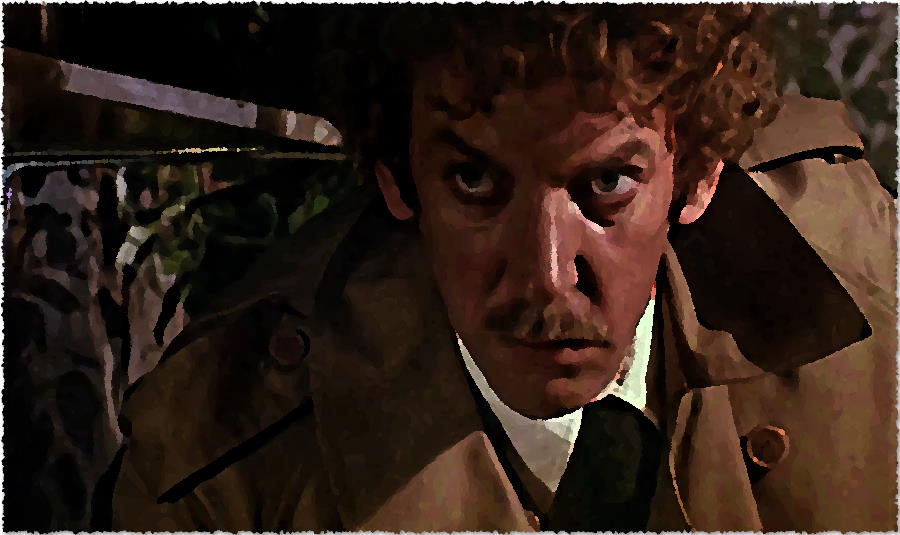
Like the 1956 classic original, Philip Kaufman’s remake is based on Jack Finney’s popular novel The Body Snatchers, in which seed pods from another planet drift to earth and begin replacing humanity with soulless replicas. But Kaufman added his own twist, which was to move the story from a California backwater to modern day San Francisco, a city he knows very well. In doing so, he preserved the suspense and chills of the original story while also getting to show off the gorgeous City by the Bay while also gently parodying some of its self-consciously hip and alternative residents.

Our likable and believable heroes this time around are Donald Sutherland and Brooke Adams as dedicated public health department employees (Back when such people could afford lovely homes in San Francisco). W.D. Richter’s screenplay wisely never explains if they once were lovers, but the actors convey the romantic undertone of their relationship, even though she is, awkwardly, living with a guy who doesn’t quite seem to be himself lately.

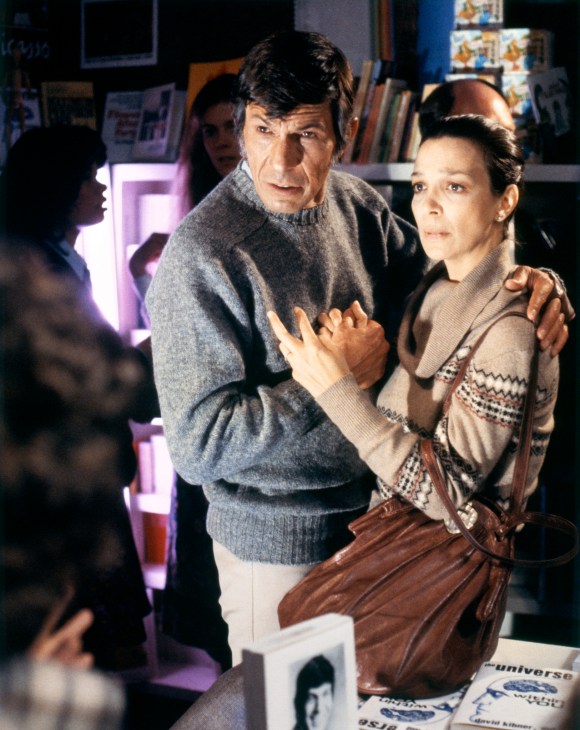
There’s always a character in paranoia films who explains to the anxious protagonist why nothing is really amiss, it’s all in your head, and why not lie down and get some rest? Here that part is a San Francisco archetype, a psychological growth-touting guru, played perfectly by Leonard Nimoy. If you are going to be typecast, Spock is a fabulous role to have, but Nimoy didn’t get as much chance as he deserved to try other things.

As for the extraterrestrial nasties, kudos to the special effects and makeup teams for creating some unnerving aliens with gut churning reproductive habits. One wonders if the makers of the Alien films were inspired by this movie’s parasitic menaces. Combined with terrific pacing (something lacking in some of Kaufman’s other movies), the heroes’ battle to resist the invaders is edge of your seat stuff.

Another thing I cherish about this movie is that while it’s mainly in the sci-fi/horror genre, it has noir elements and cinematographer Michael Chapman shot it as such. As has been shown in many classic noirs, San Francisco was made for shadowy lighting, unusual camera angles, and lonely compositions, all of which Chapman artfully employs here.

Last but certainly not least, this film breaks away from its classic predecessor in many respects, but at the same time stays reverent to it. Most notably, both the star (Kevin McCarthy) and director (Don Siegel) of the 1956 version have cameo roles that are both fun and scary. Put it all together and you have in my opinion both the best movie in Kaufman’s impressive ouevre and one of Hollywood’s freshest remakes ever.

p.s. Look fast in the opening scenes for a creepy looking priest on a swing played by Robert Duvall! As Kaufman tells it, he thought every horror movie should have priest in it so he asked his friend Duvall to do the wordless cameo.

Categories
Action/Adventure Romance

Captain Blood

An intelligent, dashing, apolitical doctor tends to a wounded rebel during the English Civil War and finds himself branded a criminal and sold into slavery. But his courage, leadership ability, and swordsmanship enable him to reverse his fortunes by becoming the greatest outlaw pirate of the high seas!: Captain Blood. This 1935 movie was a mega-hit adaptation of a mega-hit novel by Rafael Sabatini. Many a wildly popular film has had minimal artistic merit, but in this case craft and entertainment value go hand in hand.

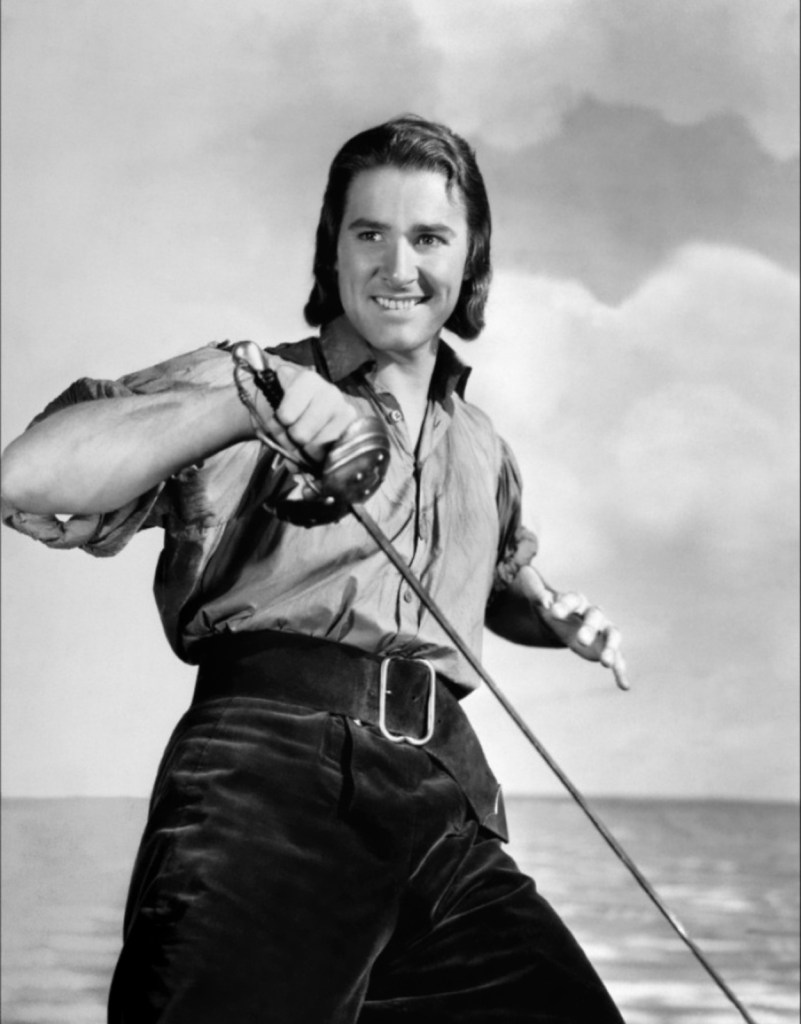
Warner Brothers gambled big financially on Captain Blood but even moreso by resting the movie on the shoulders of two little-known actors, Errol Flynn and Olivia de Haviland. Thus was born a screen pairing of which audiences could not get enough, leading to seven more films together that were rich in adventure, romance, and some comedy too. As the heroic Peter Blood, Flynn is passionate and athletic but also thoughtful and at times — particularly in his scenes with de Haviland — even vulnerable. This being the 1930s, de Haviland was given less to do, but she makes the most of it with charm, teasing humor, and a remarkable ability to non-verbally convey disabling sexual desire.

The film also benefits enormously from the literate dialogue in the adapted screenplay of Casey Robinson, and, the presence of a first rank director, Michael Curtiz, in the first of the 11 films he made starring Flynn. Curtiz handles so much so well in this movie, ranging from intimate romantic moments to epic battles with complex sets and hundreds of actors, that Captain Blood should be more often mentioned alongside Casablanca among his most significant achievements.

And though his character comes and goes a bit too quickly, Basil Rathbone delivers the goods as Blood’s frenemy, pirate captain Levasseur. He overacts zee Franch rrrrogue stuff a bit, but all sins are forgiven when he picks up a sword. Rathbone was a champion fencer in real life, and to the extent Flynn is credible as a duelist here, the credit goes to his coaching. Kudos to the rest of the supporting players as well, who are all credible in parts large and small.

Movies! TV Network | The Making of a Swashbuckler: Captain Blood

The action scenes, especially the closing sea battle in Jamaica, are completely credible and thrilling (props to George Amy for outstanding editing). Even though special effects have come a long way since 1935 (e.g., in the magnificent Master and Commander: The Far Side of the World) the cannon shots, swordplay, wooden ships, and iron men in Captain Blood are as vivid and vital as any Hollywood has ever portrayed.

Captain Blood would rank on any list of Hollywood’s greatest swashbuckling pirate movies, and has connections to another Sabatini novel whose adaptations would appear the same roll of honor twice: The Sea Hawk. The 1924 silent version included battle scenes filmed with massive sea-going models that were so astonishing that footage from them was recycled (with added sound of course) in subsequent films, including Captain Blood. The other connection is more obvious, namely that without Captain Blood lifting Flynn from obscurity in 1935, there would never have been the equally good 1940 Flynn version of The Sea Hawk.

p.s. If you like this movie, you will almost certainly enjoy two other movies I recommend: The Sea Hawk and The Adventures of Robin Hood.

p.p.s. Dame Olivia de Haviland, incredibly, was with us until July of 2020. Late in her long life, she said that she and Flynn were in love but never consummated their relationship. It’s easy to imagine that the genuine, aching desire they experienced in real life was part of what made them such an irresistible pairing on screen.

Categories
Documentaries and Books

Unseen

One of my formative professional experiences was clinically assessing individuals entering addiction treatment in Detroit at the height of the crack cocaine epidemic. I follow each patient up many months later to see how their lives were going and whether they had benefited from treatment. In the low-income, predominately Black neighborhoods of an industrial city in steep decline I witnessed and heard about horrifying things, but also came away impressed by the resilience and decency human beings can summon in extreme circumstances. No film brought me back to those experiences more than Laura Paglin’s powerhouse 2016 documentary Unseen.

The subject matter of the movie could at one level not be more grim: the serial rape and murder of 11 African-American women in the Mount Pleasant neighborhood of Cleveland. Though the sociopathic killer behind the crimes committed them over a series of years, almost no inquiries were made by the police until a brave woman survived his attack, went to the police, and was believed (I emphasize this last point because the police had done little or nothing when presented with similar complaints by other women in the past). Unseen asks why so little notice was taken for years of multiple human beings being assaulted, tormented, and murdered.

To answer this question, Paglin takes an approach unlike most documentaries about serial killers: putting the focus on the victims rather than the perpetrator. Multiple women who survived terrifying assaults tell their shattering stories directly to the camera with courage and insight.

Why did no one intervene? The victims were all low-income Black women who were addicted to crack cocaine, engaged in sex work, or both. Many were already estranged from their families or anyone else who could have noticed and reported their disappearance. They had no worth in the eyes of the killer of course, but the film makes clear that this was a disturbingly widely held sentiment. A local shopkeeper says the killer did a service by cleaning up the neighborhood’s “garbage” and many of the police clearly could not be bothered to investigate complaints of sexual assault filed by drug using prostitutes. The women themselves sometimes took this devaluation into their own hearts and therefore lacked the self-respect to demand better treatment from the world around them.

The film’s great achievement is humanizing the victims. It does this via moving interviews of those women who survived and of the friends and family of those who did not. Several interviewees are particularly skillful as well at humanizing the neighborhood as a whole, illuminating how the loss of jobs, prosocial cultural institutions, and hope for the future, ground down almost everyone in Mount Pleasant. The interviews are interspersed with scenes of the neighborhood, from the court trial, and from the police interrogation of the killer, making the movie even more compelling.

I also respect the way this movie dismantles myths (some conservative, some liberal) that many people who have never been in neighborhoods like Mount Pleasant propagate. The bigoted stereotype of inner city immorality cannot survive the love for family and community that the interviewees evince. The trope that crack cocaine was just another drug about which there was an overblown moral panic (which my friend David Kennedy, who worked in the same sorts of neighborhoods I did, eloquently refers to as “bullshit”) is also deservedly left in ruins by addicted women describing its uniquely destructive effect on their lives. And the currently fashionable idea that getting rid of police would help low-income African-Americans looks both naive and dangerous in light of the monster that stalked and murdered so many. These women needed more and better police, not a perpetual absence of protection from law enforcement. The latter would be the ultimate fantasy of the man who raped and murdered them.

Can material this dark be uplifting? I think it can. You weep with the victims and share their pain and rage, but also come away in awe of their grit, honesty, and desire for justice.

Categories
Action/Adventure Science Fiction / Fantasy

War of the Worlds **Double “Feature”**

Did the 1938 Radio Broadcast of 'War of the Worlds' Cause a Nationwide  Panic?

I often recommend multiple movie adaptations of the same story (e.g., The Lodger, Dracula, The Hands of Orlac) for the enjoyment and education that comes from comparing how the same material has been filmed by different artists in different eras. H.G. Well’s classic novel War of the Worlds presents an opportunity to make a different type of comparison, namely between strong adaptations in two different media: radio and film.

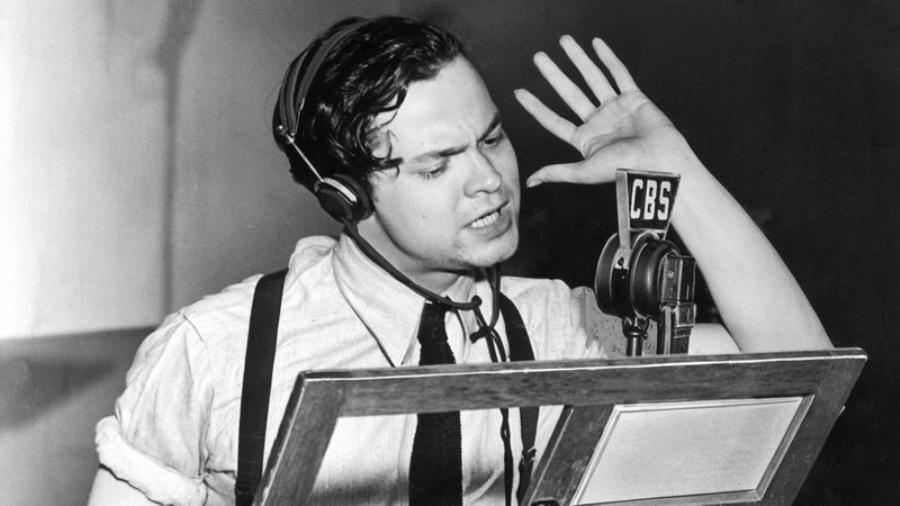
I’ll begin by recommending the 1938 radio adaptation (click here to listen). To the extent people have heard of it at all, they know it as the show that allegedly drove America into a national panic about invading Martians (in truth, very few people actually listened to the broadcast). What it ought to be remembered for is its high level of artistic achievement.

Too Much Johnson Is Never Enough Orson: The 'Lost Film' of Orson Welles |  lokke heiss

The radio play was performed by the Mercury Theater troupe founded by two wildly talented people: Orson Welles and John Houseman. Howard Koch, who later became justly famous as the co-scripter of Casablanca, gets the credit for brilliantly adapting H.G. Wells’ novel to radio in a fashion that took advantage of everything the medium and the Mercury Theater company could do. The novel’s rather lengthy set-up chapters and some of its clunky plot development (i.e., having the narrator run into someone who provides crucial information) were a function of the book being told through the eyes of a single narrator. In contrast, staged as a fake news broadcast with scattered, breathless, reports coming in as the Martians wreak havoc, the radio play grips the audience by the lapels immediately, giving a range of details from different geographic locations in an utterly realistic fashion.

Radio also of course opens up opportunities to accentuate the power of sound — the screams and footfalls of panicked crowds, the horrible, metallic, unscrewing of the Martian cylinders, and the terrifying zzzaaapppp of those heat rays! It’s high craftmanship that still leaves us the fun of imagining how it all looked

Last, but not least, what an explosion of talent this troupe of actors represented! Not just the big names, but also people like Ray Collins, Dan Seymour, Kenny Delmar, and Frank Readick. They are all masterful at creating characters with voice alone, each of whom seems like a real human being responding to out of this world events. Some New York theater fans were disappointed when talented, stage-trained actors they admired began transferring to new, middle brow, media like radio and film, but the upside was that the whole country and indeed the whole world got to enjoy the dramatic gifts and skills of companies like the Mercury Theater.

Orson Welles - War Of The Worlds (1969, Gatefold, Vinyl) | Discogs

I loved listening to radio play as a kid (the image here is of the record album of it my parents owned) and it’s just as suspenseful and exciting for me today. The radio adaptation of War of the Worlds is in the public domain so you can give it a listen anytime.

The most widely known cinematic version of the same story is probably the Steven Spielberg/Tom Cruise mega-buck 2005 adaptation. But the sci-fi magic that duo summoned in the superb Minority Report was nowhere in evidence in their dreary, weirdly lifeless, take on H.G. Wells. You’d be far better off revisiting the work of another talented pair of frequent collaborators, producer George Pal and Director Byron Haskin, who made a groundbreaking version of War of the Worlds in 1953.

Barré Lyndon, like Orson Welles, took creative license with the original material to create a story telling style that worked well in a new medium. The film opens with two set up narrations, the longer of which, by Sir Cedric Hardwicke, is coupled with an imaginative tour of the planets in our solar system (at least as understood long ago). We then get straight into the action, with the crash landing of a mysterious meteor near an all-American small town (this time, in California). The townspeople are curious, the aliens are aggressive, the military is helpless, but luckily a sturdy Gene Barry as the heroic scientist and a believable Ann Robinson as his love interest and fellow crusader against Martians, are on the job. The quick-moving plot has many parallels with the original work, with the addition of some religious themes that likely played well in the 1950s America.

In addition to the exciting story, what wowed audiences about this movie were the trend-setting, Oscar-winning, special effects. Force fields, laser guns, exploding landmarks, devastated cities, and creepy Martians are among the sights on which to feast your eyes and ears. Of course modern computer-created effects are slicker, but for 1953, this was gobsmacking stuff that showed what movie magic could add to a Victorian English novel.

Categories
Drama Mystery/Noir

Witness for the Prosecution

The Ace Black Blog: Movie Review: Witness For The Prosecution (1957)

Agatha Christie’s popular blend of mysterious murders, eccentric characters, droll humor, and surprise endings have translated smoothly into many entertaining movies, including some all time-classics. In that glittering club along with another of my recommendation (And Then There Were None) is Billy Wilder’s 1957 gem Witness for the Prosecution.

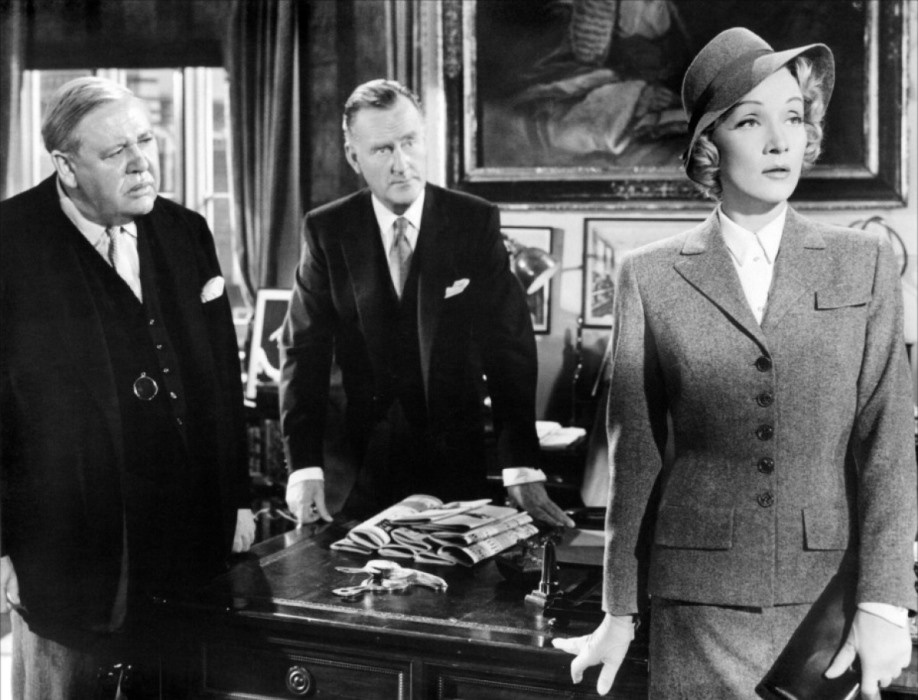
Plot: While recovering from a heart attack, the brilliant and caustic Sir Wilfrid Robarts (Charles Laughton) is presented a murder case that tempts him back to the Old Bailey, despite the risks to his health. A charming ne’er do well named Leonard Vole (Tyrone Power) stands accused of murdering an older, well-heeled, widow named Emily Jane French (Norma Varden), who had fallen under his spell. Vole’s glamorous, enigmatic, German wife (Marlene Dietrich) at first seems willing and able to provide an alibi…but the audience shares Sir Wilfrid’s suspicion that the case will be nowhere near that simple.

Christie was comfortable with liberal adaptations of her work. Indeed, she herself changed the ending of her story Traitor’s Hands when turning into a play called Witness for the Prosecution. And she countenanced a number of further changes in the film version, as scripted by Wilder, Larry Marcus, and Harry Kurnitz. Their most brilliant innovations were enlarging the part of Sir Wilfred to give Laughton a showcase role and inventing outright the character of Miss Plimsoll, his long suffering nurse. Casting Laughton’s real-life wife, that shamelessly funny ham Elsa Lanchester, as Miss Plimsoll was another stroke of genius. The first quarter of the film could have stood on its feet just as a comedy, as Plimsoll mothers and badgers Sir Wilfrid to follow his health regime and he schemes and wheedles to obtain his treasured cigars and brandy.

Reviewing performances: Best Actress in a Supporting Role 1957 ...

But of course it’s not primarily a comedy, but a murder mystery and courtroom drama. It’s very strong on those terms, with articulate jousting in the courtroom and engrossing plot twists outside of it. The ending, which I will not ruin (and the post-credits ask audiences to abide by the same silence), is a bit contrived but still satisfying.

The smaller roles are also very well essayed, include Una O’Connor as the hilariously crotchety maid of the victim and Henry Daniell, whom I loved in multiple Rathbone-Bruce Sherlock Holmes films, as another lawyer. But even in this strong cast, Laughton towers over them all with one of signature performances of his stellar career. His Sir Wilfrid is a complete character: insufferable at times, dazzling at others, and always, at the core, honorable.

Tyrone Power was an intriguing choice as the accused. Entering middle age (and tragically, to die of a heart attack after this picture was released) , his handsomeness is still visible, but at a less godlike level that in the 1940s. He looks, appropriately, like a chancer who knows his looks will fade soon but are still impressive enough to spark fantasies in a lonely older woman. Marlene is as beguiling as ever, and it doesn’t really bother us that despite her penury, she wears a series of smashing outfits designed by Edith Head.

The movie is of course also another triumph for Billy Wilder, and one that at moments echoes some of his other movies. Leonard’s relationship with Mrs. French brings to mind Sunset Boulevard and a scene in post-war Germany with Dietrich and Power recalls A Foreign Affair. Resonant grace notes for fans of the legendary director.