Categories
Documentaries and Books Drama

Nanook of the North

I admire Robert Flaherty and Neil Sheehan for the same reason: Their persistence in the pursuit of creation. Sheehan’s Pulitzer Prize winning book A Bright Shining Lie was almost never published because he lost 8 months of work in a computer hard drive crash and was so depressed that he nearly quit. Flaherty shot 30,000 feet of film in the Arctic in 1914 and 1915, but lost it all when he dropped a lit cigarette (This was in the days of nitrate). He too somehow persisted, returning to Northern Canada with a Bell & Howell camera and making one of the most influential films of the 20th century: 1922’s Nanook of the North.

The story: In an area of land as large as England that abuts the Hudson Bay of Canada, only a few hundred human beings scratch out an existence. Nanook and his family are among the Inuits who live in this bleak, deadly, yet beautiful environment. We see them fishing, hunting walrus, building igloos and interacting with white traders. We also see them laughing and playing and being a family. The tone is partly anthropological and partly human drama, and viewers find themselves fascinated by the lives of the Inuit family as well as rooting very much for their survival.

Nanook of the North | The Current | The Criterion Collection

Generally hailed as the first documentary, it might better be termed the first docu-drama because it is assembled in a narrative form and because some of the sequences were staged. The family were not really a family; indeed the wife Nyla was Flaherty’s wife. The amazing walrus hunt sequence is real, but Flaherty asked the Inuit to use traditional spears when by this point in history they had firearms.

Cinéma vérité enthusiasts have raked Flaherty over the coals for the above and many other liberties he took with the “documentary” form. But in fairness to him, there was no documentary form at the time, so it’s not as if he overturned conventions upon which the audience had long ago come to rely. And whatever sins he committed as a story teller, it was a remarkable feat with 1916 technology to be shooting and developing film in such an unforgiving place.

Despite being known mainly for its historical significance, this movie is not “film school medicine” (in contrast, say, to the first 15 minutes of Häxan). There is something extraordinarily moving about watching fellow members of our species hanging on by the skin of their teeth yet also finding joy and love in an unimaginably remote, dangerous part of the planet. It is hard to imagine the sensation the film must have caused when it debuted, and it still has psychic weight today.

Nanook of the North is in the public domain and you can watch it for free here. This version has a lovely soundtrack which the original print did not (music was added in 1939).

Categories
Comedy Drama

Slap Shot

George Roy Hill and Paul Newman scored two mega-hit, crowd pleasing films with Butch Cassidy and the Sundance Kid and The Sting (Recommended by Johann Koehler here). When they reunited in 1977, the commercial temptation would have been to more or less repeat themselves. Being highly creative artists, they instead challenged many of their fans’ expectations by making a foul-mouthed, violent, raunchy comedy set during America’s dreary blue collar decline: 1977’s Slap Shot.

Some (though not all) viewers were appalled. But, with critic Gene Siskel being the most well-known example, reactions to Slap Shot have warmed over time to the point that it is today justly regarded as a classic American movie.

The plot: The Chiefs are a minor league hockey team who lose more than they win under aging player-coach Reggie Dunlop (Newman). Meanwhile, the local plant is closing, leading the team’s owner (Newman’s frequent co-star, Strother Martin) to shop the franchise around. His career and marriage on the rocks, Dunlop knows he needs to gin up some victories and some interest for the team. The answer comes in the form of the Hanson brothers, who lead the team into a new style of hockey: Beating the crap out of their opponents! The dirty play pays off as The Chiefs start to win and the fans begin to rally around them. Meanwhile, there is lots of 1970s bed-hopping and retrograde attitudes under threat.

Some may be surprised that the script was written by a woman. But Nancy Dowd, whose brother was a minor league hockey player, knows her way around the game and also around people who use language that would make a sailor’s parrot blush. Hockey fans love the authenticity of the film, not least that Michael Ontkean (As a clean-cut Princeton grad who is the star of The Chiefs and disapproves of dirty play) and many of the other performers were in fact excellent hockey players. The resulting film is funny, rude, politically incorrect, and a jolly good time. Having lived myself though the 1970s de-industrialization of Western Pennsylvania and seen all the leather suits, huge shirt collars, towering heels and other fashion horrors I can vouch for this film’s accuracy about life at the time.

Newman, in a role that was a stretch for him (he apparently rarely even swore in private life), gives a very appealing comic performance as an over-the-hill jock. He also has great byplay with Strother Martin and with Jennifer Warren as his ex-wife. Andrew Duncan is hilarious as a radio announcer with hair from hell. Lindsay Crouse, as Ontkean’s binge drinking wife, delivers a one-note and eventually tedious performance, but all of the other smaller parts are well-turned by the actors.

Last but not least, the scenes of the hockey games are very well done. Everyone can skate and the crushing impacts and high-velocity shots feel real.

Slap Shot will never be shown at a church social or at a gathering of anti-violence activists. As long as that doesn’t put you off, get ready to laugh and be enormously entertained.

p.s. Some fun trivia: can you name ALL the films that Newman and Martin were in together? Martin’s Wikipedia entry claims six such pairings, but I could only come up with five so I am either forgetting one or gasp Wikipedia is wrong about something.

Categories
Drama Musical

Fiddler on the Roof

Gifted filmmakers are able to delve into the particularity of one group’s life to illustrate universal human experiences, thereby appealing simultaneously to those inside and outside the group. That’s part of the transcendent power of 1971’s Fiddler on the Roof. At one level, the film is steeped in the particularity of Jewish villagers under persecution of the Russian czar, and it’s a powerful story on those terms. But it’s also a moving treatment of crumbling tradition, parenthood, culture and faith which spoke to a whole generation of diverse religious and ethnic backgrounds.

The story focuses on a dirt-poor, devout and intelligent milkman named Tevye, his wife Golde and their marriageable daughters. The family scratches out an existence sustained by the bonds, traditions and religion in their shtetl of Anatevka. As suitors present themselves for his fiercely independent daughters, Tevye struggles to reconcile his traditional beliefs and concern about their material welfare with their desire to choose their own husbands based on love. Meanwhile, rumors of pogroms and forced exiles reach his ears, and he wonders when Anatevka will suffer a similar fate.

This is a very hard judgment to make, but of any Broadway musical, I would cite Fiddler on the Roof as having the best songs. “Sunrise, Sunset”, “Tradition”, “Matchmaker” are among the unforgettable musical pieces Jerry Bock and Sheldon Harnick created for the play. These show stoppers are brought beautifully to life in the film by director Norman Jewison (A Canadian Protestant who got the job because the Hollywood execs assumed that with a name like that, he must be Jewish!). Jewison and the fine cast are equally adept at the dramatic scenes, which are given more prominence in the film than in the play because Jewison wanted a more serious tone to what he saw as a largely grim story.

The big debate about this film concerns the non-casting of Zero Mostel as Tevye, the role he made famous on Broadway. To the bitter disappointment of Mostel and his many fans, the part went instead to Topol, the actor who had played Tevye in the London production of the play. It remains a stellar cast regardless, with an extraordinarily talented set of performers with both musical and dramatic talent.

This clip features one of the many wonderful, touching songs from the movie. It also shows how Jewison and top-flight cinematographer Oswald Morris did much much more than photograph a play; they created a remarkable piece of cinematic art using all the techniques the medium can offer.

L’Chaim!

Categories
British Drama

Great Expectations

The great director Sir David Lean is remembered mainly for lushly coloured 70mm epics with big international casts, sweeping stories and long running times (e.g., Lawrence of Arabia, A Passage to India, Bridge on the River Kwai, Dr. Zhivago). But he had a fine career before those triumphs during which he made tightly constructed black and white films with British casts, stories and locations. These early Lean films include two excellent Dickens’ adaptations, one of which is the 1946 version of Great Expectations.

The origins of Lean’s adaptation of the oft-filmed novel are visible in another film I recommend: In Which We Serve. Lean was an accomplished film editor when he got a chance to break into directing alongside Noël Coward on that movie. The cinematographer Ronald Neame is the producer of Great Expectations (and likely an influence on Guy Green’s trendsetting camera work). Bernard Miles and John Mills are back as actors, again adroitly playing off each other with emotional impact. Kay Walsh goes from acting to collaborating with Lean on the screenplay (along with Neame, Anthony Havelock-Allan, and Cecil McGivern), a masterpiece of economy which relates Dickens’ 500-page novel in just 118 minutes. Walsh went on to star in Lean’s excellent Oliver Twist and in private life to become the second in his series of six wives (imagine the alimony payments!). Alec Guinness was not in In Which We Serve, but Great Expectations, his first sizable film role, began his long-running cinematic partnership with Lean. All of this demonstrates what a small community British film was in its glorious period after the war, and the even smaller nature of the network Lean constructed around his own projects.

Categories
Action/Adventure Drama

The Sting (Guest Review)

My friend Johann Koehler of the London School of Economics is a criminologist, an innovative thinker, and a lover of movies. I asked him to contribute a review of one of his favourites, The Sting. Over to Johann:

Fans of Paul Newman and Robert Redford’s pairing in 1969’s Butch Cassidy and the Sundance Kid would have been raring for a cinema ticket in 1973 to see Hollywood’s most bankable leading duo in George Roy Hill’s multiple Academy Award-winning The Sting.

The plot revolves around a desperate revenge story shrouded in fanciful con artist scheme-ery. After the murder of his mentor, Redford’s Johnny Hooker, an impulsive neophyte in the world of confidence schemes, looks to Newman’s Henry Gondorff for instruction and assistance in bringing about the demise of the villainous Doyle Lonnegan (impeccably played by Robert Shaw). Shaw projects the same unpredictable brutality he mastered as Henry VIII in Fred Zinnemann’s 1966 classic A Man for All Seasons and the Newman/Redford team deliver a characteristically heart-warming performance redolent of Butch and Sundance.

While the film has been rebuked for a plot that drags at times, one can’t help feeling eager to find out how the final scene’s con plays out. In truth, the “long con” provides a deeply satisfying ending. In contrast to the “short con”, in which the con artist fleeces the mark for all that he has on his person, the “long con” is a much more deliberate and vicious scheme. It requires that the mark be seduced into the con artist’s deception and to participate in the construction of his own demise. In so doing, he ultimately becomes both the perpetrator as well as the victim. Lonnegan thus becomes either the most unsympathetic villain, or the least, depending on your mood while watching the film.

Scott Joplin’s jolly ragtime music, anachronistically written two decades before The Sting is actually set, imbues the film with enough whimsy to conceal the bitterness of the underlying storyline. And for a master-class in comic acting, be sure to look out for Newman’s show-stealing drunken poker scene on the train.

Closing trivia note from Keith: The money that Rick Blaine gives up to a needy couple using number 22 on a rigged roulette wheel finally gets paid back by Johnny Hooker in this movie.

Categories
Action/Adventure Drama Science Fiction / Fantasy

The Day the Earth Stood Still

Graffiti messages tend to be clichéd, obscene or vapid, but once every few years I get a smile on my face when I see “Klaatu barada nikto!” scrawled on some random bit of fence or wall. It’s a critical line in Robert Wise’s 1951 science fiction classic The Day the Earth Stood Still.

In a decade when countless movies showed the good people of Earth being threatened by evil aliens (e.g., Earth vs. The Flying Saucers, The War of the Worlds) Edmund H. North’s subtle, intelligent screenplay inverted the usual premise. In this case, a flying saucer lands in Washington DC and disgorges a literate, moral, peace-loving and thoughtful alien (Michael Rennie, in his finest hour) who spends most of his movie under siege by petty, violent and backward Earthlings.

The alien, Klaatu, hopes to persuade humanity to renounce war and atomic weaponry, but mankind isn’t ready to agree (This is wistfully conveyed to Klaatu early in the film by Frank Conroy, in an uncredited, quietly powerful performance as an advisor to The POTUS). After an initial brutish encounter with the military, Klaatu escapes and decides he must learn more about humanity if he is going to save it. He adopts the name of Carpenter (ahem) and moves to a rooming house run by a widow and her boy (Patricia Neal and Billy Gray, who are believable and appealing). The two of them give Klaatu’s hope for humanity, leading him to confide in them about his true nature and mission.

The ingenious premise of the script allows this film to be as much social comment as science fiction. As the alien visitor watches human beings interact, tours the graves of Arlington Cemetery and reflects on our greatest president’s words at the Lincoln Memorial, we see ourselves through his sadder and wiser eyes, with profound emotional effect.

The special effects are solid for the period, with the Frank Lloyd Wright-influenced flying saucer being a particular highlight. Yet the effects don’t overwhelm the story or acting as they often have in more recent zillion dollar CGI-laden sci-fi films. Bernard Herrman’s score is also appropriate to the visuals and themes of the movie. All of this is a credit to Robert Wise’s ability to maintain tone throughout a film. To a number of film buffs, Robert Wise is the hack who destroyed The Magnificent Ambersons, a company man who did whatever project he was assigned but had no artistic vision of his own. If you hold to that negative view of Wise, you really should watch this movie, observe how well it is constructed, see how consistently excellent are the performances, and note how efficiently and effectively the story is told. Wise won Oscars for other films, but in my opinion this movie best demonstrates his considerable skills as a film maker.

Here is the cleverly crafted trailer to this masterpiece of science fiction:

p.s. for trivia fans. There’s a scientific errors in the script: Klaatu says he is from 250 million miles away yet knows how to talk like a contemporary American because he has been monitoring Earth’s radio programs on his home planet.

Categories
Action/Adventure British Drama

The Frightened City

In nearly a century on this earth, Herbert Lom had a long and varied acting career. Born in Prague under the Austro-Hungarian Empire, he achieved screen immortality as the Chief Inspector whom Clouseau slowly drives mad in the Pink Panther films. But before that did excellent work in many high-quality films, most of which unfortunately are largely forgotten today. I have spotlighted his fine performance as the kindly, devout, ill-fated Gino in Hell Drivers. Lom has a completely different role as a cold, clever and super-smooth criminal mastermind in 1961’s The Frightened City.

The Frightened City is a B-movie which doesn’t pretend to be otherwise. The budget is modest and so are the ambitions. But on those terms it delivers as a solid crime melodrama with a great starring role for Lom and excellent supporting work by a then little known Scottish actor who was only a year away from becoming an international superstar: Sean Connery.

The film is set in the London criminal underworld. A wily financier (Lom, conveying the calm of the truly powerful in every scene) figures out that the six biggest gangs could enhance the revenue of their protection rackets by organising themselves as a syndicate. He convinces one gangster (an agreeably lubricious Alfred Marks) to head the syndicate, who in turn recruits a former burglar (Connery) to be the face of the mob to the shops, pubs and restaurants it extorts. All goes well until the gang falls out, leading to a murder that throws the syndicate into turmoil and gives a dogged Scotland Yard detective inspector (John Gregson) the chance he needs to pounce.

The secondary plotline concerns Yvonne Romain as a luscious, ambitious immigrant singer who catches Connery’s eye. They have great chemistry on screen, and the script does a gratifying job of making her craftier than him rather than portraying her as a brainless tart (funnily enough Romain’s real-life husband went on to write the lyrics of several of Connery’s Bond films, including Goldfinger). The other engaging aspect of the story is Connery’s relationship to his former burglary partner (well-played by Kenneth Griffith), who has been crippled in a fall during an attempted break-in. Connery skillfully conveys the guilt he feels about the accident, and how it drives him into the hands of the new, more violent crew who are running the protection racket.

The film is not without weaknesses. Some of the sets look cheap, probably because they are. The script underdevelops its theme of how crime was changing to become more violent and organised and thereby outpacing long-standing law enforcement tactics. As a result, the scenes with the police are a bit slow and stale. And John Lemont’s direction is more reminiscent of a TV show than a movie (on the plus side, if you watch this on DVD instead of in a theater, you are not missing anything). For those reasons, the film goes into the good rather than great category.

As a closing note: Norrie Paramor’s jazzy title song became a big hit for Britain’s premier instrumental group of the era, the Shadows. Just for fun, you can see their totally pukka rendition of the theme on Crackerjack. Love those suits and dance steps!

Categories
British Comedy Drama Musical

The Ruling Class

I stand outside myself, watching myself watching myself. I smile, I smile, I smile.

It takes courage to make a movie that defies all conventions and challenges the audience. Sometimes, indeed most of the time, the filmmakers fall on their faces. But every once in awhile a group of wildly innovative iconoclasts create something that has the right to be called unique, such as this week’s film recommendation: The Ruling Class.

The story begins with the solid, respectable, fiercely pro-Empire 13th Earl of Gurney (The always watchable Harry Andrews, holding nothing back) putting on a tutu and playing an auto-erotic asphyxiation game that goes awry. Enter greedy potential heirs, but the old coot has left his money to his manservant Tuck and his schizophrenic son Jack (Peter O’Toole). Jack currently believes himself to be the risen Christ, though after a dramatic series of events 2/3 of the way into the film he alters his self-identity in a profound fashion, with deadly results. The story barrels along with equally bizarre twists, punctuated by cast members bursting into song and doing Broadway-style dance numbers! It may sounds like an utter mess, but it’s a sublime piece of cinematic art.

As you would guess, there is a good deal of very black humor in the film. There are also many lighter-hearted laughs courtesy of Alastair Sim as a half-baked bishop (Honestly, he could evoke chuckles reading the phone book) and Arthur Lowe as the suddenly rich, alcohol-soaked Trotskyite butler Tuck, who stays on in his servant role while talking relentless smack to his “betters”.

The film is a triumph of three Peters. Peter Barnes wrote the original stage play and the screenplay, Peter Medak directed, and Peter O’Toole leads a champagne cast by giving an all out performance playing a volatile, complicated, exuberant character. Hats must also be doffed to Jack Hawkins, whose acting I have much praised in prior recommendations (e.g., The Long Arm, The Cruel Sea), and who is in the co-producer’s chair here (alongside Jules Buck).

This film did poor box office in 1972 and seemed to get no middling reviews: Critics loved it or hated it. Likewise, today, I can imagine some intelligent people of good will finding this film contrived, overlong, pretentious, and maybe even obnoxious. But in other modern viewers it will evoke wonder and admiration. If you are open to something completely different, please do give it a look, particularly if you can get your hands on the stunning print available from the Criterion Collection.

p.s. Harlaxton Manor, the magnificent pile where much of the film was shot, was once the site of my employer’s study abroad program.

Categories
Action/Adventure Comedy Drama

Zero Hour! and Airplane! **Double Feature**

Icebox Movies: Zero Hour! (1957)

This double feature recommendation comes with a strong suggestion for viewing order. You absolutely should watch Zero Hour! first, because once you’ve seen Airplane!, you will have a hard time taking the former film seriously again. And that would be too bad, because it’s a perfectly solid drama/thriller.

Written by Arthur Hailey of Airport fame, 1957’s Zero Hour! stars Dana Andrews as former squadron leader Ted Stryker. I’ve written before about this period in Andrews’ career, during which he labored in B-movies as he struggled with alcoholism (not incidentally, his co-star here, Linda Darnell was in the same boat). Yet he managed to class up these productions with good performances, a strong jaw and leading man looks (albeit a bit drink-ravaged). Perhaps because he himself was a man whose career and life were on a downslope, he is particularly good in Zero Hour! at making the audience sympathetic with Ted Stryker. Following one terrible misjudgment during the war, Ted has been haunted by self-doubt. He has lost the respect of his wife (Linda Darnell) but is consoled by the fact that his son still looks up to him (Raymond Ferrell).

And then, before you can say “contrived plot development”, the Stryker family ends up on an airplane on which many passengers are sickened by bad food. The plane’s captain also falls ill and can no longer fly (The captain is played by Crazylegs Hirsch…a famous athlete playing an airline pilot..I wonder if someone could ever find a way to make fun of that?). A serious, silver haired physician (Geoffrey Toone) who happens to be on board intones somberly that if the passengers are not hospitalized soon, they will die. Meanwhile, the weather is worsening, becoming reminiscent of the horrible conditions during Ted’s failed World War mission. Can Ted shake off his fears, land the plane, and at the same time save his son, who is among the ill? He will have at least some help: on the ground, the hard-headed, no nonsense Capt. Martin Treleaven (Sterling Hayden, as alcohol-soaked at this point in his career as Andrews) has taken command at the airport and is prepared to bring the plane in safely.

OK, it’s a bit of a potboiler, but the acting is fine, the effects are good for the period, and the story is genuinely exciting. And this film is probably the high point of Hall Bartlett’s uneven career as a director; he gets everyone to play things super straight, which you could pull off with a 1950s audience in a way you never could with a modern one.

Which brings me to the 1980 film Airplane! Three very, very funny guys (David Zucker, Jim Abrahams and Jerry Zucker) saw Zero Hour! late at night and apparently laughed all the way through. They then created a movie that is hilarious in its own right and also deserves admiration for being one of the best parodies of a prior movie ever made. If you have just watched Zero Hour!, Airplane! is even MORE funny, if that’s possible. Indeed, some of the most laugh-inducing lines in Airplane! appear as dead serious lines in Zero Hour! (“Looks like I picked the wrong week to quit smoking…”).

Categories
Action/Adventure British Drama

Watership Down

All the world will be your enemy, Prince of a Thousand enemies. And when they catch you, they will kill you. But first they must catch you; digger, listener, runner, Prince with the swift warning. Be cunning, and full of tricks, and your people will never be destroyed.

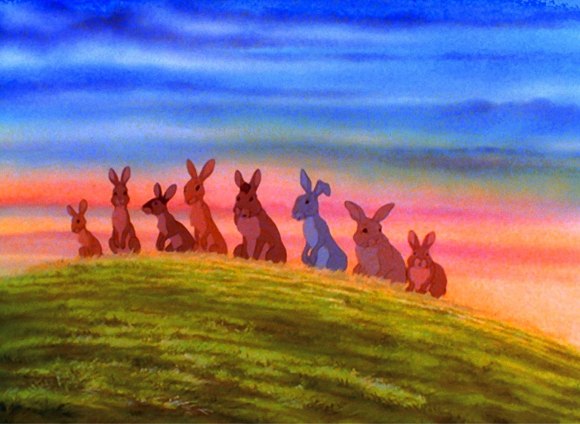
These words are uttered by an unseen narrator (well-voiced by Sir Michael Hordern) in the magical opening sequence of writer/director Martin Rosen’s Watership Down. The opening presents a creation myth centered on a god called Frith and a prince of rabbits named El-ahrairah. The movie then turns to the story of some of the descendants of the Rabbit Prince, who live in modern day Sandleford and are about to embark on a perilous journey to find a new home.

A cartoon movie about bunny rabbits doesn’t sound like the sort of thing that would hold the interest of a thoughtful adult. But give this 1978 movie a chance. Like the Richard Adams book upon which it is based, the film is dark, dramatic, and in parts, engagingly philosophical. Although older children will probably like it, Watership Down is really an animated movie for grown-ups.

The story centers on a warren in which all the rabbits seem happy and safe. Yet a rabbit named Fiver has a prophetic vision of blood and destruction. He and his older brother Hazel cannot get the local rabbit chief to believe them about the danger; indeed the warren’s police (the Owsla) try to suppress their dissent. With a group of fellow rebels, including a powerful former Owsla member named Bigwig, Fiver and Hazel fight their way out of their warren to seek a new home.

Watership Down too violent for tots? Probably, but parents should take  control of the remote | Animation in film | The Guardian

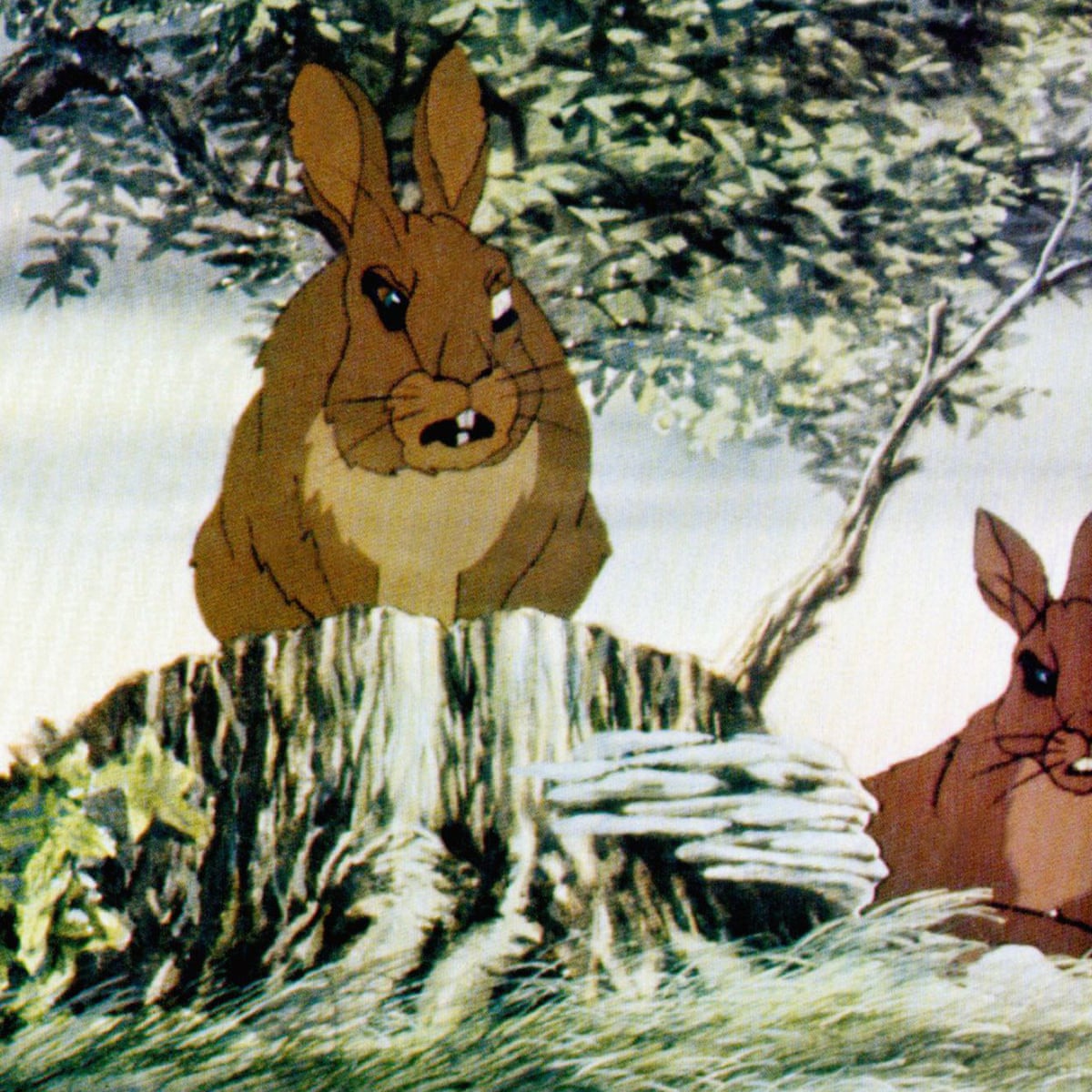
Their journey is filled with hazards and some of the rabbits come to bloody ends. They encounter different warrens with different sociologies and politics, eventually establishing their own independent warren at Watership Down, which Fiver had seen in a vision. But they soon come into conflict with another, imperialistic warren run by the menacing General Woundwart (as scary a villain as one could ask for in a movie about rabbits).

I consider Watership Down the best animated film ever produced in the UK. The rabbits’ faces are expressive and their movements realistic. The story is exciting and contains moments of serious drama. As for music, Art Garfunkel fans will appreciate “Bright Eyes”, which is accompanied here by an appealing animated sequence. And the voice actors, especially John Hurt, are outstanding. My only complaint is the presence of a comic relief bird character voiced by Zero Mostel (it was his final film performance). I suppose that was put in to make the film more kid-friendly…I think it would have better to just go for it and target the film at adults, but YMMV. Even if you don’t like the bird, it’s a small annoyance in what is overall a very good movie.

The trailer is a bit long, but gives a flavor of the film.

p.s. Rosen (and Hurt) went back to the Adams well a few years later to make The Plague Dogs. It drew nowhere near the same audience, probably because it’s significantly grimmer than Watership Down. But it too is an accomplished work.