Categories
Action/Adventure British Drama

The Hill

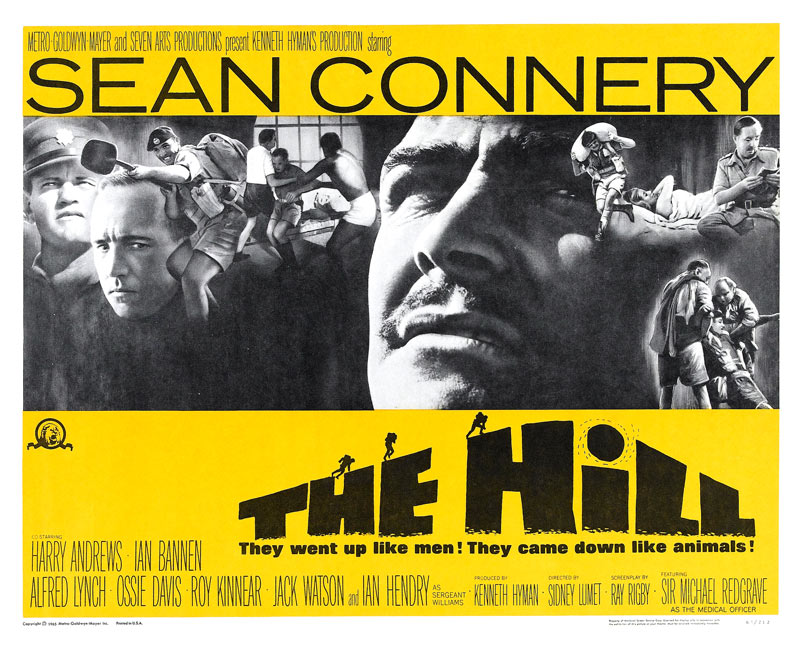
Sidney Lumet’s brutal, gripping 1965 movie The Hill opens with a solitary figure laboring up the man-made torture device that gives the film its title. In one of Oswald Morris’ many mesmerizing crane shots, the man collapses in the North African heat and then the camera begins to move slowly away, off into the distance, abandoning the man and the compound in which he is forced to live. As in the rest of the film, no music is heard, which lets the hopelessness and isolation of the people we are watching sink in.

The story begins with five British soldiers arriving at a military prison. Four of them are privates who have committed various crimes (including Ossie Davis as a West Indian soldier and Roy Kinnear as a fat spiv), but the fifth is something different. Joe Roberts (Sean Connery) was a heroic sergeant major who has been busted down for beating up his commanding officer. Connery, given his first chance as a star to do something different from James Bond, plays the part well, showing how Roberts can be callous in some respects yet gentle in others. He is in emotional agony, for reasons that become clear as the film progresses.

The most complex performance is given by Harry Andrews, as RSM Wilson, who runs the daily operations of the prison. It would have been easy to write and play the character of RSM Wilson as a heartless martinet. But Ray Rigby’s script and Andrews’ acting are much more sophisticated than that. Yes, the RSM can be tough, but he also shows compassion because he is committed to rebuilding the prisoners rather than simply destroying them. He’s a three dimensional person, unlike the newly arrived Sergeant Major Williams (Ian Hendry), who is uncomplicatedly nasty. Ian Hendry, who was by all accounts a piece of work in real life (sadly, he drank himself to death in his early 50s) is convincingly vicious as Williams. As Connery’s character says “Wilson wants to build toy soldiers and Williams wants to break them”.

The prisoners struggle against the harsh prison regime, and also among themselves. But as Williams gets more brutal, causing a tragic incident, they begin to unify in opposition to the screws. They are aided by a diffident medical officer (a solid as ever Michael Redgrave) and a staff sergeant whose motives are interesting to speculate about (Ian Bannen).

Two complaints. The film would have benefited from some tightening in length and from dropping the final stages of evolution of Ossie Davis’ character. His behavior at the end seems a theatrical flourish to please a 1965 audience and not, like the rest of the film, a realistic take on WWII prison life. His performance though, like that of everyone else in the all-male cast, remains top-notch.

It would be an injustice to close on such cavils, however. Sidney Lumet’s “movie as play” style works perfectly in the claustrophobic setting of a prison. Cinematographer Oswald Morris and editor Thelma Connell do brilliant work throughout, particular during the scenes in which the prisoners are forced to climb the hill (In one case, while wearing a gas mask — horrifying). Given its subject matter and tone, this isn’t a date movie…but it’s a great movie.

A closing note on Connery’s evolution: As this critically-acclaimed movie bombed at the box office he saw audiences line up world wide to munch popcorn and watch Thunderball, which began to disgust him with the James Bond franchise and the state of his career. But while he didn’t know it at the time, he had already made the wisest move possible, which was to link up with a great director who saw more to him as an actor than the Bond films revealed (For more on this, see my recommendation of The Offence). 

Categories
Action/Adventure British Drama

The Cruel Sea

To compliment my recommendation of The Long Arm, let me endorse an even better film featuring the wonderful Jack Hawkins. In the high point of his career as a star (although he would go on to have a career as a character actor in upmarket blockbusters such as Lawrence of Arabia, Zulu, and Ben-Hur), Hawkins turns in a powerful, weighty performance as Captain Ericson in 1953’s The Cruel Sea. Scripted by Eric Ambler and based on the well-regarded Nicholas Monsarrat novel of the same name, this is a realistic, exciting and emotionally affecting portrayal of the British Royal Navy’s efforts to protect convoys from the predations of German U-Boats.

As the story begins in 1939, Ericson is called from the merchant marine to captain a corvette with a crewful of amateurs. His second lieutenant, Bennett, is a martinet of questionable ability (Stanley Baker, who really registers here in an early role for which he campaigned after being impressed with the character’s possibilities in the novel), and the junior officers below him were only recently working as barristers, journalists and in other professions that are of no value in naval combat. Ericson must train and lead them while making the terrible life or death decisions that wartime demands (If you want a short, powerful take on the nature and challenges of leadership, the events about 40 minutes into this movie are hard to beat). He is at least encouraged that when Bennett suddenly departs the ship, one of his young officers, Lockhart (Donald Sinden), starts to grow into the kind of officer he can count on.

Meanwhile, the crew have to protect convoys from U-boats, which increasingly gain the upper hand as the war wears on. In these scenes, documentary footage is smoothly blended with shots of the actors to give us the feel of being at sea as storms rage and the terrible possibility of torpedoes is ever-present. There are moments that will have you gripping the armrests and hoping along with the men that they will survive each crisis in which they find themselves.

Categories
Drama Horror/Suspense

A Christmas Carol

One of the most memorable adaptations of A Christmas Carol is a short, animated film of the same name. Made in 1971 by animation icons Richard Williams, Ken Harris and Chuck Jones, this is by far the most eerie and dark version of the much-filmed Dickens classic.

Despite being condensed to 25 minutes, this Oscar-winning film’s storytelling will be comprehensible even to people unfamiliar with the original. Adding immeasurably to the production are the voice talents of two actors from the best live action version of the old chestnut (Alastair Sim and Michael Hordern, who reprise their 1951 roles as Scrooge and Marley, respectively).

But the real star here is the animation, which was inspired by illustrations in early editions of the book (especially the Victorian era drawings of John Leech). The images are lugubrious and scary yet hard to look away from, not unlike Goya’s Pinturas Negras. I first saw this film as a child and the visual of “ignorance and want” haunted my imagination for years. The film makers accentuate the power of the animation by employing arresting pan and zoom shots that are extremely effective both as storytelling devices and as setters of mood.

The threnodic tone of the film does not stop the essentially positive message of the story from emerging brightly in the end. Ebenezer Scrooge’s transformation to a life of charity and decency remains uplifting, perhaps even moreso for the considerable terrors of the night before.

Categories
Action/Adventure British Drama

Hell Drivers

Having recommended the movie that gave Stanley Baker his first break (The Cruel Sea) and one he produced and starred in once established (Robbery), let me fill in the middle by recommending the thrilling film that made him a star in 1957: Hell Drivers.

The plot is agreeably simple. Baker plays Tom Yately, a tough but moral ex-con trying to go straight. He takes a job at a trucking firm managed by a ruthless boss (William Hartnell, who effectively plays the villain here, albeit of a different type than in Brighton Rock). The business would give OSHA a coronary. The truckers are assigned to ship gravel from a mine to a worksite many times a day, getting paid more money the more trips they make. They respond by driving like maniacs, at significant risk to themselves and others. And they all compete to topple the domineering, violent and reckless “Red” (Patrick McGoohan) as the top driver of the crew. Meanwhile, Tom befriends a kindly, devout Italian driver named Gino (a spot on Herbert Lom) whose girlfriend (Peggy Cummins) begins to put the moves on him.

The driving scenes in this movie are thrillingly shot by the justly revered Geoffrey Unsworth (I’ve praised his work in A Night to Remember, Superman and Unman, Wittering and Zigo). This includes the ultimate driving test from hell for Tom Yatley, in which he is accompanied by a perfectly droll Wilfrid Lawson as the firm’s mechanic. The final confrontation of the film, as Red and Tom have a trucking duel in an abandoned quarry, is particularly well-done and highly satisfying.

Categories
Drama Romance

Flirting

Adolescence includes aches (loneliness, alienation from adults, sexual longing) and joys (first love, treasured friendship and music). Few films have portrayed both classes of teenage experience as warmly and intelligently as the 1991’s Flirting.

Due to an execrable U.S. advertising campaign, which misrepresented the film as a sniggering teen sex comedy from “those crazy blokes down under” (I cannot bring myself to post the trailer) this Australian gem barely opened in the U.S. and when it did mostly the wrong people saw it. But a precious handful of people outside of Oz have found this excellent film and continue quite properly to point others to it. Having been so blessed by a friend some years ago, I wish to pay it forward here with the strongest possible recommendation that you give this excellent movie a look.

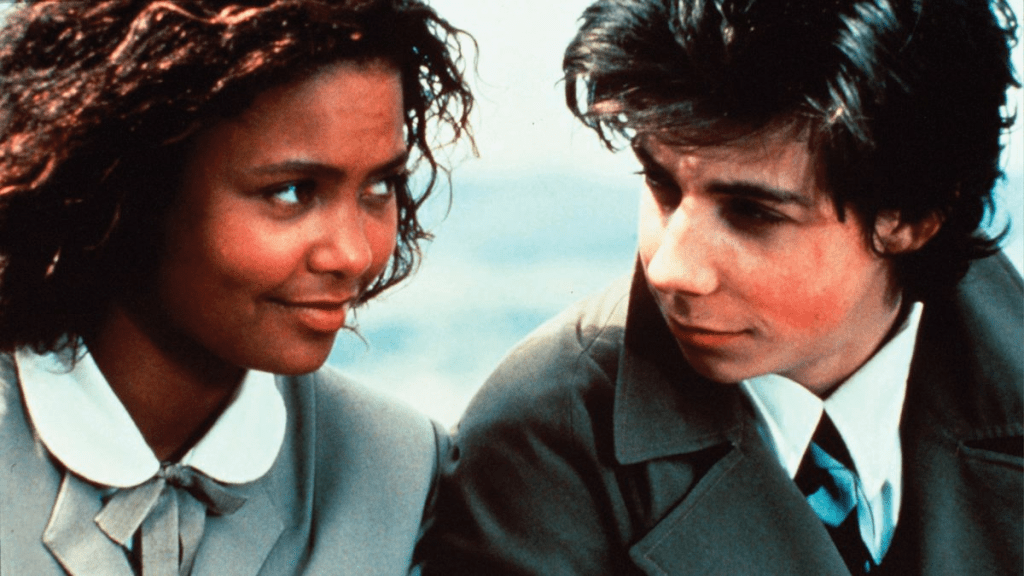
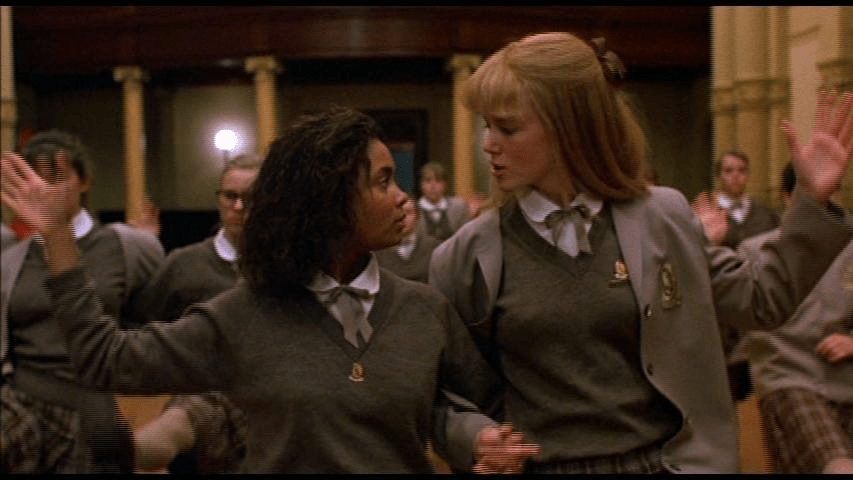
Writer-Director John Duigan sets his story in two boarding schools that stare at each other (like their residents) across a lovely lake. In the boys’ school, anxious, stammering Danny Embling (sweetly played by Noah Taylor) is being ground down by sadistic masters and bullying classmates. Meanwhile, a student from Uganda, Thandiwe Adjewa (the luminous star-to-be Thandie Newton), is getting a cold welcome at the girls’ school. Yet as is so often the case, the underdogs attract a stout friend or two, and are also drawn irresistibly to each other. Taylor and Newton have great chemistry on screen, and you will be rooting for their budding romance from the very first.

The other central character is the alpha girl of Thandiwe’s school, played to perfection by a pre-fame Nicole Kidman. Initially imperious and frosty, she eventually reveals more accessible layers beneath, particularly in the superb scene after she catches Thandiwe sneaking back into the school after a rendezvous with Danny.

Many of the plot elements and themes here are familiar (Rebel Without a Cause is one a zillion films to tread similar ground). But it wasn’t fresh plots that made Shakespeare the Immortal Bard, it was what he did with them. With its wisdom, sensitivity and wit, Flirting turns the usual coming-of-age story into an fresh and inspiring experience that is not to be missed.

Categories
British Drama Horror/Suspense

Unman, Wittering and Zigo

I have recommended the film Flirting, in which sadistic masters torment the new students in a boys’ school. I now turn the tables by recommending a film in which a new teacher John Ebony (David Hemmings) and his wife Silvia (Carolyn Seymour) are terrorized by the fifth form from hell. The last three students on the class roll are Unman, Wittering and Zigo, but Zigo is always absent, even going back to the time when the teacher that Ebony is replacing, Mr. Pelham, fell to his death (by accident?).

Director John Mackenzie of Long, Good, Friday fame made this creepy, nasty, thriller in 1971. He was aided immeasurably by master cinematographer Geoffrey Unsworth, who contributed some dazzling and disturbing point of view shots in the opening sequence as well as during the most horrifying scene in the film (which I will not spoil by describing other than to say, don’t bring the kids to this one).

The nefarious school boys (who include some actors who went on to distinguished careers including Michael Kitchen and Michael Cashman) are hard for the viewer to keep straight but that actually works, along with skillful editing, to make them seem less a group of individuals than a multi-headed hydra snapping relentlessly at Mr. Ebony. Hemmings, who also produced, is good as the pitiable Ebony, including in those scenes where he starts destroying himself with alcohol (perfect casting there, sadly enough. Hemmings left us too soon).

Unman, Wittering and Zigo (1971) | Nostalgia CentralWhile struggling with the boys ostensibly below him in the hierarchy, Ebony must also cope with the headmaster, played by Douglas Wilmer with just the right amount of Old Brit unctuousness overlaying snobbery and cold-heartedness. Although the scenes with the boys are chilling, the pre-dinner drinks scene with the Ebonys, another master and his wife and the headmaster, make one’s skin crawl in an entirely different way.

The final third of the movie is not entirely satisfying in terms of logical plotting, but the film still delivers a consistent air of menace that gets under your skin. Certain ambiguities in the story invite debates about the interpretation of this film; to avoid spoiling the movie for those who haven’t seen it, I have placed my own nagging questions about this movie after the jump (i.e., Don’t read the rest of this unless you have seen the film, it will ruin it for you).

Categories
British Comedy Drama

Peter’s Friends

One of my favorite Christmas movies is Kenneth Branagh’s Peter’s Friends. Sometimes glibly dismissed as a “British knockoff of The Big Chill” this 1992 movie is in fact superior in most respects to that film (which not incidentally was itself based on a better, little seen movie, The Return of the Seacaucus Seven).

The plot: Peter (Stephen Fry) has inherited a large estate and house from his recently deceased and very formidable father, whom he hated but now misses. He is also grappling with a serious personal problem — the nature of which is not revealed to the audience until late in the movie — that is causing him great strain. Unable to decide what else to do, he throws a weekend Christmas party for his dear friends from Oxbridge days. Once a young and happy troupe reminiscent of the Footlights (of which many of the actors in the film are alums), Peter’s friends have since run into their own painful challenges in life.

Rita Rudner, who is hilarious as a shallow and unhappy American TV star, wrote the witty script with her husband Martin Bergman. The script also includes some strong dramatic moments, even though it doesn’t quite seem to know how to wrap things up at the very end. Without spoiling the plot, Peter’s Friends also deserves praise as being one of the first major British movies to deal with a particular topic that had been too long avoided.

Director Kenneth Branagh gets the best out of the talented ensemble cast, even though he himself gives only a so-so performance (for whatever reason, with the exception of the Wallander series, Branagh often seems a bit too mannered and self-conscious when he plays modern parts). You are blessed with more than a bit of Fry and Laurie here, as well as good work by Imelda Staunton, Tony Slattery, and Alphonsia Emmanuel. But the best performances of all come from the mother-daughter team of Phyllida Law as the housekeeper-quasi-parent of Peter, and Emma Thompson as a bookish turbo-neurotic who is secretly in love with him. I have never met anyone whose former boyfriend wrote self-help books right up to the moment he committed suicide, but if I did, I would expect her to be exactly like Thompson’s pathetic, nerdy but still very appealing Maggie Chester.

The film’s music is also enjoyable, including hits of the period (by Bruce Springsteen, The Pretenders, and Tears for Fears) as well as a lovely version of Jerome Kern’s “The way you look tonight” sung by the entire cast (Imelda Staunton can really hit a note!). The then-popular music and focus on a particular British generation’s experience could have turned this into a period piece which would age badly, but the many laughs and the moving moments gives Peter’s Friends appeal that extends to the present day.

Categories
Action/Adventure British Drama

Layer Cake

Layer Cake (2004) where the old criminal boss has a nice library.

Let’s get meta: That’s Sir Michael Gambon sitting in the very chair where I wrote this recommendation of the film in which he and it appear: Matthew Vaughn’s stylish and hard-edged Layer Cake. Gambon plays wily drug kingpin Eddie Temple in one of the great British gangster films (which is saying something, they have been making outstanding movies about guns and geezers over here for three quarters of a century).

The film centers on cocaine middleman “Mr. X”, played convincingly by a pre-James Bond Daniel Craig. One of the many things the film gets right about the illegal drug trade is that it includes people like Mr. X who think they can make big money while remaining untouched by the damage that drugs do downstream and the violence and immorality of the kingpins who call the shots upstream. Mr. X tells himself he is just a businessman whose commodity happens to be illegal, and that he will simply leave the drug trade behind him when he is financially secure. But when drug honcho Jimmy Price (Kenneth Cranham) gives him an unusual assignment, his assumptions are shattered and he quickly gets in way, way over his head. Meanwhile, he develops a serious case of the hots for a low-level gangster wannabe’s girlfriend (played by Siena Miller…rumor has it that she and Craig prepared for their sex scenes together Lee Strasberg-style).

The supporting cast is uniformly strong, with a standout performance by Colm Meaney as a long-time gangster. There are some over-the-top camera shots by Vaughn which some people found self-conscious and annoying, but they work well given the kinetic story line. And Gambon’s soliloquy on “the facts of life” is as quotable and as well-delivered as anyone could ask.

p.s. This film is rated R with an exclamation point, so by all means don’t bring the kids.
p.p.s. Vaughn shot three different endings for this movie, all of which I’ve watched and he definitely picked the right one.

Categories
British Drama Mystery/Noir

Brighton Rock

The 2010 remake of Brighton Rock got mixed reviews, so I recommend discovering instead the 1947 original, which is both a fine character study and a solid piece of British film noir. Made just after the war by the Boulton Brothers, this story of razor-wielding gangsters was considered shocking in its day. Though a bit dated, it remains worth watching for its strong acting, emotional impact and truly memorable visuals (particularly during some jolting violence).

Scripted by two lions of British cinema, Graham Greene and Terence Rattigan, the plot centers on a small criminal gang led by the cold hearted Pinkie Brown (A genuinely chilling Richard Attenborough). The former boss of the gang has just been murdered and Pinkie is struggling to revenge the loss while fending off internal and external threats to his control. A saintly, pretty young girl named Rose (a pitch perfect Carol Marsh in her film debut) has evidence that can put Pinkie away for a killing, but also, strangely enough, seems to be falling in love with him. Meanwhile he grapples with Catholic guilt at the life he is leading.

Richard Attenborough in "Brighton Rock" (1947) | Brighton rock ...

As in many British dramas of the era, highly experienced actors take every advantage of the smaller roles in this movie. A pre-Dr. Who William Hartnell plays a complicated criminal who is heartless when committing violence yet develops a paternal protectiveness towards Rose. Veteran stage actor Harcourt Williams steals scene after scene as a Shakespeare quoting shyster.

Only quibble: In trying to contrast “carefree tourist Brighton” with the seedy underbelly, the film makers go overboard early in the film with annoyingly upbeat music that detracts from the mood of menace. But that trope fades out after the first 20 minutes or so, leaving the viewer plenty of time to be both fascinated and repulsed by Pinkie Brown and the criminal world which he inhabits.

Categories
Action/Adventure Drama

Robbery

If you are one of the many admirers of the 1968 American classic Bullitt starring Steve McQueen (my recommendation here), you will almost certainly enjoy the British film Robbery. Released the year before Bullitt, it’s a partly fictionalized account of the astonishing 1963 heist of a British mail train by a gang of bold and crafty thieves.

Like many heist films, this one begins with a smaller job that introduces us to the characters and sets up the big score to come. The gang upon which the movie centers is led by criminal mastermind Paul Clifton (Stanley Baker, who also produced). Baker was one of a number of rough-hewn leading men who captivated British audiences in the 1960s. One wonders if we would have ever heard of a similar actor — Sean Connery — had Baker not turned down the offer to play a secret agent named James Bond (Side note: It is nothing less than eerie to see how much an older Baker looks like an older Connery in later projects such as the ITV mystery special Who killed Lamb?). In all his roles, Baker radiates power, even as in this case when his character is intellectual and non-violent. Credit him here also with first-rate production values on a film was no doubt good practice for the studio that would go on to make The Italian Job.

The gang escape their first job after a harrowing, thrilling car chase through London, but they don’t spend the money. They need the swag to fund something much bigger that Clifton is planning. The actors playing Clifton’s crew all turn in good performances, as does James Booth as the Police Inspector who doggedly pursues them. We don’t get detailed back stories on any of the characters, but it doesn’t matter because the actors are talented enough to bring them to life and make them distinct.

It was the amazing car chase, much of it shot with handheld cameras by the great Douglas Slocombe, that made Steve McQueen chose Peter Yates as the Director for Bullitt. But that isn’t the only parallel between the two films. Unusually for a director gifted at action films, Yates is comfortable with long silences and seems to encourage his actors to underplay their parts. It creates a distinctive mood that is somewhat melancholy, which fits the many of Yates’ characters who are driven to do things that seem very unlikely to satisfy them in the end.

The bulk of the film is devoted to the painstaking preparations of the gang to pull off the crime of the century, and then the heist itself. As in the actual great train robbery, a number of things go wrong, giving the police a chance to track down the gang and its crafty leader. The resolution of the film is perhaps a bit sudden, and there are a few draggy spots, but overall it’s a solid caper film that will please fans of the genre.