The decade of the 1970s in American film witnessed the continuation of the auteur-driven creative revival that began in the late 1960s (see my recommendations The Kid Stays in the Picture and Bonnie and Clyde for details) as well as the beginning of the blockbuster era led by Jaws, Star Wars et al. But with the dawn of the 1980s, a new genre of slick, cool, cinematic products emerged in the theaters and on television. I regard Michael Mann’s gripping 1981 crime drama Thief as the first movie of this new era.
The plot focuses on an emotionally-walled off master thief named Frank (none of the characters in the film have last names). After 11 years in prison, Frank returns to his craft and starts to hope for a real life built around an equally damaged woman he fancies (Tuesday Weld) and the forthcoming return of his mentor from the joint (Willie Nelson). But with attachments and possessions come vulnerability, and Frank’s is exploited by a ruthless mobster (Robert Prosky) and corrupt cops who wants to profit from his scores. Frank is pushed to his emotional limit even as he plans the biggest heist of his life, which he dreams will let him start anew.
Made just a few years before his as-1980s-as-it-gets hit TV show Miami Vice, Thief highlights writer-director Michael Mann’s signature style, which blends some old time film noir themes with modern flashy camerawork, pulsating music, gritty performances, and attention to realistic details (real-life criminals were hired to consult on the film). There were many slick but stupid films in the 1980s, but Mann consistently managed to to make style serve substance rather than substitute for it. Thief is Mann’s best work in my view, though some of his fans would stump for Heat, which I consider excellent but not quite as tightly constructed or compelling as Thief.
Putting aside a miscast Jim Belushi, the performers are all strong here, with Caan turning in what he correctly called the best work of his career. His extended scene with Weld in which he explains how prison affected him is flawless in its writing and acting, and draws the viewer into Frank’s emotional world rather than keeping us at a distance as did too many films of this era.
This is also a terrific Chicago film. It’s not just the iconic and prosaic Chicago locations employed, but also the way the actors deliver their lines in Windy City-ese. Last but certainly not least, Tangerine Dream’s score is quite memorable, and is well supplemented by Craig Safan’s closing music that riffs on Pink Floyd’s Comfortably Numb, which not incidentally is the state this film ultimately leaves its heroes.
p.s. Look fast for Dennis Farina as one of Prosky’s gunmen.
Edward Dmytryk was a talented filmmaker whose career and life were severely damaged during Hollywood’s red scare. As one of the Hollywood Ten, he refused to testify to the House of Un-American Activities Committee and was sentenced to jail. He fled to England, where he made some high quality films including another of my recommendations, Obsession. When the Brits kicked him out he came back to the U.S. and was incarcerated. He then decided to testify against his communist associates, meaning that Hollywood was divided between those who hated him as a communist and those who hated him for naming names. However, in 1952 his career got back on track when Stanley Kramer hired him to direct The Sniper, a brooding B-picture about a serial killer that gave Dmytryk a chance to express his alienation and isolation on screen.
The story opens with psychologically disturbed veteran Eddie Miller (Arthur Franz) struggling against his impulse to gun down a woman in his neighborhood, right at the moment she is kissing her lover on the stoop. As Miller walks the streets, his chance encounters illuminate how he has felt scarred by women from childhood through his adult life, filling him with a mixture of misogyny and sexual frustration. After his efforts to seek help for his psychiatric problems are met with incompetence and indifference by the health care system, this ticking time bomb of a man is stung when a women to whom he is attracted (Marie Windsor) does not reciprocate his feelings. In a rage, he comes unraveled and goes on a fearsome, guilt-wracked hunt for the women whom he believes have wronged him.
For the period in which it was made, The Sniper was startling stuff, particularly the scenes of Miller stalking and then executing his victims. In style and structure, the film draws a good deal from the the police procedurals that became popular after the war (see my recommendations He Walked by Night and The Naked City) as well as from film noir. It also has a pronounced streak of urban alienation and rage that prefigures later films like Taxi Driver (I was not surprised to learn that Martin Scorcese admires The Sniper).
Other than Adolphe Menjou, who plays the police detective who tries to track Miller down, the cast of this low-budget picture are unknowns with unremarkable faces, which works well with the underlying message that horrors such as the film portrays have become everyday, ordinary events. Harry Brown’s script, which is based on a story by Edna and Edward Anhalt, underscores this point even more by having the city in which the crimes occur have no name. It could, implictly, be anywhere.
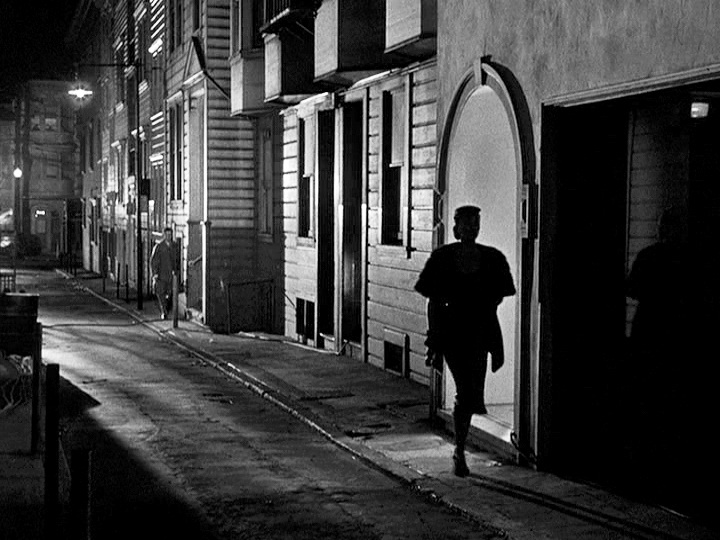
Most of the film was shot in San Francisco, which has rarely looked as moody or lonely. When Miller stalks his first victim, the shadows are surreal as is the lack of any other person on the street. Burnett Guffey, a number of whose films I have recommended here, contributes effective photography and Dmytryk worked with him to create excellent camera set ups throughout. I particularly liked the scene where Miller, who has a menial job delivering dry cleaning, is being upbraided by his boss (another women who makes him feel weak and worthless). Rather than shooting the scene in an open space, the film makers put the camera in the front of Eddie’s parked van looking back at him as he crouches in the cramped, dark space surrounded by hanging dresses. His boss on the loading deck is visible because the van’s back door is open, making her tower over him as if he were a worm under her heel.
The only significant weakness of the film is something characteristic of many Stanley Kramer productions (Judgement at Nuremberg, The Wild One, Guess Who’s Coming to Dinner): It needlessly makes some of its points with a sledgehammer. Starting a film with a printed message telling the audience how shocking and serious the subject is and including a scene where some authority-figure gives a pious speech about how society-is-to-blame are the sort of things that earned Kramer a reputation as the kind of sanctimonious and self-satisfied liberal who drives away more people from his causes than he draws in. Some of that cringeworthy stuff is on display here, and it just doesn’t work.
But let that flaw go and this tautly directed, disturbing film will get under your skin. My belief is that The Sniper is in the public domain, so I offer this link as a place where you can watch it for free.
p.s. Trivia: The bar where Eddie’s first victim sings is the Paper Doll Club, famous in real life as one of America’s first lesbian bars even though it isn’t portrayed that way in the movie.
Hollywood studios were in a rut in the late 1950s and early 1960s, struggling to cope with the rise of television, the loss of control of movie theaters after the Paramount case, and a widening cultural chasm between modern audience tastes and studio traditions. In desperation, the studio chiefs opened up filmmaking to a wave of young actors, directors, producers and writers who re-energized American movies, making them arguably the world’s trendsetters from the late 1960s through mid-1970s. One of the pivotal movies from this fertile period in American cinema is 1967’s Bonnie and Clyde.
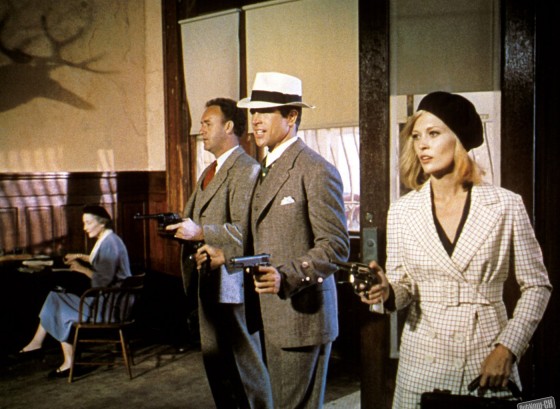
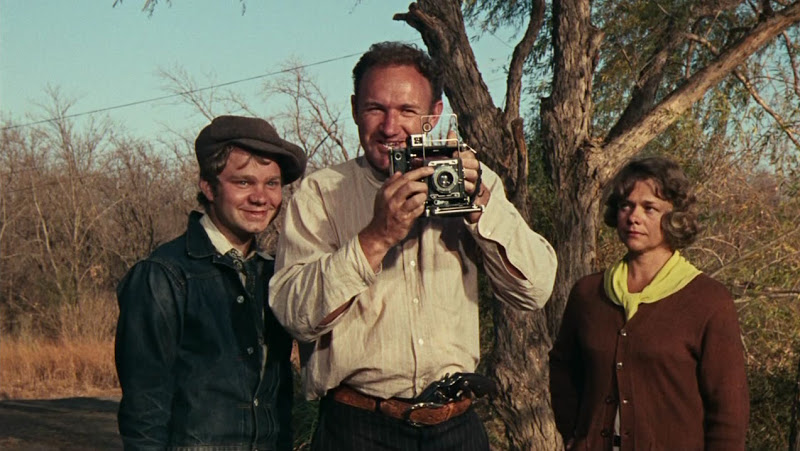
The story opens with a bored, sexually frustrated small town girl (Faye Dunaway) meeting a charming bad boy (Warren Beatty). She questions his courage and masculinity, and he shows off by drawing a gun and committing a robbery. They flee her backwards hometown together, intoxicated by freedom, danger and each other. More daring robberies follow, and with it growing fame for Bonnie and Clyde. Soon they gather other people around them, including a slow witted ne’er do well (Michael Pollard), Clyde’s older brother Buck (Gene Hackman) and Buck’s prim, God-fearing wife Blanche (Estelle Parsons). The law of course comes after them, spurring epic gun fights and a wild cross-country chase sparked with episodes that are surreal (the mesmerizing family reunion scene, which was shot by putting a window pane in front of the camera) and comic (the best of which features Gene Wilder, in his first movie). The story’s conclusion, which I will not spoil, is justifiably one of the most famous scenes in the history of American cinema.
The sexuality and graphic violence on display here was beyond anything Hollywood films had done since the Hays Code came into force in 1934. This is one of the first movies to use squibs and to show bullet wounds spouting blood. The impact of the violence is further amplified through use of the choppy editing style that been popularized by the French New Wave. Also, in a striking reversal of the typical gender roles of films in the 1950s, the woman is the confident sexual aggressor and the man is sexually timid and indeed non-functional (in early drafts of the script, Clyde was in a gay relationship with one of the men in his gang, but in the final version he instead is impotent). The point of view of the story was also novel and in keeping with the rebellious spirit of the times: The heroes are murderers who mow down police officers without compunction.
But it is not just the sexual and violent themes that make Bonnie and Clyde a landmark American film, it is also the movie’s meditation on fame. The criminals’ exhilaration in their notoriety, their self-conscious pursuit of increased publicity and the way they are hero-worshiped by strangers highlight the absurdity of American celebrity culture in supremely effective fashion.
As for the acting, under Arthur Penn’s direction, the entire cast explodes off the screen. Parsons won an Academy Award for her performance but any of the leads and supporting players would also have been worthy choices. Last but certainly not least, Burnett Guffey’s “flat style” camerawork — a complete inversion of his remarkable work in films I have recommended like My Name is Julia Ross, In a Lonely Place, and The Sniper — is one of the lasting achievements in Hollywood cinematography. That Guffey could early in his career thrive in the deep focus, shadowy, stylized world of film noir yet later became a leading exponent of unadorned, naturalistic cinematography shows that he was truly one of the giants of his profession.
The backstory to this film has also become part of its legend. Clyde Barrow and Bonnie Parker were of course real-life bank robbers in Depression-Era America. The Oscar-winning script of this film was brilliantly adapted from their exploits by David Newman and Robert Benton, with uncredited help from Robert Towne. (All of whom, like so many of the people associated with the film, went on to notable success in American cinema). The writers tried unsuccessfully to recruit a French New Wave director to make the movie, but none of them were ultimately interested. Fortunately, Warren Beatty saw the potential of the story and bought production rights, eventually signing Penn as the director. As a sign of how out of touch studio executives were with 1960s filmgoers, the suits at Warner Brothers had so little confidence in the film’s audience appeal that they were comfortable promising Beatty 40% of the gross receipts. They barely released and minimally promoted the picture, and were not surprised when establishment movie critics sneered at it. But it hit audiences like a thunderbolt, becoming a massive box office hit. Remarkably, some chastened film critics went so far as to publicly apologize for their dismissive reviews and to write new reviews praising the movie (except for the New York Times’ insufferable Bosley Crowther, who campaigned against the film so vigorously that his bosses finally realized that it was time to find a more discerning critic). Many years later, this initially unwanted, disregarded and disrespected film became one of the first movies selected for preservation by the National Film Registry.
p.s. If any film prefigures Bonnie and Clyde in American cinema, I think it’s Joseph Lewis’ extraordinary 1950 movie Gun Crazy. If you have time for a double feature, that’s the film to pair with this one. And if you have time for a triple feature, throw in Lewis’ My Name is Julia Ross to appreciate the incredible range of cinematographer Burnett Guffey.
If God could do the tricks that we can do, he’d be a happy man.
The late Peter O’Toole signed on to many over the top, unconventional films (no small number of them when he was intoxicated). This resulted in him headlining some legendary stinkers (e.g., Caligula). But it also landed him plum roles in off-beat masterworks such as The Ruling Class (recommended here) and The Stunt Man.
The film was released to only a handful of theaters in 1980 (In O’Toole’s words, “it wasn’t released, it escaped”) because the studios had no faith in it. Some critics found the film pretentious, manipulative and tiresome, yet it ended up on other critic’s best of the year lists and landed three Oscar nominations. Over time it has attracted a cult following, which it very much deserves, despite its flaws.
The Stunt Man is a film that messes with the minds of the characters — and with the audience’s as well — by relentlessly mixing movie fantasy with reality. The unreality is embedded in the plot from the first. An alienated Viet Nam veteran named Cameron (Steve Railsback) is wanted for an unknown crime and flees the police, only to find himself in what seems to be World War I. But it’s actually a war movie being directed by Eli Cross (O’Toole). Cameron has a run in with a man he thinks is trying to kill him, but who turns out to be a stunt man shooting a scene. The stunt man dies, and Cameron may or may not be responsible: only the film shot of the event by Cross could reveal the truth. As the police close in, Cross makes Cameron a bizarre offer: to hide within the movie company as a replacement stunt man so that Cross can complete the movie! Cameron agrees, and from then on is manipulated, tricked and exploited while simultaneously trying to romance the lovely starlet Nina Franklin (Barbara Hershey), who seems to have genuine feelings for him…or is that just a manipulation too?
Yes, it’s one hell of a set up. But then again, the script is adapted from a novel in which all the lead characters are insane. The writer/director was Richard Rush, an eccentric, talented but ultimately unsuccessful Hollywood figure whose erratic career path is probably worth a novel of its own. If everyone has one great movie in him, this is Rush’s, and he went for broke, mixing black comedy, action, romance, suspense and satire with largely successful results.
The best thing about the film is Peter O’Toole, who turns in another of his unrestrained, arch performances as Eli Cross. His part is written to be larger than life, and he plays it to the hilt. They say the best roles for British actors are kings and drunks. O’Toole played many of both in his career, and was in real life a King among Drunks. It wasn’t happenstance that he was nominated for an acting Oscar 8 times yet could never quite seal the deal with Academy Award voters (The Stunt Man was one of those disappointments). His distinctive style and obvious talent draws most of us in, but at the same time his flamboyant performances put a significant minority of people off because they feel that he is just playing Peter O’Toole again.
Other strengths of the film are the memorable score by Dominic Frontiere and some vivid supporting performances which help compensate for Railsback being rather one-note as the film’s hero. Also, true to its name, this film is full of jaw-dropping stunts.
The script, with its movie-in-a-movie, riddle-in-a-riddle structure is a matter of taste. I found it a work of near-genius, but I can understand why other viewers consider it exhausting and even alienating. This scene from the film gives a sense of the proceedings, and the compelling nature of O’Toole’s appropriately theatrical portrayal of a mad genius filmmaker. Give this unusual film a chance and make your own judgement.
Most movies fit into particular genres, with plots that in at least some respects are recycled. There is nothing inherently wrong with this: The same thing could after all be said of almost all of Shakespeare’s plays. But just as The Tempest is refreshing because of its novelty, so too are films with unique stories that one can’t really analogize or trace back to any earlier films, or even to a cinematic genre. Love and Death on Long Island and Junior Bonner are two of my favorite movies of this highly original kind. Another is this week’s film recommendation: Seance on a Wet Afternoon.
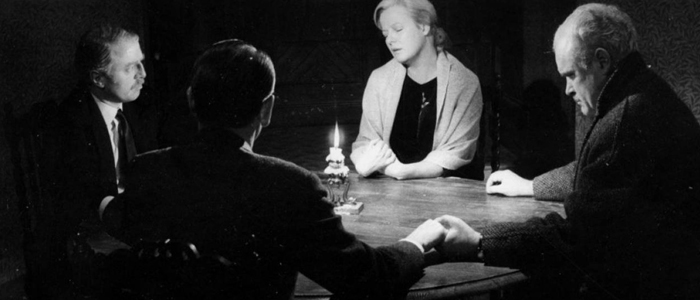
The film opens as a two-handed play about a strange and strangely compelling married couple. Myra (Kim Stanley) holds seances for her credulous neighbors and is convinced that she has remarkable psychic gifts. Her asthmatic husband Billy (Richard Attenborough) seems afraid to disagree with her. It soon becomes apparent that the two are hatching some sort of bizarre kidnapping and ransom plot, though it would be better said that Myra has hatched it and Billy is too uxorious to resist. Despite the ransom demand, the motive for the planned crime is nothing so simple as money. Many twists of story and anguished human psychology follow, taking the audience on a journey that is suspenseful, dramatic, and ultimately, quite sad.
This 1964 film is the most artistically impressive product of the highly successful, long-running collaboration between British cinema worthies Richard Attenborough and Bryan Forbes. The two men took on different roles in their various films; in this case Forbes wrote and directed and Attenborough acted and shared producer duties with Forbes.
As producers, the team’s masterstroke was reaching across the pond to cast Kim Stanley, who was then a stage and television actress barely known outside of New York City. As Myra, Stanley gives one of the outstanding performances of the 1960s as the sort of person who is deeply disturbed and fragile yet at that same time exerts enormous power over those around her. Stanley was dubbed The Female Brando by her biographer and she puts on a method acting clinic here in what sadly turned out to be one of few opportunities movie audiences got to see her masterful work. After being nominated for an Oscar for Seance on a Wet Afternoon, she returned to the stage and virtually disappeared from films until 1982, when she garnered another Oscar nomination for Frances.
Forbes’ direction and Stanley and Attenborough’s performances are truly above reproach. The way Billy is lacerated by Myra’s every critical remark and disapproving look, yet also clearly loves her and feels protective of her, is beautifully, painfully brought out. Their marriage is not quite a folie à deux because Billy retains some grip on reality and decency, which serves to create tension in the relationship and the plot that propels the film forward.
Though the script could have been slightly tightened, every line of dialogue rings true and the plot is consistently compelling. Gerry Turpin’s photography is also a virtue, both in the interiors of Myra and Billy’s house but also in, around, and underneath bustling 1960s London. Overall, one gets the sense of a production in which every professional in front of and behind the camera knew exactly what they were doing.
Billy and even moreso Myra will haunt your imagination after you see this movie. Don’t miss it.
This week’s film recommendation is an unusual, disturbing film noir that has enjoyed a renaissance in recent years: 1951’s The Prowler. Made by left-wing artists who were being harassed by the House Un-American Activities Committee, it’s a dark take on class resentment, sexual repression, and the ruthless pursuit of the American dream.
Many film noirs feature cops who are half-witted or on the take, but The Prowler is the only one I know where the central character is both a police officer and a calculating, manipulative psychopath. Van Heflin is mesmerizing as Webb Garwood, a flatfoot who is called to investigate a report of a prowler in a wealthy neighborhood. The call comes from Susan Gilvray, played with vulnerability by Evelyn Keyes (I also raved about her work in 99 River Street). Webb lusts for Susan immediately, not just physically but also for her and her husband’s obvious status in society.
Susan is both flattered and scared by Webb. Sensing her ambivalence, he pays her several more visits until the lonely and repressed Susan — who wants a baby — gives in to his advances. Eerily, their liaisons are accompanied by the sound of her husband’s voice, a radio announcer who works at night. Webb now has the wealthy man’s wife that he wanted, but he knows he doesn’t possess her completely, nor does he have access to the money he wants to buy his own place in the world. But if her husband were out of the way, who knows what might be possible?
In terms of establishing character and framing the plot elements, the script of The Prowler is one of the best in noir. The screen credit went to Hugo Butler, but Dalto Trumbo wrote much of the script. He was blacklisted and couldn’t be acknowledged publicly as a screenwriter, but in what was probably an inside joke at the expense of the McCarthyites, he provides the voice of Susan’s husband on the radio (again, uncredited). Anyone who wants to learn how to write strong scripts should watch the scene early in the movie in which Webb and Susan discuss their experiences growing up in Indiana. As Webb explains how he blew his chance to get a college education, the audience understands immediately his smallness as a human being and his entitled rage towards people whom he tells himself have denied him what he deserves.
The film also demonstrates something many producers forget: Characters don’t have to be likable, they just have to be interesting. Neither of the principals are people you’d want as your neighbors, but it’s extremely compelling to follow the tenebrous twists of their relationship.
The direction, by the soon to be blacklisted Joseph Losey (probably best known for the thematically similar The Servant), is unusual and effective. He structures the scenes in play-like fashion, with long takes in just a few key, evocative sets. Those locations each have their own vivid bleakness, especially the ghost town in which the third act occurs (memorably shot by the great Arthur C. Miller). Congratulations are due to Art Director Boris Leven and Set Designer Jacques Mapes for tremendous work on a small budget.
The film suffers slightly from a lull between the first and third acts as well as some plotting improbabilities, but it’s still a bit surprising that it wasn’t more of critical and popular hit upon release. It may have been a bit ahead of what a 1951 U.S. audience wanted to see in a story focused on a police officer. It was however very popular in Europe, where Losey was soon to flee to escape political persecution. Later, the film was reappraised by U.S. film noir devotees and its reputation has deservedly grown.
The Prowler is in public domain, and has been remastered version by UCLA’s vaunted restoration team (with financial support from The Stanford Theater Foundation).
Screenwriter Peter Morgan and actor Michael Sheen ventured into the life and career of British Prime Minister Tony Blair three times, with tremendous success. The Queen is by far the best known of these films, but this week I recommend the conclusion of the trilogy: 2010’s The Special Relationship.
The film begins with a wet-behind-the-ears Tony Blair (Sheen) being briefed on how Bill Clinton’s (Dennis Quaid) third way brought Democrats back to power in the U.S. Fast forward to Blair’s own resounding 1997 victory, and a congratulatory phone call from the POTUS he so admires (Blair hanging up on Jacques Chirac to take the call is one of the movie’s many funny and satisfying moments). Soon the Blairs arrives in Washington for an in person meeting. Tony is star struck, but his wife Cherie (Helen McCrory) is more skeptical of the slick Arkansan. Cherie does however admire the steel of the First Lady (Hope Davis), even while wondering why she puts up with Bill’s skirt chasing. The relationship between the world leaders develops further, with an initial triumph in Belfast followed by the Lewinsky scandal, which reverses the dynamic between a now-weakened President and a rising, more confident Prime Minister. They then cross swords over Bosnia, with profound consequences for their relationship as well as for the lessons Blair will take forward in his dealings with the next U.S. President.
If you are a political junkie and/or an Anglophile, this is compulsively watchable stuff. The events are recent enough to be well recalled by the audience, but the insider perspective of the movie enlivens those happenings rather than boring us with what we already know. The film is also professionally made from stem to stern. Stephen Frears did not sign on for the third installment of the series, but he was succeeded by another worthy of British directing, Richard Loncraine, so the series does not skip a beat in that department. Even the actors in the smaller parts make a strong impression.
In an age when intelligent dialogue is disappearing from film, Morgan’s screenplay is an oasis in the desert. Although some of the exchanges between the characters are imagined, sufficient research went into the script that everything feels plausible. The script is craftily constructed to reveal character structurally: Cherie and Tony pad around their kitchen minding their kids and digging through the laundry for lost shirts, but Bill and Hillary are generally shown as the power couple who are thoroughgoing politicians even when the news cameras are not rolling. The script gives the Clintons no real domestic life (Chelsea never appears). Even their private moments brim with impression management and campaign messaging, most painfully when Bill lies to Hillary about his relationship with Lewinsky and then, guilt-wracked, watches her on television as she gamely denies everything on his behalf.
Last but definitely not least, the film provides a plausible explanation for why Blair befriended his ideological opposite, George W. Bush, and went on to immerse his country in two wildly unpopular wars. The Bosnian success that resulted from a mix of good intentions and grandiose Churchillian aspirations was apparently easy to overgeneralize. The script also hints in its excellent closing scenes that Blair’s personal desire to be a player on the world stage ultimately overcame whatever policy goals he had at the beginning of his career (Indeed, the film questions whether those goals were even genuinely valued before his election).
This film recalls Sinclair Lewis’ observation that men can seem completely different on the surface while being exactly the same underneath, whereas women who seem the same on the surface can be completely different underneath. As Cherie and Hillary, the lead actresses are utterly credible, and they peel their characters like onions, progressively revealing new layers. McCrory and Davis deserve plaudits for giving full-blooded performances rather than merely impersonating their real-life counterparts.
At this point in his career, Sheen could have played Blair in his sleep. But he doesn’t sleep, turning in another strong performance as the British Prime Minister. As President Clinton, a heavily made-up Dennis Quaid easily surpasses John Travolta’s half-baked impression in Primary Colors (another film with a terrific portrayal of Hillary, that time by Emma Thompson). But of the four leads, his performance is somewhat less compelling for reasons that are hard to put one’s finger on. Perhaps Bill Clinton is simply a hard part to play for anyone other than Bill Clinton.
The Special Relationship did not receive quite as strong reviews as did the first two entries in the trilogy (The Queen and The Deal), perhaps because some critics felt it was a case of too many trips to the same well. But if like me you find real politics more engaging than the goings on of the royal family, you will enjoy The Special Relationship as a meatier film than The Queen. The movie brings home the apocryphal Foreign Office quip that the two most important things in the world are love and Anglo-American relations.
The 1957 Wolfenden Report kicked off a decade-long debate in Britain over whether consensual sex between men should be illegal. In that era, British police regularly jailed gay men on charges such as “gross indecency” and “homosexual acts”. Men with economic means and status were rarely among the arrested, but they were soft targets for blackmailers. In this environment, it was nothing less than daring to make 1961’s Victim.
The plot of the film concerns a barrister named Melville Farr (Dirk Bogarde), so successful in his profession that he has been asked to take silk at the tender age of 40. His life radiates conventional respectability: Cambridge education, comfortable house in an upper-middle class neighborhood, lovely and devoted wife (Sylvia Sims, very strong in a complicated role). But everything comes unraveled when the police inform him that a young gay construction worker named “Boy” Barrett (Peter McEnery) has hanged himself, and has left behind a series of photos and news clippings which suggest that he and Farr had a strong emotional attachment. The police tell Farr that Barrett was being blackmailed, leading Farr on a righteous hunt for the perpetrators. But the risk to everything Farr possesses is enormous, for the blackmailers have a photo that can reveal his sexuality to the world.
Dirk Bogarde, who was gay in real life, personally lifts Victim from good to great. The handsome star was a screen idol of the teeny-bopper set in the 1950s, but with this movie he turned his back on all that to begin a far more artistically remarkable career in offbeat and challenging movies. Even though Janet Green and John McCormick’s script designs Farr to be as unthreatening to audiences as possible (He is married, resists his homosexual urges and, like Bogarde himself, stays in the closet), taking the role was a risk to Bogarde’s emerging stardom. And the performance itself, with thick layers of British composure hiding surging rage and sexual desire, hits discerning viewers like a thunderbolt.
The script has two other important virtues. The first is its unwinding of the blackmail mystery, which includes a superb bit of misdirection followed by a most intriguing portrayal of the criminals’ motives. Second, the script is sensitive to how different heterosexuals come to a position of tolerance of gay people. A friend of Barrett’s tells him sympathetically “It used to be witches” who were persecuted, and we find out later his sympathy comes more from pity for gays than respect. In contrast, in an understated and moving exchange, Farr’s law clerk tells him simply that he has always respected Farr’s integrity and sees no reason to change his mind upon learning that Farr is gay. Unlike Barrett’s friend, the clerk sees Farr as an equal, indeed even a role model.
Victim is one of many films made after the war by the team of Director Basil Dearden and Producer Michael Relph. The two were recently awarded the distinction of a Criterion Collection boxed set, and there has been an effort by some critics in recent years to say that their talents have been grossly underrated. I recently went on a little binge of watching their films, and I must say that Dearden and Relph strike me as justly underrated filmmakers. I often find myself drumming my fingers because of the leaden pacing of most of their films (e.g., Woman of Straw). I also dislike their occasional lapses into heavy-handed music, speechifying and camerawork and I sometimes suspect that they didn’t have sufficient emotional understanding of the controversial material with which they were often working. Their filmmaking is serviceable, but I suspect a more talented producer-director team could have made every one of their movies better.
It is thus not surprising to me to have read that it was Bogarde who demanded the key scene of the Victim, in which he speaks passionately of his desire for another man (a mainstream movie first) and explains so movingly to his wife the emotional vice that his closeted life places on him. Bogarde personally gives psychic weight to Victim that was lacking in, for example, Sapphire, a less successful Relph-Dearden effort to make a social message film (That one was about race — not bad really — but just not in the same league as Victim).
Given the talent of a remarkable lead actor and a strong script, even a middling producer-director team can make a classic movie, and that is what we have in Victim. It succeeds both as social message and as art, and also may have contributed to the decriminalization of homosexuality in Britain in 1967.
p.s. Kudos as well to another gay actor — Dennis Price — for taking the risk to play another prominent victim of the blackmailers.
I saluted the Tinker, Tailor, Soldier, Spy mini-series as the summit of BBC programming. The 1989 mini-series Traffik is in the same league. Most Americans remember Steven Soderbergh’s Oscar-winning adaptation of this series, but far too few have seen the British original, which at just over 5 hours allows much more character and plot development than could Soderbergh’s excellent movie.
Simon Moore’s masterful script anchors what could have been a sprawling, confusing series in the lives of a small number of characters: A UK Home Office drugs minister (Bill Paterson) whose daughter is a heroin addict (Julia Ormond), a dogged German cop (Fritz Müller-Scherz) who relentlessly pursues an ice queen (Lindsay Duncan) who steps into the drug trafficking business when her husband (George Kukura) is indicted, and a desperate Pakistani poppy farmer (Jamal Shah) who finds work with a ruthless drug lord (Talat Hussain). As events buffet the protagonists and their respective story arcs cross, Moore’s narrative skills and Alastair Reid’s deft direction ensure that the viewer is irresistibly drawn in emotionally and able to track the complexities of the plot.
The performances by the actors range from good to amazing. Though it is hard to choose some to single out for praise, Müller-Scherz completely inhabits his role as a working class police detective who seems to hate traffickers as much for their wealth as their drugs. Paterson (best known to US audiences from Fleabag) is marvelous in a tragic role, playing a rigid man who desperately wants to do good at home and at work yet almost always fails in both domains. Lindsay Duncan is also impressive, beginning the film as a woman accustomed to wealth and knowing yet not wanting to know where the money comes from. After her husband’s arrest, Duncan makes credible her character’s transformation into someone even more cold-hearted than he, revealing the greed and entitlement that was lurking in her all along. Her character, along with Talat Hussain’s Pakistani drug lord, are used by the film to portray the drug trade much as socialists tend to see all of capitalist enterprise: A system with a few rich sociopaths on the top and countless marginal people (whether in the drug trade or addicted to its products) scraping by and suffering at the bottom.
The cinematic team behind Traffik took a somewhat subjective approach in their portrayal of drug production and daily life in Pakistan. Home Office minister Jack Lithgow (Paterson), improbably, roams around Pakistan unstaffed, not unlike Macbeth lost in the haunted forest. His encounters with the locals are more emblematic than realistic, including his somehow running into Fazal, the farmer who will be a hub of the story that unfolds. Coupled with dreamlike, sun dappled shots of the countryside by cinematographer Clive Tickner, the whole effect of the Pakistan sequences is akin to watching a surrealist play. Yet it works because Lithgow is on a mission of unreality, trying to stop drug production with a feeble crop substitution program and more generally trying to control a culture that he can barely even understand.
In contrast, the scenes set in Europe are more gritty and realistic, particularly Ormond’s descent into addiction. The skies are darker, the shadows longer and the cinematic look grimier. And over both the European and Pakistani scenes hangs Tim Souster’s music, a quasi-mystical threnody that accentuates the emotional anguish that the film creates. You won’t get his score out of your head quickly nor will not want to.
Traffik is a powerful, mournful film that doesn’t speechify or offer easy answers about drugs. Both artistically and as an education about its subject, it’s a triumph from start to finish.
Nothing lasts really. Neither happiness nor despair. Not even life lasts very long.
Elsewhere I recommended In Which We Serve, the first collaboration between Noël Coward and David Lean. As their partnership evolved, Coward ceded full directorial control to Lean and the two men made a series of films (now available as a boxed set from Criterion Collection) that both reflected and defined the image of Englishness for a generation. The strongest of their efforts is 1945’s Brief Encounter.
Expanded from a one-act play of Coward’s, the plot is so simple that it would have been slight in less talented hands. A plain-looking, thoroughly respectable suburban housewife and mother named Laura Jesson is waiting for her regular train on her regular shopping day. A train throws a piece of soot into her eye. The handsome Dr. Alec Harvey comes to her aid and something sparks between them. They meet again by chance, a third time by intention mutually disguised as a trivial convenience, and then, guiltily, on purpose. A forbidden — though by modern standards, extremely restrained — romance develops. But where can it go, for two married parents with a lifetime of British socialization in their veins?
Other than The Browning Version, no British film conveys the nature of quiet desperation as achingly as does Brief Encounter. Coward wisely does not make the choices simple for the characters or the audience. Laura’s husband is gentle and devoted and her children loveable. Alec’s family is never seen, but the audience imagines something similar regarding his own responsibilities and constraints. Alec and Laura are drawn to each other not because they are fleeing violence, hatred or some other overt misery. Rather, they are running from dullness towards passion, which is underscored (pun intended) by perfectly chosen music by Rachmaninoff.
Lean and his frequent collaborators Ronald Neame and Anthony Havelock-Allan understood the possibilities of film as well as any team in the history of cinema (Not incidentally, they went on to make many classics together post-Coward, including another of my recommendations, Great Expectations). This movie is one of their many triumphs. The tone, look, pacing and editing are all unimpeachable.
The other undeniable virtue of Brief Encounter is the acting. Trevor Howard, as Alec, is strong, but Celia Johnson tour de force as Laura, the more fully developed of the two characters, will stay with you until the end of your days. She might have been an unsympathetic character but Johnson’s evident humanity and emotional turmoil will elicit forgiveness from even judgmentally-inclined viewers. Johnson’s most unforgettable moment: Her character’s realization that her husband loves and trusts her so much that he will never suspect the lies she tells to cover up meeting with Alec. Johnson deservedly received a 1947 Oscar nomination for her performance. It came that long after the 1945 British release because a movie in which infidelity is not punished was long considered too scandalous to release in a number of countries, including the U.S.
Every moment, every look and every gesture rings true in Brief Encounter. Pour yourself a cup of tea, get out your hanky and watch this truly magnificent film made by a creatively matchless group of artists.