Categories
Drama Mystery/Noir

The Turning Point

LOS ANGELES'S ANGELS FLIGHT by Jim Dawson - "The Turning Point ...

Recognizing that post-war audiences were gripped by more realistic, torn from the headlines crime stories, Hollywood producers were giddy over the Kefauver Committee’s investigation of organized crime. Many Americans were transfixed by the hearings, both because they provided their first glimpse into the workings of the Mafia and because they were on this new fangled gizmo known as a television. A raft of films followed that were based on the hearings either directly or obliquely (the latter including one of my recommendations, Bullitt). Many of the Kefauver films were cheap and unimaginative, but 1952’s The Turning Point is quality cinema.

The strong cast features Edmond O’Brien as John Conroy, a special prosecutor appointed to take down a criminal syndicate run by the slimy, brutal Neil Eichelberger (Ed Begley), who poses as a legitimate businessman. Conroy’s hard-nosed childhood pal (William Holden), now a crime reporter, comes along for the ride, not because he believes anything will come of the investigation but because he admires his old friend and also, rather guiltily, has eyes for Conroy’s gorgeous, idealistic assistant (Alexis Smith). Meanwhile, John’s father, a beat cop played by reliable veteran character actor Tom Tully, is also in the mix, but what side he’s playing is a subject of mystery.

Warren Duff never became famous as a screenwriter, but he was very good in his niche of tough crime stories. He does a particularly admirable job here creating dramatic face off scenes between each pair of principals. Lionel Lindon’s skilled camerawork makes the film pleasing to the eye (love the long tracking shot with Holden and O’Brien early on) as does William Holden, who looks fabulous in a series of tailored suits that the legendary Edith Head picked for him (I guess ink-stained wretches could afford those kind of threads and fashion advice back then). The broad-shouldered screen icon has real chemistry with his equally toothsome co-star Alexis Smith, who puts spine and depth into her character rather than just being eye candy. She and Duff’s script are particularly good at ripping apart the cynical facade of Holden’s character, which is potent stuff for Holden fans given how often he played this type.

The Turning Point has a few weaknesses. After a gripping first 45 minutes there is a lull in the action at the actual commission hearings, which should have been a highlight of the film, especially with an actor of Begley’s stature at center stage. There are also a couple small logical holes and overly worn elements in the plot. As a result, I would not call The Turning Point an all-time classic crime melodrama. But it’s definitely exciting and entertaining, with a cast that is aces right down the line.

p.s. Plug ugly Neville Brand, who made a career out of playing nasty thugs, appears at the end as a hired killer. Both he and O’Brien were another of my recommendations, D.O.A.

Categories
Action/Adventure Drama Mystery/Noir

D.O.A.

I have recommended The Turning Point, starring Edmond O’Brien and featuring Neville Brand in a small part as a vicious killer. For a change of pace, let me also recommend a film starring Edmond O’Brien, featuring Neville Brand in a somewhat larger part as a vicious killer: 1950’s D.O.A.

D.O.A. has one of best opening premises in the history of film noir. A man stumbles down an impossibly long, shadowy hallway at the police station, followed by a tracking camera. Upon meeting the officer in charge of homicide investigation, he announces that he wants to report a murder: His own. What follows is partly a mystery/action story and partly an existential meditation.

The central character, Frank Bigelow (O’Brien) has a life that screams conventionality. He’s an accountant in a small town with a small town girlfriend (Pamela Brittan) who is nagging him to do the decent thing by marrying her, settling down, and having a conventional family. This is a noir film, so naturally Bigelow wants nothing more than to flee. He goes for a wild weekend in San Francisco, where he ogles sophisticated urban beauties and swills liquor until for an inexplicable reason, someone covertly poisons him with a lethal, slow-acting toxin. After the terminal diagnosis is confirmed, a justly famous film noir sequence commences as Bigelow races madly through the crowded streets until, exhausted, he looks up to heaven and then down to see a little girl’s ball at his feet. He returns the ball to the girl and then sadly stands up, knowing that he will never be carefree as a child again for he is doomed to die, and very soon at that (Nice touch: Look at the particular magazine arrayed next to him in the shot above).

Although Bigelow cannot save his life, he is driven to understand why he will die, and thus spends his final precious days not enjoying what remains, but ruthlessly pursuing his killer. With his death in no doubt, he transforms from a mild-mannered accountant into a fearless, even brutal, angel of vengeance. He doesn’t fear death from the assorted villains he encounters, just the prospect of dying before he can find out why a nobody accountant from a nothing small town was worthy of cold-blooded, calculated murder.

As you would guess, D.O.A. offers much to chew on thematically. It can be enjoyed at one level as an exciting (if overly complicated) crime mystery, but at another level it’s a philosophically engaging take on venerable film noir themes of isolation, futility and the cruelty of fate.

Director Rudolph Maté earned his place in movie heaven as a cinematographer, including in my recommendations Vampyr and Gilda. He directed much less often, and that’s a good thing because he didn’t attain the same level of excellence in that role. Here, he allows some of the actors to go over the top too often, and there is also an embarrassingly puerile use of a “Va Va Voom” sound effect when O’Brien sees attractive women that is completely inconsistent with the noir mood.

I would say I wish Maté had been director of photography instead, but that wouldn’t be fair to Ernest Laszlo, who gives the film a stunning look, especially in the street scenes in San Francisco and Los Angeles. The crowded street shots must have been particularly challenging from a technical viewpoint.

Neville Brand, in a role that helped make his fairly successful if completely typecast career, is admirably scary here as a psychopath, and Luther Adler makes a smooth, cultured, but ultimately nasty villain. As mentioned, some of the other performances — including O’Brien’s — are uneven, but all the main actors have their moments.

The basic existential conceit of D.O.A. is not about a man trying to prevent his death; he doesn’t have that power. Rather, it’s all about the desire to know why — why me and why this fate? The best noirs never answer this question, but bathe the audience in the agony of being unable not to ask it nonetheless. D.O.A. is a noble example of this tradition.

D.O.A. is in the public domain, so you can watch it for free on Internet Archive. However, that print looks nowhere near as good as the digitally remastered version, which you can probably find on a paid streaming service.

Categories
Documentaries and Books Drama Mystery/Noir

The Naked City

Disruptive innovations in technology have been one of the defining aspects of the short history of cinematic art. The introduction of sound in the 1920s, followed by color in the 1930s, followed much more recently by computer-generated imagery — all of which had profound creative implications — are the ones with which most movie fans are familiar. A lesser known but still important set of innovations occurred in the 1940s: faster film, improved microphones and lighter-weight cameras and equipment. Combine these enhanced technologies with a large number of cinematographers gaining experience in shooting under every conceivable condition during World War II, and you had the basis for a raft of films shot in realistic style on location. A high-quality example of the form, which explicitly packaged itself as such, is Jules Dassin’s 1948 docu-drama The Naked City.

As the famous voice-over narration tell us as the film opens with a stunning airplane shot of Manhattan, The Naked City is not just a story of a murder investigation but of New York City and the people in it. The narration was provided by producer Mark Hellinger, a Runyonesque Big Apple journalist whose own colorful life could have been the basis for a fine biopic itself if he hadn’t sadly dropped dead shortly after the movie was finished. With New York and New Yorkers being the main characters, the film tells the story of the murder of a beautiful striver/gold digger and the efforts of the police to solve it. In addition to being distinctly its own film, The Naked City also fits into the then-emerging subgenre of crime investigation procedurals (Call Northside 777, The Street With No Name, and He Walked by Night were also released in 1948).

The City that Never Sleeps, as seen through the Oscar-winning camerawork of William H. Daniels, has rarely been captured so vividly in film. Dozens of small performances, most of them I assume turned in by average NYCers rather than professional actors, add flavor throughout: The lady at the root beer stand, the guy hawking newspapers on a street corner, the funeral home director, the cop on the beat, the woman having her hair done and many others get their moment. Many of these little slices of life bear no relation to the murder mystery, but are instead intended to bring alive post-war Gotham.

The murder mystery itself is actually a bit slow and convoluted, but it’s watchable because Barry Fitzgerald once again plays a twinkly-eyed charmer with a brogue. As Detective Lieutenant Muldoon, he has wonderful father-son style byplay with his eager-beaver protege and investigative leg man Jimmy Halloran (Don Taylor). The two of them help the film along during its slow spots, which most viewers will forget anyway because of the thrilling conclusion in which the police chase the killer on the Williamsburg bridge.

One critical note on The Naked City. It is often referred to as a film noir, but that’s only true to a degree. Jimmy Halloran’s incredibly happy and loving suburban family is revealed underneath to be…an incredibly happy and loving suburban family. The cops are all honest and clearly differentiated from the very bad gang of criminals. Urban dwellers are generally portrayed without cynicism and the look of the film owes more to Italian Neorealism than noir. If you want a police docu-drama that is also a noir, see my recommendation of He Walked by Night.

Final suggestions: The Naked City is so visually striking that if you seek it out, you owe it to yourself to watch the restored print available from the Criterion Collection. And if you like the movie, you will probably like the television series it spawned, which was decades ahead of its time.

Categories
Documentaries and Books Drama Mystery/Noir

He Walked By Night

Crime investigation procedurals became popular after World War II and continue to be a staple of television and movies today. A fine example of the form with pronounced noir elements is 1948’s He Walked by Night.

Normally, police detectives have substantial advantages over perpetrators. The typical violent offender is unintelligent, impulsive, minimally-skilled and ignorant of police procedures. But every once in awhile a criminal comes along who is smart, planful, technically proficient and knowledgeable about the investigative methods of law enforcement. One of such extraordinarily dangerous people was Erwin M. Walker, who repeatedly evaded Los Angeles law enforcement while engaging in an extended violent crime spree in 1946. He Walked by Night is a Dragnet-style dramatization of the Walker case, and indeed the origins of that famous radio and TV show are right here to see.

Richard Basehart gives an icily compelling portrayal of Walker, who is here re-named Roy Morgan. Basehart is particularly skilled at embodying Morgan’s disturbing level of emotional restraint, even when he is inflicting violence on others. The only visible break in the killer’s sociopathic detachment comes in a riveting scene in which he does meatball surgery on himself to remove a bullet from his ribcage. On the other side, Roy Roberts, as Police Captain Breen, is credible as usual in one of his many no-nonsense authority figure roles. Some of the portrayals of police procedure (e.g., the assembling of a composite sketch) will be dramatically slow for modern audiences who have seen it all before. But of course that wasn’t true of audiences in 1948, so be forgiving.

The docudrama’s look is one of the many jewels in legendary cinematographer John Alton’s crown. In an interview, he said the crew and director all asked him where the lights were when they started filming the justly famous chase through the sewers. He told them that a single flashlight was enough, which gives you an idea of how very dark he preferred his shots. If you watch very carefully you will see that the king of darkness did have a trick up his sleeve: There are wires visibly trailing the actors in some of the sewer chase shots, indicating that he rigged the flashlights with much more powerful than usual light bulbs.

In addition to Alton’s bravura work behind the camera, this film also benefits from effective use of silence. In several highly arresting sequences (no pun intended), the sound goes dead as the police close in on the killer. The suspense is amped up enormously by these eerie scenes, as hunter and prey creep noiselessly through the dark until a violent confrontation shatters the silence.

The one mystery this film does not solve is who directed what. Alfred Werker got the director’s credit on screen, but it was later revealed that much of the film was actually directed by Anthony Mann (whose work I have touted here and here). Some scenes scream “Mann” in their style but others could have been directed by either him or Werker. Whoever did what, this taut, exciting film hangs together in tone and style with no directorial seams showing.

He Walked by Night is sadly little remembered today, but it did launch some much better known radio and television shows. Jack Webb, who plays a police investigator here, befriended L.A. police technical advisor Marty Wynn on the set and soon launched Dragnet to dramatize the real-life cases of the L.A.P.D. (FYI: This story is well-told in John Buntin’s terrific book L.A. Noir). Richard Basehart never became a big movie star, but was able to parlay his modest cinema success into a long-running career on television, most notably as Admiral Nelson on Voyage to the Bottom of the Sea.

This thrilling, visually stunning docudrama is in the public domain, so you watch it for free right here.

p.s. The fabulous sewer chase sequence in one of the greatest films in British history, 1948’s The Third Man bears more than a little resemblance to the similar sequence in He Walked by Night. No one seems to know for sure, but given that He Walked by Night’s production studio, Eagle-Lion films, had extensive British ties it is entirely possible that Carol Reed et al saw this movie and decided to mount something along the same lines.

Categories
Drama Mystery/Noir

Pickup on South Street

Many films have been set in seamy settings where everyone is on the make, believing in nothing and exuding cynicism until something comes along to drive one person into moral behavior (e.g., The Third Man, Casablanca, The Mission). Sometimes what makes the worm turn is romance, sometimes it’s an attack of conscience, sometimes it’s religious faith, but in Pickup on South Street, it’s hatred of Commies!

Samuel Fuller’s 1952 hard-boiled masterpiece is set in the urban world of schemers, grifters, prostitutes, cops and robbers that he knew so well. The film’s perfect opening sequence, which is dialogue, backstory and exposition-free, shows cool as a cucumber pickpocket Skip McCoy (Richard Widmark) lifting the wallet from the kind of woman a respectable young man’s parents hope he never brings home (Jean Peters). The theft is observed by two men who turn out to be federal agents. They’ve been trailing the woman because she has been unknowingly passing military secrets to the Reds at the behest of her lover/co-conspirator (Richard Kiley). Meanwhile, the clever Skip soon figures out that the piece of microfilm he found in the stolen wallet is extremely valuable. Skip decides to sell it to the highest bidder, politics notwithstanding, thereby throwing himself into conflict and intrigue with the cops, the feds and the Reds.

The entire cast is on fire here, and all of them are well-matched to Fuller’s pulpy tone and visuals. Even though she hated playing the sexy bad girl, Jean Peters electrified a generation of men when this film was released, which was just before women of her physical type were largely pushed aside by Hollywood producers in favor of curvaceous blondes like Marilyn Monroe and Jayne Mansfield. Richard Widmark, who might remind modern audiences of a young Jack Nicholson, exudes cocky charm, which is an ideal foil for Kiley’s more restrained performance as a desperate Communist agent.

But despite all the thespian talent put on display by the leads, this film is nearly stolen by Thelma Ritter in a supporting performance as Moe, an aging, raffish stoolie/ragwoman who just wants to save enough money for a nice funeral. She will sell almost anyone out — even her surrogate son Skip — but she draws the line at helping Reds. And Skip, otherwise amoral, draws his own line in the sand when Moe becomes a target.

Pickup on South Street is a rough, tough tale of the city which features corruption, disloyalty, double-dealing, licentiousness and some savage physical violence (I would not be surprised if both Peters and Kiley got some bruises making this movie). In short, for fans of Fuller and film noir more generally, what’s not to like?

To give you the flavor of this movie, I embed below one of my favorite scenes, which is representative of the whole. Jean Peters’ character is looking for the “cannon” (slang for pickpocket) who stole her wallet and believes that someone named Lightning Louie can facilitate her search.

Categories
Comedy Drama

The Bingo Long Traveling All Stars & Motor Kings

Hollywood has made many beloved films about baseball from Field of Dreams to The Pride of the Yankees. 1976’s The Bingo Long Traveling All Stars & Motor Kings is a lively, enjoyable movie about America’s pastime that like the era it portrays is often forgotten today.

The plot: In the waning days of the Negro League, a free-spirited Satchel Paige-esque pitcher named Bingo Long (Billy Dee Williams, at the peak of his considerable charisma) chafes under the exploitative tactics of his team’s owner. He persuades a fearsome slugger (the ever-impressive James Earl Jones) and a number of other Black players to form their own barnstorming baseball team. Bingo’s motley group includes a slow-witted outfielder (A quite funny Richard Pryor) who thinks he can play in the Major Leagues if he can just persuade white people that he is Cuban or Native American. After the Negro League owners close off the Traveling All Stars & Motor King’s access to other black teams, they begin to play white teams instead. The teammates thus must confront the question that every Black entertainer of the era faced: Is it morally acceptable to clown around in front of white audiences in order to appease the bigots and thereby stay employed?

This is mainly a bright comedy that delivers a few big laughs and many smaller smiles. There are dramatic themes as well. For a Hollywood film, there is more Marxism than one would expect. The white baseball teams of this era were owned by wealthy white people who generally treated their players like serfs. The black teams in this film are owned by wealthy black people who generally treat their players like…serfs. As Jones’ character tells Bingo Long, their team’s struggle for economic independent is not so much about race as it is about how the “workers can seize the means of production”. The story also includes some intriguing (if underdeveloped) observations on race, most particularly in a subplot involving a Jackie Robinson-like member of Bingo’s team (earnestly portrayed by Stan Shaw) who attracts the interest of a white team. Bingo wants the best for him, but also knows that the breaking of Major League baseball’s color line will destroy the all-Black baseball world which he loves.

mqdefault

The only significant weakness of the movie is its uneven tone. First-time director John Badham didn’t quite decide whether he was fundamentally making a comedy or a drama, and he shifts gears back and forth pretty roughly at times. For example, the owners of the black teams are buffoonish villains at one moment, but then order that someone be slashed with a razor the next. As a result, if you look over the careers of the three leads, you will note some more consistently funny comedies and some more consistently weighty dramas than this film.

That said, the entertainment value of this movie is very high end-to-end, and the art direction and set design bring its historical period alive. There are films that are very hard to like, and films that are very hard to dislike. Thanks to its irresistible leads and the window it opens into an aspect of baseball history that Hollywood usually ignores, this film falls decisively into the latter camp.

Categories
Drama Foreign Language Horror/Suspense

Onibaba


When movie aficionados think of Japan, their minds typically turn to Akira Kurosawa. That’s understandable, as one could make a plausible case for him being the best director in the history of cinema. But Kurosawa is far from the only brilliant filmmaker to hail from the Land of the Rising Sun. Another is writer-director Kaneto Shindô, the creative force behind Onibaba.

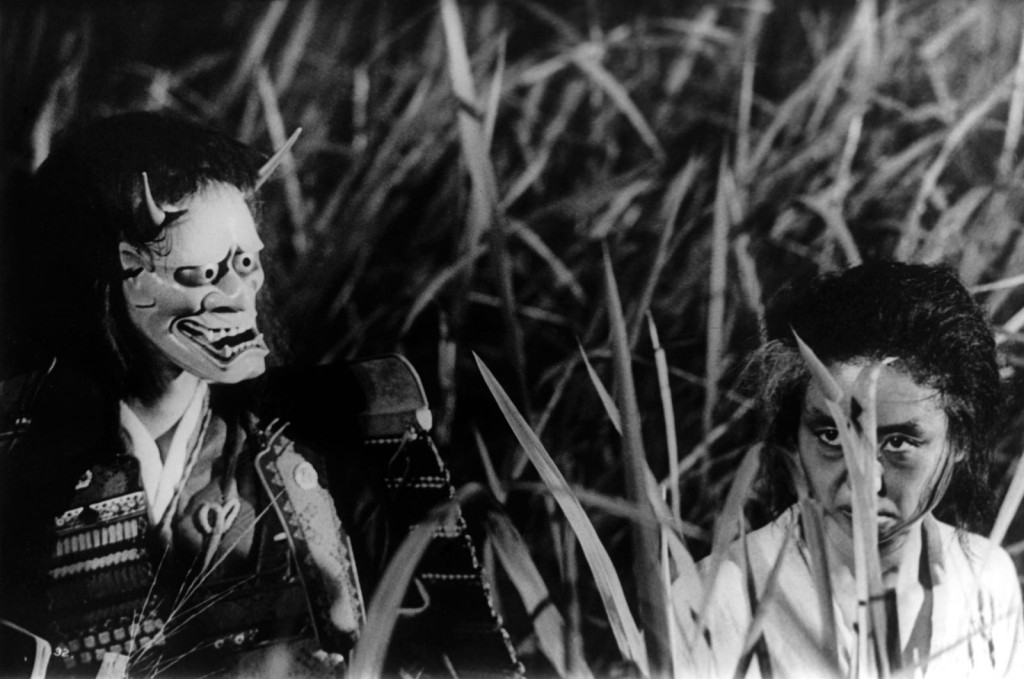
Shot in lustrous black and white under demanding conditions in 1964, Onibaba is a primal, sensual and eerie story of human beings struggling to survive. Emphasizing the mythological nature of the tale and its universal themes, the two central characters do not even have names. The older woman and her young daughter-in-law eke out a living in a swamp by murdering unfortunate soldiers who are lost or are fleeing the battles that rage across 14th century Japan. Strong, complex women characters were one of Shindô’s hallmarks, and he chose brilliant actors here to essay the roles: Nobuko Otowa (his real-life wife) and Jitsuko Yoshimura.

Onibaba (1964) | The Criterion CollectionInto this small, brutal world eventually comes a disruptive force, an ex-soldier played by Kei Satô who informs the women that the link between them is gone: the older woman’s son is dead and the younger woman is therefore now a widow. The ex-soldier moves into the swamp, while keeping a lustful eye on the young woman, whose own uncontrollable sexual yearnings are memorably dramatized by her racing through the tall, undulating susuki grass (truly, the grass forest is the film’s fourth character). The older woman is consumed both by her own sexual frustration and her fear that the young woman will leave her, ending the bloody partnership that allows her to survive. So she concocts an unusual scheme to disrupt the relationship, which backfires as the movie takes a supernatural turn that will resonate with those viewers who are familiar with Buddhist folklore.
myReviewer.com - Review for Onibaba (Masters of Cinema)This is a raw film about how human beings’ animal nature emerges under harsh conditions. On display are unbridled lust, jealousy, greed and violence. Even the way the characters eat suggests animality. Hikaru Hayashi’s one-in-a-million score, a mix of Taiko, jazz and ghostly notes from wind instruments, is the perfect marriage of music with celluloid. Kudos are also in order for cinematographer Kiyomi Kuroda for achieving technical brilliance on a hot, rainy and swampy set (It was so brutal that Shindô allegedly refused to pay the rebellious crew unless they finished the shoot). Like Saed Nikzat, Kuroda has the confidence to hold a still long shot and let the audience experience the environment and characters rather than forcibly directing our attention by moving from one quick cut to another. This is especially effective in his hypnotic, sensual images of the ever-swaying susuki grass forest.

Although the film is perhaps 10 minutes too long, Onibaba is completely original and fascinating. It’s also rather unsettling in the best artistic sense of that word. To fully enjoy this classic of Japanese cinema, try to get your hands on the gorgeous Criterion Collection re-issue.

Categories
Drama Foreign Language

A Time for Drunken Horses

A Time For Drunken Horses review | GamesRadar+

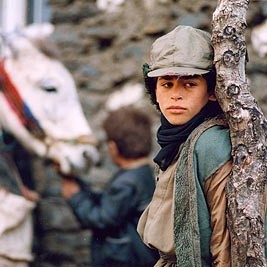
I remember the Kurdish area on the Iran/Iraq border as a land of stunning beauty and inordinate risk. No movie captures both realities better than A Time for Drunken Horses. Made by then-unknown Iranian director Bahman Ghobadi in 2000, it’s the first widely-released film in the Kurdish language, one of many virtues that help it bring alive this part of the world in an authentic way.

The Kurdish villagers (most of whom Ghobadi had play themselves on screen) eke out an existence by smuggling goods back and forth across the snowy, mountainous border. In addition to avoiding border guards who mete out lethal summary punishments, the smugglers must also scramble to evade armed bandits who raid their caravans. Crushing poverty is the lot even of those smugglers who succeed, but they are too economically desperate to abandon their dangerous business. The film’s plot centers on an orphaned family led by a heroic 12-year old boy named Ayoub. He provides for his siblings by smuggling, but his profits are too small to save his deformed, pained, and ill brother Medi. Though an operation will only extend rather than save Medi’s life, Ayoub takes on increasingly dangerous work out of love for his sickly brother.

This is an achingly sad film that tells a painful story in an unsparing fashion (Analogies to Vittorio De Sica’s Bicycle Thieves are inevitable and accurate). But it’s watchable because of the astonishing performances of the young actors and the inspirational courage and love of the family upon whom the story centers. As a director, Ghobadi is wise enough to never descend into mawkishness or to idealize the moral character of the poor, some of whom are portrayed here as greedy and conniving. Nor does he make the mistake of some films of this sort by lecturing the audience (e.g., by having some character deliver an earnest speech about the callousness of wealthy Westerners). Rather, he lets the audience feel their own emotions and draw their own conclusions about the characters’ bleak lives.

The Film Sufi: "A Time for Drunken Horses" - Bahman Ghobadi (2000)

Saed Nikzat’s cinematography captures the harsh gorgeousness of the region. Nitzat also, wonderfully, lets the camera linger in extended shots so that viewers can immerse themselves in the events portrayed rather than have their attention jerked around by constant jump cuts and close ups. The camerawork makes watching this film at times feels like a melancholy form of meditation.

A Time for Drunken Horses is a powerful piece of cinematic art that deservedly raised the profile of Iranian film worldwide. It will not make you happy, but it will stay with you in a way that is precious beyond words.

Categories
Drama

The Intruder

It is pretty hard to imagine a Hollywood Producer sitting in a meeting in 1962 and saying “I want a daring and powerful film about racism in the civil rights era…get Roger Corman and Bill Shatner on the phone pronto!”. Yet the B-Movie king and television’s most beloved overactor did indeed make such a movie, and The Intruder still packs a punch today. .

The story opens with an angelic-looking charmer (Shatner) named Adam Cramer arriving at a small Southern town for the purpose of “social work”. He is boyish and innocent-seeming at first, but it quickly becomes apparent that he is a member of a John Birch-type society and intends to stir up racial animosity concurrent with the arrival of school integration. He preys on weakness in all its forms and foments hatred and violence which spins out of control. Disgusted by Cramer, a fence-sitting newspaper editor (Frank Maxwell) has an attack of conscience and moves to side decisively with integration, at horrible cost to himself and his family.

Maybe because it was his first movie leading role or because Corman kept him under control, Shatner is unusually restrained here and it really works well for him. Then young and handsome, he is particularly effective at portraying seductive yet smarmy sexuality. Most of the extras and small roles were people of the town in which the crew filmed and were eventually chased out of because of the dirty laundry the movie was airing. Charles Barnes as the high school senior leading the first Black students into the previously segregated school movingly conveys strength, dignity and sadness all at once. This was a role from the heart for him as the prior year he had actually done the same thing in real life.

Although The Intruder can be experienced as a film about racism, it can be even better appreciated as a mesmerizing character study. Adam Cramer is a blend of the calm salesman and someone desperate to obtain, a bully and a weakling, an Adonis who is deeply ugly. The development of this strange yet realistic character is the best thing about Charles Beaumont’s script. For someone with a tragically short life, Beaumont had significant artistic impact, including co-creating The Twilight Zone with Rod Serling and going on with Corman and much of the cast here to make the first adaptation of H.P. Lovecraft’s work for the big screen (The above-average horror film, The Haunted Palace).

Corman was known for making cheap, unpretentious grindhouse films about motorcycles, monsters and mayhem (Including Edgar Allen Poe adaptations I recommend here and here). He also, famously, never lost money on a movie. Until The Intruder that is, which was denied bookings in much of The South and in other parts of the country where the film was considered too controversial. It was re-titled multiple times to try to get it into theaters (as “Shame” and later with the cringe worthy exploitation title “I Hate Your Guts!”), but with minimal success. As the film’s reputation grew and it was the subject of some documentaries and festivals, it finally broke even four decades after its release.

The only thing I didn’t love about The Intruder was the climax, which though still downbeat comes out a bit happier than I expect it would have in real life. But if Corman had gone for complete realism his film would never have been released at all. This was daring stuff for its time, and both for its themes and character development The Intruder remains an impressive piece of cinema over 50 years later.

The Intruder is in the public domain and you will be able to find it online pretty easily. It took only the first six minutes for me to be completely hooked.  After you have watched it, you might enjoy this short film about the making of the movie (spoilers).

Categories
Action/Adventure Drama Romance

Canyon Passage

Image result for canyon passage 1946

Between making bettered remembered films, Dana Andrews starred in an underappreciated 1946 frontier yarn made in glorious Technicolor by an extraordinarily unlikely director: Black and white film noir master Jacques Tourneur! The result is an entertaining, highly original (if blandly titled) Western: Canyon Passage.

The plot, set in mid-19th century Oregon, is not easy to summarize, which turns out to be one of the film’s virtues. Throughout there is a movie-length story thread concerning whether brave, restless entrepreneur Logan Stuart (Andrews) will marry a sweet, stay-at-home woman (Patricia Roc) or end up with the sassy, adventurous flame-haired beauty the audience knows is made for him (Susan Hayward) if only she were not engaged to his friend (Brian Donlevy). But there is much more to the film than that. It’s a slice of frontier life, told through different lenses. Indeed, the film’s highlight is an extended sequence of slight relevance to the love triangle storyline in which the pioneers raise a cabin for a newly married couple. The panoramic tale also includes subplots about the cruelty of “justice” in towns where no police or courts exist, the workings and risks of gold mining-based economic systems and how boredom leads small town dwellers to seek out destructive entertainments (e.g., egging on fistfights, engaging in compulsive gambling). Some critics found Canyon Passage too “plotty” but if you step back from the details and see it more as the story of a entire frontier community, it’s unified and not a bit overstuffed.

That style of storytelling is one sign that Tourneur clearly didn’t want to make a typical Western. Another is that the first closeup doesn’t occur until 15 minutes into the movie! Throughout the film, Tourneur keeps the camera at a distance from his stars (thereby driving producer Walter Wanger batty), which makes the audience think about the many characters in the town as a whole rather than just seeing them as background for the leads.

What makes Andrews’ commanding performance so enjoyable is the way he plays off three other talented actors. His flirty, forbidden jousting with Hayward has palpable electricity, his dedication to his flawed friend Donlevy is both inspiring and sad, and his conflict with a vicious local bully (Ward Bond) is gripping. Bond was a physical powerhouse, and his brutal character here is what Jud Fry would have been in Oklahoma! if he had regularly consumed steroids. The physical confrontation between Andrews and Bond, one of the film’s highlights, left both men bruised and in need of stitches (that’s an juicy detail in the engaging Carl Rollyson biography about Andrews that I recommended here). Other fine performances in the film are turned in by Andy Devine, Halliwell Hobbes and a then-unknown Lloyd Bridges. When such a large cast is uniformly good, you should credit the director, so hats off to Tourneur for his skill.

Whether you find this film to be outstanding or just pretty good may well turn on whether you are a fan of Hoagy Carmichael, who had an enormously successful and unique multi-decade career in Hollywood. He is primarily remembered for his music, but also acted in some movies in the 1940s and early 1950s including in the Andrews-anchored classic The Best Years of Our Lives (my favorite Carmichael role in is one of my recommendations, To Have and Have Not). Here he plays (what else?) a musically inclined shopkeeper and performs several original songs which he wrote for the movie, including Ole Buttermilk Sky and Silver Saddle. I think his music is pleasing in any event and also fits the movie particularly well, but see what you think.