Categories
Action/Adventure Drama Mystery/Noir

Across 110th Street

Blaxploitation films are often described as sloppily produced, overly violent, sexist, racist, and demeaning to their audiences. Those gibes definitely apply to many entries in the genre, but roses exist among the thorns, particularly when a film had a bit more budget than usual and drew on other genres in creative ways (e.g., Blacula, for which I have long had a soft spot). Accordingly, I am recommending a 1972 blaxpolitation-film noir blend which is usually remembered today only as a Bobby Womack song: Across 110th Street.

The plot: The long-entrenched Italian mob is struggling to maintain the upper hand over the rising African-American gangs who rule the underworld across 110th street (i.e., Harlem’s boundary). Some small-time black criminals execute — and I do mean execute — a bold robbery of both criminal organizations, netting a massive haul of cash. The big-time criminals set out for vengeance, led by an arrogant, racist, Mafioso (Anthony Franciosa). But the robbers’ leader (Paul Benjamin) is nobody’s fool, and also knows how to handle a machine gun. Meanwhile, an honest African-American police detective (Yaphet Kotto) and a much less honest old school Italian-American police captain (Anthony Quinn) spar with each other as they try to round up all three criminal gangs.

Probably the best thing about the blaxploitation genre is the opportunities it afforded African-American actors to strut their stuff. Paul Benjamin carries the emotional heart to what otherwise would have been a routine crime melodrama. He conveys the power of friendship in his scenes with his fellow thieves, and even moreso expresses quite movingly how the degrading life of being a black ex-con in America drove him to crime as his only apparent option. True to his character’s cynicism, Benjamin sadly never became a big star in white-controlled Hollywood despite his evident talent. Where Benjamin brings the passion, Yaphet Kotto radiates intelligence here, as he was always able to do even when cast in cardboard roles (e.g., the James Bond villain in Live and Let Die, for which he was recruited while making this movie). Quinn as usual gives a blowy performance trying to dominate the screen, but in those same scenes you can’t stop looking at Kotto quietly thinking about what the hell he’s going to do next to crack the case.

Although many of its plot elements are straight from noir (cops being as crooked as criminals, small time crooks robbing big-time mobsters), the film retains the action-packed, violent, sensibility of the blaxploitation genre. The sadism of Franciosa’s character is hard to watch, but it’s central to the plot rather than being gratuitous: He’s such a racist that he enjoys torturing black people even to the point that his murderous black criminal allies are repulsed by him.

Across 110th Street’s modest budget shows here and there. At a few points, the plot jumps forward as if an intervening scene were missing, and there are some visible goofs (including two howlers in the first 10 minutes that I won’t ruin for you). But for the most part the unadorned sets and Naked City veteran Jack Priestly’s unvarnished cinematography are assets for a grim, gripping, story set in the rotting big apple that was 1970s New York City.

p.s. After watching this film, you will laugh very hard seeing Antonia Fargas send up his character 16 years later in I’m Gonna Git You, Sucka.

p.p.s. I don’t have a lot of company on this recommendation. Wikipedia summarizes contemporary critical reaction thus: Roger Greenspun of  The New York Times wrote, “It manages at once to be unfair to blacks, vicious towards whites and insulting to anyone who feels that race relations might consist of something better than improvised genocide … By the time it is over virtually everybody has been killed—by various means, but mostly by a machine gun that makes lots of noise and splatters lots of blood and probably serves as the nearest substitute for an identifiable hero.” Variety wrote that “Those portions of it which aren’t bloody violent are filled in by the squalid location sites in New York’s Harlem or equally unappealing ghetto areas leaving no relief from depression and oppression. There’s not even a glamorous or romantic type character or angle for audiences to fantasy-empathize with.” Gary Arnold of The Washington Post slammed the film as “a crime melodrama at once so tacky and so brutal that one feels tempted to swear out a warrant for the arrest of the filmmakers.” Kevin Thomas of the Los Angeles Times wrote that the film “self-destructs by consistently selling out to stomach-churning displays of unrelieved violence.” Yet I stand by my recommendation, because I’m a complicated man and no one understands me but my woman.

Categories
Action/Adventure British Horror/Suspense Mystery/Noir

The Hound of the Baskervilles (1959)

Hound of the Baskervilles has a special place in The Sherlock Holmes canon. Arthur Conan Doyle’s story is substantially longer than the typical Holmes outing, allowing him to weave two distinct mystery tales together. It’s also remarkable for putting Watson at center stage for a significant part of the book, allowing the sidekick a turn as the protagonist. And last but not least, it has been adapted as a movie more than any other Holmes tale, beginning with a silent version made in Germany in 1914. One of the better adaptations, and the first to be shot in color, is the 1959 Hammer Films version.

The plot of the book concerns Holmes’ investigation of the ancient, wealthy, Baskerville family, and the curse of a demonic hound which has allegedly brought ruin upon them for generations. Holmes and Watson must solve the mystery about how the latest Baskerville has died, protect the new heir (Sir Henry Baskerville), and also cope with a mentally ill mass murderer named Selden who has broken out of prison and roams the moors near Baskerville Hall. I won’t ruin it for you in case you haven’t read it, but it’s a compelling mystery with more suspense and horror elements than most of Doyle’s shorter Holmes stories.

The 1959 version, playing to the studio’s strengths, puts the accent on the horror elements of the novel. Who better than Hammer to give us fog-shrouded moors and ruined abbeys in the English countryside? And who at Hammer better than Terence Fisher to direct? As in another of my recommendations, The Devil Rides Out, Fisher deftly moves from realistic treatment of interpersonal relationships to the more fantastic elements of the story.

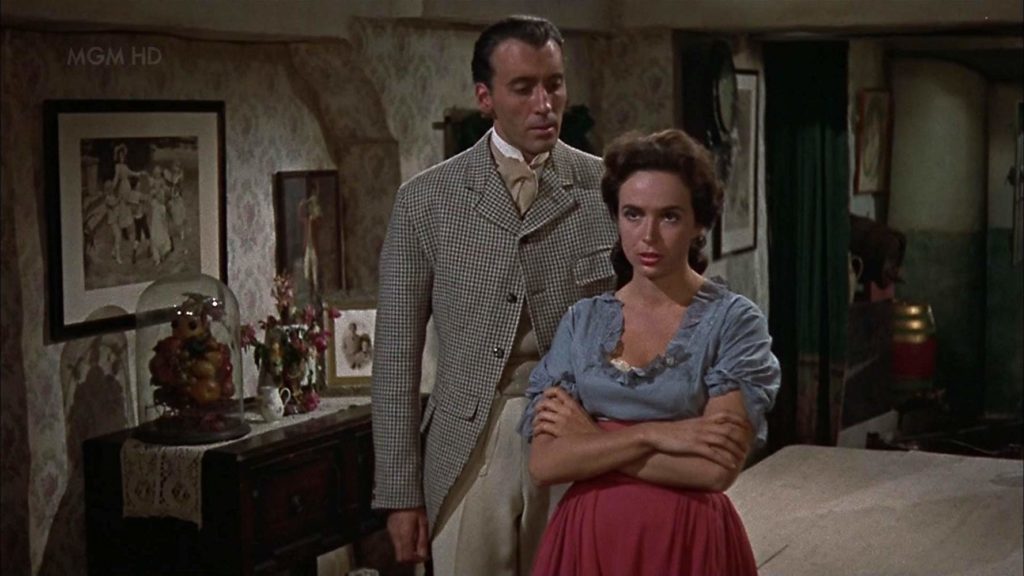
Hammer also wisely cast their most reliable stars, Peter Cushing and Christopher Lee, in the major roles of Sherlock Holmes and Sir Henry Baskerville, respectively. Cushing’s interpretation of Holmes is true to the book, rendering the detective as eccentric, brilliant, and not particularly warm. Lee’s performance as well as Peter Bryan’s strong script make Sir Henry a more substantial and engaging character than he is in the book. As mentioned, this particular story also needs a strong Doctor Watson, and André Morell is well up to the task. He eschews the comic elements that Nigel Bruce injected into his portrayal of Watson and instead coveys gravitas, as he also did in some other good Hammer films (e.g., The Plague of the Zombies).

Being a Hammer film, the 1959 version also throws in some décolletage and sex in the person of Maria Landi. Bryan’s script also changes her character’s role from what it was in the book, which may be objectionable to Holmes purists. But I found it a refreshing take, and one that gives the film a more jaundiced take on the aristocracy than did the book and other film adaptations of it.

You can watch this worthy adaptation of a beloved novel for free and legally on Dailymotion.

Some other adaptations which are worth your time: The handsomely produced 1939 version with Basil Rathbone as the great detective; the Livanov/Solomin adaptation from the utterly brilliant Soviet cycle of Holmes films; the little known Sy Weintraub production starring Ian Richardson; and the justly respected Granada Television version starring Jeremy Brett.

And a few to avoid: The disappointing 2002 version with Richard Roxburgh as Holmes; the yet worse Stewart Granger/William Shatner 1972 television version; and the execrable 2000 version starring the guy who played Max Headroom.

Categories
British Horror/Suspense Mystery/Noir

The Innocents

The Innocents 1961, directed by Jack Clayton | Film review

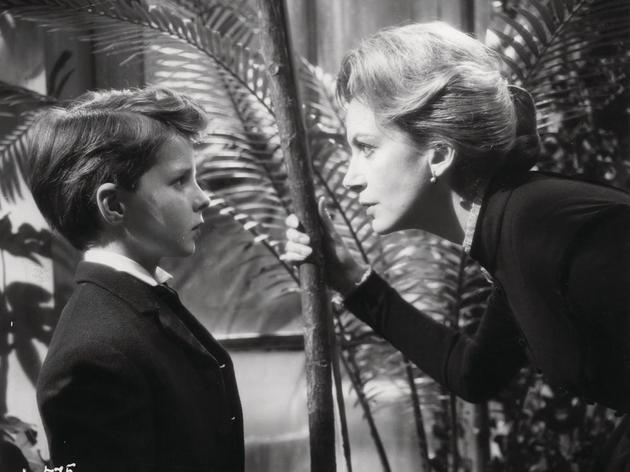
Many an eerie film has been described as a “spine-tingling” experience, but few live up to that description literally for most cineastes. The movie that did that to me more than any other, giving me physical shivers like a bucket of ice down my back, is The Innocents.

Producer/Director Richard Clayton’s 1961 art house thriller demonstrates that a skilled director can jangle nerves without spattering the screen with blood. Clayton started with ideal source material: Henry James’ psychological horror masterpiece, The Turn of the Screw (Although the film’s title comes from William Archibald’s prior effort to adapt the novel to the stage). But Clayton was wise enough to bring in a modern master, Truman Capote, to write most of the script. Capote kept the best elements of the Victorian English novel and suffused them with Freudian overtones and a dose of American Southern Gothic, rotting blossoms and all.

The plot sounds deceptively unoriginal on the surface. A wealthy man uninterested in two child relations (Michael Redgrave) hires a sheltered, rather jejune woman (Deborah Kerr) to be their governess. She moves in to care for them in a Gothic mansion, and the children at first seem wonderful. But strange passions and mysterious events arise which plunge the woman into a terrifying experience. The film, like the novel, leaves the central question of the plot a matter of some ambiguity, making it almost as enjoyable to analyze and discuss as it is to watch.

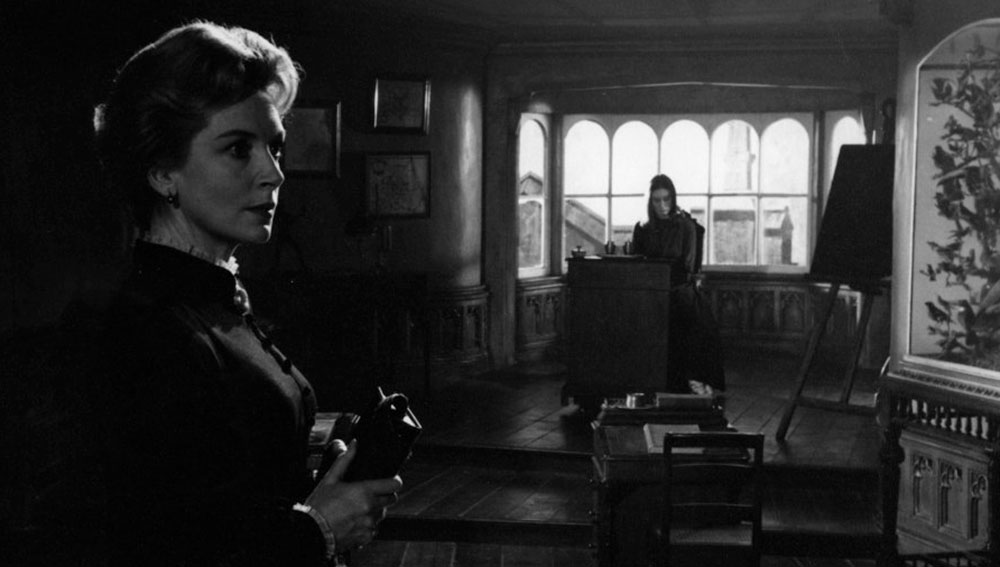
I don’t know how the 40-year old Deborah Kerr was cast as the lead in this film (unless her governess role in The King and I typecast her), because James’ governess character was originally conceived as a naive woman barely into adulthood who had never been away from home before. Yet Kerr turns in one of the best performances of her storied career, steadily unraveling before our eyes. To the extent the film is interpreted as portraying the psychologically deleterious effects of loneliness and sexual frustration, a 40-year virgin gave Kerr lots of material with which to work her magic.

Astonishingly, the veteran Kerr is matched step for step by the riveting acting of a 12-year old, Martin Stephens. He was already a star in Britain, based in part on his similarly unnerving turn in Village of the Damned. His role here is even more challenging because not only does he need to mix childlike moments with menacing ones, he also has to convey sexual awareness well beyond his years. He manages it all brilliantly.

This is also an amazing looking film, with the gardens and house exteriors (Sheffield Park), and the custom built interior sets contributing to the atmosphere. Even more important is the camerawork of superstar cinematographer Freddie Francis. From the very first shot, he pulls off an impressive array of visual feats, including blackening the edges of many of his interior shots to create a claustrophobic effect, as well amping up the central lighting when needed to get depth of field shots in CinemaScope’s otherwise flat look. Without spoiling the movie, I will just offer that the images from the most frightening scenes of The Innocents have stayed with me forever.

This movie didn’t quite land with audiences or critics when it was released. It was too arty and reserved for fans of more typical horror films of the period, and too traditionally haunted house bound for the arty set. I’m not going to embed the trailer for this reason, because all it does is show that even a major studio with a big promotions department could not figure out how to effectively market The Innocents. Fortunately, as magnificent films sometimes can do, The Innocents gained a larger and larger following as the years went by, until today it deservedly wins a place on virtually every “best horror films of all time” list.

Categories
Action/Adventure Mystery/Noir

Plunder Road

Some decades ago, after being up all night playing cards with a Papua-New Guinean family on their first train journey across America, I sat down in the observation car to watch the sun rise over the Utah Salt Flats. A tired-looking middle-aged woman sat down directly opposite me but looked away, as if she had just entered a confessional. She may have been a little drunk or a little hungover, and I may have been too.

“I was a vote counter under Ferdinand Marcos, so I had to flee The Philippines”, she wearily intoned.

Because we were alone in the car, this cryptic remark was clearly an invitation to me. I did not know her name, her background, her motives or even her veracity. But I didn’t need to know them either. She was offering to tell me a story, take it or leave it.

“Tell me about it”, I said.

An extraordinary, tortuous tale followed, commanding my complete attention for some lost amount of time. When she was done relating it, she left the car and I never saw her again. But I have thought about that interaction many times when analyzing movies because it illustrates something important: All an audience really needs is a good story. All the ponderous scripts, lax direction and flabby editing in movies that results in 20-30 tiresome minutes spent telling us about all the characters’ childhoods and marriages and personalities and little quirks before getting to the story can almost always be condensed or eliminated entirely if the filmmakers fundamentally have a good tale to tell. That lesson is beautifully illustrated by the criminally forgotten 1957 crime caper Plunder Road.

The films opens with the execution of what is clearly a meticulously planned robbery of a train carrying gold bars from the U.S. Mint. The four men who pull off the heist barely speak to each other so the audience knows almost nothing about them, not even their names. The audience’s sole insight into their characters comes from brief voice overs of each of their racing thoughts. The thieves move with precision despite the pitch-black night and unexpected driving rainstorm, escaping the scene of the crime and transferring their weighty loot into three separate trucks which they start driving south, hoping to elude a growing police cordon.

Categories
Action/Adventure Mystery/Noir

Farewell, My Lovely

A film critic once wrote of one of my recommendations, the 1998 retro-noir Twilight, that you might have to be over 35 to really enjoy it. That may also be true of this week’s film recommendation, a reverent revival of detective noir starring an old hand at the genre: 1975’s Farewell, My Lovely.

The plot is from a Raymond Chandler novel, so in some sense there is no point in explaining it because his books are more about language and character than storyline (indeed, it didn’t even bother him to realize that he himself didn’t know who committed one of the murders in The Big Sleep). But anyway, private eye Phillip Marlowe is hired by Moose Malloy, a mountain of a man with rice pudding for brains (ex-heavyweight boxer Jack O’Halloran, perfectly cast in his acting debut). Moose lost track of his girlfriend Velma after he went to prison, and now that he is out he wants Marlowe’s help in tracking her down. But every time Marlowe starts to get close to locating her, there is a violent backlash against him, Moose or both. Powerful forces clearly don’t want Velma found, but who are they and what is their motive?

The most famous and lionized adaptation of Chandler’s novel was made in 1944 under the name Murder, My Sweet, with Dick Powell as Marlowe. I have written about how I never quite bought Powell’s transformation from pre-war light comedy/song and dance man to noir tough guy (His contemporary John Payne was more successful). In contrast, the star of the 1975 version, Robert Mitchum, was born for this kind of stuff.

As a world-weary, cynical, Phillip Marlowe, Mitchum carries the 1975 adaptation end to end with aplomb. Many movie tough guys tried to play the invulnerable hero in their autumn years and looked a bit silly or even embarrassing. Mitchum, in his mid-50s, is playing a guy in his mid-50s and he’s just not that tough anymore. Indeed, in this movie, he takes way more physical punishment from the bad guys than he can dish out.

Sylvia Miles received a supporting actress Oscar nomination for solid work here as a boozy floozy, but it just as well might have gone to little known Kate Murtagh for her ferocious performance as a tough-as-nails madam. It’s also fun to see John Ireland, so often the bad guy in the heyday of noir (see for example my recommendation of Railroaded!), playing the “one honest cop” role here. Charlotte Rampling makes a sultry, Bacall-esque femme fatale whose hair is the color of gold in old paintings and who gives a man a smile that he can feel in his pocket (Added fun for noir fans: her screen entrance mirrors Barbara Stanwyck’s in Double Indemnity). Also look fast for a young Sylvester Stallone in a small part.

Director Dick Richards really took a chance in making this old story in the 1970s with no condescension or trendy upgrades. The whole look of the film is a throwback, particularly the almost Sepia Tone color scheme created by the set and costume designers and cinematographer John Alonzo (who also shot Chinatown). If this had been shot in black and white, it could have been released to praise in the 1940s or 1950s. Some critics found that tiresome and affected, but for me this retelling of the classic story is as honest as you can expect a man to be in a world where it’s going out of style.

p.s. Look faster for legendary pulp crime writer Jim Thompson as a judge.

Categories
Action/Adventure Horror/Suspense Mystery/Noir

Kiss Me Deadly

They? A wonderful word. And who are they? They’re the nameless ones who kill people for the Great Whatsit. Does it exist? Who cares? Everyone everywhere is so involved in the fruitless search for what?

In 1955, detective film noirs were nearing the end of their magnificent cycle, with seemingly little fresh to say. But just before the lights went out, Director Robert Aldrich and Screenwriter A.I. Bezzerides went for broke with a brutal pulp masterpiece which blended crime drama with 1950s political paranoia and some science fiction to boot: Kiss Me Deadly.

Ostensibly based on one of Mickey Spillane’s wildly popular Mike Hammer novels, Kiss Me Deadly (which Spillane hated) mocks the genre as much as embodies it, amping up the main character’s sliminess, cruelty and misogyny to absurd levels — and Hammer’s ostensibly the hero! From its arresting opening shot of Cloris Leachman desperately running barefoot down a highway, followed by a perversely upside down credit sequence, this is a movie of extremes in every respect, right up to its atomic conclusion.

Ralph Meeker, in the most memorable film work of his career, is aces as a cold, scheming and domineering Mike Hammer. It’s a fine example of how an actor and director can make a fairly unlikable character magnetic on screen, which is one of a number of ways this movie recalls another film I recommended, Pickup on South Street.

Most American critics considered Kiss Me Deadly a seamy low-budget piece of trash when it was released, and moralists condemned it outright for allegedly corrupting the nation’s youth. But it found a following in France and eventually among some American directors as well, who cherished the brash artistry and attitude the film exudes. Decades later, Kiss Me Deadly became fully respectable, being selected for inclusion in the National Film Registry as an utterly original American classic.

p.s. In the decades between my first and second viewing of Kiss Me Deadly, the original ending was discovered. When the film was originally released, some audiences saw the intended ending and some saw a mutilated version which only slightly shortens the film but does alter its meaning. If you want to know more about this unusual piece of film history after you’ve seen the film, check out this fascinating article.

Categories
British Horror/Suspense Mystery/Noir

The Lodger **Double Feature**

I had long wanted to experience Alfred Hitchcock’s first foray into suspense, 1927’s The Lodger (sometimes subtitled “A Story of the London Fog”), but could never get through the film because the available prints were so beat up as to make it virtually unwatchable. To the rescue came British Film Institute, which despite the lack of the negative managed to restore the movie beautifully using a tinted print that had been maintained in excellent condition. Hitchcock’s version of the Belloc Lowndes tale as well as the best of the many subsequent efforts to remake it constitute my double feature film recommendation.

The story is set during a series of Jack the Ripper-like murders in London. One of the respectable families in the neighborhood takes in a mysterious lodger played evocatively in the 1927 version by early 20th century entertainment superstar Ivor Novello. His manner is strange, his habits are out of the common and he always seems to be out in the fog when the murders happen. Both the police and the family hosting him begin to suspect that a wolf has found its way into the fold. Hitchcockian magic ensues.

I embed here the restored version, which looks marvelous (Though BFI earns only an A minus because of a bone-headed decision to insert some jarring pop love songs in at particular moments of the new score). But the real attraction here is Hitchcock, who even this early in his career shows how he will come to define with unbounded creativity the suspense film genre. His origins in the silent era no doubt helped him develop his “pure cinema” style of storytelling because of course without sound it’s all about shots, images and editing. What can also be seen in The Lodger is his impish ability to break tension with humorous moments. He and Eliot Stannard also changed the original story in a way that increases tension up to the very end. All in all, the movie serves both as entertainment and an education in the early years of The Master.

Novello went to Hollywood in 1934 and made an ill-fated talkie version of the same film without Hitchcock, but the story was taken up again to much better effect by a different group of filmmakers in 1944, and I recommend it as the second half of a double feature with the 1927 version.

This version keeps closer to the original story, making it as much a character study as a mystery/thriller. This provides a chance for the sadly short-lived Laird Cregar to showcase his considerable talents as an actor. He’s near-perfect as a man whose proper British exterior hides a roiling mass of emotion and need. The rest of the cast is also strong, particularly Sara Allgood as the woman of the house and George Sanders as a police detective. The production values are first rate, with much of the budget apparently spent by respected costumer designer Rene Hubert on a series of flouncy outfits for the bewitching Merle Oberon (More information about her career is in my recommendation of The Scarlet Pimpernel). The result is a movie that if not at the level of Hitchcock’s work is still a handsome and gripping piece of cinema.

p.s. The same story was made again in 1953 as The Man in the Attic and yet again in 2009 as The Lodger. As the man once said, “In Hollywood they don’t make movies, they re-make them”.

p.p.s. In Robert Altman’s fine film Gosford Park, Ivor Novello was portrayed by Jeremy Northam.

Categories
Foreign Language Horror/Suspense Mystery/Noir

The Hands of Orlac

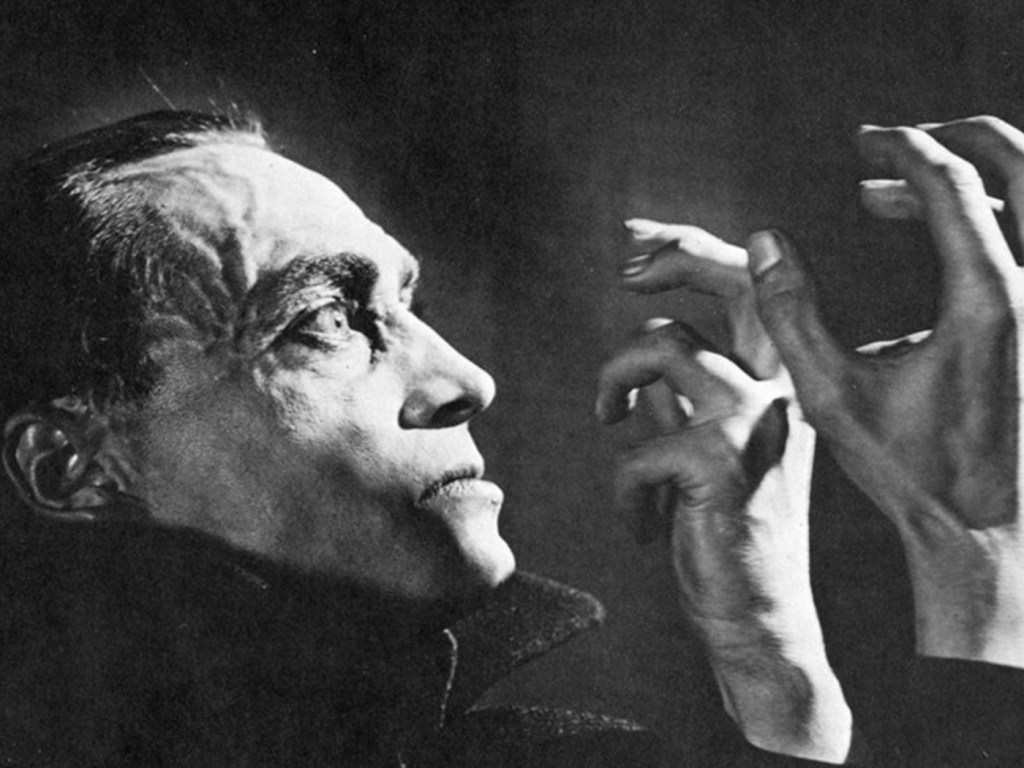
The idea that a possession or even more creepily a body part of a dead person can take over the life of its living owner has appeared in fairy tales and ghost stories for centuries. In cinema, the touchstone story of this sort is Maurice Renard’s 1920 novel Les Mains d’Orlac, which has been adapted to the screen many times, including in both films I am recommending: The 1924 Austrian and 1935 US version of The Hands of Orlac (The latter is sometimes titled Mad Love).

The story concerns gifted pianist and composer Paul Orlac, whose hands are severely damaged in an accident. He survives his injuries, but the surgeon must replace his hands with those of a recently executed murderer. As Orlac and his devoted lady love Yvonne attempt to put their lives back together, the murders start again, and Orlac begins to suspect that his new hands are driving him to commit horrible crimes.

The 1924 version is a silent film directed by Robert Wiene and starring Conrad Veidt, who will be familiar as principals of the all-time cinema classic Cabinet of Dr. Caligari, which I recommended here. Like that famous film, the Hands of Orlac is skillfully made in the expressionist style and is anchored by striking visuals and Veidt’s uncanny ability to convey emotion without dialogue. The film was recently restored with a newly composed soundtrack and became deservedly popular on the classic film festival circuit.

The 1935 version is a talkie that changes the story substantially in an effective way. Here, the surgeon is the central character and is driven by his lust for Orlac’s wife rather than any desire to help the composer. This was Peter Lorre’s first American film and he’s magnetic as a villain who is loathsome in some ways and pitiable in others. I like this version even better than the original because of Lorre’s strong performance, director Karl Freund’s visual sensibilities and the tighter pacing.

Here is a short promotional film made for the US release of the 1935 version. It’s more than a traditional trailer because while Lorre was a big star in Germany, Hollywood had to introduce him to American audiences.

Categories
Action/Adventure British Mystery/Noir

The Adventures of Sherlock Holmes

Beginning with a Mutoscope adaptation made in 1900, Sherlock Holmes has been one of the most oft-portrayed roles in world cinema. Among the most handsome of the countless movie productions featuring the world’s greatest consulting detective were made by 20th Century Fox in 1939. The first of these was the excellent Hound of the Baskervilles and the second is the even better The Adventures of Sherlock Holmes.

The plot of the film owes little to any of Arthur Conan Doyle’s classic stories, and indeed is one that had been used many times before and still gets a workout in movies today: A brilliant champion of justice matches wits with an equally gifted master criminal who has announced that he will soon commit “the crime of century”. But when the hero is Sherlock Holmes played by Basil Rathbone in his signature role and the villain is Professor Moriarty played with comparable verve by George Zucco, everything old is first-rate entertainment again.

As Zucco and Rathbone circle each other in their battle of wits, two supporting players bring added energy to the proceedings. Many Holmes fans do not care for Nigel Bruce’s comic take on Dr. Watson, as it goes against his portrayal in the canon. But I am with those who find it endearing, in part because it adds some sweetness to the films that sets off Rathbone’s appropriately rationalistic and at times even cold Sherlock. As the woman around whom much of the mystery centers, a then unknown Ida Lupino also strengthens the film by giving the audience vulnerability leavened with strength and intelligence (Lupino would go on to become a pivotal figure in women’s advance in Hollywood, as I describe here).

Fox rolled out the budget for its Holmes films, which shows in the excellent production values throughout. These are enhanced by the legendary Leon Shamroy’s cinematography, which has effective film noir/horror overtones. Last but not least, this is the one and only film in which I can honestly compliment Alfred Werker’s direction (I recommended He Walked by Night previously, but recall that despite the credit going to Werker, that film was mostly directed by a true master, Anthony Mann). If every journeyman director has one great film in him, this well-paced, exciting and suspenseful treat is Alfred Werker’s.

p.s. Even though both of Fox’s 1939 Sherlock Holmes films were excellent, they were not critically well-received at the time and also led to some grousing from Doyle’s descendants, who controlled the rights to his stories. After promising to make this a long-running series, Fox abandoned the enterprise after the Adventures of Sherlock Holmes. However, a new series of lower-budget Rathbone-Bruce Holmes movies set in the modern era was launched at Universal immediately thereafter. That turned out to be one of Hollywood’s very best film series. If you want to explore those films, I recommend my favorite of them, The Scarlet Claw.

Categories
Horror/Suspense Mystery/Noir

The Little Girl Who Lives Down the Lane

Hollywood superstar Jodie Foster had a remarkable 1976, with five movies hitting the theaters. They showcased her talent and poise — both startling for an actress who has just become a teenager — and also the tendency of 1970s cinema to lionize teenage liberation while at the same time exploiting it through sexualization. Foster’s Oscar-nominated turn as a child prostitute in Taxi Driver is the best known example, and the same themes are present in an effective low-budget shocker that was released the same year: The Little Girl Who Lives Down the Lane.

Appropriate to its mood, the movie opens with its central character, Rynn Jacobs (Foster) walking on a deserted beach. As the film progresses, we learn that Rynn’s independence and isolation are in some mysterious way connected to her poet father, who purchased them a house together in a small town but has never been seen by the locals. Rynn manages the finances, cooks her own food, sets her own schedule and makes her own way in the world.

What could possibly impinge on her freedom? Horrible adults of course. Most particularly the vile local family of influence, led by a frosty, bigoted WASP named Mrs. Hallet who has the town and her pedophile son Frank under her thumb (Alexis Smith and Martin Sheen, both credibly menacing). The only kindness available to Rynn comes from the Italian immigrants that the Hallets despise, specifically a creative, polio-stricken, local lad who falls in love with her (Scott Jacoby) and a friendly police officer who tries to shield her from harm (well-played by famous songwriter Mort Shuman!).

This movie works well on two levels. First, it’s a character study exploring the tension between children’s desire to be independent and adults’ desire to control and/or protect them. Foster’s emerging greatness is a major asset here, particularly as she holds her own in her scenes with seasoned adult actors. Second, this is a suspenseful tale in the mystery/horror vein, both because of Sheen’s unnerving performance and the enticing nature of the film’s central riddle: Where is Rynn’s father, and for that matter her mother? The resolution to Laird Koenig’s macabre story is easy to guess wrong, which only makes the film more engrossing.

The small budget of this Canadian film shows, both in the limited number of sets (which makes one think incorrectly that it is an adaptation of a play rather than a novel), the by-the-numbers production and camerawork, and the cheap wig on Foster’s head. But that doesn’t stop the Little Girl Who Lives Down The Lane from holding viewers’ interest and the edge of their seat as well.

p.s. There was some controversy about young Foster allegedly appearing nude in this movie, and that brief scene was cut by censors in some countries. However, as in her character’s sexual scenes in Taxi Driver, Foster’s older sister body doubled her for the shot.