Categories
British Drama Mystery/Noir

The Offence

The James Bond films made Sean Connery an international superstar, but presented him few challenges as an actor. In the midst of Bondmania, desperate to avoid typecasting and to take on more substantial roles, Connery began collaborating with Director Sidney Lumet. This resulted in one financially successful and entertaining film (The Anderson Tapes), but more importantly led to Connery turning in two critically-praised, Oscar-worthy performances that hardly anyone saw. The first was one of my recommendations, The Hill. The second gets roses from me too: The Offence.

The back story of this far-too-rarely-seen 1972 movie reveals much of Connery’s psychology at the time, as well as his star power. He had walked away in disgust from the Bond enterprise, and his replacement (George Lazenby, not as bad an actor as reputed but also no Connery) had not had the same box office draw. United Artists was so desperate for their superstar’s return to Bondage that they offered him whatever he wanted. He could have insisted on the world’s biggest paycheck, but instead he demanded that United Artist support two low-budget art house films! One was to be a Connery-directed adaptation of Macbeth, which would have been a Scottish treat and was unfortunately never made. The other was The Offence, which everybody concerned made for art’s sake because they knew there was no way in the world this film would garner even 1% of the box office receipts of the Bond films. The modestly-paid cast and crew worked like dogs to complete the entire shoot in less than a month (Connery himself allegedly put in up to 20 hours a day). The resulting labor of love is a shattering cinematic experience.

The plot centers on disillusioned, angry and unstable Detective Sergeant Johnson (Connery). In the visually distorted, almost dissociative opening sequence that reflects the tortured workings of his mind, the audience sees that Johnson has just beaten a suspected child molester. He snaps out of his rage and realizes what he has done, but it’s too late. The suspect is being taken to hospital and may well die. We then learn the background: A monster has been victimizing little girls and getting away with it time and again despite the efforts of the police. Another girl is kidnapped and raped, but ultimately found by DS Johnson. But rather than regard him as a rescuer, she reacts in terror to him, leading something inside him to snap. The smug, posh suspect who is eventually brought in gets under Johnson’s skin even more, causing him to lose control, although we do not learn the reasons why until the film’s devastating final act.

After this opening, the movie then turns into a three-act play, with each act being a two-hander (This staginess is the film’s only flaw; given more time and money I suspect Lumet could have escaped the story’s playhouse origins as he did in other films adapted from the stage). First is Connery and his long-suffering wife (Vivien Merchant), then Connery and the investigating senior officer (Trevor Howard), and finally Connery with the suspect (Ian Bannen).

The acting in these three scenes is a revelation. Vivien Merchant absorbs Connery’s brutality but is unable to reach her husband, making him even more rageful but also more pathetic. In a scene of fewer than 15 minutes the two actors let the viewer grasp everything about the long agonies of this unhappily married couple and how they have disappointed and torn at each other over the years. The scene with Howard is almost as good, but is topped by the astounding concluding act with Ian Bannen (who was also brilliant alongside Connery in The Hill). Bannen and Connery play off each other magnificently in a cat-and-mouse game during which each experiences fear of, hatred for and yet also some identification with the other.

Categories
Horror/Suspense Mystery/Noir

Lured

No doubt you have often said “I’d love to watch a 1947 Douglas Sirk movie starring Lucille Ball and Boris Karloff that was a remake of a French film and was re-made again a half century later with Lucy’s part played by Al Pacino.” Okay, you’ve never said that, but nonetheless I gave you Lured.

The film tells the exciting story of the hunt for a serial killer who finds his young female victims though the newspaper’s “personal column” (This eventually became the title of the movie in the US after the Production Code censors ruled that “Lured” sounded too much like “Lurid”!). The fiendish villain taunts the police by sending them poems about his next intended victim. When another young woman is murdered, her plucky pal and fellow dance hall gal (Lucille Ball) feels it’s her duty to help a police inspector (Charles Coburn) catch the killer. Shadowed discreetly by a police minder (George Zucco), she starts answering ads in the personal column, which leads to dates which are by turns funny, disappointing and disturbing. Meanwhile she finds herself falling for a smooth-as-silk impresario (George Sanders) who with his business partner (Cedric Hardwicke) runs a chic club in which she hopes to audition as a dancer after the mystery is solved. But as she tries to decide whether to trust her beau enough to tell him of her work with the police, evidence emerges that he may somehow be connected to the case!

Many people only know Ball as Lucy Ricardo, but in fact she turned in some good performances in dark, dramatic films prior to ruling American television comedy for a quarter century. Lured and The Dark Corner are the best of her film noir work.

Ball had the fortune to launch her film career in a period when it was acceptable for female performers to be both funny and physically attractive. For most of the last half of 20th century, these attributes were often perceived as incompatible by entertainment moguls: Actresses were usually pigeon-holed as comic or sexy, but not both. My favorite example of this phenomenon was that Phyllis Diller was once going to do a Playboy spread as a joke, but when they took the photos it turned out that she looked beautiful under that house dress. The project was therefore shelved. Tina Fey and Amy Poehler are among the stars of today who have helped break down this constraint, restoring the possibility for other women to essay more multi-dimensional roles like Ball did in the late 1940s.

Ball is only one of the performers in Lured from whom Sirk got the very best. George Sanders played the sophisticated British rake in many movies and he does it yet again here. But so what? He’s very fun to watch doing what he does best. Coburn as the police inspector is appealing, particularly in his father-daughter style interactions with Ball. George Zucco, normally cast as a villain, shows a fine comic touch. Karloff is only on screen for one extended sequence, but nearly steals the movie as a deranged, grief-stricken has-been obsessed with the past. Last but not least, Hardwicke does well in perhaps the most complex part as Sanders’ business partner. The subtext of his emotions regarding Sanders and Ball is brought out subtly, in a way that clearly eluded the censors at the time. That is also a testament to Douglas Sirk, who loved to tell overtly conventional stories with implicit, then unacceptable, undertones that only some of the audience appreciated.

Lured is also a fine-looking picture, as you would expect when the camera in the hands of William H. Daniels. Sirk clearly influenced at least some of the shot framings, as they strongly prefigure the scene compositions he would employ in his 1950s heyday.

Lured does have some problems with tone and pace. It’s effort to mix comic, suspenseful and disturbing elements simply doesn’t always work. There are also some draggy moments that should have been left on the cutting room floor. One has to ask as well why the movie is set in London when it clearly was not shot there and Coburn’s police inspector sounds thoroughly American. Collectively, these flaws keep Lured in the good rather than great category.

If the story of Lured appeals to you, you might enjoy the other two above-average efforts to adapt it to the screen: The 1939 French movie Pieges directed by Robert Siodmak, and the 1989 U.S. film Sea of Love with Al Pacino and Ellen Barkin.

p.s. Look fast for Gerald Hamer in an uncredited small role in the dance hall early in the film. He was an essential part of another of my recommendations: The Scarlet Claw.

Categories
British Comedy Musical

A Hard Day’s Night

Keynote: A Hard Day's Night couldn't contain The Beatles / The ...

The beloved film critic Roger Ebert maintained that what we now remember as the “the 1960s” may actually have started in 1964, as the magnificent sound of George Harrison’s new 12-string guitar opened A Hard Day’s Night.

At the time, it had every promise of being a forgettable flick: low budget, quickly made, unknown director and some trendy band that was probably going to be forgotten in a few years. But faster than you could say “She loves you, yeah, yeah, yeah” emerged movie magic that holds up very well a half century on.

There isn’t much plot (and why should there be?). The Beatles run from screaming fans, dance with admiring birds, make wisecracks and eventually arrive at a big concert, where they drive the on screen and movie theater audience into ecstasy. Along the way they play the title tune, “I wanna be your man”, “Can’t buy me love”, “This boy” and many other wonderful songs. Everything about this movie is as buoyant as the music; the Fab Four were naturals on screen and it’s impossible not to share in their fun.

Looking back, you might think “How hard could it have been to make a good movie with The Beatles?”. But remember that no one knew at the time what enduring, globe-spanning stars the Fab Four would become, and, that most movies starring pop music stars over the years have been shoddily-scripted, boringly-shot, products designed to make a fast buck. Alun Owen could have been lazy and let The Beatles’ charm and popularity sell movie tickets, but instead he wrote a funny, clever, original screenplay that deservedly netted an Oscar nomination.

Meanwhile, Richard Lester and Gilbert Taylor may well have created the modern music video with this film. If you look at typical rock musicals in the 1950s (e.g., Elvis Presley’s films) there are many static set-ups on the musical numbers, almost as if you were watching a big Broadway number on stage in front of you. But the camera is everywhere in a Hard Day’s Night, including a number of shots from the Beatles’ viewpoint during the final concert, which works perfectly for a film that was trying to convey what their lives at the time were like from the inside. The resulting visual look is fresh, exciting and high-energy.

Put it all together and you have not just one of the best rock-and-roll movies ever made, but one of the Silver Screen’s best musicals of any sort.

p.s. Richard Vernon was still in his 30s when he played the stuffy Establishment fellow in the bowler hat who doesn’t approve of our young heroes!

Categories
British Mystery/Noir

Dear Murderer

Have you been sleeping with my wife, my dear chap?

Yes old man I’m afraid I have been. Cigarette?

Thanks awfully. You realize old bean that I’ll have to murder you of course.

I’d think very little of you if you didn’t. Care for some Scotch?

I have a weakness for Brit movie dialogue that is completely savage in message while being unctuous in delivery. Such lines are the most delicious aspect of Ray Milland’s murderous character in Dial M for Murder (recommended here), and they are also a virtue of the equally suave-and-nasty Dear Murderer.

Made by the Box family in 1947 during the brief life of Gainsborough Studios in South London, the film stars the smooth Eric Portman as a man who discovers that his flash, icy wife has been stepping out on him while he has been in America. In the movie’s best scene, he visits the man whom he has discovered is her lover (Dennis Price), and after some perfectly mannered exchange of pleasantries, announces that he is going to murder him. Things do not go quite to plan however, not least because wifey hasn’t been limiting herself to one beau. It only gets colder and nastier from there, with plot twists aplenty and entertainment value to spare.

Portman and Price’s urbane, scary face-off is brilliantly done, and it is a shame that it wasn’t the first scene, which would have started the film off with a bang (The first scene instead is some unneeded background exposition to explain how the infidelity was discovered..I so dislike it when filmmakers don’t just tell the story from the get go). An irony of the scene for modern audiences is that the actors playing the two men battling over their shared love of a woman were both gay. It would have been interesting to be a fly on the wall afterwards to hear the actors discuss between themselves how they played the scene and how they felt about it.

Watch Dear Murderer online - BFI Player

As for the woman herself, Greta Gynt is a revelation as the twisted, narcissistic wayward wife. Like Lizabeth Scott in No Time for Tears (passionately praised here) Gynt plays a far more scary character than the murderous men around her. The delight on her face when she realizes that desire for her has led one man to murder another is chilling. Few Americans have heard of Gynt because despite significant success in British films in the 1930s and 1940s, she never caught hold in Hollywood. After you have seen this film, you will want to put in the effort to find more of her movies.

Even as film noirs go, this one is pretty dark. There are only two morally decent characters, neither of whom is very interesting. You may find yourself rooting for some bad people at least some of the time, even if by the end you are glad they get what they had coming to them.

Categories
Horror/Suspense

Tales of Terror

Low budget whiz Roger Corman revered Edgar Allen Poe and brought his stories to a new generation through film. The best known is probably Masque of the Red Death (my recommendation here), but most of them are rewarding, including Tales of Terror.

This 1962 film is a trilogy of stories based on four different Poe stories: Morella, a pastiche of The Black Cat and The Cask of Amontillado, and The Facts in the Case of M. Valdemar. The stories are well-employed in the script of the late, great Richard Matheson, whose ability to infuse new, um, blood, into hoary tales I have praised many times. Vincent Price anchors the film with three lead performances, which vary in tone from lugubrious to frothy to sepulchral.

Price is joined by two aging stars who still know how to deliver the goods. Peter Lorre makes a fine boozy bully in The Black Cat and Basil Rathbone lends gravitas to the role of Carmichael, the hypnotist who tries to hold Valdemar at the point of death in the final story. The roles of the women characters however are comparatively flat, with the female performers cast mainly for their looks.

Many horror films, including some of the most famous, include some element of camp, and Tales of Terror is very much in that tradition. Price and Lorre enjoy themselves enormously in The Black Cat, inviting the audience to laugh at them as much as be frightened by the murderous proceedings. As a viewer, you should bring eggs for this part of the film, because these guys are bringing the ham.

In addition to the tension and fear generated by the three stories, the film makes for good horror viewing because Corman, as always, was experimenting as he went along. Some novel special effects are on display, all of which work pretty well. On the small screen, some of the Cinemascope trickery at the screen edges will be lost, so see this one on the big screen or in letterbox format if you can.

In some people’s minds, Corman is nothing but a schlock merchant, but that’s not fair to him. Like Richard Rodriguez, he has a genius for improvising in a low-budget environment. He shot movies on the sets of other movies while they were being torn down, writing a script each night to take advantage of whichever set would be gone by the end of the next day. He told Peter Bogdanovich that “Boris Karloff owes me a few days of filming, let’s make something out of that”, which became the nail-biting Targets. And he also helped launch many future superstars, including Jack Nicholson, Peter Fonda, Charles Bronson, Jonathan Demme, Martin Scorsese, Ron Howard, and Francis Ford Coppola. I was absolutely delighted when Hollywood finally woke up and gave the 83-year old Corman an Academy Award for Lifetime Achievement, because he’s long been the kind of disruptive, creative force that the film industry needs to maintain its vitality.

Categories
Foreign Language Horror/Suspense

Vampyr

Some film historians consider Carl Theodor Dreyer cinema’s most visionary director. His talent is on vivid, memorable display in the pioneering 1932 horror classic Vampyr.

The story, which Dreyer and co-writer Christen Jul adapted in part from the writings of Sheridan Le Fanu of Carmilla fame, concerns a student of the occult named Allan Grey. Grey arrives at a French town with a blank expression on his face that suggests he might be dreaming. He checks into a small hotel and is startled when a strange man enters his room and gives him a package “to be opened upon my death”. Grey wanders around the hotel, where he encounters a creepy doctor and his elderly female companion, as well as dancing shadows and a one-legged old soldier. Travelling through the town, Grey witnesses the murder of the strange man, leading him to open the package. It contains a book relating the story of the vampyr, one of which is currently menacing the village. The vampyr’s victims include a lovely young woman who catches Grey’s eye and whom he wants to save. As Grey tries to battle the fiend and its accomplices, he experiences disorienting visions and mysterious events that may daze the viewer as well, but at the same time will compel attention.

As the film was destined for release in France, Germany, and England, Dreyer kept dialogue to a minimum to avoid language challenges. Instead, he tells the story through unforgettable images: A strange metal sculpture against cloudy skies, an inside-the-coffin view of a live burial, a mysterious figure with a scythe, a relentless downpour of deadly flour, the visible carnal hunger of an incipient vampyr, and shadows that move independently of their casters. The novel visual effects are many, including double-exposure, shooting through cheese cloth and other trickery.

No film I have seen quite captures the inner logic of nightmares as well as Vampyr. In our scary dreams, events often seem nonsensical, yet we encounter characters who are completely undisturbed at the maddeningly illogical proceedings. They proceed in their own bizarre course and we proceed along with them because we have no choice but to obey the rules of our nightmare. That is the journey on which this film takes the audience, and it’s completely original and masterfully executed.

It’s a tribute to Dreyer’s directorial skills that he got effective performances out of an almost entirely amateur cast, including colorful bon vivant Nicolas Louis Alexandre, Baron de Gunzburg who bankrolled the project and appears under the name Julian West. The other critical ingredient is the groundbreaking camerawork of the legendary Rudolph Maté. The resulting film is probably too “arty” for some tastes, but most viewers will find it stays with them for a long time.

p.s. The public domain version of this film is available for free on Internet Archive and is watchable, but you will enjoy yourself much more if you view the Criterion Collection restored version, which is leagues better in terms of visual quality.

Categories
Horror/Suspense

The Howling (Plus a Trivia Quiz!)

There may be only one film that’s more packed with references to other horror films than Scream: Joe Dante’s 1981 cult favorite, The Howling.

Originally intended as a straight-ahead werewolf film, it was changed significantly in tone by a late-arriving co-screenwriter, the ever-creative John Sayles. Sayles kept the scary bits, but added a pile of in jokes and satiric moments (including one with himself as a coroner). The result was unsatisfying to some viewers, but the movie returned its modest budget many times over as horror fans embraced it enthusiastically.

The story opens with earnest, All-American TV reporter Karen White (Dee Wallace) putting herself in danger to help capture a serial killer who has developed an obsession with her. Despite police backup (actually, BECAUSE of police backup), things go horribly awry and she is psychologically traumatized. With the support of her ex-Stanford football star husband Bill Neill (Christopher Stone) she seeks treatment from a pompous psychiatrist who emphasizes the need to release the beast within (Patrick Macnee). He sends Karen and Bill to “the colony” an Esalen-type retreat, for healing. What the innocent couple don’t know is that the colony is a den of werewolves, and before you can say “Aaahooooooooo” they are both being terrorized by a motley assortment of lycanthropes!

The budget apparently prevented the casting of any A-listers, but the performers do a serviceable job, especially MacNee, who gamely spouts 1970s psychobabble, and the sultry Elisabeth Brooks, who memorably redefines the term “maneater”. But the real stars are Sayles’ parade of little gags (everyone eats Wolf Chili and drinks Wolf’s Liquor; look fast also for a copy of Ginsberg’s Howl), and the astonishing person-to-wolf transformations of Rob Bottin. Bottin leaves the CGI-dependent special effects artists of today in the dust with his extraordinarily scary work here.

The film has some flaws. After a gripping opening 20 minutes, it shifts the pace to neutral for too long before revving up a thrilling final act (In fairness, the film is over 30 years old, so perhaps a little flab in the middle is forgivable). I can understand also that the smart-alecky script may elude some viewers or seem to precious to others. But for horror movie buffs, The Howling is a fun screamfest that will enliven your Halloween.

And, now A TRIVIA QUIZ, with answers after the jump, with all the questions deriving from Sayles’ script flourishes.

  1. MacNee’s character is named George Waggner. The real Waggner directed what horror classic?
  2. One member of the colony is named Erle Kenton, after the director of the spooky 1945 movie House of the Dracula. The actor playing Kenton in The Howling was actually IN that movie. Who is he?
  3. Early in the film, when Karen White is in a phone booth waiting to meet serial killer Eddie Quist, a tall man stands just outside the door. Is he waiting to use the phone, or is he the killer, blocking her escape? Well, when he turns to face the camera he is revealed to be which famous horror movie director?
  4. Stone’s character is named after R. William Neill, who directed what great horror “team-up” movie?
  5. Noble Willingham plays a character named Charlie Barton. Barton directed what famous comedy-horror mashup?

ANSWERS

  1. The Wolf Man
  2. John Carradine
  3. Roger Corman.
  4. Frankenstein meets the Wolf Man
  5. Abbott and Costello meet Frankenstein

Categories
Action/Adventure Drama

The Untouchables

The Untouchables: A Search for Period Flavor - The American ...

Many classic TV shows have been made into dreadful movies, but Brian De Palma came up aces in 1987 when he made The Untouchables.

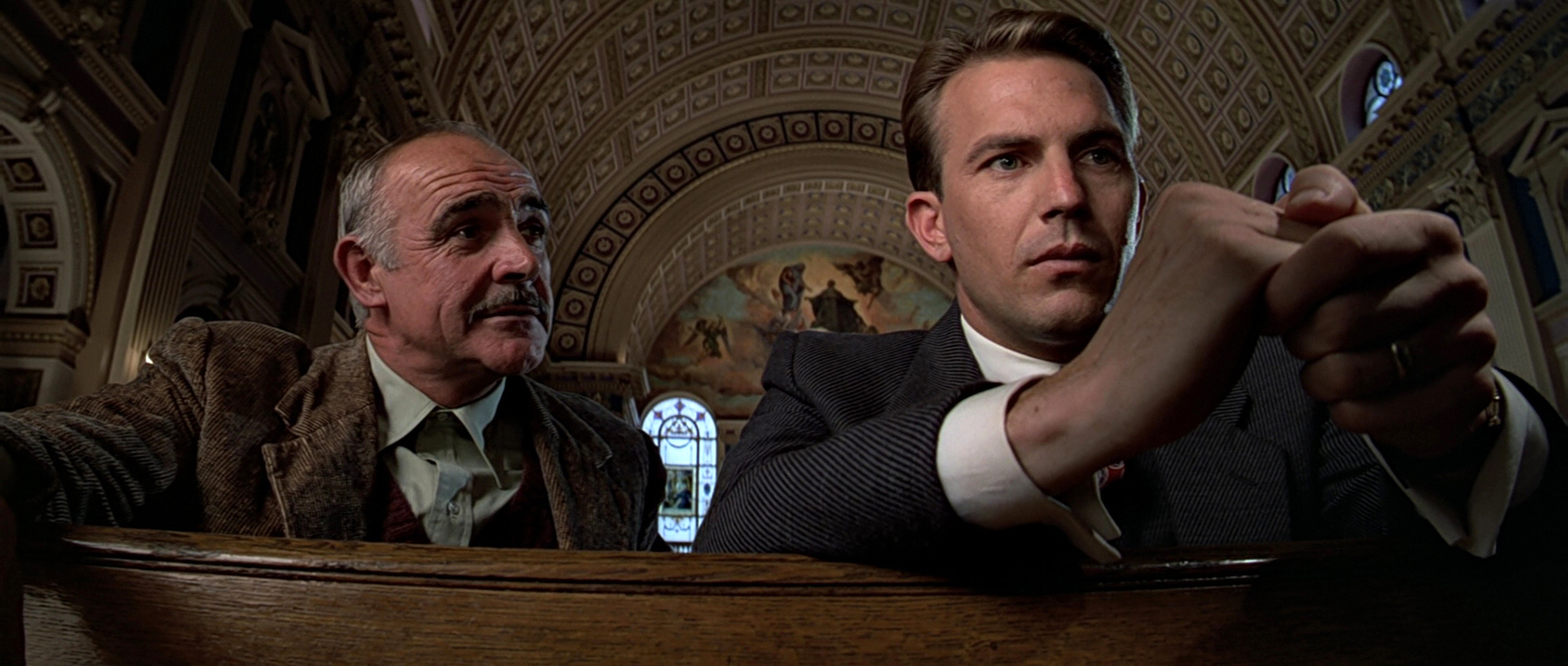
The plot: Naive treasury agent Elliot Ness (Kevin Costner) comes to Prohibition-era Chicago to do battle with bootlegger, murderer and king of the gangsters Al Capone (Robert De Niro). Realizing that the police and politicians are all corrupted by Capone, Ness assembles his own team of “untouchable” agents who can’t be bought. His squad is anchored by a cynical, over-the-hill beat cop named Jim Malone (Sean Connery), who teaches him how the game is played in The Windy City. The two of them and their fellow untouchables embark on an epic confrontation with powerful, violent mobsters and a legal system that is rotten from top to bottom.

The key theme of the film is voiced by Connery, in one of the many scenes where he virtually acts the bland Costner right off the screen: What are you prepared to do? The basic tension of David Mamet’s crackerjack script derives from the fact that the good guys can’t win without breaking the rules they have sworn to uphold. This adds moral weight to a story that is also packed with thrilling action sequences and powerful dramatic moments.

De Palma often echoes classic films in his movies, and The Untouchables is no exception. A spectacularly executed shoot-out sequence in Union Station is an homage to the equally brilliant Odessa Steps sequence in Battleship Potemkin. Although I don’t know for sure, I believe the first scene of the movie, in which a terrified barber reacts to having nicked Capone’s face while shaving him, is an echo of one of the opening scenes of another of my recommendations, The Chase. De Palma makes these allusions is such a way that you don’t have to get them to enjoy the film, but if you do it’s even more fun.

This was a big budget Hollywood film and it shows in every scene. The set design and art direction are darbs, and the period cars, clothes and architecture are the cat’s meow. Producer Art Linson is a Chicago native, and clearly knew where to spend money to bring the Prohibition Era alive. To top it all off, Ennio Morricone contributes one of the most memorable and evocative scores of the 1980s.

Other than Costner, who is painfully weak here, the entire cast explodes. But even in that field, Connery and De Niro tower over everyone with powerhouse performances. Capone has been portrayed many times on film, but never in such a scary fashion. In De Niro’s hands, he is a man who can go from mirth and charm to murderous rage with no warning, and the viewer fully appreciates why all of his underlings tiptoe around him.

Connery, who won a long-overdue Oscar for playing Malone, also tears up the screen. His Malone is world-weary and tough yet also capable of wit and even a sort of gentleness (His big brother-little brother relationship to Andy Garcia’s rookie cop is perfectly played by the two actors). Because he became famous playing James Bond, it took Connery a long time to convince people that he really is a fine actor. I have commended his strong performances in my recommendations many times, including in The Hill, The Offence, and Outland. He triumphs again in The Untouchables, one of many reasons to see this near-perfect update of classic cops-versus-gangsters television shows and movies.

Categories
Action/Adventure British Drama

Callan: The Richmond Files

Many Americans know Edward Woodward only as The Equalizer from television, but his career started long before that. Woodward was an extraordinarily gifted actor who was equally comfortable with classic Shakespeare plays, light comedies and grim dramas. Unlike some stage-trained actors, his dramatic skills didn’t wane when he made the move first to television and then to the movies. Beyond all that, he was even an outstanding singer! (Check him out on this Morecambe & Wise clip, he starts crooning about two minutes in and he’s bloody marvelous).

Woodward became a star playing David Callan, a tough, moody and smart British espionage agent from a working class background who tussled with his plummy superiors as often as he did his Soviet counterparts. I recommend here The Richmond Files, the three-part conclusion to the Callan television series.The mood of the series was set by an evocative set of images and guitar notes:

The glum tone and stark themes of Callan put it squarely in the cynical Le Carre camp of British spy stories, which funnily enough co-existed easily in the 1960s with James Bond-mania. The writing was consistently strong (more so than on the Callan-inspired TV series The Equalizer, which was made in America decades later) and the acting and direction were effulgent. The budget was clearly not large but this was well-used to convey the show’s point of view: Callan and his colleagues were doing dirty, unglamourous work. It made sense that the entire suite of offices of “The Section” looked like they cost less than M’s desk.

Categories
Horror/Suspense

The Wicker Man

Not long after the Callan TV show ended (My recommendation here), Edward Woodward starred in an unconventional low-budget horror film that has no monsters or ghosts, includes almost no night time scenes, blood, gore or special effects, yet is unquestionably harrowing: 1973’s The Wicker Man.

The plot: Uptight, devout and dedicated Police Sergeant Howie (Edward Woodward) arrives alone by seaplane at a small Scottish island to investigate reports that a little girl has gone missing. He finds a strange community of back-to-nature types who claim never to have heard of the girl, much to Howie’s frustration. He is further inflamed by their paganistic world view, sexual expressiveness and apparent disregard for his authority as a representative of HMG. He eventually meets the head of the community, Lord Summerisle (Christopher Lee), who confounds him further even while ostensibly supporting his quest to find the missing girl. His anger and anxiety mounting, Howie presses his investigation to the limit, but matters become only more maddening and much, much more dangerous.

It’s easy to see why Christopher Lee, who has made almost 300 films, declared that this was the best one he was ever in. He, Woodward, and the actors in other key roles (Diane Cilento and Britt Ekland) give performances that are somehow both realistic and otherworldly at the same time. And Anthony Shaffer’s script has the perfect set-up for suspense: A man absolutely alone in a strange place that he cannot understand and in which no help is available.

In addition to being scary, The Wicker Man is also sensually pleasurable. It features among other sexually charged moments one of the most erotic and original seduction scenes in the history of film. The soundtrack is also rich and stimulating. It would have been easy to simply have the music of the islanders be a recycled collection of old Celtic folk songs, but instead Paul Giovanni composed authentic sounding music that adds immeasurably to the atmosphere.

Warning: This film had an unhappy history post-production, with many cuts being made both by studio suits who didn’t get the film and morality police who hated the sex. The lack of respect for the film at the time is best expressed by the fact that the negative ended up buried beneath the M4 motorway (not a joke, sadly). Work very hard to get as long a cut as you can; Wikipedia has an account of all the versions here.

I hope you will take the time to discover this cult classic of British horror cinema. After the jump, I offer an interpretational addendum for those of you who have already seen it.

SPOILER ALERTSPOILER ALERT READ NO FURTHER IF YOU HAVEN’T SEEN THE MOVIE

When I first saw The Wicker Man many years ago, I read it incorrectly. As Sergeant Howie yells out Biblical verses while being burned alive by Lord Summerisle and his happy, dancing pagan followers, I took the filmmakers to be implying moral equivalence, i.e., one religious zealot destroying another. But when I re-watched the film to prepare for this review, I realized I had misapprehended Anthony Shaffer’s script. Yes, Howie is judgmental, moralistic and a bit of a prig, but his goal is to save an innocent child, and he pursues it with bravery and intelligence. In contrast, the pagans are cold-blooded, calculating murderers. Shaffer’s protagonist thus dies a martyr’s death at the hands of his theological enemies, not as their equal, but as their moral better.