“Invasion of the Giant-Sized X” films were almost their own genre in the 1950s. Many of them were wretched (Attack of the 50 Foot Woman being generally considered the nadir), but some of them stand the test of time. If forced to choose my favorite giant insect film I would go with Them!, but since spiders are not insects I feel I have the right to also have a favorite giant spider movie: 1955’s Tarantula.
I preface this recommendation by expressing an opinion about B-movies, which is no one should be ashamed of making one as long as they know that is what they are doing. B-movies that pretend to be A-movies are typically an agony to view, but films that use a modest budget to achieve modest ambitions can be highly satisfying for the audience. The Frightened City, which I recommend here, is one such worthy B-movie, and Tarantula is another. The makers’ goal was to tell an entertaining, scary monster story, and they pulled it off.
Like most of the giant critter films, this one begins with science gone awry, in the person of reclusive Professor Gerald Deemer (the wily old pro, Leo J. Carroll). He is concerned about the world’s food supply because he projects that by the year 2000, the Earth’s population will be — wait for it — 3.6 billion! Injections of a radioactive nutrient seem like a sensible alternative to traditional food: just look at how quickly Deemer’s test animals are growing. In the meantime, no one is trying the nutrient on humans, are they?
Star Wars: The Force Awakens was a good example of how recycling characters and plot from a wildly popular movie can led to tedious viewing. An infinitely more successful effort to rip-off a prior cinema classic is Howard Hawk’s To Have and Have Not.
Perhaps the greatest film ever produced via the old Hollywood studio system — Casablanca — was still playing in a few theaters when production began on To Have and Have Not. Although putatively based on a Hemingway novel, To Have and Have Not recycles Casablanca’s characters, plot, style and indeed some of its cast to tremendous effect. In the Ingrid Bergman role of a resourceful, beautiful woman with a past, the incomparable Lauren Bacall became an instant star as well as Bogart’s real-life bride.
The plot: Humphrey Bogart again plays an outwardly cynical man of the world who doesn’t want to get involved in World War II intrigue, despite the pleas of the idealists around him. But the better angels of his nature and an alluring stranger (Bacall) pull him into the fight on behalf of the Free French versus the hateful, corrupt Vichy regime that oversees the Island of Martinique. Nearly peerless entertainment ensues.
The movie has exciting moments of high tension as well as some laughs, but what positively sizzles here is the interaction between “Bogie and Baby”, who were soon to become an enduring Hollywood power couple beloved by millions. May-December romance in the movies can be unrealistic and even downright gross, but here it’s so deeply felt that it works. The two stars were in each other’s thrall, which puts spark and wit into their scenes together. Some immortal lines in the script (“You know how to whistle don’t you?”) enliven their exchanges, which is a credit to Jules Furthman and William Faulkner (Since the average Faulkner sentence runs about 50 pages, I lean towards crediting Furthman with the best one-liners).
The film also features one of Walter Brennan’s many memorable supporting actor turns, this time as Bogie’s alcoholic friend Eddie (See Carl Rollyson’s thoughtful take on Eddie here). Also on hand is the appealing actor-musician Hoagy Carmichael (for another fine Hoagy performance see my recommendation of Canyon Passage). He’s well-cast as the piano player at Rick’s Cafe, um, I mean, Frenchy’s bar. In one of the movie’s highlights, Hoagy and his band back up Bacall as she gives a sultry rendition of his song “How Little We Know”. The studio has originally planned to dub her, but she pulled off the musical number on her own.
I first saw To Have and Have Not as a teenager, and immediately fell in love with Lauren Bacall. I suppose it may reflect a lack of emotional development on my part that I am still just as enchanted by her four decades later…but what can you do?.
In the 1930s, film studios made a run of lavish historical costume dramas based on best-selling books (Some of them literary classics, others meretricious tripe). The majority were set in Europe and a few were even made there (including my recommendation The Scarlet Pimpernel). But most were produced on Hollywood back lots, such as MGM’s Tale of Two Cities, Warner Brothers’ Anthony Adverse, RKO’s The Hunchback of Notre Dame, and Selznick/United Artists’ Prisoner of Zenda (my recommendation here). Another classic of the form was made in 1934 by RKO: The Count of Monte Cristo.
Dumas’ thrilling tale of romance, revenge and redemption is catnip for filmmakers. It had been adapted to the silver screen several times before and has been filmed many times since (and referenced in other films as well). But the 1934 version is arguably the best of the bunch and certainly holds up very well today.
The key presence is British actor Robert Donat, who made his only trip to Hollywood to make this movie (he did not care for it, returning soon after to spend the rest of his life in England). As the Count (nee Edmund Dantes), he’s dashing, eloquent, passionate and also manages to make the credibility-stretching aspects of the plot believable. His lady love is played winningly by Elissa Landi, who like Donat is so agreeable to the eyes that it’s easy to miss her acting talent. The two performers bring across their aching romance as much through non-verbal gestures and anguished looks as with dialogue, reminding us that this was the era in which most actors were used to working without sound (The previous adaptations of this story in fact were all silent movies). Watching Donat and Landi today exerts an extra tug on the heart because modern viewers will know that both of them died young, given them a tragic air that makes them even more romantic as couple.
As was the norm for these affairs, the studio spared no expense on set designs, costumes and props, producing a spectacle that must have given Depression Era audiences some wonderful moments of escape. The sumptuous scene in which the Count throws a ball as part of his plan to avenge himself on those who betrayed him is a particularly memorable “film in a film” sequence. The cast at the ball gawps as elaborate tableau after tableau is revealed on a grand stage, and the movie audience gawps at them gawping. It’s a visual feast.
Director Rowland Lee had a touch for this sort of material and brought out the best in the talented cast. There isn’t a bad performance in the movie, and there are several powerful ones. The result is pure escapist entertainment of the first order.
p.s. If you like Robert Donat in this movie, you will probably also enjoy his performance in another of my recommendations, The 39 Steps.
The decade of the 1970s in American film witnessed the continuation of the auteur-driven creative revival that began in the late 1960s (see my recommendations The Kid Stays in the Picture and Bonnie and Clyde for details) as well as the beginning of the blockbuster era led by Jaws, Star Wars et al. But with the dawn of the 1980s, a new genre of slick, cool, cinematic products emerged in the theaters and on television. I regard Michael Mann’s gripping 1981 crime drama Thief as the first movie of this new era.
The plot focuses on an emotionally-walled off master thief named Frank (none of the characters in the film have last names). After 11 years in prison, Frank returns to his craft and starts to hope for a real life built around an equally damaged woman he fancies (Tuesday Weld) and the forthcoming return of his mentor from the joint (Willie Nelson). But with attachments and possessions come vulnerability, and Frank’s is exploited by a ruthless mobster (Robert Prosky) and corrupt cops who wants to profit from his scores. Frank is pushed to his emotional limit even as he plans the biggest heist of his life, which he dreams will let him start anew.
Made just a few years before his as-1980s-as-it-gets hit TV show Miami Vice, Thief highlights writer-director Michael Mann’s signature style, which blends some old time film noir themes with modern flashy camerawork, pulsating music, gritty performances, and attention to realistic details (real-life criminals were hired to consult on the film). There were many slick but stupid films in the 1980s, but Mann consistently managed to to make style serve substance rather than substitute for it. Thief is Mann’s best work in my view, though some of his fans would stump for Heat, which I consider excellent but not quite as tightly constructed or compelling as Thief.
Putting aside a miscast Jim Belushi, the performers are all strong here, with Caan turning in what he correctly called the best work of his career. His extended scene with Weld in which he explains how prison affected him is flawless in its writing and acting, and draws the viewer into Frank’s emotional world rather than keeping us at a distance as did too many films of this era.
This is also a terrific Chicago film. It’s not just the iconic and prosaic Chicago locations employed, but also the way the actors deliver their lines in Windy City-ese. Last but certainly not least, Tangerine Dream’s score is quite memorable, and is well supplemented by Craig Safan’s closing music that riffs on Pink Floyd’s Comfortably Numb, which not incidentally is the state this film ultimately leaves its heroes.
p.s. Look fast for Dennis Farina as one of Prosky’s gunmen.
Beginning with a Mutoscope adaptation made in 1900, Sherlock Holmes has been one of the most oft-portrayed roles in world cinema. Among the most handsome of the countless movie productions featuring the world’s greatest consulting detective were made by 20th Century Fox in 1939. The first of these was the excellent Hound of the Baskervilles and the second is the even better The Adventures of Sherlock Holmes.
The plot of the film owes little to any of Arthur Conan Doyle’s classic stories, and indeed is one that had been used many times before and still gets a workout in movies today: A brilliant champion of justice matches wits with an equally gifted master criminal who has announced that he will soon commit “the crime of century”. But when the hero is Sherlock Holmes played by Basil Rathbone in his signature role and the villain is Professor Moriarty played with comparable verve by George Zucco, everything old is first-rate entertainment again.
As Zucco and Rathbone circle each other in their battle of wits, two supporting players bring added energy to the proceedings. Many Holmes fans do not care for Nigel Bruce’s comic take on Dr. Watson, as it goes against his portrayal in the canon. But I am with those who find it endearing, in part because it adds some sweetness to the films that sets off Rathbone’s appropriately rationalistic and at times even cold Sherlock. As the woman around whom much of the mystery centers, a then unknown Ida Lupino also strengthens the film by giving the audience vulnerability leavened with strength and intelligence (Lupino would go on to become a pivotal figure in women’s advance in Hollywood, as I describe here).
Fox rolled out the budget for its Holmes films, which shows in the excellent production values throughout. These are enhanced by the legendary Leon Shamroy’s cinematography, which has effective film noir/horror overtones. Last but not least, this is the one and only film in which I can honestly compliment Alfred Werker’s direction (I recommended He Walked by Night previously, but recall that despite the credit going to Werker, that film was mostly directed by a true master, Anthony Mann). If every journeyman director has one great film in him, this well-paced, exciting and suspenseful treat is Alfred Werker’s.
p.s. Even though both of Fox’s 1939 Sherlock Holmes films were excellent, they were not critically well-received at the time and also led to some grousing from Doyle’s descendants, who controlled the rights to his stories. After promising to make this a long-running series, Fox abandoned the enterprise after the Adventures of Sherlock Holmes. However, a new series of lower-budget Rathbone-Bruce Holmes movies set in the modern era was launched at Universal immediately thereafter. That turned out to be one of Hollywood’s very best film series. If you want to explore those films, I recommend my favorite of them, The Scarlet Claw.
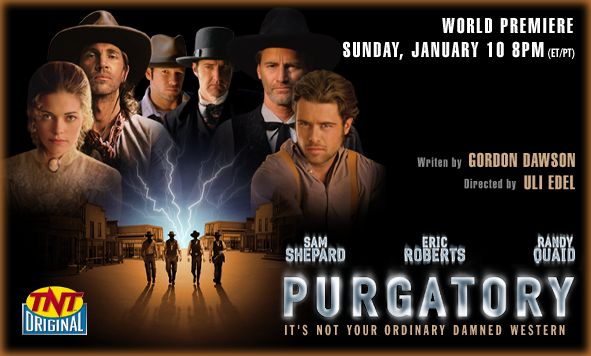
One of the happy outcomes of the cable television revolution was that more stations were competing to brand themselves with audiences, and one method some of them chose was to start making their own films. The budgets were not as large as what Hollywood might provide, but the results were often more original. Such is the case with Uli Edel’s unconventional western Purgatory, which debuted in 1999 on Turner Network Television and has attracted a growing base of fans ever since.
Purgatory opens as a classic oater, with glorious vistas, exciting gunfights, noble sheriffs and vicious outlaws. But then the film takes an entirely novel, Twilight Zone-eque turn as a group of bank robbers gets lost in a sandstorm and arrives in the strangely peaceful town of Refuge, where a sheriff who doesn’t even carry a gun (Sam Shepard) unhesitatingly welcomes them to stay. The town has a saloon that no one enters, a church that every single resident attends every day, and some strangely familiar-looking locals, all of whom are watched over by a wizened Native American medicine man. I am not going to tell you more than that for two reasons. First, I don’t want to spoil this fine film for you and second, I need the space for a special treat: An interview with the star.
Brad Rowe is the emotional center of the film as “Sonny” the one member of the pack of snarling bad guys who is a decent, vulnerable human being to whom the audience can relate. Brad has since gone on to become an expert in drug and crime policy, working with Mark Kleiman’s BOTEC consulting firm. I am grateful for him for taking the time to talk about Purgatory.
Brad, you’ve been in many movies and television shows, but say that this film was probably the most fun you ever had as an actor. What was so enjoyable about it?
First of all I was a very young actor and had hardly been around the block. Uli Edel was kind enough to have me come in to read for one of the lead roles in a project that already had Sam Shepard, Eric Roberts and Randy Quaid attached. After getting the role, when I arrived for the cast read through, my eyes were as big as saucers. These guys were legends to me and it was really endearing that they all took me under their collective wing. And then we got to the work of training, which included riding professional stunt horses, learning how to quick draw guns, staging screen fist fights and perfecting our cowboy swagger in period clothes. Lots of down time too where the other actors and crew would share fun stories about the countless projects and people they had experienced over the decades. I was in heaven. There was something magical to the story telling as well. Gordon Dawson had written a solid screenplay and TNT was really invested in making that story come to life. I think we all knew we were working on something special. As it turned out the project was well produced and promoted, so it found an audience. It wasn’t until I had been around for a while that I truly appreciated how many wonderful professionals had come together for a few months to make some movie magic. And of course the genre of the Western has become more of a scarcity recently so that time holds a bit of additional nostalgia for me.
I could imagine an actor first reading Dawson’s script and thinking This strange plot may just not work for an audience expecting a traditional western”. Did you have that worry or did the story hook you right away?
I personally didn’t have any reservations. It felt like the super-western with a cast of characters that spanned the storied history of the wild west. The supernatural twist was an essential tool for exposing everyone in the story’s true character — warts and all in some cases. What resonated for me was how close that character was to me at that point in my life. I was new to Hollywood and eager to learn and in many cases found myself swimming with sharks. Sonny was doing his best throughout the story to stay true to his values but finding mentors who shared the same compass was nearly impossible.
Do you think of Purgatory as a religious film?
I do. There are both themes of spiritual redemption and rigid religious observance. Churchgoing is a central to community life in Refuge and it is the place where individuals who have lived characteristically sinful lives get a shot at redemption through faithful observance of a very strict protocol. It is the adherence to that difficult path that causes the biggest challenge for several of the main characters. Forgiveness, selflessness, and sacrifice all play heavy in the story as well. I don’t want to make the movie seem overtly fire and brimstone but it hits the audience pretty squarely. Thankfully Purgatory is the uplifting kind of spiritual journey though.
“Larger than life” is an overused phrase, but it applies to the playwright-actor-director Sam Shepard. What is he like in person?
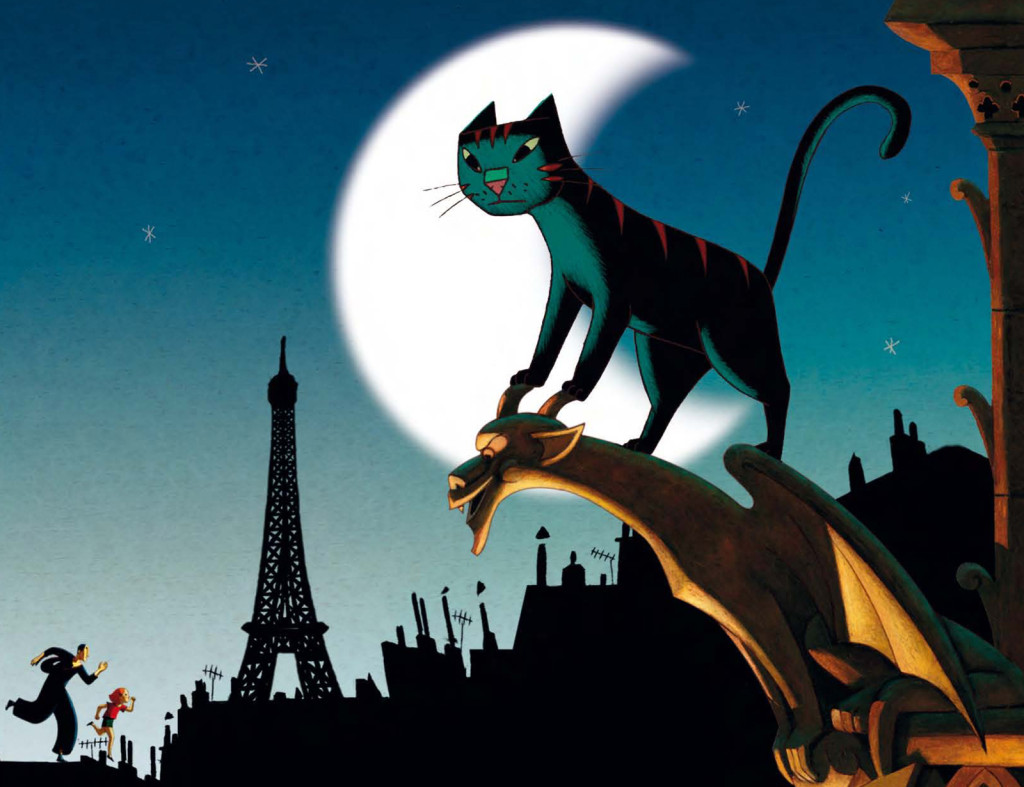
I like to recommend films for kids every now and then. Accordingly, allow me to point you to a charming 2010 Oscar-nominated French animated film originally titled Une Vie de Chat that was subsequently re-voiced using English language actors as A Cat in Paris.
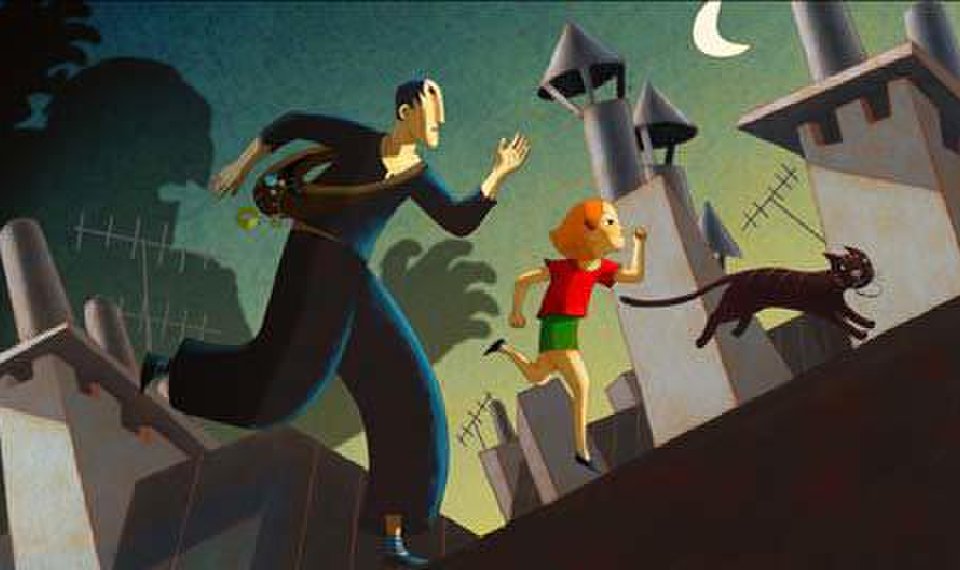
The titular cat of the film is Dino, who lives a double life. By day he is the beloved pet of a little girl named Zoe. But at night he makes a daring (and amusing) journey across the neighborhood to the flat of Nico, who is a (what else?) cat burglar. The two conduct daring robberies until dawn, when Dino races back to Zoe’s bed. Zoe very much needs Dino because she has been so traumatized by the murder of her policeman father that she has lost the ability to speak. This frustrates her grieving mother Jeanne, who is a senior police detective. Jeanne is trying to track down her husband’s fearsome killer as well as the burglar who is stealing precious jewels across the city. She has no idea that the two mysteries will become interwoven. The stage is set for suspense and excitement, as well as the possibility of healing both for Zoe and Jeanne.
The snazzy, jazzy animation is somewhat impressionistic but not so much that children will be confused. Nico’s movements and figure show that he is at heart as much a cat as Dino. Through some artful drawing and script writing, Jeanne, initially seeming to be on the steely side, is revealed in a scene where she practices martial arts to have a bit of the cat in her as well, albeit hidden under emotional scar tissue. This feline connection ties Dino, Zoe, Nico and Jeanne together thematically and artistically in a way that makes the resolution of the story highly satisfying (even if you are more of a dog person).
I watched this movie with three little boys who enjoyed it as an exciting story, but I think I would recommend it even more for little girls. The struggles to understand each other that mothers and daughters can have are well brought out, and Jeanne (voiced by the great Marcia Gay-Harden in the English language verson) is a terrific role model as a wounded but also strong and brave woman. Jeanne chides her daughter at times but when the chips are down, she protects her with inspiring ferocity.
Roses to Jean-Loup Felicioli and Alain Gagnol for their artistry and for their ability to craft a film that parents and children can enjoy together. A Cat in Paris delivers drama, excitement, sweetness and laughter in a pleasing combination that will put a smile on your little one’s face and quite probably yours as well.
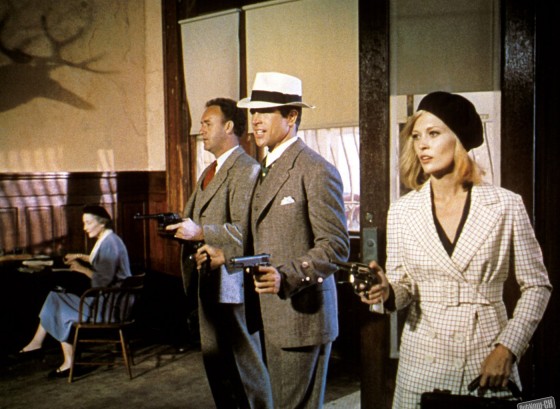
Hollywood studios were in a rut in the late 1950s and early 1960s, struggling to cope with the rise of television, the loss of control of movie theaters after the Paramount case, and a widening cultural chasm between modern audience tastes and studio traditions. In desperation, the studio chiefs opened up filmmaking to a wave of young actors, directors, producers and writers who re-energized American movies, making them arguably the world’s trendsetters from the late 1960s through mid-1970s. One of the pivotal movies from this fertile period in American cinema is 1967’s Bonnie and Clyde.
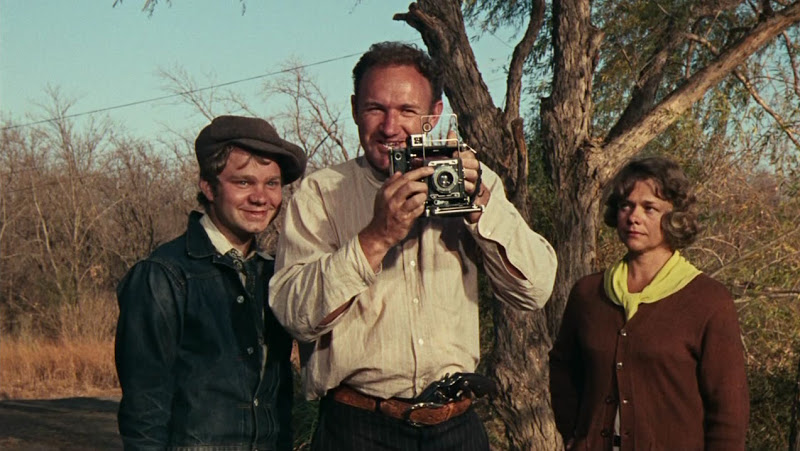
The story opens with a bored, sexually frustrated small town girl (Faye Dunaway) meeting a charming bad boy (Warren Beatty). She questions his courage and masculinity, and he shows off by drawing a gun and committing a robbery. They flee her backwards hometown together, intoxicated by freedom, danger and each other. More daring robberies follow, and with it growing fame for Bonnie and Clyde. Soon they gather other people around them, including a slow witted ne’er do well (Michael Pollard), Clyde’s older brother Buck (Gene Hackman) and Buck’s prim, God-fearing wife Blanche (Estelle Parsons). The law of course comes after them, spurring epic gun fights and a wild cross-country chase sparked with episodes that are surreal (the mesmerizing family reunion scene, which was shot by putting a window pane in front of the camera) and comic (the best of which features Gene Wilder, in his first movie). The story’s conclusion, which I will not spoil, is justifiably one of the most famous scenes in the history of American cinema.
The sexuality and graphic violence on display here was beyond anything Hollywood films had done since the Hays Code came into force in 1934. This is one of the first movies to use squibs and to show bullet wounds spouting blood. The impact of the violence is further amplified through use of the choppy editing style that been popularized by the French New Wave. Also, in a striking reversal of the typical gender roles of films in the 1950s, the woman is the confident sexual aggressor and the man is sexually timid and indeed non-functional (in early drafts of the script, Clyde was in a gay relationship with one of the men in his gang, but in the final version he instead is impotent). The point of view of the story was also novel and in keeping with the rebellious spirit of the times: The heroes are murderers who mow down police officers without compunction.
But it is not just the sexual and violent themes that make Bonnie and Clyde a landmark American film, it is also the movie’s meditation on fame. The criminals’ exhilaration in their notoriety, their self-conscious pursuit of increased publicity and the way they are hero-worshiped by strangers highlight the absurdity of American celebrity culture in supremely effective fashion.
As for the acting, under Arthur Penn’s direction, the entire cast explodes off the screen. Parsons won an Academy Award for her performance but any of the leads and supporting players would also have been worthy choices. Last but certainly not least, Burnett Guffey’s “flat style” camerawork — a complete inversion of his remarkable work in films I have recommended like My Name is Julia Ross, In a Lonely Place, and The Sniper — is one of the lasting achievements in Hollywood cinematography. That Guffey could early in his career thrive in the deep focus, shadowy, stylized world of film noir yet later became a leading exponent of unadorned, naturalistic cinematography shows that he was truly one of the giants of his profession.
The backstory to this film has also become part of its legend. Clyde Barrow and Bonnie Parker were of course real-life bank robbers in Depression-Era America. The Oscar-winning script of this film was brilliantly adapted from their exploits by David Newman and Robert Benton, with uncredited help from Robert Towne. (All of whom, like so many of the people associated with the film, went on to notable success in American cinema). The writers tried unsuccessfully to recruit a French New Wave director to make the movie, but none of them were ultimately interested. Fortunately, Warren Beatty saw the potential of the story and bought production rights, eventually signing Penn as the director. As a sign of how out of touch studio executives were with 1960s filmgoers, the suits at Warner Brothers had so little confidence in the film’s audience appeal that they were comfortable promising Beatty 40% of the gross receipts. They barely released and minimally promoted the picture, and were not surprised when establishment movie critics sneered at it. But it hit audiences like a thunderbolt, becoming a massive box office hit. Remarkably, some chastened film critics went so far as to publicly apologize for their dismissive reviews and to write new reviews praising the movie (except for the New York Times’ insufferable Bosley Crowther, who campaigned against the film so vigorously that his bosses finally realized that it was time to find a more discerning critic). Many years later, this initially unwanted, disregarded and disrespected film became one of the first movies selected for preservation by the National Film Registry.
p.s. If any film prefigures Bonnie and Clyde in American cinema, I think it’s Joseph Lewis’ extraordinary 1950 movie Gun Crazy. If you have time for a double feature, that’s the film to pair with this one. And if you have time for a triple feature, throw in Lewis’ My Name is Julia Ross to appreciate the incredible range of cinematographer Burnett Guffey.
If your life is giving you some family time, you and your kids can together enjoy a rollicking tale of derring do set in Merry Olde England: 1938’s The Adventures of Robin Hood. Famous as the film that transformed swashbuckling Errol Flynn from a movie star into a global sensation, it’s also historically important as Warner Brothers’ first foray into glorious Technicolor.
The plot is of course familiar and has been adapted dozens of times: When King Richard the Lionhearted leaves the country, his heartless brother John begins terrorizing the peasantry. The courageous noble Robin of Locksley voluntarily leaves his comfortable life to fight for the oppressed, becoming a daring outlaw who along with his Merry Men takes a personalized approach to progressive taxation. Along the way Robin wins the love of Lady Marian, who becomes a brave advocate for the downtrodden despite her blue blood.
This was a big budget film, with lavish costumes and sets designed to show off the possibilities of Technicolor photography. It’s also big in other ways: Huge battles, extended sword fights, heroic stunt work and full-blooded performances by the whole cast. For raw entertainment value alone, this is a Hollywood studio system classic, and was deservedly selected for preservation in the National Film Registry.
Despite being wracked with numerous health problems in real life (He died at 50 with the body of an old man), on screen Flynn is the apotheosis of the virile, roguishly charming man of action. He was working with his frequent collaborator Michael Curtiz (Who also directed him in my recommendations Captain Blood and The Sea Hawk), who clearly knew how to get the most out of Flynn. Flynn gets outstanding support from the rest of the cast, including Claude Rains as a fey Prince John and Basil Rathbone as the dastardly Sir Guy of Gisbourne. Olivia de Havilland, who worked with Flynn on eight films, was cast more for her looks than talent in her early career, but she became a better actress over time. She’s good enough here at portraying Marian’s growing awareness of the plight of the poor and her own love of Robin. The actors in the smaller parts also do well, especially Eugene Pallette as Friar Tuck.
This is a particularly good film for kids, not only because the exciting story is easy to follow but also because it embodies admirable values. I love all the ethical shading of film noir, but there is also a place for movies that teach uncomplicated moral lessons: The rich have an obligation to the poor, and good people must fight back when the strong exploit the weak. Roger Ebert, who loved this movie, said it beautifully: “In these cynical days when swashbucklers cannot be presented without an ironic subtext, this great 1938 film exists in an eternal summer of bravery and romance”.
Before closing my recommendation of this rousing classic, I leave you with two notes of trivia (1) The 1922 Douglas Fairbanks Sr. version of Robin Hood was filmed in Bidwell Park in Chico, California, and the Flynn version returned there for some of its shoot. (2) Much of the film was hilariously parodied in another of my recommendations, The Court Jester, with Rathbone sending up his own performance.
The left-wing Swedish author Stieg Larsson had a strange and remarkable life. As a teenager, he witnessed some of his friends commit gang rape, and was haunted thereafter both by guilt about his failure to intervene and the omnipresence of violence against women. As a journalist he was unknown outside of Sweden when he died suddenly at the age of 50, but soon became one of the most widely read authors on Earth when his Millenium triology was posthumously published. The first filmed adaptation of Larsson’s crime novels is the unforgettable 2009 Swedish television mini-series Män Som Hatar Kvinnor.
Though known as “The Girl with the Dragon Tattoo” to Americans, the original Swedish title actually translates as “Men who Hate Women”, which better describes what this film is about: a ferocious, unforgettable, superheroine battling some of the slimiest and scariest misogynists in film history (which is saying something).
Noomi Rapace knocked the film world on its ear with her four-barreled performance as Lisbeth Salander, a social misfit with a history of trauma, a genius for computer hacking, and an invincible survival instinct. Events bring Salander together with crusading journalist Mikael Blomkvist (Michael Nyqvist, nicely underplaying his part), who is attempting to solve the long-ago disappearance of a little girl in a remote Swedish village that is icy in more ways than one. Along the way they encounter enormous human ugliness (almost all of it male), perplexing clues, and life-threatening risk.
Having not read Larsson’s books, I cannot evaluate the faithfulness of Rasmus Heisterberg and Nikolaj Arcel’s screenplay to the original story. But I certainly aver that it’s a fine bit of writing, rounding out each character and having them bounce off each other in ways that advance the story. The relationship between Salander and Blomkvist is particularly refreshing because it completely reverses the gender role conventions of the genre. The mystery/thriller elements are also fairly well-done, keeping the audience puzzling over the solution at times and on the edge of their seat at others.
As photographed by Eric Kress, Northern Sweden is a bleak and lonely physical environment populated by bleak and lonely people, amongst whom some true monsters can easily hide. The film could easily have been a downer if not for the breathtaking power of Salander’s character and Rapace’s performance. Multi-layered female roles are sadly uncommon in movies; the worldwide embrace of Lisbeth Salander shows that audiences are hungry for more.
p.s. This review is based on the 180 minute version that played on Swedish television (later edited down into a shorter film for release in theaters). The 2011 English-language remake has a bigger budget with bigger stars (including a miscast Daniel Craig as Blomkvist) and is certainly a polished piece of work, but not quite as effective as the original.



 One of the happy outcomes of the cable television revolution was that more stations were competing to brand themselves with audiences, and one method some of them chose was to start making their own films. The budgets were not as large as what Hollywood might provide, but the results were often more original. Such is the case with Uli Edel’s unconventional western
 “
“




 All Good Movies